
Washington (WA) — Expungement & Record Clearing
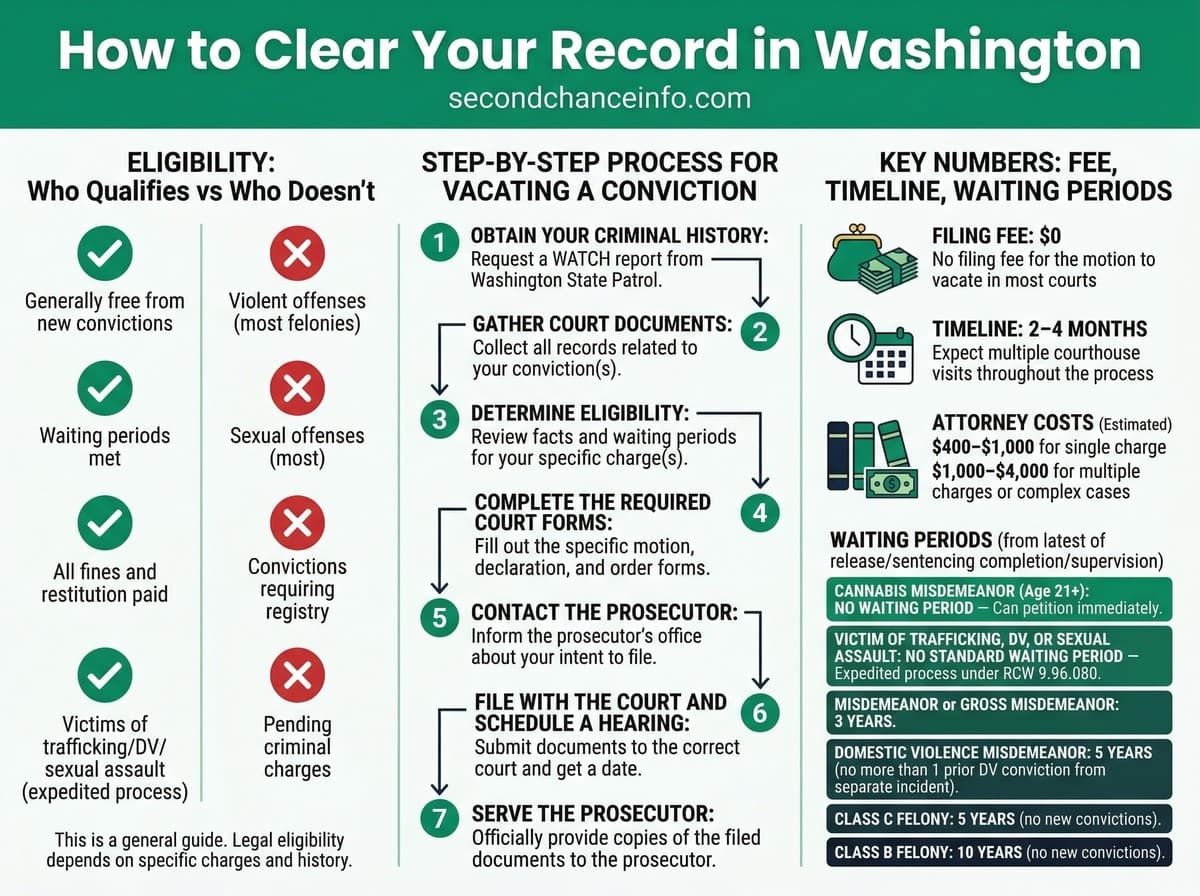
Yes, you can clear eligible criminal convictions in Washington State through a legal process called vacating under RCW 9.94A.640 (felonies) and RCW 9.96.060 (misdemeanors). Misdemeanors can be vacated 3 years after sentence completion; Class C felonies after 5 years; Class B felonies after 10 years. The New Hope Act (2019, expanded 2024) broadened eligibility and removed the requirement to pay all fines before the waiting period begins. There is generally no filing fee, and free legal help is available. DUI convictions, violent offenses, and sex offenses cannot be vacated. Vacating removes the conviction from your WSP record and lets you legally deny the conviction, but does not restore gun rights, seal court records, or affect federal immigration consequences. Below is the full guide with eligibility, step-by-step process, costs, timeline, and FAQ.
Prepare questions about a record-clearing process
Last updated:
Overview
Washington does not use the term "expungement." Instead, the state allows eligible individuals to "vacate" criminal convictions under RCW 9.94A.640 (felonies) and RCW 9.96.060 (misdemeanors). Vacating withdraws a guilty plea or sets aside a guilty verdict and dismisses the charges. The New Hope Act (2019, expanded in 2022 and 2024) significantly broadened eligibility by adding more qualifying offenses and allowing the waiting-period clock to start at release from custody rather than after all fines are paid.
Official term: Vacating a Conviction — Washington uses "vacating" rather than expungement. Vacating officially cancels the conviction, but does not destroy court records — the court file remains publicly accessible.
Routes and conditions to check
- ✓Misdemeanor or gross misdemeanor convictions (3-year waiting period after sentence completion)
- ✓Class C felony convictions (5-year waiting period after release from custody or sentencing)
- ✓Class B felony convictions (10-year waiting period after release from custody or sentencing)
- ✓Assault 2nd degree, Assault 3rd degree, and Robbery 2nd degree — if no firearm, deadly weapon, or sexual motivation enhancement (added by New Hope Act)
- ✓Marijuana/cannabis misdemeanor convictions if the person was at least 21 at the time of offense
- ✓Domestic violence misdemeanors (5-year waiting period with additional requirements)
- ✓Convictions resulting from being a victim of sex trafficking, domestic violence, or sexual assault (expedited process under RCW 9.96.080)
- ✓Pre-1975 treaty Indian fishing rights convictions
Exclusions and limits to check
- ✗Violent offenses as defined in RCW 9.94A.030 (murder, manslaughter, kidnapping, etc.) — with limited exceptions for Assault 2/3 and Robbery 2
- ✗Crimes against persons as defined in RCW 43.43.830
- ✗Sex offenses requiring registration (except failure to register may be vacated for misdemeanors)
- ✗DUI/DWI convictions (RCW 46.61.502/504) — felony or misdemeanor
- ✗Obscenity and child sexual exploitation offenses
- ✗Class A felonies
- ✗Offenses committed before July 1, 1984 (felonies)
- ✗Persons with pending criminal charges in any court
- ✗Persons who have new convictions within the required waiting period
Waiting Periods
| Misdemeanor or gross misdemeanor | 3 years from release from supervision, confinement, or sentencing (whichever is latest) |
| Domestic violence misdemeanor | 5 years from sentence completion; no more than 1 prior DV conviction from a separate incident |
| Class C felony | 5 years from release from custody or sentencing (whichever is later), with no new convictions |
| Class B felony | 10 years from release from custody or sentencing (whichever is later), with no new convictions |
| Cannabis misdemeanor (age 21+) | No waiting period — can petition immediately |
| Victim of trafficking, DV, or sexual assault | No standard waiting period — expedited process under RCW 9.96.080 |
Step-by-Step Process
Obtain your criminal history (WATCH report)
Request a WATCH report from the Washington State Patrol to confirm your criminal history and verify you have no new arrests or convictions. The online fee is $11; you can also inspect your record in person at WSP for free.
Gather court documents
Obtain your Judgment and Sentence and Certificate of Discharge from the court where your case was heard. These documents prove you completed all sentence requirements.
Determine eligibility
Confirm your conviction qualifies: check the offense type, verify the waiting period has passed, ensure you have no pending charges or new convictions, and confirm all sentence conditions are met. Since 2024, you no longer need to wait until all Legal Financial Obligations (LFOs) are fully paid.
Complete the required court forms
For misdemeanors, fill out Petition and Declaration for Order Vacating Conviction (CrRLJ 09.0100) and proposed Order (CrRLJ 09.0200). For felonies, use Motion and Declaration for Order Vacating Record of Felony Conviction (CR 08.0900) and proposed Order (CR 08.0920). The Washington Courts website also provides a guided interview tool for felonies.
Contact the prosecutor
Call the prosecutor's office that handled your case. If the prosecutor agrees to your petition, you may be able to get an Agreed Order without a hearing, which saves significant time.
File with the court and schedule a hearing
File your motion with the court clerk's office. Make at least three copies of all documents. Schedule a hearing 3–4 weeks out if the prosecutor does not agree to an Agreed Order.
Serve the prosecutor
Deliver copies of all filed documents to the prosecutor at least 14 days before the hearing, by mail or hand delivery. File your Proof of Service with the court.
Attend the hearing and obtain the order
If required, appear before the judge. If the motion is granted, obtain certified copies of the signed order from the clerk. Contact Washington State Patrol within one month to confirm they received and processed the order.
Visual Guide
Automatic Record Clearing (Not Available in Washington)
Washington does not currently have automatic record clearing or a Clean Slate law. A 2020 bill (HB 2793) that would have created an automatic expungement pilot program was vetoed by Governor Inslee, citing COVID-19 budget concerns. All vacating in Washington requires filing a petition with the court. However, the New Hope Act (2019, expanded 2022 and 2024) significantly simplified the petition-based process and broadened eligibility.
| Scenario | Timing and conditions |
|---|---|
| Automatic record clearing | Not available — Washington requires petition-based vacating |
| Non-conviction records (arrests without charges) | May be sealed under court rules, but not automatic statewide |
| Juvenile records | May be sealed upon petition under RCW 13.50; some juvenile records seal automatically at age 18 if criteria are met |
Costs
- Filing fee
- No filing fee for the motion to vacate in most courts
- Fee waiver
- Court can reduce or forgive outstanding Legal Financial Obligations (LFOs) if you cannot afford to pay
- Attorney (optional)
- $400–$1,000 for a single charge; $1,000–$4,000 for multiple charges or complex cases
The WATCH report costs $11 online. Certified copies of court orders have a per-page fee. Free legal help is available through CLEAR hotline (1-888-201-1014), Northwest Justice Project, and county-based programs like the KCBA Records Project.
Timeline
- With attorney
- 4–8 weeks (faster if prosecutor agrees to an Agreed Order)
- Standard
- 2–4 months with multiple courthouse visits
Timeline varies by county and whether a hearing is required. If the prosecutor agrees to an Agreed Order, the process can be significantly faster.
Effects of the relief
- ✓Officially cancels the conviction — the guilty plea is withdrawn or the verdict is set aside and the case is dismissed
- ✓Washington State Patrol removes the conviction from your public criminal history (WATCH) record
- ✓You can legally state you were never convicted of that offense
- ✓Employers covered by the Washington Fair Chance Act cannot ask about vacated convictions
- ✓Vacated conviction cannot be disclosed by WSP or local law enforcement to non-criminal-justice entities
- ✓Removes barriers to housing, employment, and professional licensing tied to the conviction
Limits of the relief
- ✗Does NOT restore firearm rights — requires a separate petition under RCW 9.41.040
- ✗Does NOT seal or delete court records — the court file remains publicly accessible on the Washington Courts website and court indexes (JIS/SCOMIS)
- ✗Does NOT remove the conviction from FBI records or private background check databases
- ✗Does NOT prevent prosecutors from using the vacated conviction in a later criminal prosecution
- ✗Does NOT relieve federal immigration consequences of the conviction
- ✗Vacated convictions after July 28, 2019 still count as prior convictions for charging present recidivist offenses
- ✗Does NOT affect driver's license suspensions or revocations
Other Relief Options in Washington
Governor's Pardon (Clemency and Pardons Board)
The Clemency and Pardons Board reviews petitions and recommends pardons, commutations, or reprieves to the Governor. Pardons forgive the crime but do not expunge the record. Generally requires at least 10 years since conviction. Petition at governor.wa.gov.
Firearm Rights Restoration
A separate petition under RCW 9.41.040 to restore the right to possess firearms after a felony conviction. This is entirely independent of vacating and has its own eligibility requirements and waiting periods.
Certificate of Discharge
Issued upon completion of all sentence requirements including supervision and LFOs. Restores voting rights for felony convictions and is a prerequisite for vacating felony records.
Sealing Court Records
Separate from vacating, court records may be sealed under GR 15 in limited circumstances. Sealing restricts public access to the court file itself, which vacating alone does not do.
Frequently Asked Questions
- How much does it cost to vacate a conviction in Washington?
- There is generally no filing fee for the motion to vacate. The WATCH criminal history report costs $11 online (or free in person at WSP). Certified copies of the court order have a small per-page fee. If you hire an attorney, expect $400–$1,000 for a single charge or $1,000–$4,000 for multiple charges. Free legal assistance is available through the CLEAR hotline (1-888-201-1014) and the Northwest Justice Project.
- How long does it take to vacate a conviction in Washington?
- With an attorney and prosecutor agreement (Agreed Order), the process can take 4–8 weeks. Without an attorney, expect 2–4 months with multiple courthouse visits. The timeline depends heavily on whether the prosecutor agrees and how busy the court calendar is.
- Can I vacate a felony conviction in Washington?
- Yes, if it is a Class B or Class C felony committed on or after July 1, 1984, and it is not a violent offense, crime against persons, sex offense, or DUI. Class C felonies require a 5-year wait; Class B felonies require a 10-year wait. The New Hope Act expanded eligibility to include Assault 2nd/3rd degree and Robbery 2nd degree (without weapon or sexual motivation enhancements).
- Can I vacate a DUI in Washington?
- No. DUI and Physical Control convictions under RCW 46.61.502 and 46.61.504 cannot be vacated, whether they are misdemeanors or felonies. This is one of the most significant exclusions in Washington's vacating statutes.
- Does vacating a conviction restore my gun rights in Washington?
- No. Vacating a conviction does not affect firearm rights under RCW 9.41.040. Restoring gun rights requires a completely separate petition process with its own eligibility requirements. You should consult an attorney if you need to restore firearm rights.
- Will a vacated conviction still show up on background checks?
- Washington State Patrol removes the conviction from your public WATCH record. However, the court file remains publicly accessible on the Washington Courts website and court indexes (JIS/SCOMIS). FBI records and private background check companies may still retain the information. You can present your vacate order as proof if old information resurfaces.
- Do I still have to pay my fines before vacating in Washington?
- Not necessarily. Since the 2024 amendment to the New Hope Act, the waiting period for misdemeanors starts at release from supervision, confinement, or sentencing — not after all Legal Financial Obligations (LFOs) are paid. You can also ask the court to reduce or forgive remaining LFOs as part of the vacating process.
- Does Washington have automatic expungement?
- No. Washington does not currently have automatic record clearing or a Clean Slate law. A 2020 bill (HB 2793) that would have created an automatic expungement program was vetoed. All vacating requires filing a petition with the court. However, the New Hope Act has significantly broadened eligibility and simplified the process since 2019.
- What is the New Hope Act in Washington?
- The New Hope Act, originally passed in 2019 and expanded in 2022 and 2024, broadened eligibility for vacating convictions. Key changes include: allowing multiple misdemeanors to be vacated (previously limited to one), adding Assault 2nd/3rd and Robbery 2nd to eligible felonies, and starting the waiting-period clock at release from custody rather than after all fines are paid.
Take Action — Direct Links
- Download Vacating/Sealing Court Forms
Official Washington State Courts forms page for vacating and sealing criminal records, including guided interview tools for felony and misdemeanor petitions.
- Request Your Criminal Record (WATCH)
Washington State Patrol WATCH system — search public criminal history conviction records online ($11 per search).
- Find Free Legal Help (Northwest Justice Project)
Northwest Justice Project provides free civil legal aid in Washington State. Contact the CLEAR hotline at 1-888-201-1014 for assistance with vacating convictions.
- Washington Courts Self-Help: Vacating & Sealing Records
Washington Courts guide to sealing and destroying court records, vacating convictions, and deleting criminal history records.
- RCW 9.94A.640 — Full Statute Text
Official full text of Revised Code of Washington 9.94A.640 (vacation of felony conviction records) on the Washington Legislature website.
Related Resources on This Site
More for your state
- Pardon & ClemencyPardon & clemency in Washington
- Jobs by CityFelony friendly jobs in Seattle, WA
- Jobs by StateJobs for felons in Washington
- HousingSecond chance apartments in Seattle, WA
- Voting RightsFelon voting rights in Washington
- Gun RightsFelon gun rights in Washington
- DUI RecoveryDUI license recovery in Washington
- ProbationProbation & parole in Washington
Helpful guides
- Background ChecksHow far back do background checks go?
- ToolsReentry organizations directory
- Free Legal AidFree legal aid by state
Sources
- RCW 9.94A.640 — Vacation of Felony Convictions
- RCW 9.96.060 — Vacating Misdemeanor/Gross Misdemeanor Convictions
- Washington Law Help — Vacate a Felony Conviction
- Washington Law Help — Vacate a Misdemeanor Conviction
- Washington Courts — Vacating/Sealing Records Forms
- Washington State Patrol — Criminal History (WATCH)