
Indiana (IN) — Expungement & Record Clearing
Yes, you can clear your criminal record in Indiana under the Second Chance Law (IC 35-38-9). Misdemeanor convictions can be expunged after 5 years, and Class D/Level 6 felonies without bodily injury after 8 years. Higher-level felonies may also qualify after 8–10 years. Filing costs $157 per county (fee waivers available), and the process takes 3–9 months. Since July 2022, dismissed charges are automatically expunged 60 days after disposition. Sex offenses, murder, manslaughter, human trafficking, and official misconduct are permanently excluded. Expungement seals or restricts your record, protects you from employer discrimination, and can restore firearm rights. You may only petition once in your lifetime for convictions, so it is important to include all eligible cases. Below is the full guide with eligibility by offense type, step-by-step process, costs, timeline, and FAQ.
Prepare questions about a record-clearing process
Last updated:
Overview
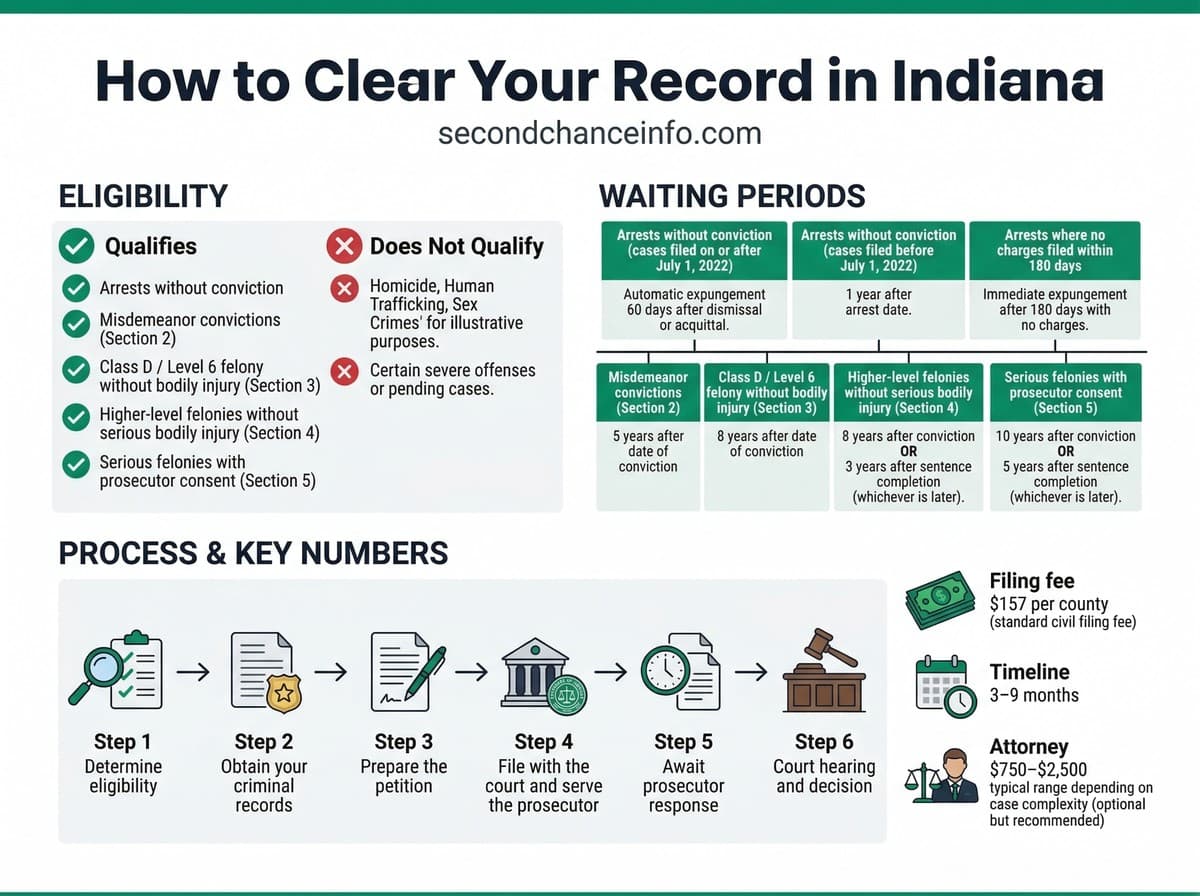
Indiana's "Second Chance Law" (IC 35-38-9) allows individuals to petition for the expungement or sealing of arrest and conviction records. The law divides eligibility into five sections based on offense severity — from arrests without conviction (Section 1) through serious felonies (Section 5). For Sections 2 and 3, granted expungements permanently seal the record from public view. For Sections 4 and 5, records are marked "expunged" but remain publicly visible with restrictions on how they can be used. Since July 1, 2022, dismissed charges and acquittals are automatically expunged 60 days after disposition for cases filed on or after that date.
Official term: Expungement (IC 35-38-9) — Indiana uses both "expungement" and "sealing." Under Sections 2–3, records are permanently sealed from public access. Under Sections 4–5, records are marked as expunged but remain on public access with use restrictions. The records are not destroyed in either case.
Routes and conditions to check
- ✓Arrests that did not result in conviction, dismissals, or acquittals (Section 1)
- ✓Misdemeanor convictions, including Level 6 felonies reduced to misdemeanors (Section 2 — 5-year wait)
- ✓Class D or Level 6 felony convictions that did not involve bodily injury (Section 3 — 8-year wait)
- ✓Higher-level felony convictions that did not result in serious bodily injury (Section 4 — 8 years or 3 years after sentence completion)
- ✓Serious felony convictions with prosecutor consent (Section 5 — 10 years or 5 years after sentence completion)
- ✓No pending criminal charges at the time of filing
- ✓All fines, fees, court costs, and restitution paid in full
- ✓No new convictions during the applicable waiting period
Exclusions and limits to check
- ✗Sex offenses or violent offender classifications (IC 35-38-1-7.5 / IC 35-47-4-5)
- ✗Murder, voluntary manslaughter, or involuntary manslaughter
- ✗Human trafficking or sexual trafficking offenses
- ✗Child molestation, child exploitation, or sexual misconduct with a minor
- ✗Two or more felony convictions involving the use of a deadly weapon (not part of the same episode)
- ✗Official misconduct or perjury committed as a public official
- ✗Convictions while serving as an elected official or candidate for public office
- ✗Federal or out-of-state convictions (Indiana courts have no jurisdiction)
- ✗Infractions and ordinance violations (not covered by the statute)
Waiting Periods
| Arrests without conviction — cases filed on or after July 1, 2022 | Automatic expungement 60 days after dismissal or acquittal |
| Arrests without conviction — cases filed before July 1, 2022 | 1 year after arrest date |
| Arrests where no charges filed within 180 days | Immediate expungement after 180 days with no charges |
| Misdemeanor convictions (Section 2) | 5 years after date of conviction |
| Class D / Level 6 felony without bodily injury (Section 3) | 8 years after date of conviction |
| Higher-level felonies without serious bodily injury (Section 4) | 8 years after conviction OR 3 years after sentence completion (whichever is later) |
| Serious felonies with prosecutor consent (Section 5) | 10 years after conviction OR 5 years after sentence completion (whichever is later) |
Step-by-Step Process
Determine eligibility
Confirm you meet the requirements: the applicable waiting period has passed, you have no pending criminal charges, no new convictions during the waiting period, and all fines, fees, costs, and restitution are paid. Identify which section of IC 35-38-9 applies to your case.
Obtain your criminal records
Get a copy of your criminal history from the Indiana State Police or through the county clerk. Identify every case in every county you need to petition — you must file separately in each county where you have a record.
Prepare the petition
Draft your expungement petition. Indiana does not mandate specific forms, but the petition is filed as a civil case using an "In Re" caption (not the original criminal case caption). Include conviction details, case numbers, proof of sentence completion, and evidence of rehabilitation.
File with the court and serve the prosecutor
File the petition in the circuit or superior court of the county where the conviction occurred. Pay the $157 civil filing fee (no fee for non-conviction cases under Section 1). Serve a copy on the county prosecuting attorney per Indiana Rules of Trial Procedure.
Await prosecutor response
The prosecuting attorney has 30 days to respond. If the prosecutor does not respond within 30 days, any objection is waived. For Section 5 petitions, you must obtain the prosecutor's written consent before filing.
Court hearing and decision
If the prosecutor objects or the court needs additional information, a hearing is scheduled at least 60 days after filing. For Sections 1–3, the court must grant the petition if all requirements are met. For Sections 4–5, granting is discretionary. If denied, you cannot refile (one petition per lifetime for convictions).
Visual Guide
Automatic Expungement for Non-Convictions (Public Law 14-2022)
Since July 1, 2022 (Public Law 14-2022), Indiana provides automatic expungement for certain non-conviction records without needing to file a petition.
| Scenario | Timing and conditions |
|---|---|
| Criminal charges dismissed (cases filed on or after July 1, 2022) | Automatic expungement 60 days after dismissal |
| Acquittal at trial (cases filed on or after July 1, 2022) | Automatic expungement 60 days after acquittal |
| Arrest with no charges filed within 180 days | Immediate expungement after 180 days |
| Charges reduced to infraction | Treated as non-conviction; eligible for automatic expungement |
Costs
- Filing fee
- $157 per county (standard civil filing fee)
- Fee waiver
- Available for indigent petitioners — courts may reduce or fully waive the fee based on inability to pay
- Attorney (optional)
- $750–$2,500 typical range depending on case complexity (optional but recommended)
No filing fee for non-conviction expungements (Section 1). If you have cases in multiple counties, you must file and pay separately in each county. Indiana Legal Services (1-844-243-8570) offers free legal assistance to eligible low-income individuals.
Timeline
- With attorney
- 2–4 months
- Standard
- 3–9 months
The prosecutor has 30 days to respond. If a hearing is needed, it is scheduled at least 60 days after filing. Timelines vary by county and court backlog. Felony cases often take longer than misdemeanor cases.
Effects of the relief
- ✓Permanently seals misdemeanor and Class D/Level 6 felony records from public view (Sections 2–3)
- ✓Marks higher-level felony records as expunged with restrictions on use (Sections 4–5)
- ✓Allows you to legally answer 'no' when asked about criminal history on job applications
- ✓Prohibits employers from discriminating based on expunged convictions (IC 35-38-9-10)
- ✓Restores firearm rights under both state and federal law for most felony convictions
- ✓Removes records from online court systems and standard background checks
- ✓Restores eligibility for many professional licenses and housing opportunities
Limits of the relief
- ✗Does NOT destroy records — law enforcement, prosecutors, and courts retain access
- ✗Does NOT remove records from news articles, social media, or third-party websites
- ✗Does NOT require FBI or national databases to remove the record
- ✗Does NOT restore gun rights for domestic violence convictions (federal prohibition remains)
- ✗Does NOT remove a name from the Department of Child Services substantiated index
- ✗Does NOT apply to federal or out-of-state convictions
- ✗Sections 4–5 expunged records remain publicly visible, only marked as expunged
- ✗Does NOT prevent use of prior convictions for sentencing enhancement in future cases
Other Relief Options in Indiana
Certificate of Actual Innocence
Available when a person was arrested or convicted and later found to be entirely innocent. This is the strongest form of record clearing — it affirms the criminal record should never have existed. It fully seals the record and serves as an official declaration of innocence.
Governor's Pardon (Clemency)
Available 5 years after sentence completion through the Indiana Parole Board. A pardon removes all civil disabilities from the conviction (right to vote, hold public office, serve on juries, possess firearms). Applications must be filed using the Parole Board's standardized form.
Specialized Driving Privileges
For those with suspended licenses due to criminal convictions, Indiana courts can grant specialized driving privileges allowing limited driving for work, school, or medical appointments even before expungement eligibility.
Frequently Asked Questions
- How much does expungement cost in Indiana?
- The court filing fee is $157 per county for conviction expungements (Sections 2–5). There is no filing fee for non-conviction expungements (Section 1). If you cannot afford the fee, the court may reduce or waive it for indigent petitioners. Attorney fees typically range from $750 to $2,500. Indiana Legal Services offers free help to eligible low-income individuals at 1-844-243-8570.
- How long does the expungement process take in Indiana?
- The process typically takes 3 to 9 months from start to finish. With an attorney, it may be completed in 2 to 4 months. After filing, the prosecutor has 30 days to respond. If a hearing is needed, it is scheduled at least 60 days after filing. Timelines vary by county and case complexity.
- Can a felony be expunged in Indiana?
- Yes. Class D and Level 6 felonies without bodily injury can be expunged after 8 years (Section 3), and the court must grant it if requirements are met. Higher-level felonies can be expunged after 8 years or 3 years post-sentence (Section 4), but granting is discretionary. Serious felonies require prosecutor consent and a 10-year wait (Section 5). Sex offenses, murder, manslaughter, human trafficking, and official misconduct are permanently excluded.
- Can I file for expungement more than once in Indiana?
- No. Indiana law allows only one petition per lifetime for conviction expungements (Sections 2–5). This means you must include all eligible convictions across all counties in your single petition opportunity. If you miss a case or your petition is denied, you generally cannot refile. Non-conviction expungements (Section 1) are not subject to this one-time limit and can be filed multiple times.
- Does expungement restore gun rights in Indiana?
- For most felony convictions, yes. Indiana expungement satisfies the federal Gun Control Act requirement for restoration of civil rights, so an expunged felony no longer counts as a disqualifying conviction for firearm ownership. However, expungement does NOT restore gun rights for domestic violence convictions due to the federal Lautenberg Amendment, which applies regardless of state-level expungement.
- What is the difference between Sections 2–3 and Sections 4–5 expungement?
- Under Sections 2–3 (misdemeanors and minor felonies), granted expungements permanently seal the record from public view — it will not appear in background checks or online court records. Under Sections 4–5 (higher-level felonies), the record is marked "expunged" but remains publicly visible on court access systems. However, employers and others face restrictions on how they can use these marked records.
- Does Indiana have automatic expungement?
- Yes, but only for non-convictions. Since July 1, 2022 (Public Law 14-2022), dismissed charges and acquittals are automatically expunged 60 days after disposition for cases filed on or after that date. Arrests where no charges are filed within 180 days are also automatically expunged. Conviction records still require a formal petition.
- Do I have to file in every county where I have a record?
- Yes. You must file a separate expungement petition in each county where you have an arrest or conviction record. Each county filing requires its own $157 filing fee (for conviction cases). This is why it is important to obtain a complete criminal history before filing, so you do not miss any county. Missing a case could be a serious problem given the one-petition-per-lifetime rule.
Take Action — Direct Links
- Expungement Petition Form (Word Document)
Official Indiana Public Defender Council expungement/sealing petition form — downloadable Word document to file with the court.
- Request Your Criminal Record (Indiana State Police)
Indiana State Police Limited Criminal History search — request your own criminal record online ($15.70) or by mail ($7). Essential for identifying all cases before filing.
- Free Legal Help — Indiana Legal Services
Apply online for free legal assistance from Indiana Legal Services, the state's largest provider of free legal help to low-income residents, including expungement representation.
- Indiana Courts — Detailed Expungement Guide
Official Indiana courts expungement guide (updated 1/1/2026) — comprehensive self-help resource covering eligibility, procedures, and filing requirements for all five sections of IC 35-38-9.
- IC 35-38-9 — Full Statute Text
Full text of Indiana Code 35-38-9 (Sealing and Expunging Conviction Records) — the complete expungement statute from the Indiana Public Defender Council.
Related Resources on This Site
More for your state
- Pardon & ClemencyPardon & clemency in Indiana
- Jobs by CityFelony friendly jobs in Indianapolis, IN
- Jobs by StateJobs for felons in Indiana
- HousingSecond chance apartments in Indianapolis, IN
- Voting RightsFelon voting rights in Indiana
- Gun RightsFelon gun rights in Indiana
- DUI RecoveryDUI license recovery in Indiana
- ProbationProbation & parole in Indiana
Helpful guides
- Background ChecksHow far back do background checks go?
- ToolsReentry organizations directory
- Free Legal AidFree legal aid by state