
Montana (MT) — Expungement & Record Clearing
Montana allows expungement of misdemeanor convictions under MCA 46-18-1104. If you completed your sentence and have remained conviction-free for 5 years, you can petition a district court to permanently seal your records. The filing fee is approximately $100 (fee waivers available), and the process typically takes 2–6 months. Felony convictions generally cannot be expunged, except for marijuana offenses reclassified under the MMRTA. Montana’s expungement can be used only once in a lifetime, so include all eligible convictions in your petition. Non-conviction records are removed automatically by the DOJ for arrests after July 2017. Below is the full guide with eligibility requirements, step-by-step process, costs, timeline, and FAQ.
Prepare questions about a record-clearing process
Last updated:
Overview
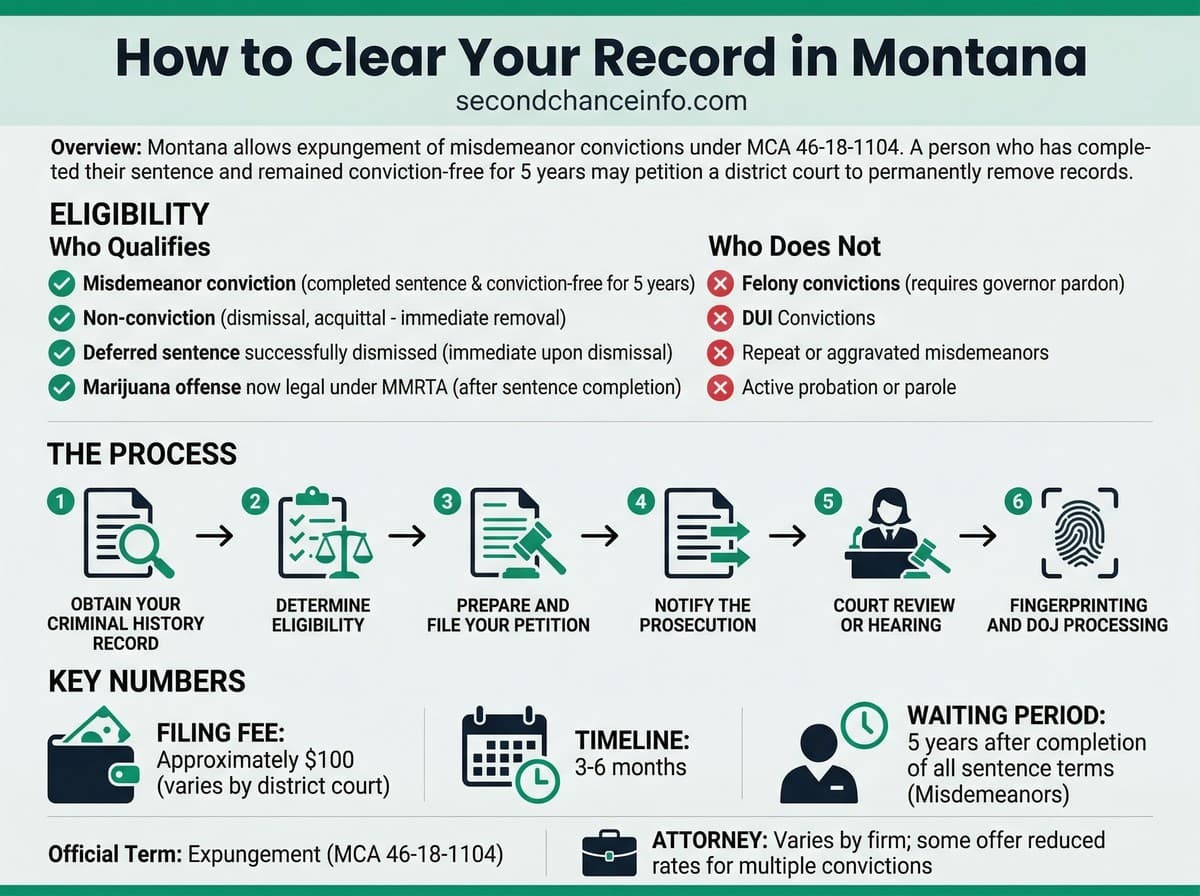
Montana allows expungement of misdemeanor convictions under MCA 46-18-1104. A person who has completed their sentence and remained conviction-free for 5 years may petition a district court to permanently seal arrest, investigation, detention, and court records. Felony convictions generally cannot be expunged, with the exception of certain marijuana-related offenses under the Montana Marijuana Regulation and Taxation Act (MMRTA). Non-conviction records (dismissals, acquittals, dropped charges) can be removed through the Department of Justice. The expungement process may be used only once in a person's lifetime.
Official term: Expungement (MCA 46-18-1104) — Montana uses "expungement" as the official term. An expungement order directs agencies to permanently seal records and the DOJ to expunge all records from the criminal history. Sealing of deferred/dismissed cases under MCA 46-18-204 is a separate process.
Routes and conditions to check
- ✓Misdemeanor convictions where all sentence requirements have been completed
- ✓5 years have passed since completion of the original sentence (including fines and court-ordered treatment)
- ✓Not currently detained or facing pending criminal charges anywhere in the country
- ✓No other convictions in any state or federal court during the 5-year waiting period
- ✓Marijuana-related felonies or misdemeanors for acts now legal or reclassified under the MMRTA
- ✓Non-conviction records (dismissals, acquittals, charges dropped or not filed)
- ✓Deferred sentences that were successfully completed and dismissed (sealed under MCA 46-18-204)
Exclusions and limits to check
- ✗Standard felony convictions (no expungement process available)
- ✗Persons who have previously had records expunged (one-time use only)
- ✗Persons currently serving a sentence, on probation, or under detention
- ✗Persons with pending criminal charges in any jurisdiction
- ✗Persons convicted of any offense within 5 years of sentence completion
Waiting Periods
| Misdemeanor conviction | 5 years after completion of all sentence terms |
| Non-conviction (dismissal, acquittal) | No waiting period (immediate removal) |
| Deferred sentence successfully dismissed | Immediate upon dismissal |
| Marijuana offense (now legal under MMRTA) | After sentence completion (no additional waiting) |
Step-by-Step Process
Obtain your criminal history record
Request a copy of your Montana criminal background check through CHOPRS (Criminal History Online Public Record Search) or by mail from the Montana DOJ. This is required to identify eligible convictions and to include with your petition.
Determine eligibility
Confirm that you have completed all sentence requirements, have had no convictions anywhere for 5 years since sentence completion, have no pending charges, and have not previously used Montana's expungement process.
Prepare and file your petition
Complete the petition for expungement and file it in the district court of a judicial district where at least one of the convictions occurred. You may include all eligible misdemeanor convictions on a single petition, even from different courts. Pay the filing fee (approximately $100) or request a fee waiver.
Notify the prosecution
Serve a copy of the petition on the county attorney responsible for the conviction(s). The prosecution has 21 days to respond and must attempt to notify any victims of the petition under MCA 46-18-1106.
Court review or hearing
The district court reviews the petition. Most expungement cases are decided on paperwork alone, but the judge may order a hearing. Expungement is presumed for most misdemeanors unless the interests of public safety demand otherwise. For certain offenses (assault, DUI, stalking, sexual assault, protective order violations), additional factors are considered.
Fingerprinting and DOJ processing
If the court grants the order, you must be fingerprinted at a law enforcement agency on a blue applicant fingerprint card (FD-258). Submit the fingerprint card, the expungement form, and the court order to CRISS at the Montana DOJ (PO Box 201403, Helena, MT 59620). Allow approximately 30 days for processing.
Visual Guide
Automatic Record Relief & Non-Conviction Removal
Montana does not have a broad automatic expungement system for convictions. However, since July 1, 2017, the Criminal Records & Identification Services Section (CRISS) automatically removes non-conviction arrest data (dismissals, acquittals, dropped charges) from criminal history records under MCA 44-5-202. For non-conviction records prior to July 2017, a Record Removal Form must be submitted manually. Civil rights lost upon conviction are automatically restored upon completion of custody and supervision (MCA 46-18-801).
| Scenario | Timing and conditions |
|---|---|
| Non-conviction arrest data (after July 1, 2017) | Removed automatically by CRISS |
| Non-conviction arrest data (before July 2017) | Must submit Record Removal Form (30-day processing) |
| Deferred sentence dismissed (MCA 46-18-204) | Sealed upon dismissal; confidential to public |
| Civil rights restoration after conviction | Automatic upon completion of custody and supervision |
Costs
- Filing fee
- Approximately $100 (varies by district court)
- Fee waiver
- Available — file an in forma pauperis form with a financial affidavit showing income and expenses
- Attorney (optional)
- Varies by firm; some offer reduced rates for multiple convictions
The Montana Legal Services Association (MLSA) runs free 'Clean Slate' clinics to help low-income individuals file expungement petitions at no cost. A criminal background check copy costs approximately $10-$30.
Timeline
- With attorney
- 2-4 months
- Standard
- 3-6 months
The county attorney has 21 days to respond. Most cases are decided on paperwork without a hearing. After court approval, DOJ processing takes approximately 30 days. Overall timeline varies by district court caseload.
Effects of the relief
- ✓Permanently seals all records of arrest, investigation, detention, and court proceedings
- ✓DOJ expunges all records from the criminal history database (CCH)
- ✓Expunged records will not appear on Montana pre-employment background checks
- ✓Allows you to legally deny the existence of the expunged conviction in most circumstances
- ✓Removes barriers to employment, housing, and education opportunities
Limits of the relief
- ✗Does NOT apply to felony convictions (except marijuana offenses under MMRTA)
- ✗Can only be used once in a person's lifetime — cannot petition again for future convictions
- ✗Does NOT prevent law enforcement and criminal justice agencies from accessing sealed records
- ✗Does NOT automatically remove records from third-party background check databases
- ✗Does NOT restore gun rights if lost due to a separate disqualifying offense
- ✗Does NOT guarantee expungement for DUI, assault, stalking, sexual assault, or protective order violations — court considers additional factors
Other Relief Options in Montana
Non-Conviction Record Removal (MCA 44-5-202)
Dismissals, acquittals, and dropped charges can be removed from your criminal history through the DOJ CRISS. Automatic for records after July 1, 2017; a form is required for earlier records.
Deferred Sentence Sealing (MCA 46-18-204)
When a deferred sentence is successfully completed and dismissed, the record is sealed and becomes confidential. Public access requires a district court order upon good cause shown. Law enforcement retains access.
MMRTA Marijuana Expungement
Under the Montana Marijuana Regulation and Taxation Act, individuals convicted of marijuana offenses that are now legal or reclassified can petition for expungement, resentencing, or redesignation to a civil infraction.
Executive Clemency / Governor's Pardon
The Montana Board of Pardons and Parole reviews clemency applications and recommends action to the Governor. A pardon relieves all legal consequences of a prior conviction. Applications must be filed in writing with the Board's Deer Lodge office.
Frequently Asked Questions
- Can I expunge a felony in Montana?
- Generally, no. Montana's expungement statute (MCA 46-18-1104) applies only to misdemeanor convictions. The one exception is marijuana-related felonies: under the Montana Marijuana Regulation and Taxation Act (MMRTA), individuals convicted of marijuana offenses that are now legal or reclassified can petition for expungement, resentencing, or redesignation. For other felonies, executive clemency through the Governor is the primary option.
- How much does expungement cost in Montana?
- The district court filing fee is approximately $100, and a criminal background check copy costs about $10-$30. If you cannot afford the filing fee, you can request a fee waiver by filing an in forma pauperis form with a financial affidavit. The Montana Legal Services Association (MLSA) runs free 'Clean Slate' clinics to help low-income individuals with the process at no cost.
- How long does the expungement process take in Montana?
- After filing your petition, the county attorney has 21 days to respond. Most cases are resolved on paperwork without a hearing. Once the court grants the order, you must submit fingerprints and the order to the DOJ, which takes approximately 30 days to process. Overall, expect the full process to take 2-6 months depending on whether a hearing is needed and the court's caseload.
- Can I expunge a DUI conviction in Montana?
- A DUI misdemeanor conviction may be eligible for expungement, but it is not presumed like other misdemeanors. Under MCA 46-18-1107, the court must consider additional factors including your age at the time of the offense, the time elapsed since the offense, your rehabilitation, and the likelihood of reoffending. You still must meet the standard 5-year waiting period and all other eligibility requirements.
- Can I expunge more than one misdemeanor at a time in Montana?
- Yes. You may include multiple eligible misdemeanor convictions on a single petition, even if they occurred in different courts or different cases. However, Montana's expungement process can only be used once in your lifetime, so it is critical to include all eligible convictions on your single petition.
- What happens to my record after expungement in Montana?
- An expungement order directs the arresting agency, prosecutor, and clerk of court to permanently seal all records. The DOJ expunges the records from the state criminal history database. Expunged records will not appear on standard background checks, and you may legally deny the conviction in most situations. However, law enforcement and criminal justice agencies may still access sealed records.
- Does Montana have automatic expungement?
- Montana does not have automatic expungement for convictions. However, since July 1, 2017, the DOJ automatically removes non-conviction data (dismissals, acquittals, dropped charges) from criminal history records under MCA 44-5-202. For non-conviction records before that date, you must submit a Record Removal Form. Successfully completed deferred sentences are automatically sealed upon dismissal under MCA 46-18-204.
Take Action — Direct Links
- Download Misdemeanor Expungement Petition and Forms
Official Montana Courts page with step-by-step instructions and all forms needed to petition for misdemeanor expungement, including the ER-100 petition form.
- Request Your Criminal History Record (Montana DOJ)
Montana Department of Justice background check page. Use CHOPRS (Criminal History Online Public Record Search) to request your own record ($20 fee).
- Free Legal Help — Montana Legal Services Association (MLSA)
MLSA runs free Clean Slate clinics to help low-income Montanans file expungement petitions at no cost. Apply online or call 1-800-666-6899.
- Montana Courts — Self-Help Program
Montana Courts self-help program providing information, forms, and assistance for people representing themselves in expungement and other court proceedings.
- MCA Title 46, Chapter 18, Part 11 — Full Statute Text
Official full text of Montana's Expungement of Records statutes (MCA 46-18-1101 through 46-18-1115) on the Montana Legislature website.
Related Resources on This Site
More for your state
- Pardon & ClemencyPardon & clemency in Montana
- Jobs by StateJobs for felons in Montana
- Voting RightsFelon voting rights in Montana
- Gun RightsFelon gun rights in Montana
- DUI RecoveryDUI license recovery in Montana
- ProbationProbation & parole in Montana
- SR22 InsuranceSR22 insurance in Montana
- License ReinstatementLicense reinstatement in Montana
Helpful guides
- Background ChecksHow far back do background checks go?
- ToolsReentry organizations directory
- Free Legal AidFree legal aid by state
Sources
- MCA 46-18-1104 — Eligibility for Misdemeanor Expungement
- MCA 46-18-1110 — Expungement Orders
- Montana DOJ — Conviction Expungement Process
- Montana DOJ — Non-Conviction Removal and Sealing
- Montana LawHelp — Misdemeanor Expungement
- Montana Courts — Misdemeanor Expungement Instructions
- CCRC — Montana Restoration of Rights & Record Relief
- Montana Courts — MMRTA Marijuana Expungement Forms