
Georgia (GA) — Expungement & Record Clearing
Georgia uses "record restriction" rather than traditional expungement to limit public access to criminal records under O.C.G.A. § 35-3-37. Non-conviction records (dismissals, acquittals) are automatically restricted for arrests after July 1, 2013. Up to two eligible misdemeanor convictions can be restricted by petition after a 4-year waiting period. Felony convictions require a pardon first (5-year wait after sentence completion). The First Offender Act (O.C.G.A. § 42-8-60) provides automatic restriction for first-time offenders who complete their sentence. Filing costs are typically $50–$75, and the process takes 2–6 months. Serious violent felonies, sex offenses, DUI, and family violence crimes are not eligible. Restriction hides your record from employers and landlords but does not restore gun rights or erase the record from law enforcement databases. Below is the full guide with eligibility, step-by-step process, costs, timeline, and FAQ.
Prepare questions about a record-clearing process
Last updated:
Overview
Georgia does not have traditional "expungement" — instead, the state uses "record restriction" under O.C.G.A. § 35-3-37, which limits public access to criminal history records. Restricted records are hidden from employers, landlords, and the general public but remain accessible to law enforcement and judicial officials. Non-conviction records (dismissals, acquittals, nolle prosequi) are automatically restricted for arrests after July 1, 2013. Misdemeanor convictions may be restricted by petition (up to two lifetime), and felony convictions require a pardon before restriction is possible. Georgia also offers the First Offender Act (O.C.G.A. § 42-8-60), which allows first-time offenders to avoid a formal conviction and have their records sealed upon successful sentence completion.
Official term: Record Restriction (O.C.G.A. § 35-3-37) — Georgia technically uses "record restriction" and "sealing" — the record is not destroyed. Restriction limits who can see the GCIC criminal history report, while sealing limits access to the court file itself.
Routes and conditions to check
- ✓Arrests with no conviction — charges dismissed, nolle prosequi, acquittal, or never prosecuted
- ✓Charges resolved through pretrial diversion or conditional discharge programs
- ✓Up to two eligible misdemeanor convictions (4-year waiting period after sentence completion, no new convictions)
- ✓Youthful offenders (under 21 at time of arrest) convicted of eligible misdemeanors (5-year waiting period with no new arrests)
- ✓Felony convictions for which a pardon has been granted by the State Board of Pardons and Paroles (non-violent, non-sexual offenses only)
- ✓First Offender Act sentences (O.C.G.A. § 42-8-60) — record restricted and sealed upon successful completion
- ✓Retroactive First Offender (O.C.G.A. § 42-8-66) — if eligible at original sentencing but not granted, with prosecutor consent
- ✓Survivors of sex or labor trafficking — convictions that were a direct result of being trafficked (Survivors First Act)
- ✓Dead docket cases inactive for 12 or more months
Exclusions and limits to check
- ✗Serious violent felonies as defined in O.C.G.A. § 17-10-6.1 (murder, armed robbery, kidnapping, rape, aggravated assault, aggravated battery, etc.)
- ✗Sex offenses requiring registration
- ✗Family violence offenses — simple assault, simple battery, battery, stalking (unless youthful offender under 21)
- ✗DUI and serious traffic violations (reckless driving, aggressive driving, fleeing/eluding, vehicular homicide)
- ✗Crimes against children or the elderly
- ✗Obstruction of law enforcement (in most circumstances)
- ✗Child molestation and related offenses
- ✗Public indecency or sexual battery
- ✗Theft offenses (except theft by shoplifting, which is eligible)
- ✗More than two misdemeanor convictions in a lifetime
Waiting Periods
| Non-conviction (dismissal, acquittal, nolle prosequi) — arrest after July 1, 2013 | Automatic — no waiting period |
| Non-conviction — arrest before July 1, 2013 | None, but must apply to arresting agency |
| Misdemeanor conviction (general) | 4 years after sentence completion with no new convictions |
| Misdemeanor conviction (youthful offender, under 21 at arrest) | 5 years after sentence completion with no new arrests |
| Felony conviction (pardon pathway) | 5 years after all sentences completed, then apply for pardon, then petition for restriction |
| First Offender Act completion | Upon successful completion of sentence — automatic restriction |
| Retroactive First Offender | No specific waiting period, but requires prosecutor consent and court approval |
| Dead docket cases | 12 months of inactivity on the docket |
Step-by-Step Process
Obtain your criminal history record
Request a copy of your GCIC (Georgia Crime Information Center) criminal history report through your local police department or the GBI. The fee is typically around $25. Review it carefully to identify which charges may be eligible for restriction.
Determine eligibility and pathway
Identify which restriction pathway applies to your case: automatic restriction for non-convictions after July 2013, petition-based restriction for pre-2013 non-convictions, misdemeanor conviction restriction (up to 2), pardon-based felony restriction, or First Offender sealing. Confirm you meet all waiting period and eligibility requirements.
Contact the appropriate office
For arrests after July 1, 2013: contact the prosecuting attorney's office in the county where the arrest occurred. For arrests before July 1, 2013: complete Section One of the "Request to Restrict Arrest Record" form and submit it to the arresting agency. For misdemeanor conviction petitions: file a petition with the court of conviction.
Submit your application and pay fees
The arresting agency or prosecutor's office may charge up to $50 for processing. For petitions to the court, serve a copy on the prosecuting attorney and the arresting law enforcement agency. The GCIC charges an additional $25 processing fee (money order or certified check payable to 'Georgia Bureau of Investigation').
Await prosecutor review or court hearing
The prosecuting attorney has 90 days to approve or deny your request. For conviction restriction petitions, the prosecutor or arresting agency may request a hearing, which must be held within 90 days of the petition filing. The court will review your eligibility and rehabilitation.
Receive confirmation and verify restriction
If approved, GCIC processes the restriction within 2-3 weeks. You will receive a letter of completion confirming the arrest has been restricted in the law enforcement database. Verify the restriction by ordering a new GCIC report. If denied, you may appeal to Superior Court within 30 days or refile after 2 years for conviction petitions.
Visual Guide
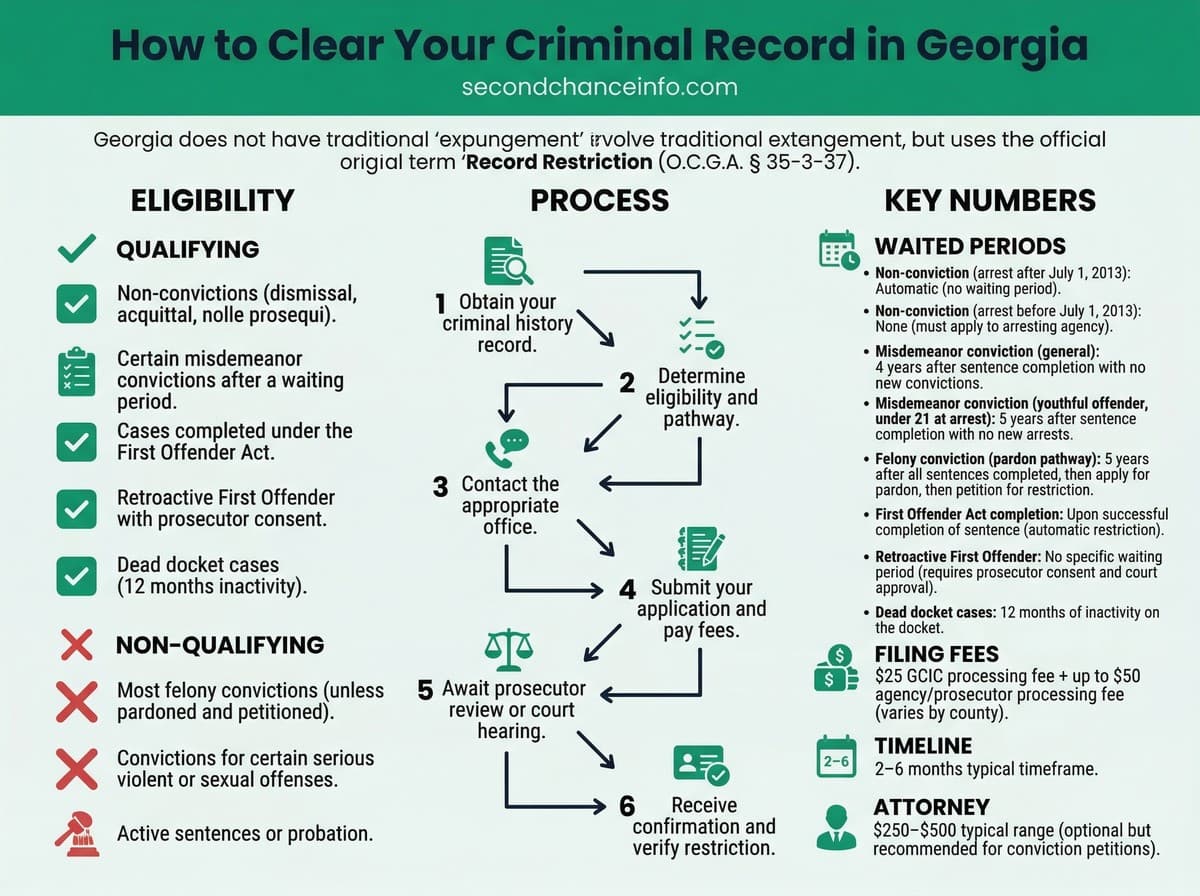
Automatic Record Restriction (Post-July 2013 & First Offender Act)
Georgia provides automatic record restriction for non-conviction dispositions on arrests occurring after July 1, 2013. The prosecuting attorney and clerk of court are responsible for updating the GCIC database. Additionally, records under the First Offender Act are automatically restricted upon successful sentence completion under O.C.G.A. § 42-8-62.
| Scenario | Timing and conditions |
|---|---|
| Charges dismissed (arrest after July 1, 2013) | Automatic upon disposition entry into GCIC |
| Acquittal / not guilty (arrest after July 1, 2013) | Automatic upon disposition entry into GCIC |
| Nolle prosequi (arrest after July 1, 2013) | Automatic upon disposition entry into GCIC |
| Pretrial diversion completed (arrest after July 1, 2013) | Automatic upon program completion |
| First Offender sentence completed successfully | Automatic restriction upon discharge under O.C.G.A. § 42-8-62 |
| First Offender sealing (court petition under § 42-8-62.1) | Court order within 90 days of petition; clerk seals records within 60 days of order |
Costs
- Filing fee
- $25 GCIC processing fee + up to $50 agency/prosecutor processing fee (varies by county)
- Fee waiver
- No formal statewide fee waiver program; some legal aid organizations may assist with costs
- Attorney (optional)
- $250–$500 typical range (optional but recommended for conviction petitions)
Total out-of-pocket cost for a standard restriction is typically $50–$75. Conviction petitions involving court hearings may cost more. The Georgia Justice Project and local legal aid organizations offer free assistance to qualifying individuals.
Timeline
- With attorney
- 1–3 months
- Standard
- 2–6 months
Prosecutors have 90 days to respond. GCIC processes approved restrictions in 2–3 weeks. Pardon applications take 6–9 months on average before the restriction petition can be filed. Timelines vary by county and case complexity.
Effects of the relief
- ✓Removes the charge from public background checks conducted by employers and landlords
- ✓Prevents most private businesses from accessing the restricted criminal history information
- ✓Allows you to legally deny the arrest or conviction on most job and housing applications
- ✓Limits the GCIC criminal history report to only law enforcement and judicial officials
- ✓Court records can also be sealed under O.C.G.A. § 42-8-62.1 for First Offender cases, hiding them from public view
- ✓Helps remove barriers to employment, housing, education, and professional licensing
Limits of the relief
- ✗Does NOT destroy or erase the criminal record — it remains in law enforcement databases
- ✗Does NOT restore firearm rights (requires separate application to the Board of Pardons and Paroles)
- ✗Does NOT prevent law enforcement, prosecutors, or courts from accessing the record
- ✗Does NOT guarantee removal from private background check databases or third-party vendors
- ✗Does NOT prevent disclosure requirements for immigration (USCIS) or federal employment applications
- ✗Does NOT remove the record from the FBI/NCIC database
- ✗Does NOT apply to serious violent felonies or sex offenses, even with a pardon
Other Relief Options in Georgia
First Offender Act (O.C.G.A. § 42-8-60)
A deferred adjudication program for first-time offenders. If you plead guilty under this act and successfully complete your sentence, you avoid a formal conviction and your record is automatically restricted. Can only be used once in a lifetime. The judge must agree to grant First Offender treatment at sentencing.
Retroactive First Offender (O.C.G.A. § 42-8-66)
If you were eligible for First Offender status at sentencing but did not receive it, you may petition to be retroactively sentenced as a First Offender. Requires prosecutor consent and judicial approval. If granted, the conviction is removed and the record can be sealed.
Pardon (State Board of Pardons and Paroles)
Available 5 years after completion of all sentences (10 years for sex-related offenses). Must have lived a law-abiding life, paid all fines, and have no pending charges. A pardon does not erase the conviction but is required before a felony conviction can be restricted. Processing takes 6–9 months on average.
Survivors First Act (O.C.G.A. §§ 17-10-21, 35-3-37)
Effective June 2020, survivors of sex or labor trafficking may petition to vacate convictions that were a direct result of being trafficked, or restrict and seal arrest records. Provides a pathway to clear records that other relief options do not cover.
Frequently Asked Questions
- How much does record restriction (expungement) cost in Georgia?
- The GCIC charges a $25 processing fee, and the arresting agency or prosecutor's office may charge up to $50. Total out-of-pocket costs are typically $50–$75 for a standard restriction. If you hire an attorney, expect to pay $250–$500. Some legal aid organizations, including the Georgia Justice Project, offer free assistance.
- How long does record restriction take in Georgia?
- For non-conviction restrictions (post-July 2013), the process is automatic once the disposition enters the GCIC database. For petition-based restrictions, the prosecutor has 90 days to respond, and GCIC processes approved applications in 2–3 weeks. The total timeline is typically 2–6 months. If a pardon is needed first (felony convictions), add 6–9 months for pardon processing.
- Can a felony conviction be expunged in Georgia?
- Not directly. Georgia does not allow felony convictions to be restricted without first obtaining a pardon from the State Board of Pardons and Paroles. You must wait at least 5 years after completing your sentence, have no new convictions, and have paid all fines. Once pardoned, you can petition the court to restrict the record. Serious violent felonies and sex offenses are never eligible, even with a pardon.
- What is the difference between record restriction and sealing in Georgia?
- Record restriction limits access to your GCIC criminal history report so it is no longer visible to private employers and background check companies. Sealing goes further — it makes the actual court file (docket books, criminal minutes, final record) unavailable to the public. Both processes still allow law enforcement and judicial officials to access the records. Restriction is handled through the GCIC/GBI, while sealing requires a court order.
- What is the Georgia First Offender Act and how does it help?
- The First Offender Act (O.C.G.A. § 42-8-60) allows a judge to sentence a first-time offender without entering a formal conviction. If you successfully complete your sentence (probation, community service, etc.), you are discharged without a conviction on your record and the charge is automatically restricted. You can also petition to have the court file sealed under O.C.G.A. § 42-8-62.1. It can only be used once in a lifetime, and certain serious crimes (violent felonies, sex offenses, DUI) are not eligible.
- Does record restriction restore gun rights in Georgia?
- No. Record restriction does not restore firearm rights. Even if your record is restricted or you receive a pardon, you must file a separate application for Restoration of Firearm Rights through the State Board of Pardons and Paroles. These are entirely separate legal processes with different requirements.
- Can employers still see my restricted record in Georgia?
- In most cases, no. A restricted record is removed from the public GCIC report and will not appear on standard criminal background checks run by private employers or landlords. However, law enforcement, courts, prosecutors, and certain government agencies retain access. Private background check vendors may have cached older data, so it is advisable to follow up with major background check companies after restriction.
- How many convictions can I get restricted in Georgia?
- You may petition to restrict up to two eligible misdemeanor convictions in your lifetime under O.C.G.A. § 35-3-37. Each must meet all eligibility requirements (4-year waiting period, no new convictions, eligible offense). There is no limit on the number of non-conviction records (dismissals, acquittals) that can be restricted. For felony convictions, restriction is only available after obtaining a pardon.
Take Action — Direct Links
- Court petition/form
GBI Request to Restrict Arrest Record form — three-section form with instructions for applicant, arresting agency, and prosecutor
- Criminal record request
Georgia Bureau of Investigation GCIC — how to request your own criminal history (Purpose Code U report) through your local law enforcement agency
- Free legal aid
Georgia Justice Project — free record restriction and sealing legal services, monthly virtual clinics, and the Freedom Expungement Project for pro bono representation
- Court self-help center
Georgia Courts self-help page — eligibility guide, step-by-step instructions, and links to restriction forms for non-conviction and conviction records
- Statute full text
O.C.G.A. § 35-3-37 — full text of Georgia's record restriction statute on Justia, covering eligibility, procedures, and definitions
Related Resources on This Site
More for your state
- Pardon & ClemencyPardon & clemency in Georgia
- Jobs by CityFelony friendly jobs in Atlanta, GA
- Jobs by StateJobs for felons in Georgia
- HousingSecond chance apartments in Atlanta, GA
- Voting RightsFelon voting rights in Georgia
- Gun RightsFelon gun rights in Georgia
- DUI RecoveryDUI license recovery in Georgia
- ProbationProbation & parole in Georgia
Helpful guides
- Background ChecksHow far back do background checks go?
- ToolsReentry organizations directory
- Free Legal AidFree legal aid by state
Sources
- O.C.G.A. § 35-3-37 (Record Restriction Statute)
- O.C.G.A. § 42-8-60 et seq. (First Offender Act)
- Georgia Courts Self-Help — Record Restrictions/Expungement
- Georgia Bureau of Investigation — Criminal History Record Restrictions
- Georgia Justice Project — Record Restriction FAQ
- Georgia.gov — File Request to Expunge a Criminal Record
- State Board of Pardons and Paroles — Pardons & Restoration of Rights