
Connecticut (CT) — Expungement & Record Clearing
Yes, you can clear your criminal record in Connecticut through erasure under Conn. Gen. Stat. § 54-142a. Connecticut's Clean Slate Act automatically erases most misdemeanor convictions after 7 years and eligible Class D/E felony convictions after 10 years — no petition needed for post-2000 convictions. Over 150,000 records have already been erased as of March 2026. For pre-2000 convictions, you can file a free petition (form JD-CR-202). Dismissed charges, nolled cases, and acquittals are erased automatically. Family violence, sex offenses, and certain violent crimes are not eligible. An Absolute Pardon through the Board of Pardons and Paroles is another path to full erasure. Erasure is stronger than sealing — records are destroyed and you are legally deemed never arrested. Below is the full guide with eligibility, step-by-step process, costs, timeline, and FAQ.
Prepare questions about a record-clearing process
Last updated:
Overview
Connecticut uses the term "erasure" rather than expungement. Under Conn. Gen. Stat. § 54-142a, criminal records are erased when charges are dismissed, nolled (after 13 months), or result in acquittal. For convictions, Connecticut's 2021 Clean Slate Act (Public Act 21-32) provides automatic erasure of most misdemeanor convictions after 7 years and eligible Class D/E felony convictions after 10 years, provided the person has completed their sentence and remained conviction-free. An Absolute Pardon from the Board of Pardons and Paroles also results in full record erasure. As of March 2026, over 150,000 criminal records have been automatically erased under the Clean Slate law.
Official term: Erasure (Conn. Gen. Stat. § 54-142a) — Connecticut officially uses "erasure" — erased records are destroyed and the person is deemed to have never been arrested. This is stronger than sealing; the record no longer exists in state databases.
Routes and conditions to check
- ✓Charges dismissed by the court
- ✓Charges nolled (not prosecuted for 13+ months)
- ✓Found not guilty / acquitted at trial
- ✓Completed a diversionary program (Accelerated Rehabilitation, Family Violence Education Program, IDIP)
- ✓Misdemeanor convictions (7+ years since most recent conviction, sentence completed) — automatic under Clean Slate
- ✓Class D or E felony convictions, or unclassified felonies with a maximum sentence of 5 years or less (10+ years since most recent conviction, sentence completed) — automatic under Clean Slate
- ✓Cannabis possession convictions (certain offenses automatically erased; others eligible by petition)
- ✓Pre-2000 convictions eligible for Clean Slate erasure by court petition
- ✓Granted an Absolute Pardon by the Board of Pardons and Paroles
Exclusions and limits to check
- ✗Family violence crimes (any conviction designated as a family violence crime)
- ✗Sex offenses — nonviolent sexual offenses and sexually violent offenses
- ✗Assault in the second or third degree (Conn. Gen. Stat. §§ 53a-60a through 53a-60c)
- ✗Strangulation or suffocation (§ 53a-64bb, § 53a-64cc)
- ✗Stalking in the first degree (§ 53a-181c)
- ✗Burglary with a firearm, various weapons-related offenses (§§ 53a-211, 53a-212, 53a-216, 53a-217, 53a-217a, 53a-217c)
- ✗Enticement of minors and child exploitation offenses
- ✗Sale/delivery/transfer of pistols or revolvers in violation of § 29-33
- ✗Second DUI conviction within 10 years (§ 14-227a)
- ✗Sex offender registry violations (§§ 54-251 through 54-254)
- ✗Currently serving a sentence, on probation, or on parole
Waiting Periods
| Dismissed charges | Erased upon expiration of appeal period |
| Nolled charges (not prosecuted) | 13 months after nolle entered |
| Acquittal (not guilty) | Erased upon expiration of appeal period |
| Diversionary program completed | Erased upon successful completion |
| Misdemeanor conviction (Clean Slate) | 7 years after most recent conviction (sentence must be completed) |
| Class D/E felony conviction (Clean Slate) | 10 years after most recent conviction (sentence must be completed) |
| Cannabis possession conviction (automatic) | Erased automatically on January 1, 2023 for qualifying offenses (2000–2015) |
| Absolute Pardon (misdemeanor) | 3 years after disposition of most recent misdemeanor |
| Absolute Pardon (felony) | 5 years after disposition of most recent felony |
Step-by-Step Process
Determine your pathway
Identify which erasure pathway applies: (a) automatic erasure for dismissed/nolled/acquitted charges, (b) automatic Clean Slate erasure for eligible post-2000 convictions, (c) petition-based Clean Slate erasure for pre-2000 convictions, or (d) Absolute Pardon through the Board of Pardons and Paroles.
Obtain your criminal history record
Request your official criminal history from the Department of Emergency Services and Public Protection (DESPP) using form DPS-0846-C. The fee is $75 for a name/date-of-birth search. This record will confirm what convictions exist and whether any have already been automatically erased.
Check if automatic erasure has occurred
For post-2000 convictions, check whether automatic Clean Slate erasure has already cleared your record. Over 150,000 records have been erased as of March 2026. If your record should have been erased but was not, submit a hearing request form to DESPP with your case details.
File a petition (pre-2000 convictions)
For eligible convictions before January 1, 2000, complete form JD-CR-202 (Petition for Clean Slate Erasure). Swear under oath that you meet eligibility requirements and sign before a Notary Public or Commissioner of the Superior Court. File a separate form for each docket number at the court where you were sentenced.
Court review
The court will either order your conviction(s) erased without a hearing or schedule a hearing on your petition. If erasure is granted, all police, court, and prosecutorial records pertaining to that charge are erased.
Alternative: Apply for an Absolute Pardon
If your conviction does not qualify for Clean Slate erasure, apply through the Board of Pardons and Paroles via the ePardon Portal (ct.gov/bopp). Submit the application, background investigation authorization, three reference questionnaires, and police reports. The Board will conduct a background investigation and may schedule a hearing or expedited review.
Visual Guide
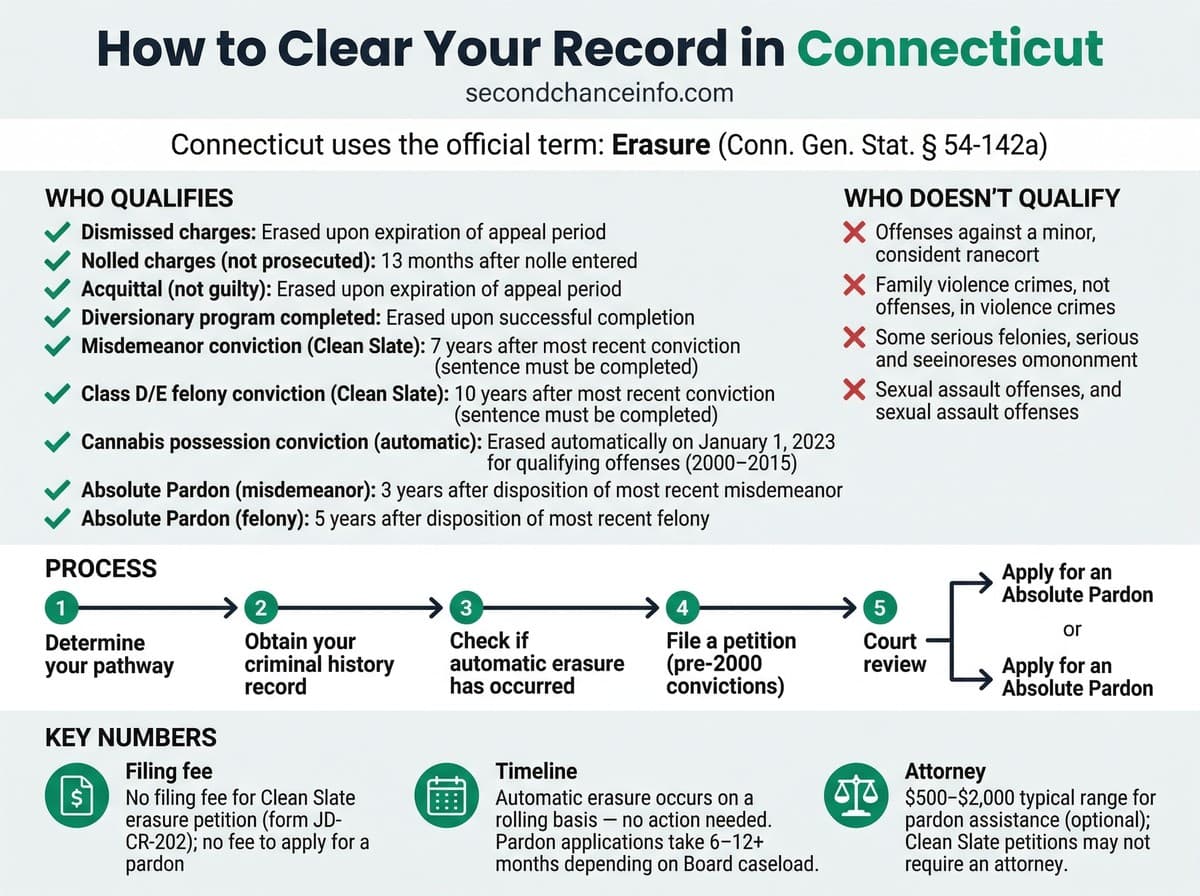
Automatic Record Erasure (Clean Slate Act / Public Act 21-32)
Connecticut's Clean Slate Act (Public Act 21-32) and Conn. Gen. Stat. § 54-142a provide automatic erasure for multiple categories of criminal records. Automatic erasure began January 1, 2023 for cannabis convictions and January 1, 2024 for other eligible offenses. As of March 2026, over 150,000 records have been erased.
| Scenario | Timing and conditions |
|---|---|
| Charges dismissed by the court | Upon expiration of appeal period |
| Charges nolled (not prosecuted) | 13 months after nolle entered |
| Acquittal / not guilty verdict | Upon expiration of appeal period |
| Diversionary program completed (AR, FVEP, IDIP) | Upon successful completion |
| Eligible misdemeanor conviction (post-2000) | 7 years after most recent conviction, sentence completed |
| Eligible Class D/E felony conviction (post-2000) | 10 years after most recent conviction, sentence completed |
| Cannabis possession (§ 21a-279(c), 2000–2015) | Automatically erased January 1, 2023 |
| Absolute Pardon granted | Immediately upon pardon |
Costs
- Filing fee
- No filing fee for Clean Slate erasure petition (form JD-CR-202); no fee to apply for a pardon
- Fee waiver
- Fee waiver available for court costs via form JD-FM-75 if you cannot afford fees
- Attorney (optional)
- $500–$2,000 typical range for pardon assistance (optional); Clean Slate petitions may not require an attorney
Obtaining your criminal history record from DESPP costs $75. The Board of Pardons and Paroles charges no application fee. Legal aid organizations such as Statewide Legal Services (1-800-453-3320) and New Haven Legal Assistance offer free help.
Timeline
- With attorney
- 2–6 months for pardon applications; Clean Slate petitions may be resolved faster
- Standard
- Automatic erasure occurs on a rolling basis — no action needed. Pardon applications take 6–12+ months depending on Board caseload.
Clean Slate automatic erasures resumed in October 2025 after implementation delays. The state is still processing a backlog. Petition-based erasure timelines vary by court.
Effects of the relief
- ✓All police, court, and prosecutorial records pertaining to the erased charge are destroyed
- ✓Person is legally deemed to have never been arrested for the erased offense
- ✓May swear under oath that the arrest or conviction never occurred
- ✓Employers cannot inquire about or discriminate based on erased records
- ✓Consumer reporting agencies (CRAs) are prohibited from disclosing erased records
- ✓Removes barriers to employment, housing, and professional licensing in Connecticut
- ✓May restore eligibility for state pistol permits (if underlying disqualification is erased)
Limits of the relief
- ✗Does NOT affect federal criminal records or FBI background checks
- ✗Does NOT prevent federal immigration authorities (USCIS) from accessing or considering the conviction
- ✗Does NOT erase convictions for family violence, sex offenses, or other excluded crimes
- ✗Does NOT reset the waiting period — all convictions must be outside the 7- or 10-year window
- ✗Does NOT guarantee notification — many people are unaware their records have been erased
- ✗Does NOT apply to convictions in other states — only Connecticut state records are erased
Other Relief Options in Connecticut
Absolute Pardon
Granted by the Board of Pardons and Paroles after 3 years (misdemeanor) or 5 years (felony) from disposition. Results in complete erasure of the conviction. Apply through the ePardon Portal at ct.gov/bopp.
Certificate of Employability (Provisional Pardon)
Available before pardon eligibility is reached. An official state document that makes it illegal for employers to deny employment solely based on your criminal record. Does not erase the conviction but protects against employment and licensing discrimination.
Cannabis Erasure
Separate track for cannabis-related convictions. Possession of 4 oz or less (§ 21a-279(c)) from 2000–2015 was automatically erased on January 1, 2023. Other cannabis convictions may be erased by petition.
Frequently Asked Questions
- What is the difference between erasure and expungement in Connecticut?
- Connecticut uses the term "erasure" rather than expungement. Erasure is actually stronger than expungement in many states — when a record is erased in Connecticut, all police, court, and prosecutorial records are destroyed. The person is legally deemed to have never been arrested and may swear so under oath. This is governed by Conn. Gen. Stat. § 54-142a.
- How does Connecticut's Clean Slate law work?
- Connecticut's Clean Slate Act (Public Act 21-32, signed in 2021) automatically erases most misdemeanor convictions after 7 years and eligible Class D/E felony convictions after 10 years, provided the person completed their sentence and remained conviction-free. Convictions on or after January 1, 2000 are erased automatically. Pre-2000 convictions require a court petition using form JD-CR-202. As of March 2026, over 150,000 records have been erased.
- What crimes are NOT eligible for erasure under Clean Slate in Connecticut?
- Family violence crimes, sex offenses (both nonviolent and violent), certain assaults (second and third degree), strangulation, stalking in the first degree, burglary with a firearm, weapons-related offenses, enticement of minors, child exploitation offenses, and a second DUI within 10 years are all excluded from Clean Slate erasure.
- How much does it cost to get a record erased in Connecticut?
- There is no filing fee for a Clean Slate erasure petition (form JD-CR-202), and no fee to apply for a pardon from the Board of Pardons and Paroles. However, obtaining your criminal history record from DESPP costs $75. If you hire an attorney to help with a pardon application, expect to pay $500–$2,000. Legal aid organizations offer free assistance.
- How do I know if my record was automatically erased under Clean Slate?
- Connecticut currently has no system to notify residents when their records are erased. You can check by requesting your criminal history record from DESPP for $75. If your eligible conviction was imposed after January 1, 2000, and it has been 7+ years (misdemeanor) or 10+ years (felony) since your most recent conviction with your sentence completed, it should have been automatically erased. If it was not, you can submit a hearing request to DESPP.
- What is the difference between an Absolute Pardon and a Certificate of Employability?
- An Absolute Pardon completely erases your criminal record — all records are destroyed and you are legally deemed never arrested. A Certificate of Employability (also called a Provisional Pardon) does not erase your record but makes it illegal for employers to deny you a job solely because of your criminal history. The Certificate is available sooner and can serve as a bridge while you wait to qualify for a full pardon.
- Can I get a job after erasure in Connecticut?
- Yes. After erasure, you may legally answer 'no' when asked about criminal history on job applications. Connecticut law prohibits employers from inquiring about erased records, and consumer reporting agencies cannot disclose them. You may also swear under oath that you were never arrested for the erased offense. Employers who violate these rules can face legal consequences.
- Does Connecticut erasure affect federal background checks or immigration?
- Connecticut erasure removes records from state databases, but it does not affect federal records. The FBI may still have a record of your arrest or conviction. Federal immigration authorities (USCIS) are not bound by state erasure laws and may still access and consider erased convictions when evaluating immigration applications. You must still disclose erased convictions if asked by federal authorities.
Take Action — Direct Links
- Download Clean Slate Erasure Petition (Form JD-CR-202)
Official Connecticut Judicial Branch petition form for Clean Slate erasure of pre-2000 convictions. Swear under oath, sign before a notary, and file at the court where you were sentenced.
- Request Your Criminal Record (DESPP)
Connecticut Department of Emergency Services and Public Protection (DESPP) State Police Bureau of Identification page for requesting your criminal history record ($75 fee).
- Find Free Legal Help (Statewide Legal Services)
Statewide Legal Services of Connecticut provides free legal advice to low-income residents, including assistance with criminal record erasure. Call 1-800-453-3320 or apply online.
- Clean Slate Connecticut Portal
Official Connecticut Clean Slate portal with eligibility checker, information on automatic erasure, petition instructions for pre-2000 convictions, and cannabis erasure guidance.
- Conn. Gen. Stat. § 54-142a — Full Statute Text
Official full text of Chapter 961a (Criminal Records) of the Connecticut General Statutes on the Connecticut General Assembly website, including § 54-142a (erasure of criminal records).
Related Resources on This Site
More for your state
- Pardon & ClemencyPardon & clemency in Connecticut
- Jobs by CityFelony friendly jobs in Bridgeport, CT
- Jobs by StateJobs for felons in Connecticut
- HousingSecond chance apartments in Hartford, CT
- Voting RightsFelon voting rights in Connecticut
- Gun RightsFelon gun rights in Connecticut
- DUI RecoveryDUI license recovery in Connecticut
- ProbationProbation & parole in Connecticut
Helpful guides
- Background ChecksHow far back do background checks go?
- ToolsReentry organizations directory
- Free Legal AidFree legal aid by state