
Rhode Island (RI) — Expungement & Record Clearing
Yes, you can expunge your criminal record in Rhode Island under R.I. Gen. Laws § 12-1.3. First offenders may petition to expunge a misdemeanor after 5 years or a felony after 10 years from sentence completion. There is no filing fee. The process typically takes 30–90 days and involves filing a motion, notifying the Attorney General and police, and attending a court hearing. Crimes of violence, domestic violence, DUI, and chemical test refusals are not eligible. Dismissed charges can be sealed under § 12-1-12.1. Prior marijuana possession convictions for decriminalized offenses are automatically expunged under § 12-1.3-5. Below is the full guide with eligibility, step-by-step process, costs, timeline, and FAQ.
Prepare questions about a record-clearing process
Last updated:
Overview
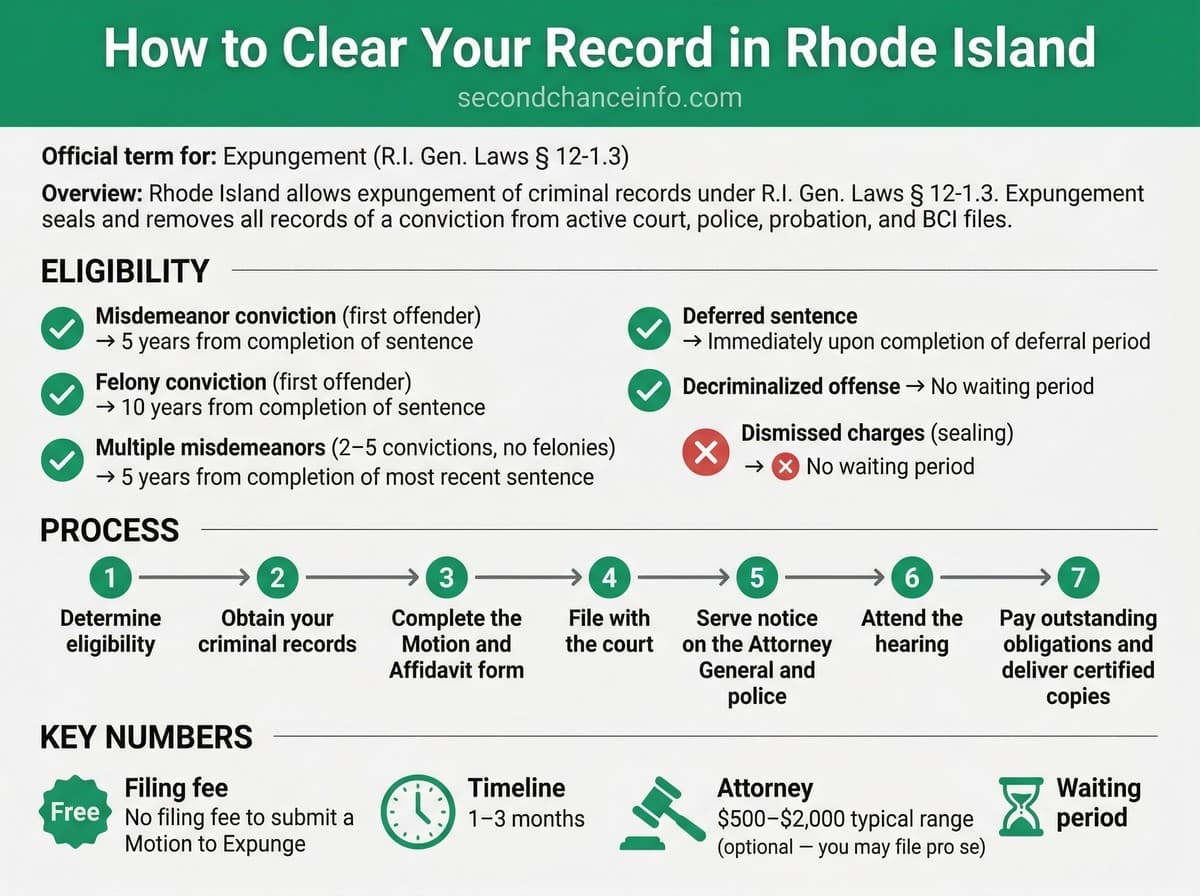
Rhode Island allows expungement of criminal records under R.I. Gen. Laws § 12-1.3. Expungement seals and removes all records of a conviction from active court, police, probation, and BCI files. First offenders may petition to expunge a misdemeanor after 5 years or a felony after 10 years. Persons with more than one but fewer than six misdemeanor convictions (and no felonies) may also petition. Crimes of violence, domestic violence convictions, DUI offenses, and refusal to submit to a chemical test are not eligible. Dismissed charges may be sealed under § 12-1-12.1.
Official term: Expungement (R.I. Gen. Laws § 12-1.3) — Rhode Island uses "expungement" for convictions (§ 12-1.3) and "sealing" for dismissed or acquitted cases (§ 12-1-12.1). Expungement removes the record from active files and directs agencies to destroy their copies.
Routes and conditions to check
- ✓First offenders convicted of a misdemeanor (5-year waiting period)
- ✓First offenders convicted of a felony (10-year waiting period)
- ✓Persons with more than one but fewer than six misdemeanor convictions and no felony convictions
- ✓Deferred sentences — eligible immediately upon completion of the deferral period
- ✓Decriminalized offenses (e.g., possession of less than one ounce of marijuana, first/second offense suspended license) — no waiting period
- ✓Prior marijuana possession convictions that have since been decriminalized (automatic expungement under § 12-1.3-5)
- ✓Dismissed charges, acquittals, no true bills, or no information filed (eligible for sealing under § 12-1-12.1)
Exclusions and limits to check
- ✗Crimes of violence — murder, manslaughter, first-degree arson, kidnapping with intent to extort, robbery, larceny from the person, first- or second-degree sexual assault, first- or second-degree child molestation, assault with intent to murder, assault with intent to rob, assault with intent to commit first-degree sexual assault, burglary, entering a dwelling with intent to commit murder/robbery/sexual assault/larceny
- ✗Domestic violence convictions
- ✗DUI (driving under the influence) offenses
- ✗Refusal to submit to a chemical test
- ✗Persons with six or more misdemeanor convictions
- ✗Persons with any pending criminal proceedings
Waiting Periods
| Misdemeanor conviction (first offender) | 5 years from completion of sentence |
| Felony conviction (first offender) | 10 years from completion of sentence |
| Multiple misdemeanors (2–5 convictions, no felonies) | 5 years from completion of most recent sentence |
| Deferred sentence | Immediately upon completion of deferral period |
| Decriminalized offense | No waiting period |
| Dismissed charges (sealing) | No waiting period |
Step-by-Step Process
Determine eligibility
Confirm you meet the definition of "first offender" (or qualify under the multiple-misdemeanor provision), the required waiting period has passed, you have no pending criminal cases, and your conviction is not for a crime of violence, domestic violence, DUI, or chemical test refusal.
Obtain your criminal records
Get a copy of your criminal record from BCI (Bureau of Criminal Identification) and identify the case number(s) for each conviction you want to expunge.
Complete the Motion and Affidavit form
Fill out the appropriate Motion and Affidavit to Expunge or Seal Record form. Use Superior Court forms for felonies and District Court forms for misdemeanors. Forms are available on the Rhode Island Judiciary website.
File with the court
File your motion in the court where the conviction took place. There is no filing fee for the motion itself. The Clerk's Office will assign a hearing date at least 10 days from filing.
Serve notice on the Attorney General and police
Provide at least 10 days' notice of the hearing date to the Office of the Attorney General and the police department that originally brought the charges. AG offices are located in all courthouses.
Attend the hearing
A judge reviews your petition and considers your rehabilitation, character, and whether expungement is consistent with the public interest. The Attorney General or arresting police department may object.
Pay outstanding obligations and deliver certified copies
If granted, all fines, fees, costs, restitution, and assessments must be paid in full (or waived by the court). The clerk prepares three certified copies of the order — one for you, one for the AG's BCI unit, and one for the arresting police department. You are responsible for delivering these copies.
Visual Guide
Automatic Relief in Rhode Island
Rhode Island provides automatic expungement for prior marijuana possession convictions that have since been decriminalized under § 12-1.3-5. For dismissed charges, acquittals, and no-information filings, records may be sealed under § 12-1-12.1 (requires filing a motion). As of March 2026, the Rhode Island Clean Slate Act (H 7508 / S 2711) has been introduced to automate expungement for eligible records, but it has not yet been enacted.
| Scenario | Timing and conditions |
|---|---|
| Marijuana possession conviction (decriminalized offense) | Automatic under § 12-1.3-5 |
| Dismissed charges, acquittals, no true bill, or no information filed | Upon motion and court order under § 12-1-12.1 (45 days after order) |
| Clean Slate Act (proposed, not yet enacted) | Would automate expungement of eligible records without requiring a petition |
Costs
- Filing fee
- No filing fee to submit a Motion to Expunge
- Fee waiver
- Court costs waived for marijuana possession expungement under § 12-1.3-5
- Attorney (optional)
- $500–$2,000 typical range (optional — you may file pro se)
After expungement is granted, all outstanding fines, fees, costs, restitution, and assessments must be paid in full or waived by the court before the order is completed.
Timeline
- With attorney
- 1–3 months
- Standard
- 1–3 months
The hearing is scheduled at least 10 days after filing. Overall processing typically takes 30–90 days depending on court scheduling and whether the AG or police department objects.
Effects of the relief
- ✓Removes the conviction from all court records, police records, probation records, public records, and BCI files
- ✓Agencies are directed to destroy their copies of the expunged records
- ✓Record will not appear on most background checks
- ✓You are not legally obligated to disclose the expunged conviction in most situations
- ✓May restore firearm rights for non-violent offenses
- ✓Improves access to employment, housing, and educational opportunities
Limits of the relief
- ✗Does NOT apply to crimes of violence — those records can never be expunged
- ✗Does NOT expunge DUI convictions or chemical test refusals
- ✗Does NOT expunge domestic violence convictions
- ✗Expunged records may still be accessible to law enforcement for limited purposes
- ✗Does NOT automatically restore all civil rights — firearm rights depend on the nature of the original offense
- ✗Federal records (FBI, immigration) are not affected by state expungement orders
Other Relief Options in Rhode Island
Sealing of Records (§ 12-1-12.1)
If you were acquitted, your charges were dismissed, or no information was filed, you can petition to seal the court records. The clerk seals records within 45 days of the court order.
Marijuana Record Expungement (§ 12-1.3-5)
Prior marijuana possession convictions for offenses that have since been decriminalized are automatically expunged. Court costs are waived for those who were incarcerated.
Clean Slate Act (Proposed 2026)
H 7508 and S 2711 would automate the expungement of eligible records without requiring individuals to file a petition, potentially benefiting approximately 77,000 Rhode Islanders. Not yet enacted as of March 2026.
Frequently Asked Questions
- How much does expungement cost in Rhode Island?
- There is no filing fee to submit a Motion to Expunge in Rhode Island. However, all outstanding fines, fees, costs, restitution, and assessments must be paid in full (or waived by the court) before the expungement order is finalized. If you hire an attorney, expect to pay $500–$2,000 depending on the complexity of your case, though you may file pro se (on your own) at no cost.
- How long does expungement take in Rhode Island?
- The process typically takes 30 to 90 days from filing to final order. The court must schedule a hearing at least 10 days after your motion is filed. Delays can occur if the Attorney General or the arresting police department objects to the motion.
- Can a felony be expunged in Rhode Island?
- Yes, if you are a first offender (no prior felony or misdemeanor convictions) and the felony is not a crime of violence, domestic violence, DUI, or chemical test refusal. You must wait 10 years from completion of your sentence before filing. The court will consider your rehabilitation and whether expungement serves the public interest.
- What is a 'first offender' for Rhode Island expungement purposes?
- Under § 12-1.3-1, a 'first offender' is someone convicted of one felony or one misdemeanor who has not been previously convicted of or placed on probation for any other felony or misdemeanor, and has no pending criminal proceedings. If you have multiple misdemeanor convictions (2–5) and no felonies, you may still qualify under a separate provision of the statute.
- Can DUI convictions be expunged in Rhode Island?
- No. Rhode Island law specifically excludes DUI offenses and refusal to submit to a chemical test from expungement eligibility. These records cannot be expunged regardless of how much time has passed.
- Does Rhode Island have automatic expungement?
- Currently, Rhode Island provides automatic expungement only for prior marijuana possession convictions for offenses that have since been decriminalized (§ 12-1.3-5). For all other offenses, you must file a motion with the court. The Rhode Island Clean Slate Act (H 7508 / S 2711), introduced in 2026, would automate expungement for eligible records, but it has not yet been enacted.
- Can dismissed charges be removed from my record in Rhode Island?
- Yes. If your charges were dismissed, you were acquitted, or no information was filed, you can petition to have the court records sealed under § 12-1-12.1. There is no waiting period, but you must file a motion and give 10 days' notice to the Attorney General and the arresting police department.
- Does expungement restore gun rights in Rhode Island?
- Expungement may restore firearm rights for non-violent offenses, since the conviction is treated as though it never occurred. However, violent or firearm-related offenses often permanently restrict gun rights. Federal firearms prohibitions may still apply regardless of state expungement. Consult an attorney for your specific situation.
Take Action — Direct Links
- Download Motion to Expunge or Seal (District Court)
Official Rhode Island District Court form (DC-33) — Motion to Expunge or Seal Record and Affidavit for misdemeanor convictions.
- Request Your Criminal Record (RI Attorney General BCI)
Rhode Island Attorney General's Bureau of Criminal Identification background check page. State background checks cost $5 by mail or in person at the Cranston Customer Service Center.
- Free Expungement Clinics (RI Public Defender)
Rhode Island Public Defender's expungement resource guide with information on free monthly expungement clinics hosted in partnership with Justice Assistance.
- Rhode Island Judiciary — Expungement Information
Rhode Island Judiciary self-help page with expungement eligibility, filing instructions, court forms, and links for Superior and District Court.
- R.I. Gen. Laws § 12-1.3 — Full Statute Text
Official full text of Rhode Island's Expungement of Criminal Records statute (Chapter 12-1.3) on the Rhode Island Legislature website.
Related Resources on This Site
More for your state
- Pardon & ClemencyPardon & clemency in Rhode Island
- Jobs by CityFelony friendly jobs in Providence, RI
- Jobs by StateJobs for felons in Rhode Island
- HousingSecond chance apartments in Providence, RI
- Voting RightsFelon voting rights in Rhode Island
- Gun RightsFelon gun rights in Rhode Island
- DUI RecoveryDUI license recovery in Rhode Island
- ProbationProbation & parole in Rhode Island
Helpful guides
- Background ChecksHow far back do background checks go?
- ToolsReentry organizations directory
- Free Legal AidFree legal aid by state
Sources
- R.I. Gen. Laws § 12-1.3 (Expungement of Criminal Records)
- R.I. Gen. Laws § 12-1.3-1 (Definitions)
- R.I. Gen. Laws § 12-1.3-3 (Motion for Expungement — Criteria)
- R.I. Gen. Laws § 12-1.3-5 (Expungement of Marijuana Records)
- Rhode Island Judiciary — Expungement Information
- Rhode Island Public Defender — Expungement Resource Guide
- Rhode Island Attorney General — Expungements