
Pennsylvania (PA) — Expungement & Record Clearing
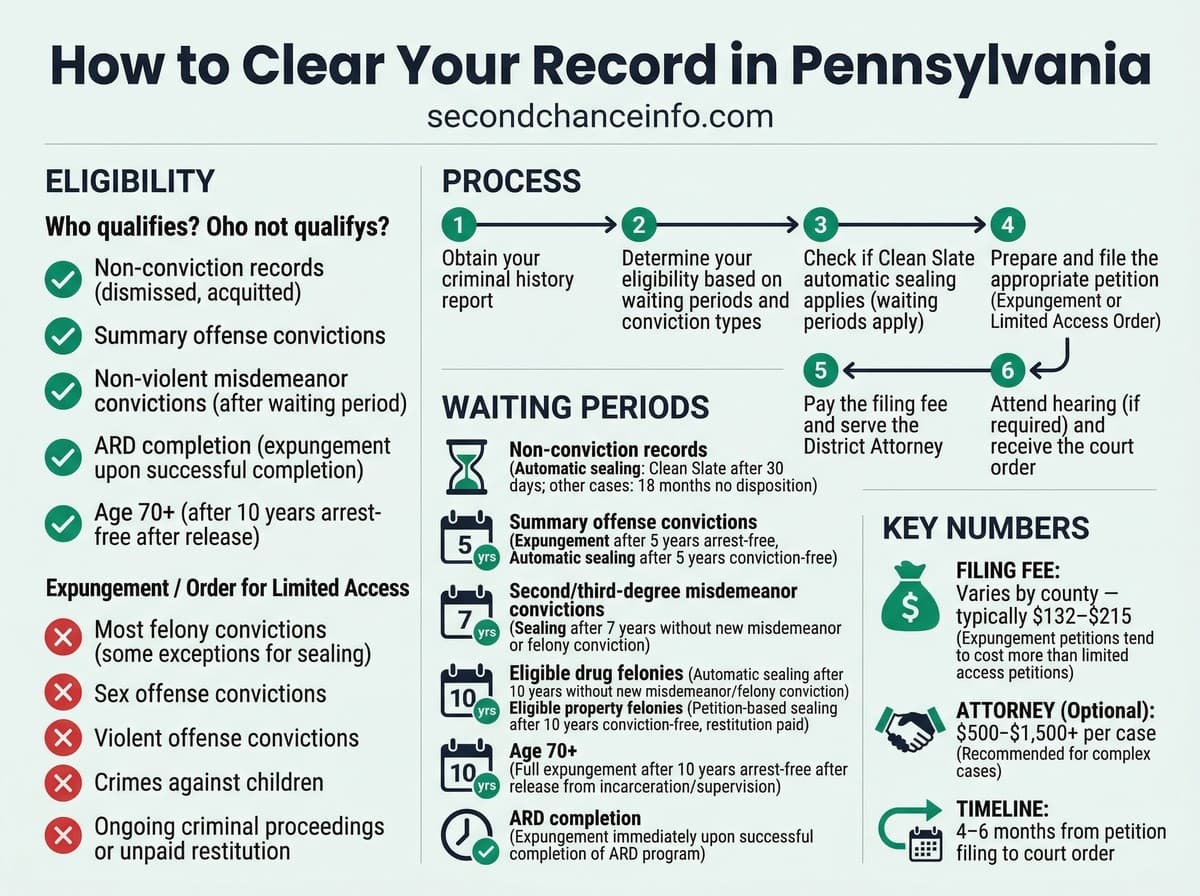
Yes, you can clear your criminal record in Pennsylvania through expungement or record sealing under the Clean Slate Act. Non-convictions, summary offenses, and ARD completions qualify for full expungement. Most misdemeanors can be sealed after 7 years conviction-free, and certain drug felonies after 10 years — many automatically under Clean Slate 3.0 (Act 36 of 2023) with no petition or fee required. Filing fees for petitions run $132–$215 by county, and the process takes 4–6 months. Restitution must be paid, but other court fines and costs will not block sealing. Sealed records are hidden from employers, landlords, and schools but remain visible to law enforcement. Felonies generally require a Governor’s Pardon for full expungement. Below is the complete guide with eligibility, process, costs, timeline, and FAQ.
Prepare questions about a record-clearing process
Last updated:
Overview
Pennsylvania offers both expungement (physical destruction of records) and record sealing (limited access orders). True expungement is available only for non-convictions, summary offenses, ARD completions, pardoned offenses, and a few narrow categories. For most misdemeanor and some felony convictions, the Clean Slate Act (updated by Act 36 of 2023, "Clean Slate 3.0") provides automatic and petition-based sealing that hides records from public background checks while leaving them accessible to law enforcement and certain agencies.
Official term: Expungement / Order for Limited Access — Pennsylvania distinguishes between expungement (record destruction under 18 Pa.C.S. § 9122) and sealing via an Order for Limited Access (§§ 9122.1, 9122.2). Clean Slate refers specifically to the automatic and petition-based sealing provisions.
Routes and conditions to check
- ✓Non-conviction records (dismissed, withdrawn, nolle prossed charges, or acquittals)
- ✓Arrests with no disposition after 18 months and no pending proceedings
- ✓Summary offense convictions (5 years arrest-free after conviction for expungement)
- ✓Successful completion of ARD (Accelerated Rehabilitative Disposition)
- ✓Underage drinking convictions (18 Pa.C.S. § 6308) after completing sentence and turning 21
- ✓Persons age 70+ who have been arrest-free for 10 years after release from incarceration or supervision
- ✓Pardoned offenses (automatically expunged as of June 2024)
- ✓Second- and third-degree misdemeanors (sealing via Clean Slate after 7 years conviction-free)
- ✓Certain drug-related felonies with sentences under 30 months (automatic sealing after 10 years conviction-free)
- ✓Some property-related third-degree felonies such as theft and forgery (petition-based sealing after 10 years)
Exclusions and limits to check
- ✗First-degree felonies or offenses punishable by 20+ years imprisonment
- ✗Murder convictions
- ✗Violent felonies and sex offenses
- ✗Firearms and weapons offenses
- ✗Offenses requiring sex offender registration (18 Pa.C.S. § 9799.55)
- ✗Cruelty to animals offenses
- ✗Corruption of minors
- ✗First-degree misdemeanors involving danger to persons, family offenses, or firearms
- ✗Persons with four or more convictions punishable by 1+ year imprisonment (disqualified from automatic sealing)
- ✗Any conviction where restitution remains unpaid
Waiting Periods
| Non-conviction records (dismissed, acquitted) | Automatically sealed after 30 days (Clean Slate) or 18 months with no disposition |
| Summary offense convictions (expungement) | 5 years arrest-free after conviction |
| Summary offense convictions (automatic sealing) | 5 years conviction-free |
| Second/third-degree misdemeanor convictions (sealing) | 7 years without a new misdemeanor or felony conviction |
| Eligible drug felonies (automatic sealing) | 10 years without a new misdemeanor or felony conviction |
| Eligible property felonies (petition-based sealing) | 10 years conviction-free, restitution paid |
| Age 70+ (full expungement) | 10 years arrest-free after release from incarceration/supervision |
| ARD completion (expungement) | Immediately upon successful completion of ARD program |
Step-by-Step Process
Obtain your criminal history report
Request a copy of your Pennsylvania criminal history from the Pennsylvania State Police (SP4-164 form, $22 fee) or use the Pennsylvania Access To Criminal History (PATCH) system. You need this to identify eligible cases.
Determine your eligibility
Review each case on your record. Non-convictions, summary offenses (5 years arrest-free), ARD completions, and underage drinking convictions may qualify for expungement. Misdemeanors and certain felonies may qualify for sealing. Use the free screener at MyCleanSlatePA.com for guidance.
Check if Clean Slate automatic sealing applies
Many records are automatically sealed without any action on your part. Non-convictions seal after 30 days, summaries after 5 years, eligible misdemeanors after 7 years, and eligible drug felonies after 10 years — provided you meet the conviction-free waiting period and restitution is paid.
Prepare and file the petition
For expungement, file a petition under 18 Pa.C.S. § 9122 at the court where your case was heard. For petition-based sealing, use the Order for Limited Access form (Form 791) available at pacourts.us. Attach a current PA State Police criminal history report (obtained within 60 days).
Pay the filing fee and serve the District Attorney
Pay the filing fee (typically $132–$215 depending on the county and petition type). Serve a copy of the petition on the District Attorney concurrently with filing. The DA has 30 days to consent, object, or take no action.
Attend hearing (if required) and receive order
If the DA consents or takes no action, the court may grant the petition without a hearing. If the DA objects, a hearing is scheduled where both parties can be heard. The judge then enters an order granting or denying the petition. If granted, records are sealed or destroyed.
Visual Guide
Automatic Record Sealing (Clean Slate Act — 18 Pa.C.S. § 9122.2)
Pennsylvania's Clean Slate Act (18 Pa.C.S. § 9122.2), expanded by Act 36 of 2023 (Clean Slate 3.0), automatically seals eligible records without any petition, fee, or action by the individual. The Pennsylvania State Police and Administrative Office of Pennsylvania Courts identify and seal eligible records through regular database analysis.
| Scenario | Timing and conditions |
|---|---|
| Non-conviction records (dismissed, withdrawn, not guilty) | 30 days after disposition |
| Arrests with no disposition filed | 18 months after arrest with no pending proceedings |
| Summary offense convictions | 5 years conviction-free |
| Second/third-degree misdemeanor convictions (max 2-year sentence) | 7 years without a new misdemeanor or felony conviction |
| Eligible drug felony convictions (sentence under 30 months) | 10 years without a new misdemeanor or felony conviction |
| Pardoned offenses | Automatically expunged upon pardon (as of June 2024) |
Costs
- Filing fee
- Varies by county — typically $132–$215 (expungement petitions tend to cost more than limited access petitions)
- Fee waiver
- Fee waivers may be available for indigent petitioners; check with your county Clerk of Courts
- Attorney (optional)
- $500–$1,500+ per case (optional but recommended for complex cases)
Automatic Clean Slate sealing has no cost — no petition, fee, or action is required. Free legal assistance is available through legal aid organizations listed at MyCleanSlatePA.com.
Timeline
- With attorney
- 3–4 months typical
- Standard
- 4–6 months from petition filing to court order
Varies by county. Philadelphia and Allegheny Counties may take longer due to higher caseloads. After the order is entered, it can take additional weeks for all agencies to update their records. Automatic Clean Slate sealing happens on a rolling basis without individual action.
Effects of the relief
- ✓Expungement physically destroys the criminal record — it no longer exists in public databases
- ✓Sealed records (limited access) are hidden from standard background checks for employment, housing, and education
- ✓Employers cannot use sealed records against applicants or employees
- ✓You do not have to disclose sealed records to most employers, landlords, or schools
- ✓Can restore firearm rights under federal law for expunged or sealed offenses (with exceptions)
- ✓Removes barriers to housing, education, and professional opportunities
Limits of the relief
- ✗Sealed records are NOT destroyed — law enforcement, courts, and prosecutors can still access them
- ✗Does NOT prevent access by criminal justice agencies, state licensing boards, or child protective services
- ✗Does NOT remove federal firearms prohibitions for domestic violence misdemeanors (Lautenberg Amendment)
- ✗Immigration officials can still see your full criminal record, including expunged records
- ✗Does NOT seal first-degree felonies, murder, violent felonies, or sex offenses
- ✗Prior convictions still count for sentencing enhancement purposes in future cases
- ✗Does NOT automatically restore a suspended driver's license
Other Relief Options in Pennsylvania
Governor's Pardon (Board of Pardons)
Available for any conviction through application to the PA Board of Pardons. If granted by the Governor, the conviction is forgiven and the record is automatically expunged as of June 2024. The process typically takes 1–3 years. Apply at pa.gov/agencies/bop.
Accelerated Rehabilitative Disposition (ARD)
A pre-trial diversion program for first-time, non-violent offenders (commonly used for DUI). Upon successful completion, the charges are dismissed and the record can be expunged.
Section 17 Diversion Program
A diversion program typically used for minor drug possession offenses. Successful completion results in dismissal of charges and eligibility for expungement.
Frequently Asked Questions
- How much does expungement cost in Pennsylvania?
- Filing fees vary by county, typically $132–$215 per petition. Attorney fees range from $500–$1,500+ per case. However, automatic Clean Slate sealing is completely free — no petition, fee, or action is required. Free legal assistance is available through legal aid organizations at MyCleanSlatePA.com.
- What is the difference between expungement and sealing in Pennsylvania?
- Expungement physically destroys the record so it no longer exists. Sealing (Order for Limited Access) hides the record from public view, including background checks, but law enforcement, courts, state licensing agencies, and child protective services can still access it. Expungement is available only for non-convictions, summary offenses, ARD completions, and a few other categories. Most misdemeanor and some felony convictions can only be sealed, not expunged.
- What is Pennsylvania's Clean Slate Act?
- The Clean Slate Act (originally Act 56 of 2018, expanded by Act 83 of 2020 and Act 36 of 2023) automatically seals certain criminal records without any petition or action by the individual. It covers non-convictions (after 30 days), summary convictions (after 5 years), eligible misdemeanors (after 7 years), and certain drug felonies (after 10 years). Clean Slate 3.0 (Act 36 of 2023) expanded eligibility to include some felonies and shortened waiting periods.
- Can a felony be expunged or sealed in Pennsylvania?
- Felonies generally cannot be expunged in Pennsylvania unless you receive a Governor's Pardon or are age 70+ with 10 years arrest-free. However, under Clean Slate 3.0, certain drug felonies with sentences under 30 months can be automatically sealed after 10 years conviction-free. Some property-related third-degree felonies (e.g., theft, forgery) may qualify for petition-based sealing after 10 years with restitution paid.
- Do I need to pay off all my fines and costs before my record can be sealed?
- No. Under Act 83 of 2020 (Clean Slate 2.0), outstanding court fines, fees, and costs no longer prevent sealing. However, you must have paid all restitution (money owed to victims) before a record can be sealed. This distinction is important — fines and court costs will not block sealing, but unpaid restitution will.
- How long does the expungement process take in Pennsylvania?
- Petition-based expungement or sealing typically takes 4–6 months from filing to court order. With an attorney, it may be faster (3–4 months). After the order, it can take additional weeks for all agencies to update records. Philadelphia and Allegheny Counties may take longer due to high caseloads. Automatic Clean Slate sealing happens on a rolling basis without individual action.
- Will an expunged or sealed record show up on a background check?
- Expunged records should not appear on any background check because they are destroyed. Sealed records (limited access) will not show up on standard background checks for employment, housing, or education. However, law enforcement, courts, state licensing agencies, and child protective services can still see sealed records. Immigration officials can access both expunged and sealed records.
- Does expungement or sealing restore gun rights in Pennsylvania?
- Expungement can restore firearm rights because the conviction no longer exists. Sealing may also help under federal law, as sealed offenses are generally not considered convictions for firearms purposes. However, the federal Lautenberg Amendment permanently prohibits firearm possession for anyone convicted of a misdemeanor crime of domestic violence, and Pennsylvania expungement or sealing does not override this federal prohibition.
Take Action — Direct Links
- Court petition/form
Unified Judicial System of PA public forms — includes expungement petition forms (Rules 490, 790) and Order for Limited Access petition (Form 791) for record sealing
- Criminal record request
Pennsylvania Access To Criminal History (PATCH) — request your own PA criminal history online through the Pennsylvania State Police ($22 fee)
- Free legal aid
Community Legal Services of Philadelphia — My Clean Slate PA free screener, eligibility tool, and legal assistance for expungement and record sealing statewide
- Court self-help center
PA Unified Judicial System — self-help guide to Clean Slate, expungement, and limited access with explanations of each process and links to petition forms
- Statute full text
18 Pa.C.S. § 9122 (Expungement) — full text of Pennsylvania's expungement statute on the official PA Legislature website
Related Resources on This Site
More for your state
- Pardon & ClemencyPardon & clemency in Pennsylvania
- Jobs by CityFelony friendly jobs in Philadelphia, PA
- Jobs by StateJobs for felons in Pennsylvania
- HousingSecond chance apartments in Philadelphia, PA
- Voting RightsFelon voting rights in Pennsylvania
- Gun RightsFelon gun rights in Pennsylvania
- DUI RecoveryDUI license recovery in Pennsylvania
- ProbationProbation & parole in Pennsylvania
Helpful guides
- Background ChecksHow far back do background checks go?
- ToolsReentry organizations directory
- Free Legal AidFree legal aid by state