
Arizona (AZ) — Expungement & Record Clearing
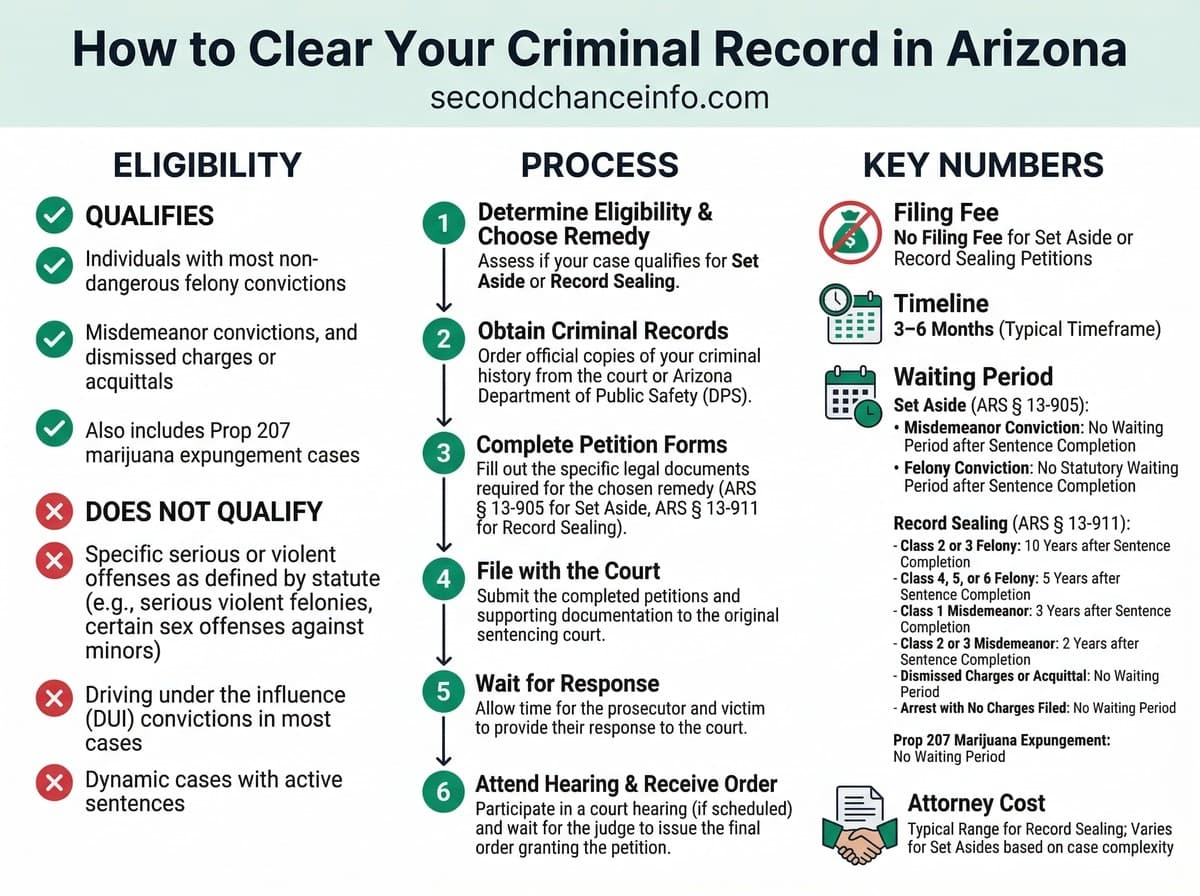
Arizona offers three ways to clear your criminal record: setting aside a conviction (ARS § 13-905), sealing your record (ARS § 13-911, effective since January 2023), or true expungement for marijuana offenses (Proposition 207). A set aside is free to file and available immediately after completing your sentence for most misdemeanors and felonies — it dismisses the case but leaves the record visible. Record sealing goes further, hiding the record from public view after a waiting period of 2–10 years depending on offense class. Dangerous offenses, sex crimes, and crimes against children under 15 are not eligible. There are no court filing fees for either process. Attorney fees typically range from $800–$1,500. The process generally takes 2–6 months. Arizona also automatically restores civil rights for first-time felony offenders and offers a Certificate of Second Chance for occupational licensing relief. Below is the full guide with eligibility, step-by-step process, costs, timeline, and FAQ.
Prepare questions about a record-clearing process
Last updated:
Overview
Arizona offers three main paths to clear a criminal record: (1) Setting aside a conviction under ARS § 13-905, which dismisses the case but leaves the record publicly visible as "set aside"; (2) Record sealing under ARS § 13-911 (effective January 1, 2023), which hides the record from public view; and (3) True expungement under Proposition 207 (ARS § 36-2862), which is limited to certain marijuana offenses. Most people will use the set aside and/or record sealing processes together for the strongest relief.
Official term: Set Aside (ARS § 13-905) / Record Sealing (ARS § 13-911) — Arizona historically used only "set aside," which does not hide the record. Since January 1, 2023, record sealing under ARS § 13-911 is also available and provides stronger privacy protection. True expungement (record destruction) exists only for qualifying marijuana offenses under Proposition 207.
Routes and conditions to check
- ✓Completed all terms of probation or sentence, including fines and restitution
- ✓Misdemeanor convictions (set aside available immediately; sealing after 2–3 year waiting period)
- ✓Felony convictions for class 4, 5, or 6 felonies (set aside after sentence completion; sealing after 5 years)
- ✓Felony convictions for class 2 or 3 felonies (set aside after sentence completion; sealing after 10 years)
- ✓Charges that were dismissed or resulted in a not-guilty verdict (sealing available immediately)
- ✓Arrests where no charges were filed (sealing available immediately)
- ✓DUI convictions (eligible for set aside despite being Title 28 violations)
- ✓Marijuana offenses under Proposition 207 (eligible for true expungement)
Exclusions and limits to check
- ✗Dangerous offenses (ARS § 13-704)
- ✗Dangerous crimes against children (ARS § 13-705)
- ✗Serious, violent, or aggravated felonies (ARS § 13-706)
- ✗Sex offenses requiring registration (ARS § 13-3821)
- ✗Offenses with a finding of sexual motivation (ARS § 13-118)
- ✗Sex trafficking (ARS § 13-1307)
- ✗Felony offenses where the victim was under age 15
- ✗Offenses involving deadly weapons or serious physical injury (for sealing)
- ✗Class 2–5 felony sexual offenses under chapters 14 or 35.1 (for sealing)
Waiting Periods
| Set aside — misdemeanor conviction | No waiting period after sentence completion |
| Set aside — felony conviction | No statutory waiting period after sentence completion |
| Record sealing — class 2 or 3 felony | 10 years after sentence completion |
| Record sealing — class 4, 5, or 6 felony | 5 years after sentence completion |
| Record sealing — class 1 misdemeanor | 3 years after sentence completion |
| Record sealing — class 2 or 3 misdemeanor | 2 years after sentence completion |
| Record sealing — dismissed charges or acquittal | No waiting period |
| Record sealing — arrest with no charges filed | No waiting period |
| Prop 207 marijuana expungement | No waiting period |
Step-by-Step Process
Determine eligibility and choose the right remedy
Confirm you have completed all sentence conditions (probation, fines, restitution). Decide whether you need a set aside (ARS § 13-905), record sealing (ARS § 13-911), or both. A set aside can be filed immediately after sentence completion for most offenses; record sealing requires additional waiting periods of 2–10 years depending on offense class.
Obtain your criminal records
Request your criminal history from the Arizona Department of Public Safety (DPS) or look up your cases through the Arizona Judicial Branch public access portal. Note the case number, court, arresting agency, and charges for each conviction you want to address. You will need a separate petition for each case number.
Complete the petition forms
For a set aside, complete the Application to Set Aside Judgment (available at your local court or the Arizona Courts Self-Service Center). For record sealing, complete the Petition to Seal Criminal Case Records. Include your full name, date of birth, case number, sentence imposed, and contact information. File a separate form for each case.
File with the court
File your petition at the court where your case was originally heard. There is no filing fee for either a set aside or record sealing petition. For record sealing of arrests with no charges, file in the superior court of the county where the arrest occurred.
Wait for prosecution and victim response
After filing, the state and any victims have 60 days to file a written opposition to a set aside, and the prosecutor has 30 days to respond to a sealing petition. You may reply within 15 days of any opposition. Either party (or the court itself) may request a hearing.
Attend hearing (if scheduled) and receive the court order
A hearing is not always required — the court may rule on the papers alone. If a hearing is held, the judge considers factors such as the nature of the offense, your compliance, time elapsed, and rehabilitation. Courts typically rule within 120 days of filing. If granted, the conviction is set aside and/or records are sealed.
Visual Guide
Automatic Civil Rights Restoration & Proposition 207 Marijuana Expungement
Arizona does not have a broad automatic expungement or sealing program. However, first-time felony offenders have their civil rights (except firearm rights) automatically restored upon completion of probation or absolute discharge from prison under ARS § 13-907, provided all victim restitution has been paid. Marijuana offenses under Proposition 207 can be expunged with a simple petition and no waiting period.
| Scenario | Timing and conditions |
|---|---|
| First felony — automatic civil rights restoration (except firearms) | Upon completion of probation or discharge from prison |
| Marijuana offense (Prop 207) — petition-based expungement | No waiting period; file anytime |
| Dismissed charges / not guilty verdict — eligible for sealing | No waiting period |
| Arrest with no charges filed — eligible for sealing | No waiting period |
Costs
- Filing fee
- No filing fee for set aside or record sealing petitions
- Fee waiver
- Not applicable — petitions are free to file. DPS may charge a fee for criminal history background checks unless petitioner is indigent or was acquitted/dismissed.
- Attorney (optional)
- $800–$1,500 typical range for record sealing; varies for set asides based on case complexity
You can file without an attorney. Forms and instructions are available free from the Arizona Courts Self-Service Center. Some legal aid organizations and the Arizona Foundation for Legal Services & Education provide free assistance.
Timeline
- With attorney
- 2–4 months
- Standard
- 3–6 months
Courts typically schedule hearings or rule within 120 days of filing. Simple set asides for misdemeanors may be faster. Record sealing cases involving felonies or victim opposition may take longer.
Effects of the relief
- ✓Set aside: withdraws the guilty plea, sets aside the judgment of guilt, and dismisses the case
- ✓Set aside: releases the person from most penalties and disabilities of the conviction
- ✓Set aside: restores the right to possess a firearm (except for serious offenses under ARS § 13-706)
- ✓Set aside: Certificate of Second Chance may be issued, removing barriers to occupational licenses
- ✓Record sealing: hides the case from public view and most background checks
- ✓Record sealing: allows you to legally state you have never been arrested for, charged with, or convicted of the sealed offense on employment, housing, and loan applications
- ✓Prop 207 expungement: completely erases qualifying marijuana offenses from the record
Limits of the relief
- ✗Set aside does NOT hide the record — the conviction remains publicly visible, marked as 'set aside'
- ✗Does NOT remove disabilities imposed by the Department of Transportation (driver's license suspensions)
- ✗Does NOT remove disabilities imposed by the Game and Fish Commission
- ✗Does NOT lift lifetime injunctions under ARS § 13-719
- ✗Sealed records are still accessible to law enforcement, prosecutors, and courts
- ✗Sealed records can still be used for sentence enhancement in future cases
- ✗Does NOT guarantee removal from private background check databases that captured the record before sealing
- ✗A set aside does NOT restore firearm rights for serious offenses under ARS § 13-706
Other Relief Options in Arizona
Certificate of Second Chance (ARS § 13-905)
Automatically issued when all misdemeanors are set aside, or for class 4–6 felonies after 2+ years, or class 2–3 felonies after 5+ years. Removes barriers to occupational licensing and provides employment and housing protections. Only one felony-based certificate per person.
Restoration of Civil Rights (ARS § 13-907 / § 13-908)
First-time felony offenders automatically regain civil rights (voting, jury service) upon sentence completion. Persons with two or more felonies must petition the court. Firearm rights require a separate petition.
Governor's Pardon
Any person convicted of an Arizona felony may apply through the Board of Executive Clemency. The Board must first recommend the pardon to the Governor. Restores rights of citizenship but does not restore firearm rights unless specifically authorized in the pardon.
Proposition 207 Marijuana Expungement (ARS § 36-2862)
True expungement (record destruction) for qualifying marijuana offenses that occurred before November 30, 2020, including possession of 2.5 oz or less, cultivation of 6 plants or fewer, and related paraphernalia offenses. No filing fee and no waiting period.
Frequently Asked Questions
- What is the difference between a set aside and record sealing in Arizona?
- A set aside (ARS § 13-905) dismisses your conviction but the record remains publicly visible, marked as 'set aside.' Record sealing (ARS § 13-911) hides the record from public view and most background checks, allowing you to legally deny the conviction on applications. For the strongest relief, you can pursue both: first get the conviction set aside, then petition to have the record sealed once the waiting period is met.
- How much does it cost to get a record set aside or sealed in Arizona?
- There is no court filing fee for either a set aside application or a record sealing petition in Arizona. If you hire an attorney, expect to pay $800–$1,500 depending on case complexity. You can file on your own using free forms from the Arizona Courts Self-Service Center. The Arizona DPS may charge a fee for criminal history records unless you are indigent.
- How long does the set aside or sealing process take in Arizona?
- After filing, the prosecution and victims have 30–60 days to respond. Courts typically schedule a hearing or rule on the petition within 120 days. With an attorney, the entire process usually takes 2–4 months. Without one, expect 3–6 months. Misdemeanor set asides without opposition are often faster.
- Can a felony be set aside or sealed in Arizona?
- Yes. Most felonies can be set aside immediately upon sentence completion, and sealed after 5 years (class 4–6 felonies) or 10 years (class 2–3 felonies). However, dangerous offenses, dangerous crimes against children, serious/violent/aggravated felonies, sex offenses, and crimes involving victims under 15 are not eligible for set aside or sealing.
- Does a set aside restore gun rights in Arizona?
- Yes, for most offenses. Under ARS § 13-905, if a conviction is set aside, the person's right to possess a firearm is restored. The exception is for serious offenses under ARS § 13-706 (serious, violent, or aggravated felonies), for which firearm rights are not restored by a set aside.
- Can I seal a DUI conviction in Arizona?
- DUI convictions can be set aside under ARS § 13-905 despite being Title 28 violations. For record sealing under ARS § 13-911, a DUI would need to meet the standard waiting period requirements for its offense class (typically a class 1 misdemeanor, requiring a 3-year wait). Felony aggravated DUI may have longer waiting periods depending on the class.
- What is a Certificate of Second Chance in Arizona?
- A Certificate of Second Chance is issued automatically when a conviction is set aside under ARS § 13-905. For class 4–6 felonies, it is available 2 years after sentence completion; for class 2–3 felonies, 5 years after. It removes barriers to obtaining occupational licenses (such as in construction, teaching, childcare, and healthcare) and provides protections in employment and housing decisions. Only one certificate per person is issued for felony convictions.
- Can I get a marijuana conviction expunged in Arizona?
- Yes. Under Proposition 207 (ARS § 36-2862), qualifying marijuana offenses that occurred before November 30, 2020 can be truly expunged (records destroyed). Eligible offenses include possession of 2.5 ounces or less, cultivation of 6 or fewer plants, and related paraphernalia charges. There is no filing fee and no waiting period. File the petition in the court that handled your case, or in superior court if no charges were filed.
Take Action — Direct Links
- Download Petition to Seal Criminal Case Records
Arizona Courts Self-Service Center page for record sealing under ARS 13-911 with petition forms, instructions, and eligibility information.
- Request Your Criminal Record (Arizona DPS)
Arizona Department of Public Safety criminal history records page — request a personal record review to check accuracy and completeness of your record.
- Find Free Legal Help (Community Legal Services)
Community Legal Services of Phoenix offers free Second Chance Set Aside and Sealing Clinics for eligible Arizonans.
- Arizona Courts Self-Service Center: Criminal Law
Arizona Judicial Branch Self-Service Center with forms and instructions for set aside, record sealing, rights restoration, and Proposition 207 marijuana expungement.
- ARS § 13-911 — Full Statute Text
Official full text of Arizona Revised Statutes Section 13-911 (sealing of arrest, conviction, and sentencing records) on the Arizona Legislature website.
Related Resources on This Site
More for your state
- Pardon & ClemencyPardon & clemency in Arizona
- Jobs by CityFelony friendly jobs in Phoenix, AZ
- Jobs by StateJobs for felons in Arizona
- HousingSecond chance apartments in Phoenix, AZ
- Voting RightsFelon voting rights in Arizona
- Gun RightsFelon gun rights in Arizona
- DUI RecoveryDUI license recovery in Arizona
- ProbationProbation & parole in Arizona
Helpful guides
- Background ChecksHow far back do background checks go?
- ToolsReentry organizations directory
- Free Legal AidFree legal aid by state