
Florida (FL) — Expungement & Record Clearing
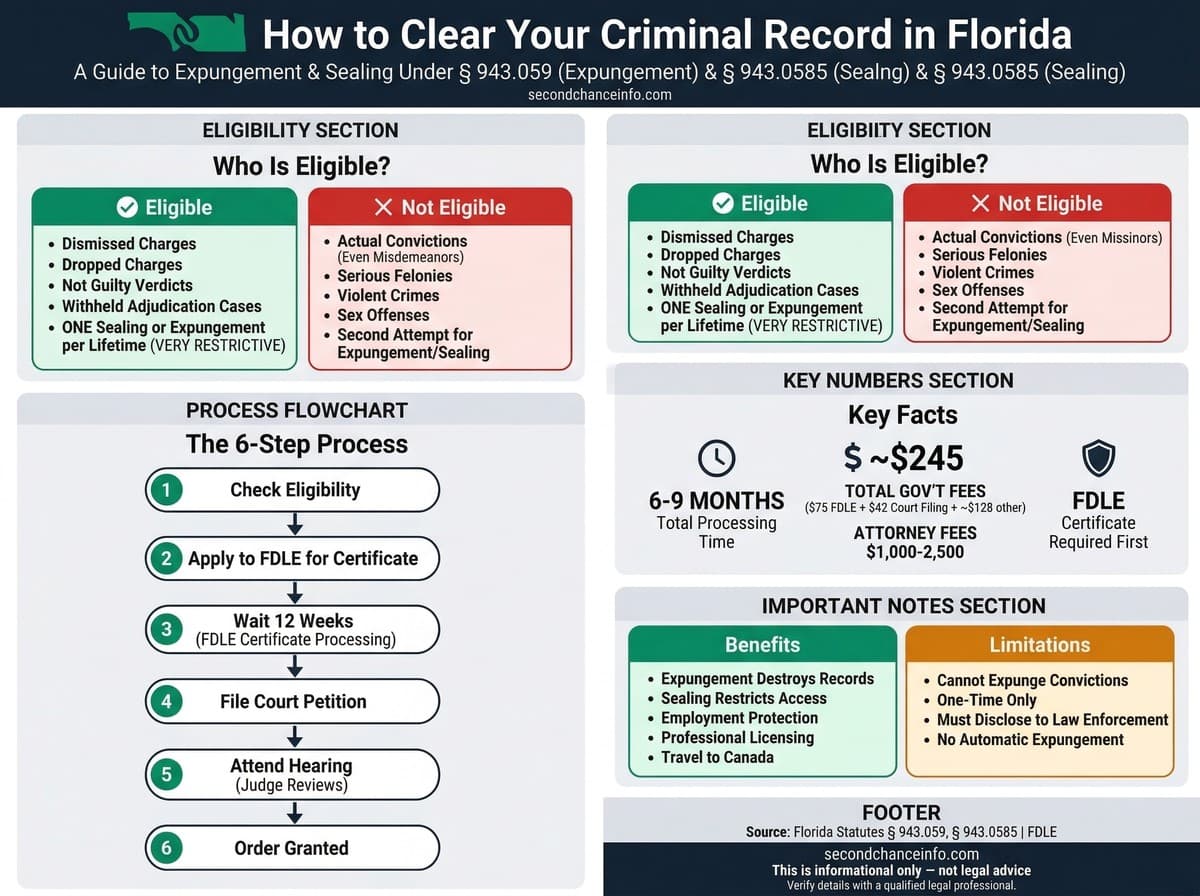
Florida allows record sealing and expungement, but only once per lifetime and never for actual convictions. Expungement applies to dismissed or acquitted charges; sealing applies to withheld adjudication cases. You must first obtain a Certificate of Eligibility from FDLE ($75, ~12 weeks), then petition the court. Total government fees are approximately $245, attorney fees run $1,000–$2,500, and the full process takes 6–9 months. Sex offenses, drug trafficking, violent felonies, and any conviction are ineligible. Below is the full guide with eligibility, step-by-step process, costs, timeline, and FAQ.
Prepare questions about a record-clearing process
Last updated:
Overview
Florida has one of the most restrictive record clearing systems in the country. You are limited to one sealing or one expungement in your entire lifetime. Expungement is only available for charges that were dismissed, dropped, or resulted in a not-guilty verdict — no convictions can be expunged. Sealing is available only for cases where adjudication was withheld. Both require obtaining a Certificate of Eligibility from the Florida Department of Law Enforcement (FDLE) before petitioning the court.
Official term: Expungement / Sealing — Florida distinguishes between expungement (physical destruction of records for non-convictions) and sealing (restricting access for withheld adjudication cases). You may only obtain one or the other in your lifetime — not both.
Routes and conditions to check
- ✓Charges that were dismissed, dropped, or resulted in acquittal (expungement)
- ✓Cases where adjudication was withheld by the court (sealing)
- ✓No prior sealing or expungement in Florida (lifetime one-time limit)
- ✓Not currently under supervision (probation, parole, or any court-ordered program)
- ✓No pending criminal charges
Exclusions and limits to check
- ✗Any actual conviction — even a misdemeanor conviction cannot be expunged or sealed
- ✗Anyone who has previously had a record sealed or expunged in Florida
- ✗Arson, aggravated assault/battery, kidnapping, homicide, manslaughter
- ✗Sexual offenses (sexual battery, lewd/lascivious acts, etc.)
- ✗Robbery, carjacking, burglary of a dwelling
- ✗Stalking, domestic violence injunction violations
- ✗Drug trafficking offenses
- ✗Child abuse or neglect
Waiting Periods
| Expungement (dismissed/acquitted charges) | Immediately eligible after case disposition |
| Sealing (adjudication withheld) | Immediately eligible after case disposition |
| FDLE Certificate of Eligibility processing | Approximately 12 weeks |
Step-by-Step Process
Verify eligibility
Confirm your case qualifies: the charges must have been dismissed/dropped/acquitted (for expungement) or adjudication must have been withheld (for sealing). You must have no prior sealing or expungement in Florida and no pending charges.
Obtain a certified disposition
Get a certified copy of the final disposition from the clerk of the court where your case was handled. This document proves the outcome of your case.
Apply for FDLE Certificate of Eligibility
Submit an application to the Florida Department of Law Enforcement (FDLE) with the $75 processing fee. Include a certified disposition, your fingerprints, and a completed application form. FDLE takes approximately 12 weeks to process.
File the court petition
Once you receive the Certificate of Eligibility, file a Petition to Expunge or Seal with the court where your case was heard. Pay the court filing fee (approximately $42) and any additional county fees.
State Attorney review
The State Attorney's Office reviews your petition and may object. If no objection is filed, the court may rule without a hearing. If the State Attorney objects, a hearing will be scheduled.
Court order issued
If granted, the court issues an order to expunge or seal the record. For expungement, agencies physically destroy the records. For sealing, records are restricted from public access. The FDLE updates its database accordingly.
Visual Guide
Automatic Relief in Florida
Florida does not currently have an automatic expungement or sealing program. All record clearing must be initiated by the individual through the petition process described above.
| Scenario | Timing and conditions |
|---|
Costs
- Filing fee
- $75 (FDLE) + $42 (court filing) + ~$128 (other costs) = ~$245 total government fees
- Fee waiver
- Limited fee waiver options; varies by county
- Attorney (optional)
- $1,000–$2,500 typical range
The FDLE fee is non-refundable even if the Certificate of Eligibility is denied. Total out-of-pocket for government fees is approximately $245.
Timeline
- With attorney
- 6–8 months
- Standard
- 6–9 months
The FDLE Certificate of Eligibility alone takes approximately 12 weeks. After receiving the certificate, the court process adds another 2–4 months.
Effects of the relief
- ✓Expungement: physically destroys criminal justice records held by agencies
- ✓Sealing: restricts access so records do not appear on standard background checks
- ✓Allows you to lawfully deny the arrest on most job applications
- ✓Removes the record from public court databases
- ✓Improves employment, housing, and educational opportunities
Limits of the relief
- ✗Does NOT apply to convictions — only non-convictions (expungement) or withheld adjudication (sealing) qualify
- ✗One-time only — you cannot seal or expunge another record in the future
- ✗Must still disclose sealed/expunged records to law enforcement agencies
- ✗Must disclose to the Florida Bar, medical licensing boards, and certain government employers
- ✗Sealed records can still be accessed by criminal justice agencies
- ✗Does NOT remove records from federal databases (FBI)
Other Relief Options in Florida
Restoration of Civil Rights
Florida's clemency process can restore voting rights, the right to serve on a jury, and the right to hold public office. Requires application to the Office of Executive Clemency.
Pardon
The Florida Board of Executive Clemency can grant a full pardon, which forgives the crime but does not seal or expunge the record.
Frequently Asked Questions
- Can I expunge a conviction in Florida?
- No. Florida does not allow expungement of any conviction, including misdemeanors. Expungement is only available for charges that were dismissed, dropped, or resulted in a not-guilty verdict. Sealing is only available when adjudication was withheld.
- How many times can I seal or expunge my record in Florida?
- Only once in your entire lifetime. Florida law limits you to one sealing or one expungement — not both. This is one of the strictest limitations in the country.
- What is a Certificate of Eligibility from FDLE?
- The Certificate of Eligibility is a document from the Florida Department of Law Enforcement confirming that you meet the legal requirements for sealing or expungement. You must obtain this certificate before you can file a court petition. It costs $75 and takes approximately 12 weeks to process.
- How much does expungement cost in Florida?
- Government fees total approximately $245 ($75 FDLE fee, $42 court filing fee, and approximately $128 in other costs). If you hire an attorney, expect to pay an additional $1,000 to $2,500.
- What is the difference between sealing and expungement in Florida?
- Expungement physically destroys the criminal records — agencies must destroy their copies. Sealing restricts public access but the records still exist and can be accessed by law enforcement and certain agencies. Expungement is only for dismissed/acquitted charges; sealing is for withheld adjudication cases.
- How long does the Florida expungement process take?
- The entire process typically takes 6 to 9 months. The FDLE Certificate of Eligibility takes about 12 weeks, and the court petition process adds another 2 to 4 months after that.
- What does 'adjudication withheld' mean in Florida?
- Adjudication withheld means the judge did not formally convict you, even though you may have pleaded guilty or no contest. It is not a conviction under Florida law. Cases with adjudication withheld are eligible for sealing (but not expungement).
Take Action — Direct Links
- FDLE Certificate of Eligibility Application
Instructions and application to obtain a Certificate of Eligibility from FDLE, required before petitioning the court to seal or expunge a record.
- Request Your Own Criminal Record (FDLE Personal Review)
Free personal review of your Florida criminal history record through the Florida Department of Law Enforcement — fingerprints required.
- Florida Justice Center — Free Record Sealing
Free attorneys for anyone in Florida who qualifies to have their arrest record sealed or expunged.
- FDLE Seal and Expunge Process Guide
Official FDLE guide covering the full seal and expunge process, eligibility requirements, FAQs, and application checklist.
- Fla. Stat. § 943.0585 (Sealing) — Full Statute Text
Official full text of Florida Statute 943.0585 (court-ordered sealing of criminal history records) on the Florida Legislature website.
Related Resources on This Site
More for your state
- Pardon & ClemencyPardon & clemency in Florida
- Jobs by CityFelony friendly jobs in Jacksonville, FL
- Jobs by StateJobs for felons in Florida
- HousingSecond chance apartments in Miami, FL
- Voting RightsFelon voting rights in Florida
- Gun RightsFelon gun rights in Florida
- DUI RecoveryDUI license recovery in Florida
- ProbationProbation & parole in Florida
Helpful guides
- Background ChecksHow far back do background checks go?
- ToolsReentry organizations directory
- Free Legal AidFree legal aid by state