
Hawaii (HI) — Expungement & Record Clearing
Hawaii allows expungement of non-conviction arrest records under HRS 831-3.2 through the Hawaii Criminal Justice Data Center (HCJDC). If you were arrested but not convicted, you can apply immediately with a $35 fee ($50 for non-first-time). The process takes about 120 days. Conviction-level expungement is limited to first-time drug offenders (HRS 706-622.5), first-time property offenders (HRS 706-622.9), and cases resolved through Deferred Acceptance of Guilty Plea (HRS 853-1). Most felony convictions cannot be expunged. As of July 1, 2025, Act 003 streamlines the process by automatically transmitting expungement orders to the Judiciary for court record sealing. Below is the full guide with eligibility, step-by-step process, costs, timeline, and FAQ.
Prepare questions about a record-clearing process
Last updated:
Overview
Hawaii allows expungement of non-conviction arrest records under HRS 831-3.2 through the Hawaii Criminal Justice Data Center (HCJDC). Conviction-level expungement is limited to specific categories: first-time drug offenders (HRS 706-622.5), first-time property offenders (HRS 706-622.9), underage alcohol-related driving offenses (HRS 291E-64(e)), and cases resolved through Deferred Acceptance of Guilty/No Contest Plea (HRS 853-1). Most felony convictions cannot be expunged. As of July 1, 2025, Act 003 streamlined the process so expungement orders are automatically transmitted to the Judiciary for court record sealing.
Official term: Expungement (HRS 831-3.2) — Hawaii uses "expungement" to mean annulling, canceling, and rescinding the record of arrest. For non-conviction arrests, the Attorney General issues the order. For qualifying convictions (first-time drug/property offenders, DAG/DANC), only the court may issue an expungement order.
Routes and conditions to check
- ✓Arrested or charged but not convicted of a crime (non-conviction arrest records)
- ✓Found eligible for redress under Chapter 661B (wrongful arrest/imprisonment)
- ✓First-time drug offenders who completed probation and treatment (HRS 706-622.5)
- ✓First-time drug offenders convicted prior to 2004 who completed probation (HRS 706-622.8)
- ✓First-time property offenders with no prior felony who completed probation (HRS 706-622.9)
- ✓Underage persons convicted of operating a vehicle after consuming alcohol (HRS 291E-64(e))
- ✓Persons who successfully completed Deferred Acceptance of Guilty/No Contest Plea (DAG/DANC) and were discharged and dismissed (HRS 853-1)
Exclusions and limits to check
- ✗Most felony convictions (Hawaii does not allow general felony expungement)
- ✗Violent felonies including murder, manslaughter, and assault
- ✗Sex offenses requiring registration
- ✗Convictions where a prison sentence was served (except qualifying first-time offender programs)
- ✗Cases where charges are still pending or probation is not yet completed
- ✗Persons previously sentenced to probation as a drug offender seeking a second drug-offense expungement (only eligible once under HRS 706-622.5)
- ✗First-time property offenders who have a prior felony conviction in any jurisdiction
Waiting Periods
| Non-conviction arrest record | No waiting period (apply immediately) |
| DAG/DANC discharge and dismissal | 1 year after discharge and dismissal |
| First-time drug offender (HRS 706-622.5) | Upon successful completion of probation and treatment |
| First-time property offender (HRS 706-622.9) | Upon successful completion of probation |
| Underage alcohol driving offense (HRS 291E-64(e)) | Upon completion of sentence requirements |
Step-by-Step Process
Determine eligibility
Confirm your arrest or conviction falls into an eligible category: non-conviction arrest, first-time drug/property offender who completed probation, DAG/DANC with discharge and dismissal, or underage alcohol driving offense. For conviction-based expungement, only the court may issue the order.
Obtain your criminal history record
Request a copy of your Hawaii Criminal History Record from the HCJDC to identify the specific arrest(s) or conviction(s) you wish to expunge and verify eligibility.
Complete the expungement application
For non-conviction arrests: download and complete Form HCJDC-159 from the HCJDC website. For conviction-based expungement, the court that handled your case will have the appropriate forms and procedures.
Submit application with payment
For non-conviction arrest expungement: submit the completed application to the HCJDC with $35 for a first-time expungement or $50 for a non-first-time expungement (includes a $10 non-refundable administrative fee). Payment must be by money order or cashier's check payable to the "State of Hawaii."
Wait for processing
The expungement process takes approximately 120 days (about 4 months). The HCJDC will review your application, verify eligibility, and process the expungement order.
Receive expungement certificate
If approved, the HCJDC mails an expungement certificate to the address on your application. The certificate authorizes you to state, under oath or otherwise, that you have no record regarding the specific arrest. As of July 1, 2025, the expungement order is automatically transmitted to the Judiciary for court record sealing under Act 003.
Visual Guide
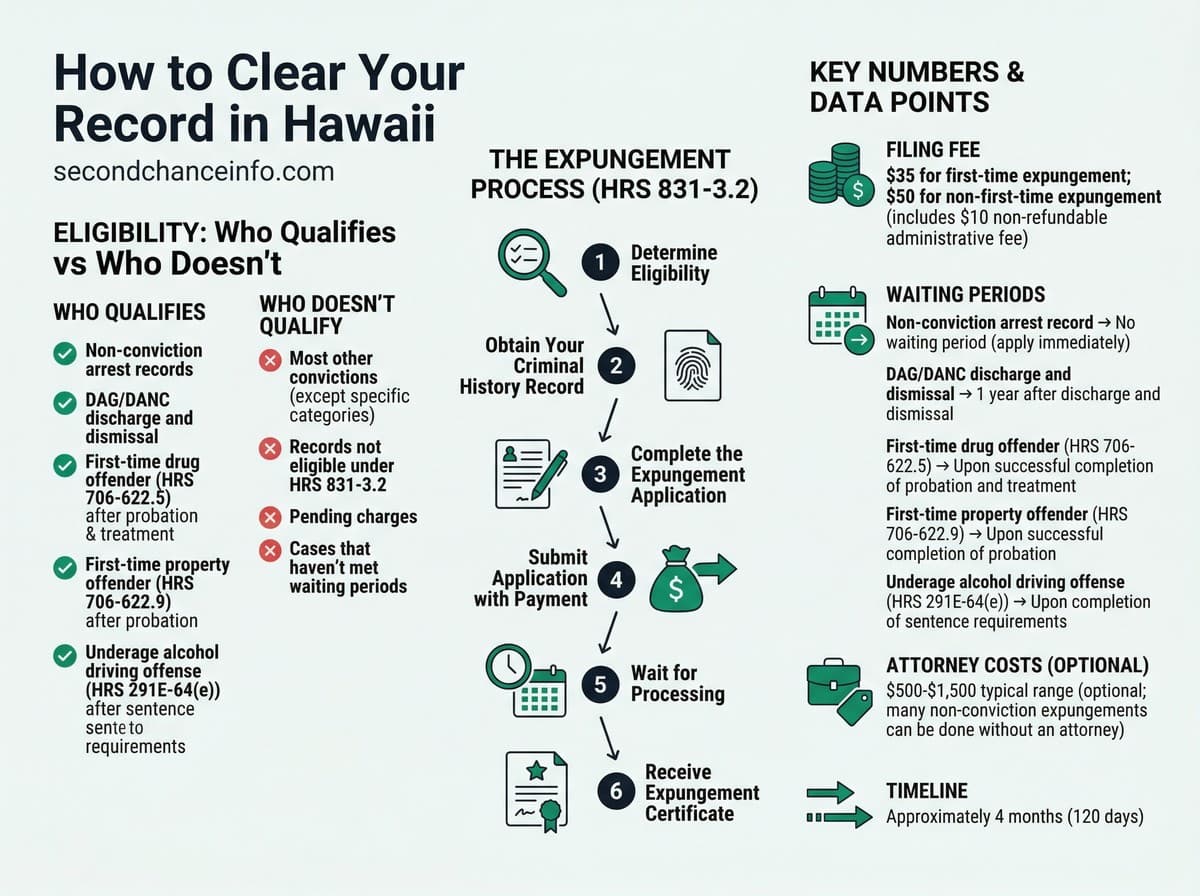
Automatic Relief in Hawaii
Hawaii does not have a comprehensive automatic (clean slate) expungement law. However, Act 003 (2025), effective July 1, 2025, streamlines the process by automatically transmitting approved expungement orders from the HCJDC to the Judiciary for court record sealing, eliminating the need for a separate request. In 2024, Gov. Josh Green signed Act 241 creating a Clean Slate Expungement Task Force to develop legislation for broader automatic record clearing, which may expand eligibility in the future.
| Scenario | Timing and conditions |
|---|---|
| Non-conviction arrest expungement approved by HCJDC | Court records automatically sealed upon HCJDC transmission to Judiciary (effective July 1, 2025) |
| Expungement orders issued before July 1, 2025 | Individual must separately contact the Judiciary to request court record sealing |
| DAG/DANC successful completion and dismissal | Eligible to apply for expungement 1 year after discharge; not automatic |
Costs
- Filing fee
- $35 for first-time expungement; $50 for non-first-time expungement (includes $10 non-refundable administrative fee)
- Fee waiver
- No formal fee waiver program; contact the HCJDC at (808) 587-3348 for assistance
- Attorney (optional)
- $500-$1,500 typical range (optional; many non-conviction expungements can be done without an attorney)
Payment must be by money order or cashier's check payable to the "State of Hawaii." Some legal aid organizations may offer free assistance.
Timeline
- With attorney
- Approximately 4 months (120 days)
- Standard
- Approximately 4 months (120 days)
The HCJDC states that the expungement process takes 120 days. Using an attorney does not significantly speed up the administrative processing time, though an attorney can help ensure the application is complete and correct.
Effects of the relief
- ✓Annuls, cancels, and rescinds the record of arrest from the statewide criminal history repository
- ✓Authorizes the person to legally state they have no record regarding the specific arrest, even under oath
- ✓Arrest records in custody of law enforcement agencies are forwarded to the Attorney General for placement in a confidential file
- ✓As of July 1, 2025, court records related to the expunged arrest are automatically transmitted to the Judiciary for sealing
- ✓Allows the person to request return of all fingerprints and photographs taken in connection with the arrest
- ✓Removes the arrest from background checks run through the HCJDC
Limits of the relief
- ✗Does NOT expunge most felony convictions (Hawaii has very limited conviction expungement)
- ✗Does NOT restore firearm rights lost due to a felony conviction
- ✗Does NOT guarantee removal from all private background check databases
- ✗Does NOT affect federal records held by the FBI
- ✗Does NOT apply to convictions for serious violent crimes or sex offenses
- ✗Does NOT constitute a pardon — a pardon is a separate process through the Governor
- ✗A pardoned offense may still be used in subsequent criminal proceedings
Other Relief Options in Hawaii
Governor's Pardon
The Governor has the power to grant pardons for state convictions. There are no strict eligibility requirements, but the process includes a formal investigation and face-to-face interview. The process takes approximately 8 months. A pardon relieves legal disabilities and prohibitions but does not expunge the record — the criminal history will show both the conviction and the pardon.
Deferred Acceptance of Guilty/No Contest Plea (DAG/DANC)
Under HRS 853-1, qualified first-time offenders may avoid a formal conviction by successfully completing the terms of the court's deferral order. Upon discharge and dismissal, the case is resolved without adjudication of guilt. One year after discharge, the person may apply for expungement.
Clean Slate Expungement Task Force (Act 241, 2024)
Gov. Josh Green signed Act 241 in 2024, creating a task force to develop legislation for broader automatic record clearing. The task force is expected to consider marijuana conviction relief and expanded expungement eligibility. Future legislation may result from this effort.
Frequently Asked Questions
- How much does expungement cost in Hawaii?
- The filing fee is $35 for a first-time expungement and $50 for a non-first-time expungement, which includes a $10 non-refundable administrative fee. Payment must be by money order or cashier's check payable to the "State of Hawaii." If you hire an attorney, expect additional fees of $500-$1,500, though many non-conviction arrest expungements can be completed without an attorney.
- How long does expungement take in Hawaii?
- The Hawaii Criminal Justice Data Center (HCJDC) states that the expungement process takes approximately 120 days (about 4 months). The expungement certificate will be mailed to the address provided on your application once processing is complete.
- Can a felony conviction be expunged in Hawaii?
- Hawaii has very limited felony conviction expungement. Most felony convictions cannot be expunged. Exceptions include first-time nonviolent drug offenders who completed probation and treatment (HRS 706-622.5), first-time property offenders with no prior felony who completed probation (HRS 706-622.9), and cases resolved through Deferred Acceptance of Guilty/No Contest Plea (DAG/DANC). For other felony convictions, a Governor's Pardon is the primary form of relief.
- What is the difference between expungement and a pardon in Hawaii?
- Expungement annuls and rescinds the record of arrest, allowing you to legally state you have no record regarding that arrest. A pardon, granted by the Governor, states that the person has been rehabilitated and relieves legal disabilities and prohibitions, but does not erase the record — the criminal history will show both the conviction and the pardon. A pardoned offense may still be used in subsequent criminal proceedings.
- What changed with Hawaii Act 003 (2025)?
- Effective July 1, 2025, Act 003 streamlined the expungement process so that individuals granted an expungement order no longer need to separately request that the Judiciary seal or remove related court records. The HCJDC now automatically transmits the expungement order to the Judiciary for court record sealing. Expungement orders issued before July 1, 2025 still require individuals to contact the Judiciary directly.
- Can I expunge an arrest that did not lead to a conviction in Hawaii?
- Yes. Under HRS 831-3.2, if you were arrested or charged with a crime but not convicted, you can apply to the HCJDC to have that arrest record expunged. There is no waiting period — you may apply as soon as the case is resolved without a conviction. Submit Form HCJDC-159 with the appropriate fee ($35 first-time, $50 non-first-time).
- What is a Deferred Acceptance of Guilty Plea (DAG) in Hawaii?
- Under HRS 853-1, a Deferred Acceptance of Guilty Plea (DAG) or Deferred Acceptance of No Contest Plea (DANC) allows qualified first-time offenders to avoid a formal conviction. If you successfully complete the court's conditions, the charge is dismissed without adjudication of guilt. One year after discharge and dismissal, you may apply for expungement of the record.
- Does Hawaii have automatic expungement or clean slate laws?
- Hawaii does not yet have a comprehensive automatic expungement or clean slate law. However, Act 003 (2025) automates the court record sealing step after an expungement is granted. Additionally, in 2024 Gov. Josh Green signed Act 241, creating a Clean Slate Expungement Task Force to develop legislation for broader automatic record clearing, potentially including marijuana conviction relief.
Take Action — Direct Links
- Download Expungement Application (Form HCJDC-159)
Hawaii Criminal Justice Data Center expungement page with the application form for non-conviction arrest record expungement under HRS § 831-3.2. Fee: $35 first-time, $50 non-first-time.
- Request Your Own Criminal History Record (HCJDC Access & Review)
Request a copy of your Hawaii criminal history from the HCJDC through the Access & Review process ($35 by mail, $55 in-office). Contact (808) 587-3279 for a fingerprint packet.
- Find Free Legal Help — Legal Aid Society of Hawaii
The Legal Aid Society of Hawaii provides free civil legal assistance to low-income individuals. Call the intake hotline at 808-536-4302 (Oahu) or 1-800-499-4302 (Neighbor Islands).
- Hawaii Judiciary — Expunging Arrest Records and Removing Court Records
Official Hawaii Judiciary page explaining the expungement and court record sealing process, including the streamlined one-step process effective July 1, 2025 under Act 003.
- HRS § 831-3.2 — Full Statute Text
Official full text of Hawaii Revised Statutes § 831-3.2 (expungement orders) on the Hawaii State Capitol website.
Related Resources on This Site
More for your state
- Pardon & ClemencyPardon & clemency in Hawaii
- Jobs by StateJobs for felons in Hawaii
- Voting RightsFelon voting rights in Hawaii
- Gun RightsFelon gun rights in Hawaii
- DUI RecoveryDUI license recovery in Hawaii
- ProbationProbation & parole in Hawaii
- SR22 InsuranceSR22 insurance in Hawaii
- License ReinstatementLicense reinstatement in Hawaii
Helpful guides
- Background ChecksHow far back do background checks go?
- ToolsReentry organizations directory
- Free Legal AidFree legal aid by state
Sources
- HRS 831-3.2 (Expungement Orders)
- Hawaii Criminal Justice Data Center — Expungements
- HCJDC Expungement FAQ
- Hawaii Judiciary — Expunging Arrest Records and Removing Court Records
- HRS 853-1 (Deferred Acceptance of Guilty Plea)
- HRS 706-622.5 (Sentencing for Drug Offenders; Expungement)
- HRS 706-622.9 (First-Time Property Offenders; Expungement)
- Collateral Consequences Resource Center — Hawaii
- Hawaii State Law Library — Removing Court Records FAQ