
South Dakota (SD) — Expungement & Record Clearing
South Dakota has very limited expungement options. If you were arrested but never convicted, you can petition to expunge the arrest record 1 year after arrest or dismissal — filing costs $70. Class 2 misdemeanors, petty offenses, and municipal violations are automatically removed after 10 years with no new convictions. For other convictions, options are narrow: a suspended imposition of sentence seals your record upon probation completion, and the Governor's pardon (available 1+ year after conviction) seals all related records. Felony convictions generally cannot be expunged — Class A, B, 1, and 2 felonies, sex offenses, crimes against minors, and DUIs are all ineligible. Below is the full guide with eligibility, step-by-step process, costs, timeline, and FAQ.
Prepare questions about a record-clearing process
Last updated:
Overview
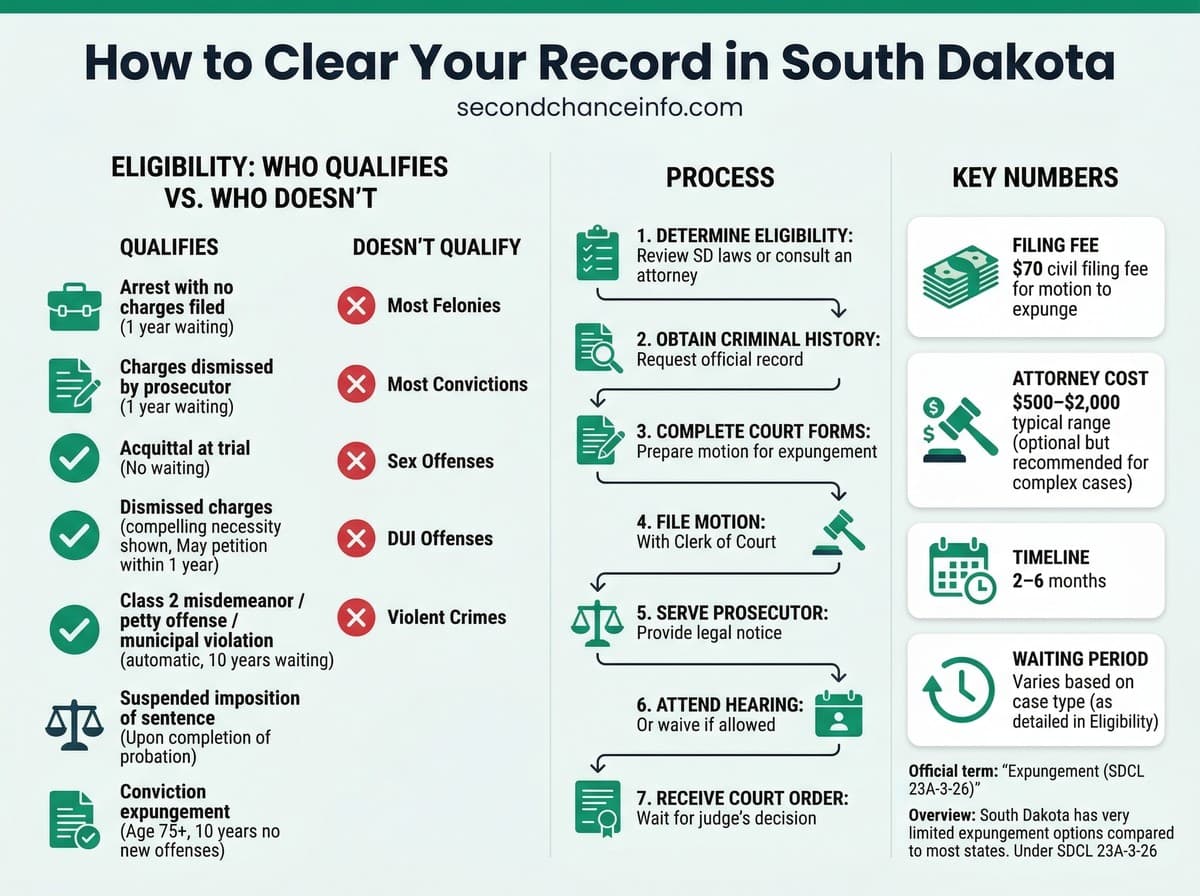
South Dakota has very limited expungement options compared to most states. Under SDCL 23A-3-26, "expungement" means the sealing — not destruction — of all records. Arrest records may be expunged if charges were never filed, dismissed, or resulted in acquittal. For convictions, expungement is generally restricted to petty offenses, municipal ordinance violations, and Class 2 misdemeanors (automatic after 10 years), or to individuals age 75 and older. Felony convictions generally cannot be expunged but may be addressed through a Governor's pardon, exceptional pardon, or suspended imposition of sentence.
Official term: Expungement (SDCL 23A-3-26) — South Dakota defines "expungement" as the sealing of all records — it does not imply the physical destruction of records. Sealed records are hidden from public view and background checks but remain accessible to law enforcement with a court order.
Routes and conditions to check
- ✓Arrest with no charges filed (1 year after arrest)
- ✓Charges formally dismissed by prosecutor (1 year after dismissal)
- ✓Acquittal at trial (immediately eligible)
- ✓Petty offenses, municipal ordinance violations, or Class 2 misdemeanors (automatic after 10 years with no intervening convictions)
- ✓Suspended imposition of sentence — record sealed upon successful completion of probation (SDCL 23A-27-13)
- ✓Conviction for an offense that is no longer a crime under South Dakota law
- ✓Persons age 75 or older with no offenses in the past 10 years
- ✓Deceased individuals (Director of Bureau of Criminal Statistics may order erasure)
- ✓Pardoned convictions (records sealed upon Governor's pardon)
Exclusions and limits to check
- ✗Class A, B, 1, or 2 felony convictions
- ✗Felony sexual assault convictions
- ✗Offenses involving a minor victim
- ✗Crimes of moral turpitude
- ✗Convictions involving the operation of a motor vehicle (including DUI/DWI)
- ✗Most felony convictions (no general felony expungement statute exists)
- ✗Persons with pending charges or currently serving a sentence
Waiting Periods
| Arrest with no charges filed | 1 year after arrest |
| Charges dismissed by prosecutor | 1 year after dismissal |
| Acquittal at trial | No waiting period |
| Dismissed charges (compelling necessity shown) | May petition within 1 year of dismissal |
| Class 2 misdemeanor / petty offense / municipal violation (automatic) | 10 years after all conditions satisfied |
| Suspended imposition of sentence | Upon successful completion of probation |
| Conviction expungement (age 75+) | 10 years with no new offenses |
| Governor's pardon application | 1 year after conviction (minimum) |
| Exceptional pardon application | 5 years after release or date of offense |
Step-by-Step Process
Determine eligibility
Review whether your situation qualifies under SDCL 23A-3-27 (arrest records) or 23A-3-34 (automatic removal of minor offenses). Confirm you are not excluded by offense type. For convictions, assess whether a suspended imposition of sentence or pardon may be a better path.
Obtain your criminal history
Request a copy of your criminal record from the South Dakota Division of Criminal Investigation (DCI). The fee is approximately $24. This helps identify the case number(s) and court(s) with jurisdiction.
Complete the required court forms
Use the SD UJS self-help Guide and File system or download forms directly: UJS-390 (instructions), UJS-232 (case filing statement), UJS-391 (motion for expungement), UJS-392 (hearing waiver), UJS-393 (notice of hearing), UJS-394 (court order), and UJS-395 (notice of entry).
File the motion with the Clerk of Court
File your motion for expungement with the Clerk of Court that had, or would have had, jurisdiction over the criminal case. Pay the $70 civil filing fee.
Serve the prosecuting attorney
Under SDCL 23A-3-28, you must serve a copy of the motion on the prosecuting attorney's office at least 14 days before the hearing date.
Attend the hearing (or waive)
The court will hold a hearing unless all parties consent to waive it (form UJS-392). The judge considers whether expungement serves the "ends of justice and the best interest of the public as well as the defendant" (SDCL 23A-3-30).
Receive the court order
If granted, the court enters an order of expungement and sends a disposition record to the Division of Criminal Investigation. All records are sealed from public access. If denied, you may refile at a later date.
Visual Guide
Automatic Record Removal (SDCL 23A-3-34) & Suspended Imposition
Under SDCL 23A-3-34, certain minor offenses are automatically removed from a defendant's public record after 10 years, provided all court-ordered conditions have been satisfied and no additional convictions occurred during the waiting period. Additionally, records are sealed upon successful completion of a suspended imposition of sentence.
| Scenario | Timing and conditions |
|---|---|
| Petty offense — all conditions satisfied, no new convictions | Automatically removed after 10 years |
| Municipal ordinance violation — all conditions satisfied, no new convictions | Automatically removed after 10 years |
| Class 2 misdemeanor — all conditions satisfied, no new convictions | Automatically removed after 10 years |
| Suspended imposition of sentence (misdemeanor) | Sealed upon successful completion of sentence conditions |
| Suspended imposition of sentence (felony) | Sealed upon successful completion of probation |
| Governor's pardon granted | Records sealed upon granting of pardon |
Costs
- Filing fee
- $70 (civil filing fee for motion to expunge)
- Fee waiver
- Fee waivers may be available for indigent petitioners — ask the Clerk of Court
- Attorney (optional)
- $500–$2,000 typical range (optional but recommended for complex cases)
Criminal history report from DCI costs approximately $24. Pardon applications have no filing fee, though document gathering incurs costs.
Timeline
- With attorney
- 1–3 months
- Standard
- 2–6 months
Timelines vary significantly by county and court scheduling. If the prosecuting attorney consents and a hearing is waived, the process can be faster.
Effects of the relief
- ✓Seals all records from public access — arrest, detention, trial, and disposition records
- ✓Sealed records do not appear on standard background checks
- ✓Restores the person to the status occupied before the arrest or conviction
- ✓Allows the individual to legally answer "no" when asked about the expunged arrest or conviction
- ✓Only the record custodian can see sealed records; others need a court order
Limits of the relief
- ✗Does NOT physically destroy the records — they are sealed, not deleted
- ✗Does NOT apply to felony convictions (except through pardon or suspended imposition)
- ✗Does NOT expunge DUI/DWI or motor vehicle offense convictions
- ✗Does NOT prevent law enforcement from accessing sealed records with a court order
- ✗Does NOT restore gun rights (a pardon or separate court action may be required)
- ✗Pardoned offenses still count as prior convictions for sentencing enhancement purposes
- ✗Government agencies and licensing boards may still view records sealed via suspended imposition
Other Relief Options in South Dakota
Suspended Imposition of Sentence (SDCL 23A-27-13)
The court withholds sentencing and places the defendant on probation. Upon successful completion, the guilty plea is withdrawn and the record is sealed. Limited to a maximum of two per person (one misdemeanor, one felony). The court has full discretion to grant or deny.
Governor's Pardon (SDCL 24-14)
Available 1 year after conviction. The Governor may pardon upon favorable recommendation from the Board of Pardons and Paroles. Upon pardon, all official records are sealed. No application fee. All fines, costs, and restitution must be paid first.
Exceptional Pardon (SDCL 24-14-8)
Available 5 years after release from a DOC facility (or 5 years after date of offense if no prison sentence). Restricted to first-time felony offenders whose offense was not punishable by life imprisonment. Excused from newspaper publication requirement.
Frequently Asked Questions
- Can felony convictions be expunged in South Dakota?
- Generally, no. South Dakota does not have a general felony expungement statute. Class A, B, 1, and 2 felony convictions are explicitly ineligible. However, felony records may be sealed through a suspended imposition of sentence (if granted at sentencing) or through a Governor's pardon. An exceptional pardon is available to first-time felony offenders 5 years after release.
- How much does expungement cost in South Dakota?
- The civil filing fee for a motion to expunge is $70. A criminal history report from the Division of Criminal Investigation costs approximately $24. If you hire an attorney, fees typically range from $500 to $2,000. Pardon applications have no filing fee, though gathering required documents incurs costs. Fee waivers may be available for indigent petitioners.
- Can a DUI be expunged in South Dakota?
- No. South Dakota's expungement law does not apply to any conviction involving the operation of a motor vehicle, including DUI and DWI offenses. The only path to clearing a DUI conviction is through a Governor's pardon, which requires at least 1 year after conviction and a favorable recommendation from the Board of Pardons and Paroles.
- What is the automatic expungement for Class 2 misdemeanors in South Dakota?
- Under SDCL 23A-3-34, petty offenses, municipal ordinance violations, and Class 2 misdemeanors are automatically removed from a defendant's public record after 10 years, provided all court-ordered conditions and penalties have been satisfied and no additional convictions occurred during the waiting period. No petition is required for this automatic removal.
- What is a suspended imposition of sentence in South Dakota?
- A suspended imposition of sentence (SIS) allows the court to accept a guilty plea but withhold sentencing, placing the defendant on probation instead. Upon successful completion, the conviction is sealed and removed from the public record. Each person is limited to two SIS grants in their lifetime — one for a misdemeanor and one for a felony. It is entirely within the court's discretion.
- How long does expungement take in South Dakota?
- With an attorney, the process typically takes 1 to 3 months. Without one, expect 2 to 6 months depending on court scheduling and county. If the prosecuting attorney consents and all parties waive the hearing, the process can be completed faster. Automatic expungement of Class 2 misdemeanors under SDCL 23A-3-34 occurs after 10 years with no petition needed.
- Do I have to be 75 years old to get a conviction expunged in South Dakota?
- The age-75 requirement applies specifically to petitioning for the sealing of certain conviction records when no other pathway applies. However, there are other paths that do not require being 75: arrest records (no conviction) can be expunged after 1 year, Class 2 misdemeanors are automatically removed after 10 years, suspended imposition of sentence seals records upon completion, and pardons are available at any age. The 75-year requirement is a last resort for convictions that do not fit other categories.
- What happens to my record after expungement in South Dakota?
- After expungement, all records are sealed from public view — they will not appear on standard background checks, and you can legally answer "no" when asked about the expunged arrest or conviction. However, the records are not physically destroyed. Law enforcement can still access sealed records with a court order, and certain government agencies and licensing boards may retain access to records sealed through a suspended imposition of sentence.
Take Action — Direct Links
- Expungement Forms and Guide & File System
South Dakota UJS self-help page with expungement forms (UJS-390 through UJS-395) and the free Guide and File system that generates completed forms by answering interview questions.
- Request Your Criminal History Record (SD DCI)
South Dakota Attorney General's DCI background check request page. Personal/state-only checks cost $26.75 and require Livescan fingerprinting. Call (605) 773-3331 for assistance.
- Apply for Free Legal Help (SD Law Help)
SD Law Help connects you to free legal aid from East River Legal Services (eastern SD), Dakota Plains Legal Services (western SD and Tribal lands), and Access to Justice (statewide).
- South Dakota UJS Self-Help Center
South Dakota Unified Judicial System self-help center with legal form help line (1-855-784-0004), Guide and File system, and resources for representing yourself in expungement proceedings.
- SDCL 23A-3 — Full Statute Text (Expungement)
Official full text of South Dakota's expungement statutes (SDCL 23A-3-26 through 23A-3-37) on the South Dakota Legislature website.
Related Resources on This Site
More for your state
- Pardon & ClemencyPardon & clemency in South Dakota
- Jobs by StateJobs for felons in South Dakota
- HousingSecond chance apartments in Sioux Falls, SD
- Voting RightsFelon voting rights in South Dakota
- Gun RightsFelon gun rights in South Dakota
- DUI RecoveryDUI license recovery in South Dakota
- ProbationProbation & parole in South Dakota
- SR22 InsuranceSR22 insurance in South Dakota
Helpful guides
- Background ChecksHow far back do background checks go?
- ToolsReentry organizations directory
- Free Legal AidFree legal aid by state