
Oregon (OR) — Expungement & Record Clearing
Yes, you can clear your criminal record in Oregon through a set aside under ORS 137.225. Most misdemeanors and many felonies are eligible after a waiting period of 1 to 7 years, depending on the offense class. There is no court filing fee — only a $33 Oregon State Police background check fee per case. The process takes 3–6 months. Class A felonies, sex offenses, person crimes, DUII, and traffic offenses are not eligible. Once set aside, your record is sealed and you can legally say you were never convicted on most job and housing applications. Free legal help is available statewide. Below is the full guide with eligibility, step-by-step process, costs, timeline, and FAQ.
Prepare questions about a record-clearing process
Last updated:
Overview
Oregon uses the term "set aside" rather than expungement. Under ORS 137.225, eligible individuals can petition the court to seal their criminal record. Once set aside, the conviction is deemed never to have occurred and the record is sealed from public view. Senate Bill 397 (effective January 1, 2022) significantly expanded eligibility by reducing waiting periods and eliminating the court filing fee.
Official term: Set Aside (ORS 137.225) — Oregon officially calls the process "setting aside" a conviction. The record is sealed — not destroyed — and law enforcement can still access it for limited purposes.
Routes and conditions to check
- ✓Class B felony convictions (non-person, non-firearm offenses) — 7-year waiting period
- ✓Class C felony convictions — 5-year waiting period
- ✓Class A misdemeanor convictions — 3-year waiting period
- ✓Class B and C misdemeanor convictions, violations, and contempt — 1-year waiting period
- ✓Arrests where charges were never filed (60 days after prosecutor declines to charge)
- ✓Dismissed charges and acquittals (no waiting period)
- ✓Most drug-related felonies, including delivery of controlled substances (per SB 397)
- ✓Pre-1972 offenses that would qualify if committed under current law
Exclusions and limits to check
- ✗Class A felonies (except certain marijuana offenses under ORS 137.226)
- ✗Class B felonies classified as person crimes by the Oregon Criminal Justice Commission
- ✗Class B felonies involving firearms (ORS 166.429)
- ✗Sex offenses requiring registration as a sex offender
- ✗Murder, manslaughter, and criminally negligent homicide
- ✗Criminal mistreatment of victims age 65 or older or involving child abuse
- ✗Traffic offenses and DUII convictions
- ✗Persons currently on probation, parole, or post-prison supervision
- ✗Persons with pending criminal charges
Waiting Periods
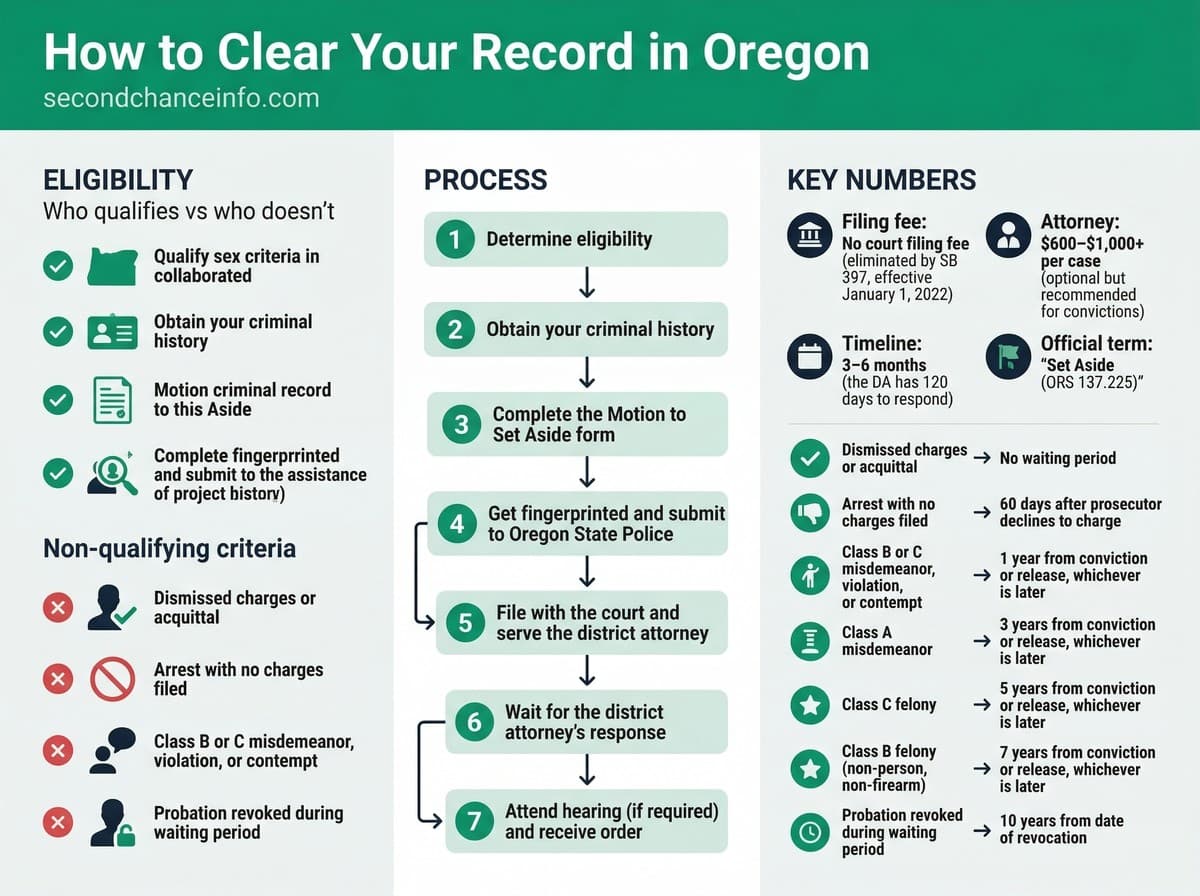
| Dismissed charges or acquittal | No waiting period |
| Arrest with no charges filed | 60 days after prosecutor declines to charge |
| Class B or C misdemeanor, violation, or contempt | 1 year from conviction or release, whichever is later |
| Class A misdemeanor | 3 years from conviction or release, whichever is later |
| Class C felony | 5 years from conviction or release, whichever is later |
| Class B felony (non-person, non-firearm) | 7 years from conviction or release, whichever is later |
| Probation revoked during waiting period | 10 years from date of revocation |
Step-by-Step Process
Determine eligibility
Confirm your conviction is eligible for set aside, the waiting period has passed, you have completed your entire sentence (including probation and financial obligations), and you have no new convictions or pending charges.
Obtain your criminal history
Get a copy of your criminal record and identify the case number(s) for each conviction you want set aside. You can request records from the court where your case was heard.
Complete the Motion to Set Aside form
Fill out the Motion and Affidavit to Set Aside Conviction (or Arrest) form, available from the Oregon Judicial Department website. Complete one motion per case.
Get fingerprinted and submit to Oregon State Police
Obtain a full set of fingerprints on an FBI standard fingerprint card (FD-258) from your local sheriff's office or police department. Submit the card along with the $33 fee (per case) and the Request for Set Aside Criminal Record Check form to the Oregon State Police.
File with the court and serve the district attorney
File the original signed motion with the circuit court where your case was heard. There is no court filing fee. Mail a copy of the motion, along with court records, to the district attorney's office in that county.
Wait for the district attorney's response
The district attorney has 120 days to investigate and decide whether to object. Victims of the crime may also object or request a hearing. If no objection is filed, the court may grant the order without a hearing.
Attend hearing (if required) and receive order
If the DA objects, the court schedules a hearing where a judge weighs your rehabilitation and the public interest. If granted, the court issues an order sealing your record and directing all agencies (including the FBI) to delete or seal the record.
Visual Guide
Marijuana Conviction Relief (ORS 137.226 / ORS 475C.397)
Oregon does not have a broad automatic expungement system for adult convictions. However, ORS 137.226 and ORS 475C.397 provide simplified set-aside procedures for certain marijuana convictions that occurred before legalization (April 21, 2017). Juvenile records may be subject to automatic expungement under separate statutes (HB 2677A, 2025).
| Scenario | Timing and conditions |
|---|---|
| Marijuana conviction before April 21, 2017 (conduct now legal) | Eligible immediately — simplified motion process |
| Marijuana conviction before April 21, 2017 (conduct now lower offense) | Court treats as Class C misdemeanor for set-aside purposes |
| Juvenile adjudication (certain offenses) | Automatic expungement under HB 2677A (2025) |
Costs
- Filing fee
- No court filing fee (eliminated by SB 397, effective January 1, 2022)
- Fee waiver
- Not applicable — there is no court filing fee; the $33 OSP fee may be waived for indigent petitioners
- Attorney (optional)
- $600–$1,000+ per case (optional but recommended for convictions)
Free legal help is available through CLEAR Clinic (Portland), Legal Aid Services of Oregon, Metropolitan Public Defender Community Law Project, and Clean Slate Clackamas
Timeline
- With attorney
- Approximately 3 months
- Standard
- 3–6 months (the DA has 120 days to respond)
Processing time varies by county and whether the district attorney objects. Including a police report with your filing may speed up the process.
Effects of the relief
- ✓Record is sealed from public view — will not appear on most background checks
- ✓You are legally deemed not to have been previously convicted and may answer 'no' to conviction questions on most job and housing applications
- ✓Restores firearm rights under Oregon state law (per Mohiadeen v. Washington County Sheriff's Office, 2025)
- ✓Restores eligibility to apply for a concealed handgun license (ORS 166.291)
- ✓May improve access to professional licensing and educational opportunities
- ✓Court orders agencies, including the FBI, to seal or delete the record
Limits of the relief
- ✗Does NOT destroy the record — law enforcement can still access it for limited purposes
- ✗Does NOT prevent disclosure on government job applications or certain state licensing applications
- ✗Does NOT affect immigration proceedings — federal agencies may still access the record
- ✗Does NOT automatically remove records from private background check databases (you may need to contact those companies)
- ✗Does NOT apply to traffic offenses or DUII convictions
- ✗Federal firearm prohibitions may still apply even after state set-aside — consult an attorney
Other Relief Options in Oregon
Governor's Pardon
The Governor may grant pardons, commutations, and reprieves for all crimes. Applicants must generally exhaust judicial remedies (set aside) first. Pardons are considered a last resort.
Marijuana Conviction Set Aside (ORS 137.226 / ORS 475C.397)
Simplified set-aside process for marijuana convictions before April 21, 2017. The court evaluates the offense as if it occurred under current law, which may make it a lower-level offense or no longer a crime.
Conviction Review (Resentencing)
Oregon law allows a person convicted of a felony and the district attorney to jointly petition a court to reconsider a sentence or conviction if it no longer advances the interests of justice.
Frequently Asked Questions
- How much does it cost to set aside a conviction in Oregon?
- There is no court filing fee for set-aside motions in Oregon — the fee was eliminated by SB 397 in 2022. You must pay a $33 fee to the Oregon State Police for a criminal record check for each case. If you hire an attorney, expect to pay $600–$1,000 or more per case. Free legal assistance is available through organizations like CLEAR Clinic, Legal Aid Services of Oregon, and Clean Slate Clackamas.
- How long does the set-aside process take in Oregon?
- The process typically takes 3 to 6 months. The district attorney has 120 days (about 4 months) to review your motion and decide whether to object. If no objection is filed, the court may grant the order without a hearing. With an attorney, the process often takes about 3 months.
- Can a felony be set aside in Oregon?
- Yes, many felonies can be set aside. Class C felonies are eligible after 5 years, and Class B felonies that are not classified as person crimes or firearm offenses are eligible after 7 years. Class A felonies are generally not eligible, with limited exceptions for certain marijuana offenses. Person felonies — as defined by the Oregon Criminal Justice Commission — are not eligible.
- Does setting aside a conviction restore gun rights in Oregon?
- Yes, under Oregon state law. In Mohiadeen v. Washington County Sheriff's Office (2025), the Oregon Court of Appeals confirmed that a successful set-aside under ORS 137.225 restores the right to possess firearms and apply for a concealed handgun license under state law. However, federal firearm prohibitions may still apply, and the Oregon State Police has sometimes denied purchases despite a set-aside — consult an attorney for your specific situation.
- Can I set aside a DUII or traffic conviction in Oregon?
- No. Traffic offenses and DUII (Driving Under the Influence of Intoxicants) convictions are specifically excluded from the set-aside statute under ORS 137.225. There is currently no mechanism to expunge these offenses in Oregon.
- Do I need an attorney to file for a set aside in Oregon?
- No, you can file on your own. The Oregon Judicial Department provides free forms and instructions. However, court staff cannot give legal advice on how to fill out the forms. Free legal clinics — including CLEAR Clinic in Portland, Legal Aid Services of Oregon, and the Metropolitan Public Defender Community Law Project — can help at no cost. An attorney is recommended for conviction cases, especially felonies.
- What happens if the district attorney objects to my set-aside motion?
- If the DA objects, the court will schedule a hearing. At the hearing, the judge weighs factors including your rehabilitation, time since the offense, and the public interest. You have the opportunity to present evidence of your rehabilitation. The judge then decides whether to grant or deny the motion. If denied, you may refile later.
- Can I say I was never convicted after a set aside in Oregon?
- In most cases, yes. Oregon law provides that once a conviction is set aside, the person 'shall be deemed not to have been previously convicted' and 'may answer accordingly any questions relating to its occurrence.' This means you can generally answer 'no' on job and housing applications. However, you may still need to disclose on government job applications, certain professional licensing applications, and in immigration proceedings.
Take Action — Direct Links
- Download Set-Aside Motion Forms (Oregon Judicial Department)
Official Oregon Judicial Department forms center for criminal and arrest record set-aside motions, including the Motion and Affidavit to Set Aside Conviction form.
- Request Your Criminal Record (Oregon State Police)
Oregon State Police Criminal History Record Checks page with instructions and the Copy of Own Record form ($33 fee, fingerprint-based).
- Find Free Legal Help (Legal Aid Services of Oregon)
Legal Aid Services of Oregon Expungement Clinic providing free advice and assistance to low-income Oregonians seeking to clear criminal records, with virtual and in-person options.
- Oregon Courts: Set-Aside Instructions (PDF)
Official step-by-step instructions from the Oregon Judicial Department for filing a criminal set-aside motion in adult cases.
- ORS 137.225 — Full Statute Text
Official full text of ORS Chapter 137 on the Oregon Legislature website, including Section 137.225 (order setting aside conviction or record of criminal charge).
Related Resources on This Site
More for your state
- Pardon & ClemencyPardon & clemency in Oregon
- Jobs by CityFelony friendly jobs in Portland, OR
- Jobs by StateJobs for felons in Oregon
- HousingSecond chance apartments in Portland, OR
- Voting RightsFelon voting rights in Oregon
- Gun RightsFelon gun rights in Oregon
- DUI RecoveryDUI license recovery in Oregon
- ProbationProbation & parole in Oregon
Helpful guides
- Background ChecksHow far back do background checks go?
- ToolsReentry organizations directory
- Free Legal AidFree legal aid by state