
Kansas (KS) — Expungement & Record Clearing
Yes, you can clear your criminal record in Kansas through expungement under KSA 21-6614. Misdemeanors and lower-level felonies require a 3-year waiting period after completing your sentence; more serious felonies require 5 years. First-offense DUI requires 5 years. The filing fee is $195 per case (waived for dismissed charges and acquittals). The process takes 2–4 months and requires a court hearing. Kansas does not yet have automatic expungement — you must file a petition. Expungement seals your record from public view and restores firearm rights under state law. Murder, rape, sex offenses, and felony DUI are not eligible. Below is the full guide with eligibility, step-by-step process, costs, timeline, and FAQ.
Prepare questions about a record-clearing process
Last updated:
Overview
Kansas allows expungement of certain criminal convictions, arrest records, and diversion agreements under KSA 21-6614. Unlike some states, Kansas uses true expungement — meaning the record is sealed from public view. Eligibility depends on the severity of the offense, and waiting periods of 3, 5, or 10 years apply after completion of the sentence or discharge from probation. A court hearing is required, and the judge must find that expungement is warranted by the petitioner's behavior and consistent with the public welfare.
Official term: Expungement (KSA 21-6614) — Kansas uses the term "expungement," which seals the record from public access. The record is not destroyed — law enforcement and certain employers can still access it in limited circumstances.
Routes and conditions to check
- ✓Misdemeanor convictions (3-year waiting period after sentence completion)
- ✓Traffic infractions and cigarette/tobacco infractions (3-year waiting period)
- ✓Class D or E felony convictions (3-year waiting period)
- ✓Nongrid felonies or felonies ranked severity levels 6–10 on the nondrug grid (3-year waiting period)
- ✓Drug grid severity level 5 felonies (crimes on or after July 1, 2012) (3-year waiting period)
- ✓Class A, B, or C felonies and nondrug grid severity levels 1–5 (5-year waiting period)
- ✓Drug grid severity levels 1–4 felonies (crimes on or after July 1, 2012) (5-year waiting period)
- ✓First-offense DUI conviction (5-year waiting period)
- ✓Diversion agreements (waiting period matches underlying offense category)
- ✓Arrest records where charges were not filed, dismissed, or resulted in acquittal (no waiting period)
Exclusions and limits to check
- ✗Murder, manslaughter, or other homicide offenses
- ✗Rape and other sex offenses listed under KSA 21-5503
- ✗Sexually violent crimes under the Kansas Offender Registration Act
- ✗Any person currently required to register under the Kansas Offender Registration Act
- ✗Felony DUI convictions (third or subsequent DUI classified as a felony)
- ✗Driving a commercial motor vehicle under the influence
- ✗Persons convicted of a felony within the past 2 years
- ✗Persons with pending felony proceedings
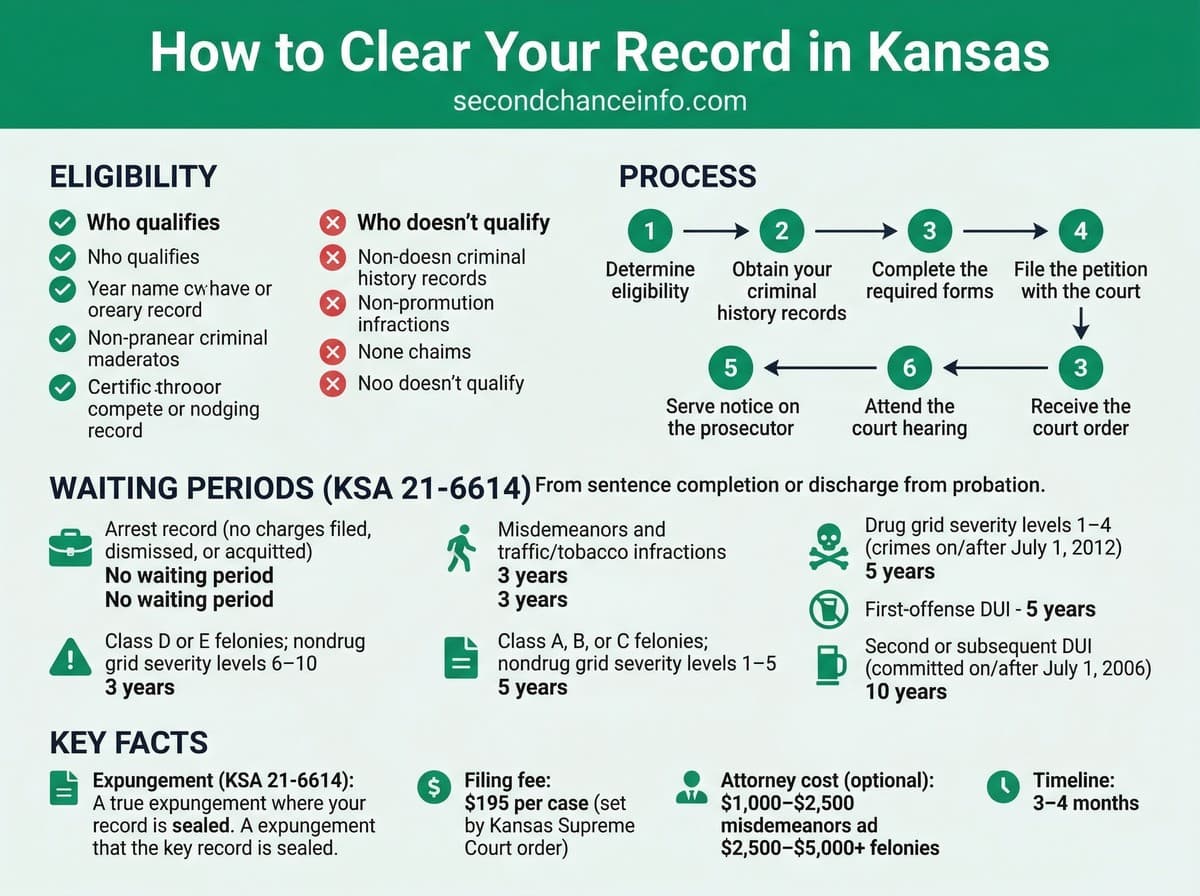
Waiting Periods
| Arrest record (no charges filed, dismissed, or acquitted) | No waiting period |
| Misdemeanors and traffic/tobacco infractions | 3 years after sentence completion or discharge from probation |
| Class D or E felonies; nondrug grid severity levels 6–10 | 3 years after sentence completion or discharge from probation |
| Class A, B, or C felonies; nondrug grid severity levels 1–5 | 5 years after sentence completion or discharge from probation |
| Drug grid severity levels 1–4 (crimes on/after July 1, 2012) | 5 years after sentence completion or discharge from probation |
| First-offense DUI | 5 years after sentence completion or discharge from probation |
| Second or subsequent DUI (committed on/after July 1, 2006) | 10 years after sentence completion or discharge from probation |
Step-by-Step Process
Determine eligibility
Review KSA 21-6614 to confirm your offense qualifies and the required waiting period has passed. You must not have been convicted of a felony in the past 2 years and have no pending felony charges.
Obtain your criminal history records
Request your criminal history from the Kansas Bureau of Investigation (KBI) or the court where your case was heard. Identify the case number(s) for each record you want expunged.
Complete the required forms
Download forms from the Kansas Judicial Council. For convictions or diversions, complete the "Petition for Expungement of Conviction or Diversion" and the Criminal Cover Sheet. For arrest records only, use the "Petition for Expungement of Arrest Record." One petition per case.
File the petition with the court
File the original petition and required copies with the Clerk of the District Court in the county where you were convicted or arrested. Pay the $195 docket fee (fee waived if charges were dismissed, not filed, or you were acquitted). A Poverty Affidavit may be filed if you cannot afford the fee.
Serve notice on the prosecutor
The county or district attorney must be notified of the petition. The court clerk will typically schedule a hearing date 60 or more days after filing and send a Notice of Hearing to all parties.
Attend the court hearing
Appear at the scheduled hearing (some courts allow virtual participation via Zoom). The judge will consider whether your behavior warrants expungement, whether it serves the public welfare, and — for felonies — whether firearm possession by you would pose a public safety threat.
Receive the court order
If granted, the court issues an Order of Expungement. The KBI processes the expungement within approximately 8–12 weeks. After processing, the record is sealed from public view. If denied, you may re-petition after addressing the court's concerns.
Visual Guide
Arrest Record Expungement (No Waiting Period)
Kansas does not currently have a comprehensive automatic expungement system. However, arrest records where no charges were filed, charges were dismissed, or the person was found not guilty can be expunged at no cost and with no waiting period. Legislative efforts (such as HB 2028) have been introduced to create automatic expungement for certain dismissed cases and diversions, but as of early 2026 the process remains petition-based for most records.
| Scenario | Timing and conditions |
|---|---|
| Arrest with no charges filed | Eligible immediately — no waiting period, no filing fee |
| Charges dismissed by the court | Eligible immediately — no waiting period, no filing fee |
| Found not guilty at trial | Eligible immediately — no waiting period, no filing fee |
Costs
- Filing fee
- $195 per case (set by Kansas Supreme Court order)
- Fee waiver
- Fee waived if charges were dismissed, not filed, or resulted in acquittal. A Poverty Affidavit may be filed if you cannot afford the fee for conviction/diversion expungements.
- Attorney (optional)
- $1,000–$2,500 for misdemeanors; $2,500–$5,000+ for felonies (optional but recommended)
Kansas Legal Services offers free expungement clinics — contact kls_expunge@klsinc.org to register. The $195 docket fee is non-refundable and applies per case.
Timeline
- With attorney
- 2–3 months
- Standard
- 3–4 months
Hearings are typically scheduled 60+ days after filing. After the court grants expungement, the KBI takes an additional 8–12 weeks to process the record update. Timelines vary by county.
Effects of the relief
- ✓Seals the conviction, arrest, or diversion record from public view
- ✓Allows you to legally answer 'no' when asked about prior arrests or convictions on most job applications
- ✓Removes the record from standard background checks
- ✓Restores firearm rights for expunged convictions that caused firearm dispossession (KSA 21-6614(k))
- ✓May improve access to housing, education, and professional licensing
- ✓Treats the petitioner as not having been arrested, convicted, or diverted of the crime
Limits of the relief
- ✗Does NOT destroy the record — it is sealed, not erased
- ✗Does NOT prevent law enforcement from accessing the expunged record
- ✗Does NOT prevent use of the expunged conviction as a prior offense for sentencing in any future prosecution
- ✗Does NOT relieve the duty to register under the Kansas Offender Registration Act
- ✗Does NOT prevent disclosure for certain government and law-enforcement employment positions
- ✗Does NOT guarantee eligibility to purchase firearms under federal law — federal restrictions may still apply
- ✗Does NOT remove the record from federal databases (e.g., FBI)
Other Relief Options in Kansas
Governor's Pardon (Executive Clemency)
The Kansas Governor may pardon or commute sentences for state convictions. Applications are submitted to the Kansas Prisoner Review Board, which reviews them before forwarding a recommendation to the Governor. A pardon does not expunge the record but forgives the conviction.
Certificate of Discharge
Issued automatically by the Kansas Parole Board upon completion of parole or post-release supervision. Restores civil rights lost by operation of law, including voting and holding office.
Diversion Programs
Kansas allows diversion agreements for certain offenses, which — upon successful completion — avoid a formal conviction. Diversion records can later be expunged under KSA 21-6614 with the same waiting periods as convictions.
Frequently Asked Questions
- How much does expungement cost in Kansas?
- The court docket fee is $195 per case, set by Kansas Supreme Court order. This fee is non-refundable. If you were not charged, charges were dismissed, or you were found not guilty, there is no filing fee. If you cannot afford the fee, you may file a Poverty Affidavit. Attorney fees typically range from $1,000–$2,500 for misdemeanors and $2,500–$5,000+ for felonies. Kansas Legal Services offers free expungement clinics.
- How long does expungement take in Kansas?
- The hearing is typically scheduled 60 or more days after filing the petition. After the court grants expungement, the KBI takes approximately 8–12 weeks to process the record update. The entire process from filing to completion usually takes 2–4 months, varying by county.
- Can a felony be expunged in Kansas?
- Yes, many felonies are eligible. Class D and E felonies and nondrug grid severity levels 6–10 require a 3-year waiting period. Class A, B, and C felonies and nondrug grid severity levels 1–5 require a 5-year waiting period. However, murder, rape, sex offenses, and felony DUI convictions cannot be expunged.
- Does Kansas have automatic expungement?
- Kansas does not yet have a comprehensive automatic expungement system. Legislative proposals have been introduced but not fully enacted as of early 2026. Currently, all expungements require filing a petition with the court. However, arrest records where no charges were filed, charges were dismissed, or the person was acquitted can be expunged at no cost with no waiting period.
- Does expungement restore gun rights in Kansas?
- Yes, under KSA 21-6614(k), expungement of a conviction that resulted in firearm dispossession restores the person's right to keep and bear arms under Kansas state law. However, federal firearms restrictions may still apply — consult an attorney to understand your specific situation.
- Can a DUI be expunged in Kansas?
- A first-offense misdemeanor DUI can be expunged after a 5-year waiting period. A second or subsequent DUI (committed on or after July 1, 2006) requires a 10-year waiting period. However, felony DUI convictions (typically a third or subsequent offense) are generally not eligible for expungement.
- Will an expunged record still show up on background checks in Kansas?
- After expungement, the record is sealed from standard public background checks and you can legally answer 'no' when asked about prior convictions on most applications. However, law enforcement agencies and certain government employers can still access expunged records. The conviction may also still be used as a prior offense for sentencing in future prosecutions.
- Can I expunge an arrest record if I was never charged or convicted?
- Yes. Under KSA 22-2410, if you were arrested but no charges were filed, charges were dismissed, or you were found not guilty, you can petition to expunge the arrest record with no waiting period and no filing fee. File a Petition for Expungement of Arrest Record with the court in the county where you were arrested.
Take Action — Direct Links
- Kansas Judicial Council — Expungement Forms (Adult)
Official downloadable petition forms from the Kansas Judicial Council for expungement of convictions, diversions, and arrest records, including the Criminal Cover Sheet.
- Request Your Kansas Criminal History (KBI)
Request your own criminal history record from the Kansas Bureau of Investigation by mail ($35 fee) or online. Includes fingerprint card instructions.
- Kansas Legal Services — Free Expungement Clinics
Free expungement help from Kansas Legal Services attorneys at clinics across the state. Contact kls_expunge@klsinc.org or call 1-316-267-3975 to register.
- Kansas Courts Self-Help — Clearing Criminal Records
Kansas Judicial Branch self-help center with guided interviews, expungement eligibility information, forms, and step-by-step instructions for self-represented litigants.
- KSA 21-6614 — Full Statute Text
Official full text of KSA 21-6614 (expungement of certain convictions, arrest records, and diversion agreements) on the Kansas Office of Revisor of Statutes website.
Related Resources on This Site
More for your state
- Pardon & ClemencyPardon & clemency in Kansas
- Jobs by CityFelony friendly jobs in Wichita, KS
- Jobs by StateJobs for felons in Kansas
- HousingSecond chance apartments in Wichita, KS
- Voting RightsFelon voting rights in Kansas
- Gun RightsFelon gun rights in Kansas
- DUI RecoveryDUI license recovery in Kansas
- ProbationProbation & parole in Kansas
Helpful guides
- Background ChecksHow far back do background checks go?
- ToolsReentry organizations directory
- Free Legal AidFree legal aid by state
Sources
- KSA 21-6614 — Kansas Expungement Statute
- KSA 22-2410 — Expungement of Arrest Records
- KBI Fact Sheet: Expungements (Feb. 2025)
- Kansas Judicial Council — Expungement Forms (Adult)
- Kansas Legal Services — Facts About Expungement
- Kansas Courts Self-Help — Record Expungement
- CCRC — Kansas Restoration of Rights & Record Relief