
Maryland (MD) — Expungement & Record Clearing
Yes, you can clear your criminal record in Maryland through expungement or shielding. Non-conviction records (acquittals, dismissals, nolle prosequi) can be expunged for free, and since October 2021, many are cleared automatically after 3 years. Certain misdemeanor and felony convictions are eligible for expungement under Criminal Procedure § 10-110, with waiting periods of 3–15 years and a $30 filing fee. Maryland also offers shielding under the Second Chance Act for 12 specific misdemeanor convictions at no cost. The 2025 Expungement Reform Act expanded eligibility, including for people with prior probation violations. Violent felonies, sex offenses, and most DUI convictions are not eligible. Below is the full guide with eligibility, step-by-step process, costs, timeline, and FAQ.
Prepare questions about a record-clearing process
Last updated:
Overview
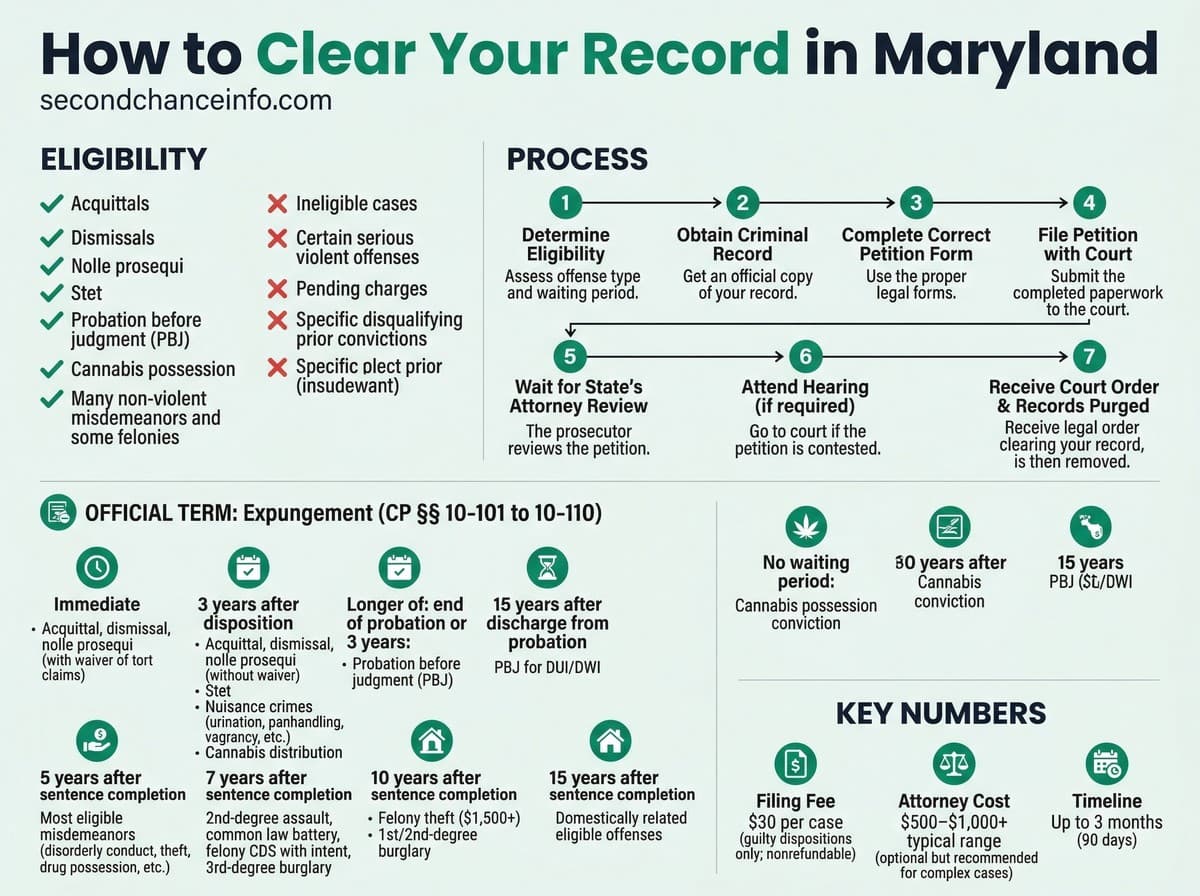
Maryland offers two main paths to clear a criminal record: expungement, which removes court and police records entirely, and shielding under the Second Chance Act, which hides certain conviction records from public view. Non-conviction records (acquittals, dismissals, nolle prosequi) can be expunged, and since October 1, 2021, many are expunged automatically after 3 years. Certain misdemeanor and felony convictions are eligible for expungement under Criminal Procedure § 10-110, with waiting periods of 3 to 15 years depending on the offense. The Expungement Reform Act of 2025 expanded eligibility and removed barriers for people with prior probation violations.
Official term: Expungement (CP §§ 10-101 to 10-110) — Maryland uses both "expungement" (which removes records from court and police files) and "shielding" under the Second Chance Act (which hides records from public view but does not destroy them). These are distinct legal processes with different eligibility rules.
Routes and conditions to check
- ✓Non-conviction dispositions: acquittal, dismissal, nolle prosequi, stet, not criminally responsible
- ✓Probation before judgment (PBJ), except DUI/DWI (15-year wait for DUI PBJ)
- ✓Nuisance crimes: public urination, panhandling, public drinking, vagrancy, loitering, sleeping in public (3-year wait)
- ✓Simple cannabis possession (no waiting period)
- ✓Most eligible misdemeanors under CP § 10-110: disorderly conduct, 2nd-degree assault, theft, drug possession, prostitution, bad checks, and others (5-year wait)
- ✓Common law battery and felony assault in 2nd degree (7-year wait)
- ✓Felony 3rd-degree burglary and CDS possession with intent to distribute (7-year wait)
- ✓Felony theft ($1,500+) and 1st/2nd-degree burglary (10-year wait)
- ✓Domestically related eligible offenses (15-year wait)
- ✓Offenses no longer classified as crimes (no waiting period)
- ✓Charges placed on the stet docket (3-year wait; removed from Case Search as of January 2026)
Exclusions and limits to check
- ✗Violent felonies not listed in CP § 10-110 (murder, rape, kidnapping, robbery, carjacking, etc.)
- ✗Sex offenses requiring registration
- ✗DUI/DWI convictions (only DUI PBJ eligible after 15 years)
- ✗Convictions not specifically listed in CP § 10-110
- ✗Persons currently a defendant in a pending criminal proceeding
- ✗Persons convicted of a new crime during the applicable waiting period (unless the new conviction is also eligible)
- ✗Cases where the "unit rule" applies: if one charge in a case is ineligible, related charges in the same unit are also ineligible
Waiting Periods
| Acquittal, dismissal, nolle prosequi (with waiver of tort claims) | Immediate |
| Acquittal, dismissal, nolle prosequi (without waiver) | 3 years after disposition |
| Stet (indefinite postponement) | 3 years after disposition |
| Probation before judgment (PBJ) | Longer of: end of probation or 3 years |
| PBJ for DUI/DWI | 15 years after discharge from probation |
| Cannabis possession conviction | No waiting period |
| Cannabis distribution with intent | 3 years after sentence completion |
| Nuisance crimes (urination, panhandling, vagrancy, etc.) | 3 years after sentence completion |
| Most eligible misdemeanors (disorderly conduct, theft, drug possession, etc.) | 5 years after sentence completion |
| 2nd-degree assault, common law battery, felony CDS with intent, 3rd-degree burglary | 7 years after sentence completion |
| Felony theft ($1,500+), 1st/2nd-degree burglary | 10 years after sentence completion |
| Domestically related eligible offenses | 15 years after sentence completion |
Step-by-Step Process
Determine eligibility
Review your criminal record to confirm your charges and dispositions are eligible under CP §§ 10-105 or 10-110. Check whether all charges in the same case ("unit") qualify — if one is ineligible, related charges may also be blocked. Confirm no pending criminal cases.
Obtain your criminal record
Request your criminal history from the Maryland Criminal Justice Information System (CJIS) or review your case on Maryland Judiciary Case Search. Note the case number(s), court, and disposition(s).
Complete the correct petition form
Use Form CC-DC-CR-072A for non-conviction dispositions (acquittal, dismissal, PBJ, nolle prosequi, stet, not criminally responsible). Use Form CC-DC-CR-072B for guilty dispositions. Forms are available on the Maryland Courts website or at any District or Circuit Court.
File the petition with the court
File in the court where your case was finally resolved. Include an extra copy for the State's Attorney and each law enforcement agency named in the petition. Pay the $30 filing fee for guilty dispositions (no fee for non-convictions). Request a fee waiver if needed.
Wait for State's Attorney review
The State's Attorney has 30 days to file an objection. If no objection is filed, the judge reviews and rules on the petition. If the State's Attorney objects, a hearing is scheduled.
Attend hearing (if required)
A hearing is only required if the State's Attorney objects. The judge considers your eligibility, public safety, rehabilitation, and whether expungement is in the interest of justice. For conviction expungements, the court also considers restitution payment.
Receive the court order and records are purged
If granted, the court issues an order of expungement. Government agencies then have up to 60 days to comply and remove the records from their systems, including the statewide CJIS database and the FBI's national database.
Visual Guide
Automatic Expungement & Case Search Removal
Since October 1, 2021, Maryland automatically expunges certain non-conviction records without requiring a petition. As of January 31, 2026, the Expungement Reform Act also requires removal of stet cases and pardoned cannabis convictions from public Case Search after 3 years.
| Scenario | Timing and conditions |
|---|---|
| Arrest with no charges filed within 60 days | Automatic after 60 days; records destroyed after 3 years |
| Acquittal, not guilty, dismissal, or nolle prosequi (on or after Oct 1, 2021) | Automatic 3 years after disposition |
| Charges on the stet docket for 3+ years (as of Jan 2026) | Removed from public Case Search automatically |
| Pardoned cannabis possession convictions (as of Jan 2026) | Removed from public Case Search automatically |
Costs
- Filing fee
- $30 per case (guilty dispositions only; nonrefundable)
- Fee waiver
- Available for financial hardship — file a Request for Waiver of Prepaid Costs
- Attorney (optional)
- $500–$1,000+ typical range (optional but recommended for complex cases)
No filing fee for non-conviction dispositions (acquittal, dismissal, PBJ, nolle prosequi, stet, not criminally responsible). No filing fee for shielding petitions. Free legal help available through Maryland Legal Aid, Maryland Volunteer Lawyers Service, and Johns Hopkins Expungement Clinic.
Timeline
- With attorney
- 1–3 months
- Standard
- Up to 3 months (90 days)
The State's Attorney has 30 days to object, the judge then has 30 days to rule, and agencies have up to 60 days to comply with the order. If there is an objection and hearing, the process may take 4–6 months. Automatic expungement of non-conviction records takes 3 years from disposition.
Effects of the relief
- ✓Removes court and police records from public inspection — records are destroyed or sealed
- ✓Employers, educational institutions, and government agencies cannot require disclosure of expunged records
- ✓You can legally answer "no" when asked about criminal history on job and housing applications
- ✓Expunged records do not appear on most background checks
- ✓Removes barriers to employment, housing, and professional licensing
- ✓For shielding: records are hidden from Maryland Judiciary Case Search and public view
Limits of the relief
- ✗Does NOT guarantee restoration of firearm rights — the FBI does not recognize Maryland expungement for federal firearms purposes
- ✗Does NOT remove sex offender registration requirements (separate process required)
- ✗Does NOT affect immigration consequences — non-citizens should consult an immigration attorney before filing
- ✗Expunged records remain accessible to law enforcement for criminal justice purposes
- ✗Shielded records remain accessible to criminal justice agencies, certain licensed employers, child care organizations, and health occupations boards
- ✗Shielding is a one-time opportunity — you may only have one shielding petition granted in your lifetime
- ✗Does NOT expunge records from federal databases if the FBI does not recognize the state order
Other Relief Options in Maryland
Shielding (Second Chance Act)
Hides 12 specific misdemeanor convictions from public view (disorderly conduct, disturbing the peace, drug possession, trespass, driving without a license, driving on suspended license, driving while uninsured, malicious destruction of property, prostitution, and others). Requires 3-year wait after completing sentence. No filing fee. One-time opportunity per lifetime. File Form CC-DC-CR-148.
Governor's Pardon
Restores civil liberties lost due to conviction. Requires 5 years crime-free after sentence for misdemeanors, 7 years for felonies. Apply through the Maryland Parole Commission. A pardon does NOT expunge your record — you must petition the court separately for expungement after receiving a pardon.
Probation Before Judgment (PBJ)
If you received PBJ, the conviction was not entered on your record. PBJ records can be expunged after the longer of your probation period or 3 years. PBJ for DUI/DWI requires a 15-year wait.
Frequently Asked Questions
- How much does expungement cost in Maryland?
- For non-conviction records (acquittal, dismissal, PBJ, nolle prosequi, stet), there is no filing fee. For guilty dispositions, the filing fee is $30 per case (nonrefundable). Fee waivers are available for financial hardship. If you hire an attorney, expect to pay $500–$1,000 or more. Free legal help is available through Maryland Legal Aid, MVLS, and the Johns Hopkins Expungement Clinic.
- How long does expungement take in Maryland?
- The standard process takes about 90 days: the State's Attorney has 30 days to object, the judge has 30 days to rule, and agencies have up to 60 days to comply. If the State's Attorney objects and a hearing is held, it may take 4–6 months. Automatic expungement of non-conviction records (for cases after October 1, 2021) occurs 3 years after disposition.
- What is the difference between expungement and shielding in Maryland?
- Expungement removes court and police records entirely — the records are destroyed or sealed from public access. Shielding, under the Second Chance Act, hides records from public view (including Maryland Case Search) but does not destroy them. Criminal justice agencies, certain employers, and other authorized entities can still access shielded records. Expungement covers a broader range of offenses; shielding is limited to 12 specific misdemeanor convictions.
- Does Maryland have automatic expungement?
- Yes. Since October 1, 2021, cases where all charges resulted in acquittal, not guilty, dismissal, or nolle prosequi are automatically expunged after 3 years — no petition needed. Arrests with no charges filed are automatically expunged after 60 days. As of January 31, 2026, charges on the stet docket for 3+ years and pardoned cannabis convictions are also automatically removed from public Case Search.
- Can a felony be expunged in Maryland?
- Yes, but only specific felonies listed in Criminal Procedure § 10-110. Eligible felonies include 3rd-degree burglary (7-year wait), felony theft over $1,500 and 1st/2nd-degree burglary (10-year wait), and CDS possession with intent to distribute (7-year wait). Violent felonies such as murder, rape, robbery, and carjacking are not eligible. The court must find that expungement is in the interest of justice and that you are not a risk to public safety.
- What did the Expungement Reform Act of 2025 change?
- The Expungement Reform Act of 2025 (SB 432) made three major changes effective October 1, 2025: (1) it overrode the Abhishek appellate decision that had barred expungement for people with probation violations — courts now evaluate overall success in completing supervision; (2) it added driving without a license, bad checks, and stolen credit cards to the list of expungeable offenses; (3) as of January 31, 2026, the judiciary must remove stet cases (3+ years) and pardoned cannabis convictions from public Case Search.
- Does expungement restore gun rights in Maryland?
- Not reliably. While Maryland expungement removes records from state systems, the FBI has taken the position that Maryland expungement does not qualify as "expungement" under federal law because records remain available to law enforcement. This means you may still be prohibited from possessing firearms under federal law even after state expungement. A Governor's Pardon may provide additional relief, but even pardons may not fully restore federal firearms eligibility. Consult a firearms attorney for specific guidance.
- Can I expunge a DUI conviction in Maryland?
- No, a DUI or DWI conviction cannot be expunged in Maryland. However, if you received Probation Before Judgment (PBJ) for a DUI/DWI, you may petition for expungement 15 years after being discharged from probation. This is the only path to clearing a DUI from your record in Maryland.
Take Action — Direct Links
- Expungement Petition Form (Non-Conviction — CC-DC-CR-072A)
Official Maryland Courts petition form for expungement of non-conviction records (acquittal, dismissal, PBJ, nolle prosequi, stet, not criminally responsible).
- Request Your Criminal Record (DPSCS Background Check)
Maryland Department of Public Safety and Correctional Services — request your criminal history through the CJIS Central Repository via fingerprint-based background check ($18 state check).
- Free Legal Help — Maryland Legal Aid
Maryland Legal Aid provides free legal assistance for expungement to financially eligible individuals — apply online, call 1-888-465-2468, or visit a free legal clinic.
- Maryland Courts — Expungement Self-Help
Maryland Courts official expungement self-help page — eligibility information, all petition forms (072A, 072B, 072C), filing instructions, and instructional video series.
- Criminal Procedure § 10-105 — Full Statute Text
Full text of Maryland Criminal Procedure § 10-105 (Expungement of record after charge is filed) — the primary expungement statute for non-conviction dispositions.
Related Resources on This Site
More for your state
- Pardon & ClemencyPardon & clemency in Maryland
- Jobs by CityFelony friendly jobs in Baltimore, MD
- Jobs by StateJobs for felons in Maryland
- HousingSecond chance apartments in Baltimore, MD
- Voting RightsFelon voting rights in Maryland
- Gun RightsFelon gun rights in Maryland
- DUI RecoveryDUI license recovery in Maryland
- ProbationProbation & parole in Maryland
Helpful guides
- Background ChecksHow far back do background checks go?
- ToolsReentry organizations directory
- Free Legal AidFree legal aid by state