
Wisconsin (WI) — Expungement & Record Clearing
Wisconsin has very limited expungement under Wis. Stat. § 973.015. Only people who were under age 25 at the time of the offense and convicted of a misdemeanor or Class H/I felony (max 6 years) may qualify — and the judge must order expungement at sentencing. Upon successful sentence completion, court records are sealed automatically via a certificate of discharge, with no filing fee. However, the conviction remains in the DOJ Crime Information Bureau database and may still appear on certain background checks. Expungement does not restore gun rights. For those ineligible, a governor’s pardon is the main alternative (requires 5+ years after sentence completion). Below is the full guide with eligibility, step-by-step process, costs, limitations, and FAQ.
Prepare questions about a record-clearing process
Last updated:
Overview
Wisconsin has one of the most restrictive expungement laws in the country. Under Wis. Stat. § 973.015, expungement is generally available only to people who were under age 25 at the time of the offense and were convicted of a misdemeanor or low-level felony (Class H or I) carrying a maximum sentence of 6 years or less. Critically, expungement must be ordered by the judge at the time of sentencing — if the judge does not grant it then, the opportunity is generally lost. Upon successful completion of the sentence, the court record is sealed, but the conviction remains in the Wisconsin DOJ Crime Information Bureau (CIB) database.
Official term: Expungement (Wis. Stat. § 973.015) — Wisconsin uses the term "expungement," but it only seals court records — it does not destroy the record. The conviction remains in the DOJ Crime Information Bureau database and can still appear on certain background checks.
Routes and conditions to check
- ✓Under age 25 at the time of the offense
- ✓Convicted of a misdemeanor (any class)
- ✓Convicted of a Class H felony (max 6 years imprisonment) with no prior felony convictions and the offense is not violent
- ✓Convicted of a Class I felony (max 3.5 years imprisonment) with no prior felony convictions and the offense is not violent
- ✓Judge ordered expungement eligibility at the time of sentencing
- ✓Successfully completed the entire sentence (probation, fines, restitution, community service)
- ✓Victims of human trafficking convicted of prostitution (Wis. Stat. § 944.30) — no age limit
- ✓Persons under 18 convicted of invasion of privacy (Wis. Stat. § 942.08) — mandatory expungement
Exclusions and limits to check
- ✗Age 25 or older at the time of the offense (with narrow exceptions)
- ✗Class A through G felonies (maximum sentence exceeding 6 years)
- ✗Violent felonies as defined in Wis. Stat. § 301.048(2)(bm)
- ✗Stalking (Wis. Stat. § 940.32)
- ✗Child abuse (Wis. Stat. § 948.03)
- ✗Sexual assault offenses
- ✗OWI / intoxicated driving convictions
- ✗Class H felony with a prior felony conviction on record
- ✗Class I felony with a prior felony conviction on record
- ✗Judge did not order expungement at sentencing (for pre-2025 convictions)
Waiting Periods
| Sentenced to probation (expungement ordered at sentencing) | Upon successful completion of probation — automatic via certificate of discharge |
| Sentenced to incarceration (expungement ordered at sentencing) | Upon successful completion of full sentence — automatic via certificate of discharge |
| Sentenced to fine/restitution only (no probation or jail) | After full payment — must file Form CR-266 petition with the court |
| Trafficking victim (prostitution conviction) | May petition at any time with evidence of trafficking |
Step-by-Step Process
Request expungement at sentencing
Your defense attorney must raise the issue of expungement during your sentencing hearing. The judge decides whether to order that the record be expunged upon successful completion of your sentence. If the judge does not grant it at this stage, the opportunity is generally lost.
Complete your sentence successfully
You must complete all conditions of your sentence without any violations. This includes finishing probation, paying all fines and restitution in full, paying all supervision fees, completing community service, and avoiding any new criminal convictions.
Certificate of discharge is issued
Upon successful completion, your probation or parole officer (or the detaining authority) submits a certificate of discharge to the court of record. This triggers the expungement process automatically — you do not need to file a separate petition.
Court seals the record
The court clerk seals both paper and electronic court files. The conviction is removed from CCAP (Wisconsin Circuit Court Access), the public online court records system. A court order is required to unseal the record.
File Form CR-266 if no probation/incarceration
If you were sentenced only to a fine or restitution (no probation or jail time), expungement is not automatic. You must file Form CR-266 (Petition to Expunge Criminal Court Record of Conviction — Non-Probation/Non-Incarceration) with the court where you were convicted.
Visual Guide
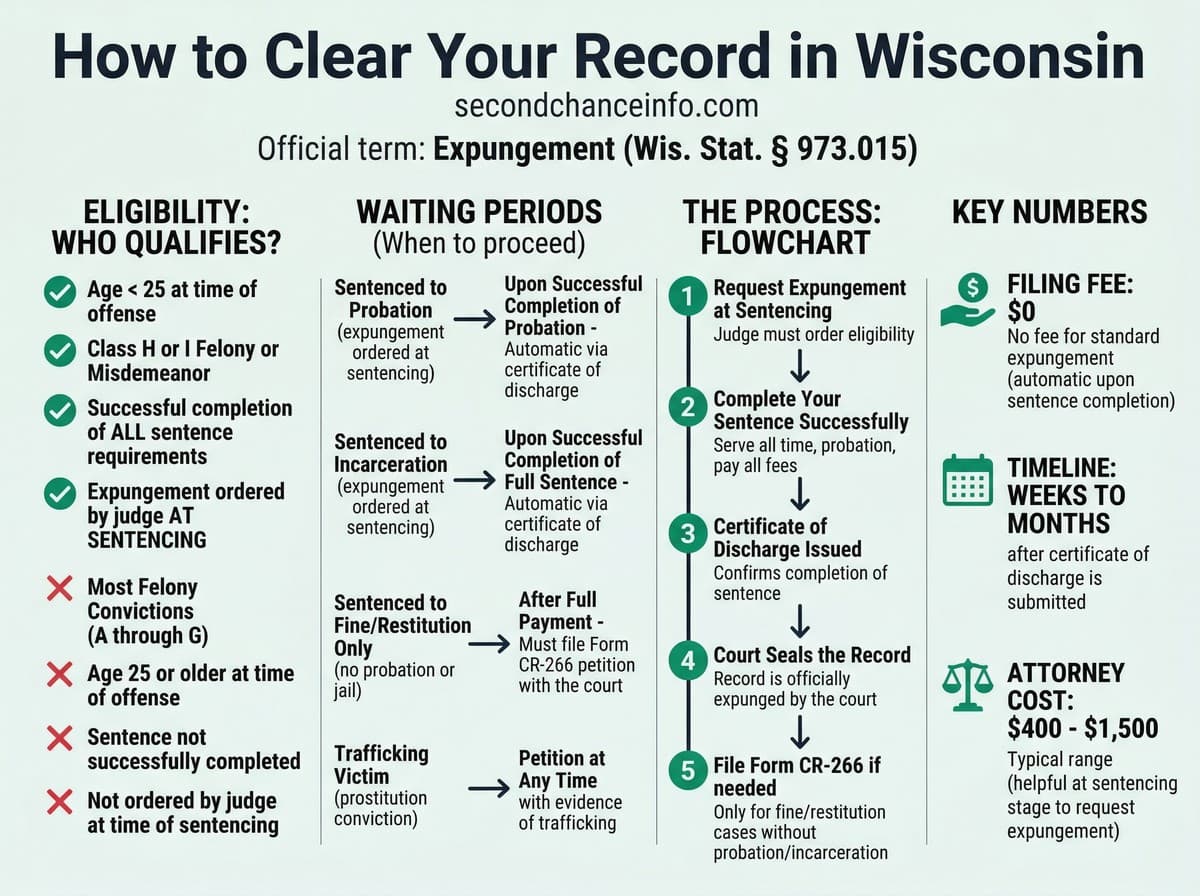
Automatic Relief in Wisconsin
Wisconsin does not have a broad automatic expungement or record-sealing program. However, if the sentencing judge ordered expungement at the time of sentencing, the process becomes self-executing upon successful sentence completion — the probation/correctional authority submits a certificate of discharge and the court clerk seals the record without any petition required from the defendant.
| Scenario | Timing and conditions |
|---|---|
| Expungement ordered at sentencing + probation completed successfully | Automatic upon certificate of discharge from probation officer |
| Expungement ordered at sentencing + incarceration completed successfully | Automatic upon certificate of discharge from detaining authority |
| Invasion of privacy (§ 942.08) committed under age 18 | Mandatory expungement upon successful sentence completion |
Costs
- Filing fee
- No filing fee for standard expungement (automatic upon sentence completion)
- Fee waiver
- N/A — there is generally no fee to file
- Attorney (optional)
- $400–$1,500 typical range (helpful at sentencing stage to request expungement)
The main cost is hiring an attorney to advocate for expungement at sentencing. If you need certified copies of court documents, clerks may charge $1.25 per page plus a $5 certification fee. Legal aid organizations such as the Milwaukee Justice Center offer free assistance.
Timeline
- With attorney
- Depends on sentence length — expungement occurs upon completion
- Standard
- Weeks to months after certificate of discharge is submitted
There is no separate court proceeding after sentencing. The timeline depends entirely on how long it takes to complete your sentence. Once the certificate of discharge is filed, courts typically process the expungement within a few weeks, though delays of several months are common.
Effects of the relief
- ✓Removes the conviction from CCAP (Wisconsin Circuit Court Access) public records
- ✓Seals both paper and electronic court files
- ✓Expunged record is not considered a conviction for employment purposes (per 2025 Wis. Act 82 amendments)
- ✓Expunged record is not considered a conviction for licensing agency purposes
- ✓Helps remove barriers to housing and education opportunities
- ✓Only a court order can unseal an expunged record
Limits of the relief
- ✗Does NOT remove the conviction from the DOJ Crime Information Bureau (CIB) database
- ✗Does NOT seal records held by law enforcement agencies, district attorneys, or the FBI
- ✗Does NOT restore firearm rights lost due to a felony conviction (only a governor's pardon can do this)
- ✗Does NOT prevent law enforcement from accessing the record
- ✗Does NOT remove the conviction from the Wisconsin DOJ WORCS (Wisconsin Online Record Check System)
- ✗Does NOT apply retroactively — judge must have ordered expungement at sentencing
- ✗Does NOT prevent courts from referencing expunged offenses during sentencing for subsequent crimes
Other Relief Options in Wisconsin
Governor's Pardon
Available to those convicted of a Wisconsin felony who completed their sentence at least 5 years ago, have no pending criminal charges, and are not required to register as a sex offender. Pardons restore rights such as firearm possession, jury service, and eligibility for public office. Processing takes approximately 18–24 months. Governor Evers has granted over 1,600 pardons since taking office.
Arrest Record Removal (Wis. Stat. § 165.84)
If you were arrested but never charged, or your charges were dismissed or you were acquitted, you can request removal of fingerprint and arrest records from the DOJ Crime Information Bureau. Submit a written request with documentation showing the case outcome.
DNA Databank Expungement (Wis. Stat. § 165.77)
If your conviction is reversed, dismissed, or you are acquitted, you may request removal of your DNA profile from the Wisconsin DNA Databank using the DOJ expungement request form.
Frequently Asked Questions
- Who is eligible for expungement in Wisconsin?
- You must have been under age 25 at the time of the offense and convicted of a misdemeanor or a Class H or I felony (maximum 6 years imprisonment). You cannot have prior felony convictions (for felony expungement), the offense cannot be violent, and the judge must have ordered expungement at your sentencing. Victims of human trafficking convicted of prostitution may petition regardless of age.
- Can I request expungement after sentencing in Wisconsin?
- Under current law, expungement must generally be ordered by the judge at the time of sentencing. If the judge did not order it then, you typically cannot petition for it later. This is the most significant limitation of Wisconsin's expungement law. Governor Evers has proposed reforms to allow post-sentencing petitions, but as of March 2026 these have not been enacted.
- Does Wisconsin expungement clear my record from background checks?
- Only partially. Expungement removes the conviction from CCAP (the public court records system) and seals court files. However, the conviction remains in the Wisconsin DOJ Crime Information Bureau (CIB) database, which is accessible through the WORCS background check system. Employers, landlords, and licensing agencies who use CIB checks may still see the conviction.
- How much does expungement cost in Wisconsin?
- There is generally no filing fee for expungement in Wisconsin — the process is automatic once you complete your sentence and the certificate of discharge is filed. If you were sentenced only to a fine (no probation or jail), you must file Form CR-266, which has no filing fee. The primary cost is hiring an attorney to advocate for expungement at sentencing, typically $400–$1,500.
- Does expungement restore gun rights in Wisconsin?
- No. Expungement does not restore firearm rights lost due to a felony conviction. Federal law (18 U.S.C. § 922(g)) prohibits firearm possession by convicted felons regardless of state expungement. Only a governor's pardon can restore gun rights in Wisconsin.
- What happens if my probation officer never submitted the certificate of discharge?
- If you successfully completed your sentence and the expungement was ordered at sentencing but your record has not been expunged after 6–9 months, contact your defense attorney or the court clerk. The probation or correctional authority is required by law to submit the certificate of discharge. You may also contact the Wisconsin Department of Corrections to follow up.
- Can I get a felony expunged in Wisconsin?
- Only Class H felonies (max 6 years) and Class I felonies (max 3.5 years) may be expunged, and only if you were under 25 at the time of the offense, had no prior felony convictions, and the offense was not violent. Class A through G felonies are never eligible for expungement.
- What is the alternative if I am not eligible for expungement?
- The primary alternative is a governor's pardon. You may apply if you completed your felony sentence at least 5 years ago, have no pending charges, and are not required to register as a sex offender. Pardons restore civil rights and can restore firearm rights but do not seal your record. Processing takes approximately 18–24 months.
Take Action — Direct Links
- Expungement Petition Form (CR-266)
Official Wisconsin Court System form CR-266 (Petition to Expunge Criminal Court Record of Conviction — Non-Probation/Non-Incarceration) — for cases where only a fine or restitution was imposed.
- Request Your Criminal Record (DOJ WORCS)
Wisconsin Online Record Check System (WORCS) — request your criminal history from the DOJ Crime Information Bureau online ($7 per search).
- Free Legal Help — Legal Action of Wisconsin
Legal Action of Wisconsin provides free legal assistance for expungement, pardons, and driver's license recovery through its Road to Opportunity Project for low-income residents.
- Wisconsin Courts Self-Help Law Center
Wisconsin Court System self-help center — forms, guides, and resources for people representing themselves in court, including expungement procedures.
- Wis. Stat. § 973.015 — Full Statute Text
Full text of Wisconsin Statute § 973.015 (Special disposition) from the official Wisconsin Legislature website — the expungement statute.
Related Resources on This Site
More for your state
- Pardon & ClemencyPardon & clemency in Wisconsin
- Jobs by CityFelony friendly jobs in Milwaukee, WI
- Jobs by StateJobs for felons in Wisconsin
- HousingSecond chance apartments in Milwaukee, WI
- Voting RightsFelon voting rights in Wisconsin
- Gun RightsFelon gun rights in Wisconsin
- DUI RecoveryDUI license recovery in Wisconsin
- ProbationProbation & parole in Wisconsin
Helpful guides
- Background ChecksHow far back do background checks go?
- ToolsReentry organizations directory
- Free Legal AidFree legal aid by state