
New Hampshire (NH) — Expungement & Record Clearing
Yes, you can clear your criminal record in New Hampshire through annulment under RSA 651:5. Waiting periods range from 1 year for violations to 10 years for Class A felonies, DWI, and domestic violence convictions. Filing costs $100 (fee waivers available), plus up to $100 for State Police record removal. Since 2019, dismissed charges and acquittals are automatically annulled after 30 days. Violent crimes, felony obstruction of justice, and offenses with extended sentences can never be annulled. Annulment seals your record from public view and lets you legally deny the conviction to employers, but law enforcement retains access and federal agencies do not recognize NH annulments. Below is the full guide with eligibility, step-by-step process, costs, timeline, and FAQ.
Prepare questions about a record-clearing process
Last updated:
Overview
New Hampshire uses the term "annulment" rather than expungement. Under RSA 651:5, eligible criminal records — including arrests, convictions, and sentences — can be annulled by the sentencing court. Once annulled, the person is treated as if the arrest or conviction never occurred. Violent crimes, felony obstruction of justice, and offenses with extended sentences cannot be annulled. For cases ending in dismissal or acquittal after January 1, 2019, records are automatically annulled 30 days after disposition.
Official term: Annulment (RSA 651:5) — New Hampshire officially uses "annulment," not expungement. Annulment seals the record from public view and removes it from the State Police criminal history, but the record is not physically destroyed — law enforcement retains access for legitimate purposes.
Routes and conditions to check
- ✓Violations (after 1-year waiting period)
- ✓Class B misdemeanors (after 2-year waiting period)
- ✓Class A misdemeanors (after 3-year waiting period)
- ✓Class B felonies (after 5-year waiting period)
- ✓Class A felonies (after 10-year waiting period)
- ✓Domestic violence misdemeanors (after 10-year waiting period)
- ✓DWI/DUI offenses (after 10-year waiting period)
- ✓Drug possession offenses under RSA 318-B:26, II (after 2-year waiting period)
- ✓Dismissed charges, acquittals, and nolle prossed cases (no waiting period for pre-2019; 30 days for post-2019)
- ✓Old marijuana possession convictions (3/4 ounce or less, before September 2017)
Exclusions and limits to check
- ✗Violent crimes — murder, manslaughter, first-degree assault, aggravated felonious sexual assault, kidnapping, robbery, class A felony arson, incest, child sexual abuse images (RSA 651:5, XIII)
- ✗Felony obstruction of justice crimes
- ✗Offenses with an extended term of imprisonment under RSA 651:6
- ✗Any conviction if you have other convictions on your record that are ineligible for annulment
- ✗Currently serving a sentence or on probation/parole for any offense
- ✗Pending criminal charges (annulment is halted until charges are resolved)
Waiting Periods
| Violations | 1 year after sentence completion |
| Class B misdemeanor | 2 years after sentence completion |
| Class A misdemeanor | 3 years after sentence completion |
| Class B felony | 5 years after sentence completion |
| Class A felony | 10 years after sentence completion |
| Drug possession (RSA 318-B:26, II) | 2 years after sentence completion |
| Sexual assault (RSA 632-A:4) or felony indecent exposure | 10 years after sentence completion |
| Domestic violence conviction | 10 years after sentence completion |
| DWI/DUI | 10 years after sentence completion |
| Motor vehicle offenses (habitual offender predicates) | 7 years after sentence completion |
| Dismissed charges / acquittals (before Jan 1, 2019) | Immediately |
| Dismissed charges / acquittals (on or after Jan 1, 2019) | 30 days after disposition |
Step-by-Step Process
Obtain your criminal record
Request a copy of your criminal history from the NH State Police Criminal Records Unit using the Criminal History Record Information Release Authorization Form. Check "Annulment/Expungement" as the purpose and request a "full and confidential" record. The fee is $25.
Verify eligibility and waiting period
Confirm that all convictions on your record are eligible for annulment, that all waiting periods have fully elapsed, and that you have completed all sentence conditions (including fines, restitution, and supervision). Filing even one day early results in denial and a mandatory 3-year wait before you can refile.
Complete the Petition to Annul
Fill out the annulment petition form, available on the NH Judicial Branch website. You must file a separate petition with each court where you had a case, unless all charges were handled in the same court.
File the petition and pay fees
File the petition with the court where the arrest or conviction occurred. Pay the $100 court filing fee (fee waivers are available for those who cannot afford it). The court will order reports from the Department of Corrections and the State Police.
Court review and prosecutor notification
The court notifies the prosecutor, who has 20 days to file an objection. The judge reviews your petition, considering whether annulment will assist in your rehabilitation and is consistent with the public welfare.
Receive the court order and pay administrative fees
If granted, the court issues a certificate of annulment and notifies the State Police, prosecutor, and arresting agency. Pay up to $100 to the State Police to remove the record from state and FBI databases (waived for non-conviction records). The $100 fee can cover multiple annulled convictions if all petitions were filed in one court.
Visual Guide
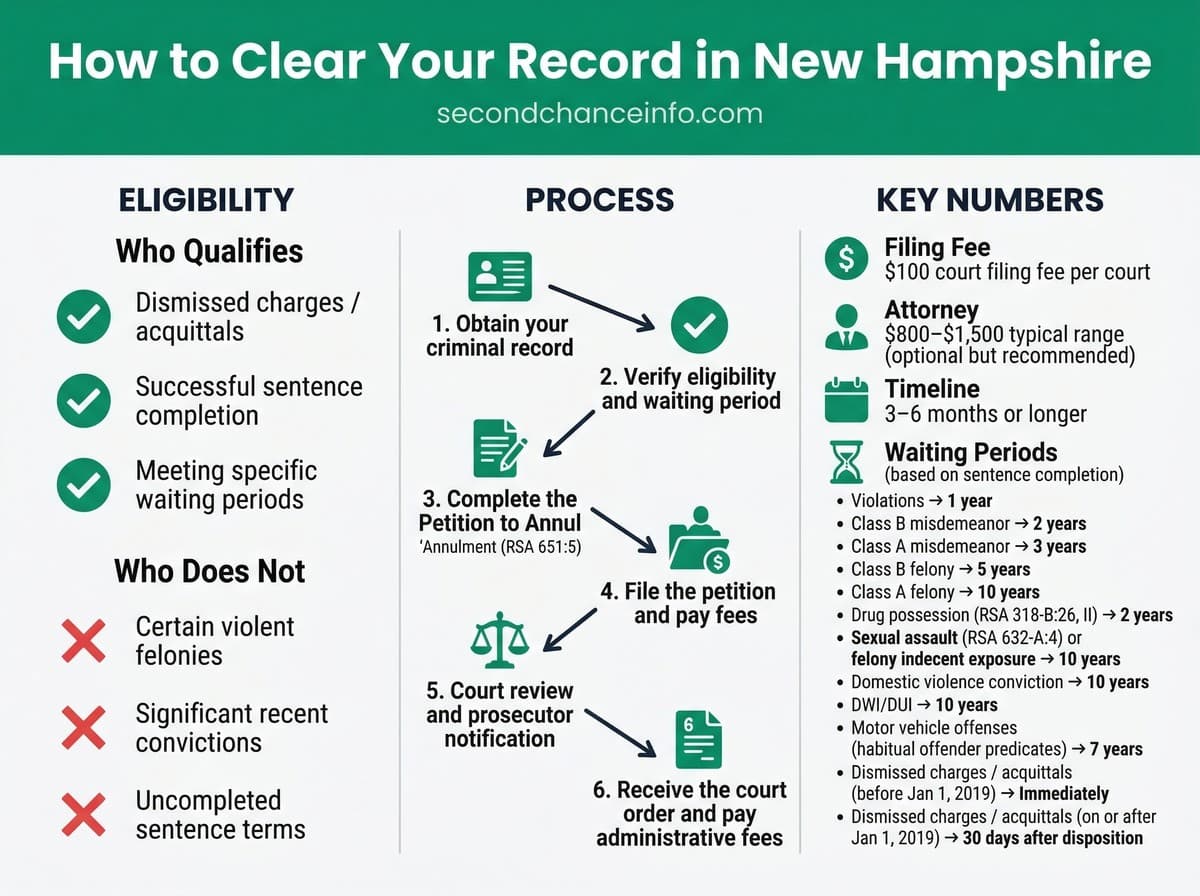
Automatic Annulment for Non-Conviction Records (RSA 651:5)
Since January 1, 2019, New Hampshire provides automatic annulment for certain non-conviction records. If criminal charges result in a not guilty finding or dismissal, the record is automatically annulled without needing to file a petition.
| Scenario | Timing and conditions |
|---|---|
| Not guilty finding (cases after Jan 1, 2019) | 30 days after the finding |
| Charges dismissed (cases after Jan 1, 2019) | 30 days after dismissal |
| Nolle prosequi / not prosecuted (cases after Jan 1, 2019) | 30 days after disposition |
| Appeal affirms acquittal or dismissal | Upon completion of appellate process |
Costs
- Filing fee
- $100 court filing fee per court
- Fee waiver
- Available for those who cannot afford the filing fee
- Attorney (optional)
- $800–$1,500 typical range (optional but recommended)
Additional costs: $25 for criminal record copy, up to $100 State Police administrative fee to remove records from state and FBI databases (waived for non-conviction records). The $100 State Police fee can cover multiple annulled convictions if petitions were filed in one court. 603 Legal Aid may offer free assistance.
Timeline
- With attorney
- 2–4 months
- Standard
- 3–6 months or longer
The process is lengthy. The court must receive reports from the Department of Corrections and law enforcement before ruling. After approval, removal from NH State Police records takes 1–2 business days, but removal from FBI records takes 2–4 additional weeks.
Effects of the relief
- ✓Person is treated in all respects as if never arrested, convicted, or sentenced
- ✓Record is sealed from public view and removed from State Police criminal history
- ✓Record is removed from the FBI criminal history database
- ✓Can legally answer 'no' to criminal history questions (employers may only ask about non-annulled records)
- ✓Removes barriers to employment, housing, education, and professional licenses
- ✓May restore state firearm rights (depending on the offense)
- ✓Court issues a certificate of annulment confirming rehabilitation
Limits of the relief
- ✗Does NOT destroy the record — law enforcement retains access for legitimate purposes
- ✗Prior conviction can still be considered for sentencing if convicted of a new crime
- ✗Prior conviction can still count toward habitual offender status
- ✗Does NOT affect federal records — federal government does not recognize NH annulments
- ✗Does NOT remove records from news archives, internet, or other public sources
- ✗Annulled records may be accessible under NH Right-to-Know law in some circumstances
- ✗Does NOT help with immigration — federal agencies retain access to records
Other Relief Options in New Hampshire
Governor's Pardon
Available only after an annulment petition has been denied. The Governor, with advice from the Executive Council, may grant a pardon. Pardons are granted very rarely. A pardon forgives the crime but does not remove the record — it becomes part of your criminal history. Apply through the NH Attorney General's office.
Old Marijuana Possession Annulment
Convictions for possession of 3/4 ounce or less of marijuana that occurred before September 2017 can be annulled with no waiting period under RSA 651:5.
Frequently Asked Questions
- How much does criminal record annulment cost in New Hampshire?
- The total government fees are up to $225: a $100 court filing fee, and up to $100 to the State Police for removing the record from state and FBI databases, plus $25 for obtaining your criminal record. Fee waivers are available for the court filing fee. If you hire an attorney, expect $800–$1,500. The State Police fee is waived for non-conviction records, and the $100 State Police fee can cover multiple convictions if petitions were filed in one court.
- How long does the annulment process take in New Hampshire?
- The process typically takes 3–6 months or longer. The court must receive investigation reports from the Department of Corrections and law enforcement before ruling. With an attorney, it may take 2–4 months. After approval, removal from NH State Police records takes 1–2 business days, but removal from the FBI database takes 2–4 additional weeks.
- Can a felony be annulled in New Hampshire?
- Yes, non-violent felonies can be annulled. Class B felonies require a 5-year waiting period after sentence completion, and Class A felonies require 10 years. However, violent felonies (murder, manslaughter, first-degree assault, sexual assault, kidnapping, robbery, class A felony arson, and child exploitation offenses), felony obstruction of justice, and offenses with extended sentences can never be annulled.
- What happens if my annulment petition is denied?
- If denied, you must wait 3 years before filing another petition for the same offense. This is why it is critical to verify that all waiting periods have fully elapsed before filing — filing even one day early results in denial and triggers the 3-year refiling restriction. After an annulment denial, you may also apply for a Governor's Pardon through the Attorney General's office.
- Does New Hampshire have automatic annulment?
- Yes, for non-conviction records. Since January 1, 2019, cases resulting in a not guilty finding, dismissal, or nolle prosequi are automatically annulled 30 days after the disposition, with no petition required. For cases disposed before January 1, 2019, you can petition for annulment of non-conviction records immediately with no waiting period.
- Can I annul a DWI in New Hampshire?
- Yes, a DWI conviction can be annulled, but the waiting period is 10 years after the completion of your sentence, including any fines, license suspension, and probation. The DWI must not involve a violent crime, and you cannot have any ineligible convictions on your record.
- Can I annul some convictions but not others?
- No. Under RSA 651:5, you cannot annul any conviction from your criminal record unless all convictions on your record are eligible for annulment. If you have even one ineligible conviction (such as a violent crime), none of your other convictions can be annulled either.
- Can I get a job after annulment in New Hampshire?
- Yes. After annulment, employers can only ask: 'Have you ever been arrested for or convicted of a crime that has not been annulled by a court?' You can legally answer 'no' regarding any annulled records. Most employers rely on State Police background checks, which will not show annulled records. However, law enforcement agencies can still access annulled records when hiring.
Take Action — Direct Links
- Download Petition to Annul Record (Form NHJB-2317-DSe)
Official New Hampshire Judicial Branch form to petition for annulment of a criminal record under RSA 651:5. File a separate petition for each charge, in the court where the charge was disposed.
- Request Your Own Criminal History Record (NH State Police)
Request a copy of your New Hampshire criminal history from the NH State Police Criminal Records Unit ($25 fee). Check 'Annulment/Expungement' as the purpose and request a 'full and confidential' record.
- Find Free Legal Help — 603 Legal Aid (NH Annulment)
603 Legal Aid provides free legal advice and representation for annulment to qualifying low-income New Hampshire residents. Call 1-800-639-5290 or apply online.
- NH Judicial Branch — Annulment Self-Help (District Division)
New Hampshire Judicial Branch self-help page covering the annulment process, required forms, fees, eligibility checklist, and step-by-step instructions.
- RSA 651:5 — Full Statute Text
Official full text of New Hampshire RSA 651:5 (annulment of criminal records) on the New Hampshire General Court website.
Related Resources on This Site
More for your state
- Pardon & ClemencyPardon & clemency in New Hampshire
- Jobs by StateJobs for felons in New Hampshire
- Voting RightsFelon voting rights in New Hampshire
- Gun RightsFelon gun rights in New Hampshire
- DUI RecoveryDUI license recovery in New Hampshire
- ProbationProbation & parole in New Hampshire
- SR22 InsuranceSR22 insurance in New Hampshire
- License ReinstatementLicense reinstatement in New Hampshire
Helpful guides
- Background ChecksHow far back do background checks go?
- ToolsReentry organizations directory
- Free Legal AidFree legal aid by state