
Louisiana (LA) — Expungement & Record Clearing
Yes, you can clear your criminal record in Louisiana through expungement under C.Cr.P. Articles 971–997. Misdemeanor convictions can be expunged after 5 years; felony convictions after 10 years — or immediately if your sentence was deferred and set aside, or you received a First Offender Pardon. Filing costs $550 (fee waivers available for low-income individuals), and the process takes 3–6 months. Since January 1, 2025, Louisiana also offers automated expungement through the Bureau of Criminal Identification and Information under Article 985.2. Crimes of violence, sex offenses, domestic abuse battery, and stalking are not eligible. Expungement removes your record from public view but does not destroy it. Below is the full guide with eligibility, step-by-step process, costs, timeline, and FAQ.
Prepare questions about a record-clearing process
Last updated:
Overview
Louisiana allows expungement of arrest records and many conviction records under C.Cr.P. Articles 971–997. Expungement removes the record from public access but does not destroy it — law enforcement retains access. Since January 1, 2025, Louisiana also offers an automated expungement process under C.Cr.P. Article 985.2, making it the first Southern state to adopt clean-slate automation. Eligible individuals can submit a request to the Louisiana Bureau of Criminal Identification and Information (BCII) for expedited processing.
Official term: Expungement (C.Cr.P. Art. 971 et seq.) — Louisiana uses "expungement" for adults and "sealing" for juvenile records. Expungement removes the record from public access but does not destroy it.
Routes and conditions to check
- ✓Arrests where charges were dismissed, not prosecuted (nolle prosequi), or resulted in acquittal (Art. 976)
- ✓Misdemeanor convictions after a 5-year conviction-free waiting period (Art. 977)
- ✓Misdemeanor convictions set aside under deferred adjudication (Art. 894(B)) — no waiting period
- ✓Felony convictions after a 10-year conviction-free waiting period (Art. 978)
- ✓Felony convictions set aside under deferred adjudication (Art. 893(E)) — no waiting period
- ✓Felony convictions eligible for a First Offender Pardon (non-violent, non-sexual offenses)
- ✓Certain controlled substance offenses with a First Offender Pardon
Exclusions and limits to check
- ✗Crimes of violence as defined in La. R.S. 14:2(B) — murder, rape, armed robbery, kidnapping, etc.
- ✗Sex offenses or crimes against minors as defined in R.S. 15:541
- ✗Domestic abuse battery (misdemeanor or felony)
- ✗Stalking (misdemeanor or felony)
- ✗Most controlled substance distribution offenses (R.S. 40:966–970) without a First Offender Pardon
- ✗Persons currently incarcerated for a felony
- ✗Persons with pending felony charges
Waiting Periods
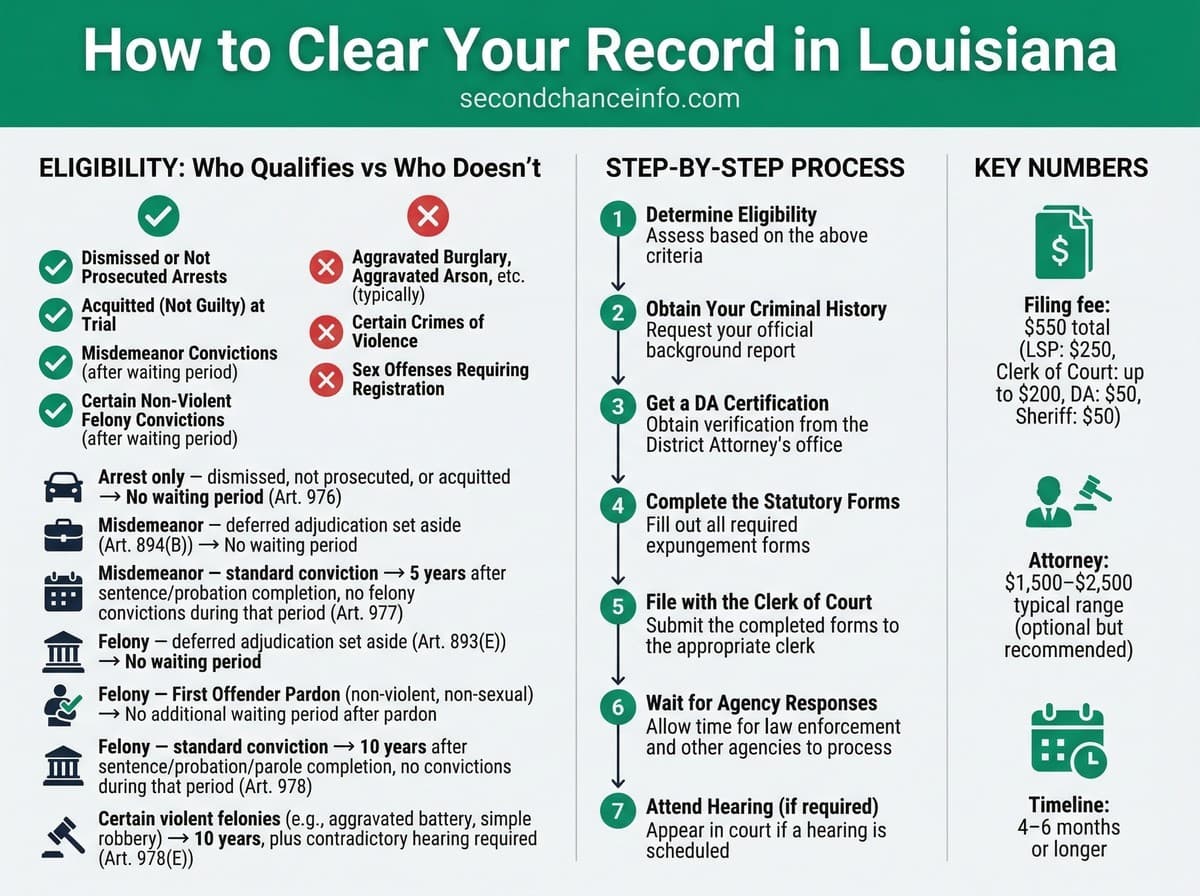
| Arrest only — dismissed, not prosecuted, or acquitted | No waiting period (Art. 976) |
| Misdemeanor — deferred adjudication set aside (Art. 894(B)) | No waiting period |
| Misdemeanor — standard conviction | 5 years after sentence/probation completion, no felony convictions during that period (Art. 977) |
| Felony — deferred adjudication set aside (Art. 893(E)) | No waiting period |
| Felony — First Offender Pardon (non-violent, non-sexual) | No additional waiting period after pardon |
| Felony — standard conviction | 10 years after sentence/probation/parole completion, no convictions during that period (Art. 978) |
| Certain violent felonies (e.g., aggravated battery, simple robbery) | 10 years, plus contradictory hearing required (Art. 978(E)) |
Step-by-Step Process
Determine eligibility
Review your criminal record to confirm you meet the statutory requirements. Use the free CLEAN JACKET app or contact the Justice and Accountability Center (JAC) at 504-273-1091 for a screening.
Obtain your criminal history
Request case minutes from the parish clerk of court and obtain a fingerprint-based background check from the Louisiana State Police (valid for 60 days). A $250 money order payable to LSP is required.
Get a DA certification
For conviction expungements, obtain a certification from the District Attorney verifying that you have no intervening convictions during the waiting period and no pending felony charges.
Complete the statutory forms
Fill out the Motion to Set Aside (Art. 987, if applicable for deferred sentences), Motion for Expungement (Art. 989), Affidavit of Response (Art. 990), proposed Order (Art. 991), and Order of Expungement (Art. 992).
File with the clerk of court
File all completed forms, the background check, and the DA certification with the clerk of court in the parish where the arrest or conviction occurred. Pay the $550 filing fee (or apply for a fee waiver if eligible).
Wait for agency responses
After filing, the State Police, arresting agency, and District Attorney have 60 days to respond. They may extend this by 30 additional days. If any agency objects, a contradictory hearing will be scheduled.
Attend hearing (if required)
If agencies object, attend the contradictory hearing before a judge. Even uncontested motions may require a brief court appearance depending on the parish.
Receive court order and certificate of compliance
If granted, obtain a certified copy of the expungement order. The Louisiana State Police will then issue a Certificate of Compliance confirming the record has been sealed, typically within 2 months.
Visual Guide
Automated Expungement (C.Cr.P. Art. 985.2)
Under C.Cr.P. Article 985.2 (effective January 1, 2025), Louisiana established an automated expungement process. Individuals can submit a request to the Louisiana Bureau of Criminal Identification and Information (BCII) with basic identifying information. If the record qualifies under Articles 976, 977, or 978, BCII must expunge it within 30 days. The system covers records dating back to January 1, 2006. Implementation is subject to state funding in the FY 2025–2026 executive budget.
| Scenario | Timing and conditions |
|---|---|
| Arrest-only records (dismissed, not prosecuted, acquitted) | Within 30 days of automated request |
| Eligible misdemeanor convictions (5-year waiting period met) | Within 30 days of automated request |
| Eligible felony convictions (10-year waiting period met) | Within 30 days of automated request |
| Deferred adjudication set aside (Art. 893/894) | Within 30 days of automated request |
Costs
- Filing fee
- $550 total (LSP: $250, Clerk of Court: up to $200, DA: $50, Sheriff: $50)
- Fee waiver
- Available via In Forma Pauperis (IFP) for those receiving federal benefits or with income below 125% of the federal poverty level; also available for human trafficking survivors, factually innocent persons, and recipients of a Governor's Gold Seal Pardon
- Attorney (optional)
- $1,500–$2,500 typical range (optional but recommended)
Filing fees are non-refundable even if the expungement is denied. DWI expungements require an additional $50 fee to the Office of Motor Vehicles. The current fee structure under C.Cr.P. Art. 983 is set to terminate August 1, 2026.
Timeline
- With attorney
- 3–4 months
- Standard
- 4–6 months or longer
The 60-day agency response period is the minimum. After the court grants the motion, the Louisiana State Police may take an additional 2 months to issue the Certificate of Compliance. Contested cases can take a year or more.
Effects of the relief
- ✓Removes the record from public background checks
- ✓Allows you to legally deny the arrest or conviction on most job and housing applications
- ✓Removes barriers to private employment and many professional licenses
- ✓May help restore firearm rights (for non-violent felonies, after 10 years and expungement, under both state and federal law)
- ✓Improves access to housing, education, and financial opportunities
- ✓Prevents the record from appearing in most commercial database searches
Limits of the relief
- ✗Does NOT destroy the record — law enforcement and criminal justice agencies retain access (Art. 973(B))
- ✗Does NOT prevent use by prosecutors for sentence enhancement in future cases
- ✗Does NOT automatically restore gun rights for violent felonies
- ✗Does NOT seal the record from certain state licensing boards specified in statute
- ✗Does NOT prevent federal agencies from accessing the record
- ✗Does NOT override sex offender registration requirements
Other Relief Options in Louisiana
First Offender Pardon (La. R.S. 15:572)
Automatically granted to first-time felony offenders upon completion of sentence. Restores civil rights (except firearm rights) but does not seal the record. Can serve as the basis for an expungement motion without the 10-year waiting period for non-violent, non-sexual offenses.
Governor's Gold Seal Pardon
Issued by the Governor upon recommendation of the Board of Pardons. Prevents the record from being used against you in future sentencing but does not seal the record from public view. A separate expungement must still be filed. Waives expungement filing fees.
Deferred Adjudication (Art. 893 / Art. 894)
A judge may defer sentencing and place the defendant on probation. Upon successful completion, the conviction is set aside and prosecution dismissed, making the record immediately eligible for expungement with no waiting period.
Human Trafficking Survivor Relief (Art. 983(H))
Survivors of human trafficking can obtain expedited, fee-free expungement of eligible arrests and convictions committed as a result of being trafficked, with DA certification.
Frequently Asked Questions
- How much does expungement cost in Louisiana?
- The total filing fee is $550, divided among the Louisiana State Police ($250), Clerk of Court (up to $200), District Attorney ($50), and Sheriff ($50). DWI expungements require an additional $50 to the Office of Motor Vehicles. If you hire an attorney, expect to pay $1,500–$2,500. Fee waivers are available for those with income below 125% of the federal poverty level or who receive federal benefits such as food stamps.
- How long does the expungement process take in Louisiana?
- The process typically takes 3 to 6 months. After filing, agencies have 60 days (extendable by 30 days) to respond. If no objections are raised, the court may grant the motion. The Louisiana State Police then takes approximately 2 months to issue a Certificate of Compliance. Contested cases or complex situations can take a year or longer.
- Can a felony be expunged in Louisiana?
- Yes, many felonies can be expunged. You must wait 10 years after completing your sentence with no new convictions, or have received a First Offender Pardon (for non-violent, non-sexual offenses). Felonies set aside under deferred adjudication (Art. 893) can be expunged immediately. However, crimes of violence, sex offenses, crimes against minors, domestic abuse battery, and most drug distribution offenses are not eligible.
- What is the automated expungement process under Article 985.2?
- Effective January 1, 2025, Louisiana allows eligible individuals to submit a request to the Bureau of Criminal Identification and Information (BCII) for automated expungement. You provide your name, date of birth, last four digits of your Social Security number, arrest date, and case number. If the record qualifies under Articles 976, 977, or 978, BCII must expunge it within 30 days. This system covers records dating back to January 1, 2006, and implementation is subject to state funding.
- Does expungement restore gun rights in Louisiana?
- It depends on the offense. For non-violent felonies, Louisiana state law restores firearm rights 10 years after sentence completion. When combined with an expungement, this may also satisfy federal law requirements, as an expunged conviction generally does not count as a conviction under federal firearms statutes. However, violent felonies and sex offenses do not qualify for firearm rights restoration through expungement alone.
- What is a First Offender Pardon, and how does it affect expungement?
- A First Offender Pardon is automatically granted to first-time felony offenders upon completion of their sentence under La. R.S. 15:572. It restores civil rights (except firearm rights) but does not seal the record. Importantly, it allows you to file for expungement without waiting the standard 10-year period, as long as the offense is not a crime of violence or sex offense.
- Can I expunge a DWI conviction in Louisiana?
- Yes, a first-offense DWI misdemeanor can be expunged after the 5-year waiting period with no felony convictions. If the DWI sentence was deferred under Article 894(B) and successfully set aside, there is no waiting period. An additional $50 fee to the Office of Motor Vehicles applies. Note that expungement of the criminal record does not automatically clear your driving record.
- What happens if an agency objects to my expungement?
- If the Louisiana State Police, the District Attorney, the arresting agency, or the Sheriff objects within the 60-day response period, the court will schedule a contradictory hearing. At the hearing, you (or your attorney) must demonstrate that you meet all statutory requirements. The judge will then decide whether to grant or deny the expungement. Having an attorney is strongly recommended for contested hearings.
Take Action — Direct Links
- Court petition/form
C.Cr.P. Art. 986 — statutory expungement forms (Motion to Set Aside, Motion for Expungement, Affidavit of Response, Orders). Parish clerk of court websites also provide downloadable versions.
- Criminal record request
Louisiana State Police — Bureau of Criminal Identification and Information (BCII). Schedule a Right to Review appointment to obtain your criminal history report.
- Free legal aid
Justice and Accountability Center of Louisiana (JAC) — free expungement screening, legal assistance, and monthly clinics in partnership with Southeast Louisiana Legal Services. Call 504-322-4050.
- Court self-help center
Louisiana Law Help — expungement self-help guide with eligibility information, fee waiver instructions, and links to parish-level self-help resource centers.
- Statute full text
La. C.Cr.P. Art. 971 et seq. — full text of Louisiana's expungement statute from the Louisiana State Legislature.
Related Resources on This Site
More for your state
- Pardon & ClemencyPardon & clemency in Louisiana
- Jobs by CityFelony friendly jobs in New Orleans, LA
- Jobs by StateJobs for felons in Louisiana
- HousingSecond chance apartments in New Orleans, LA
- Voting RightsFelon voting rights in Louisiana
- Gun RightsFelon gun rights in Louisiana
- DUI RecoveryDUI license recovery in Louisiana
- ProbationProbation & parole in Louisiana
Helpful guides
- Background ChecksHow far back do background checks go?
- ToolsReentry organizations directory
- Free Legal AidFree legal aid by state