
Illinois (IL) — Expungement & Record Clearing
Yes, you can clear your criminal record in Illinois through expungement or sealing under 20 ILCS 2630/5.2. Expungement destroys records entirely and is available for arrests without conviction and completed court supervision (2-year wait). Sealing hides records from public view and covers most misdemeanor and many non-violent felony convictions (3-year wait). Filing costs around $120–$170 (fee waivers available) and the process takes 4–6 months. DUI, domestic battery, sex offenses, and violent crimes are not eligible for sealing. Under the Clean Slate Act signed in January 2026, automatic sealing of eligible non-violent records begins January 1, 2029. Below is the full guide with eligibility, process, costs, and FAQ.
Prepare questions about a record-clearing process
Last updated:
Overview
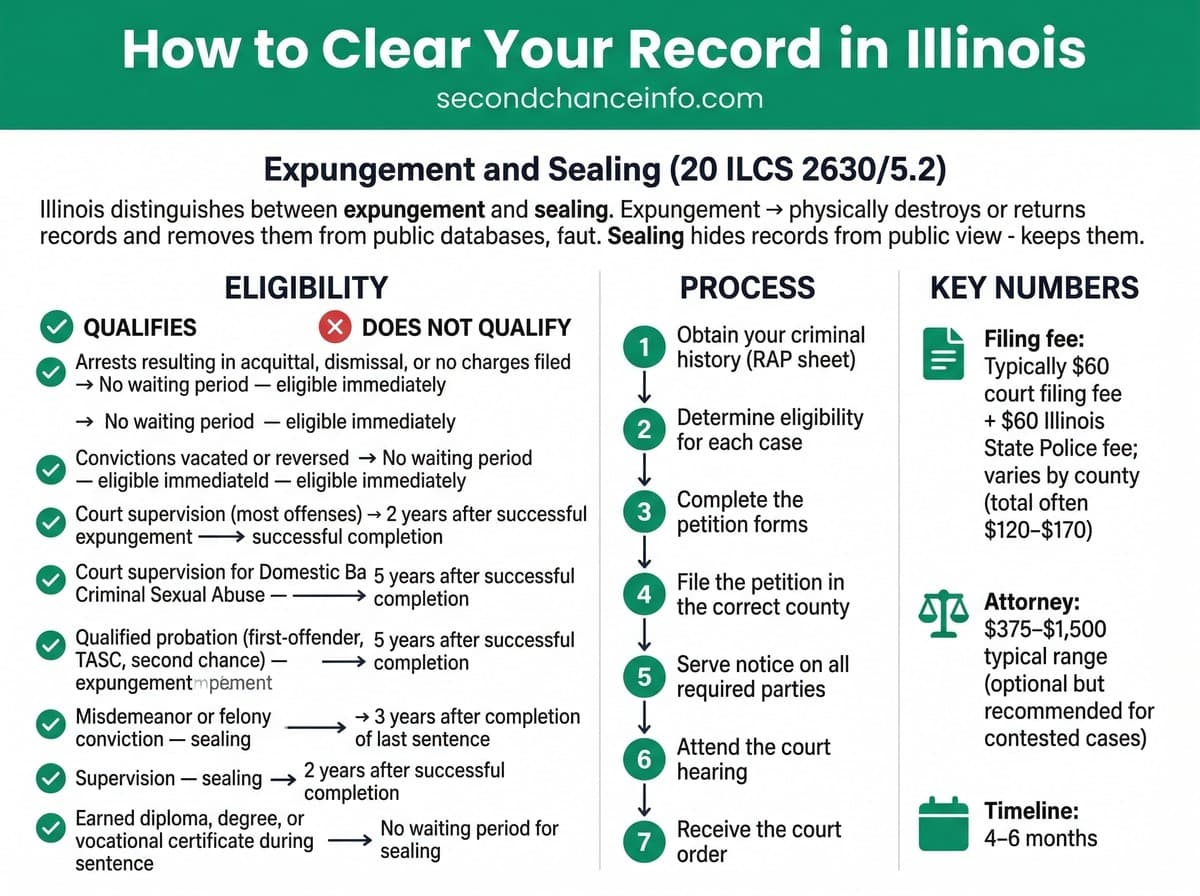
Illinois distinguishes between expungement and sealing. Expungement physically destroys or returns records and removes them from public databases. Sealing hides records from public view but keeps them accessible to law enforcement. Arrests without conviction and completed court supervision can typically be expunged, while most misdemeanor and many non-violent felony convictions can be sealed. Under the Clean Slate Act (HB 1836), signed January 16, 2026, automatic sealing of eligible non-violent records will begin January 1, 2029.
Official term: Expungement and Sealing (20 ILCS 2630/5.2) — Illinois uses both terms with distinct legal meanings. Expungement destroys the record; sealing hides it from public view but law enforcement retains access. Both are governed by the Criminal Identification Act.
Routes and conditions to check
- ✓Arrests not resulting in conviction (acquittals, dismissals, no charges filed) — eligible for expungement
- ✓Successful completion of court supervision (most offenses) — eligible for expungement after 2 years
- ✓Successful completion of qualified probation (first-offender programs: 710-1410, TASC, second chance) — eligible for expungement after 5 years
- ✓Convictions vacated or reversed — eligible for expungement
- ✓Governor's pardon with authorization for expungement
- ✓Most misdemeanor convictions — eligible for sealing after 3 years
- ✓Many non-violent Class 3 and Class 4 felony convictions — eligible for sealing after 3 years
- ✓Cannabis arrests and certain convictions under the Cannabis Regulation and Tax Act (410 ILCS 705)
Exclusions and limits to check
- ✗DUI / driving under the influence (cannot be expunged or sealed)
- ✗Reckless driving (cannot be sealed; expungement only if under 25 at sentencing)
- ✗Domestic battery (cannot be sealed; expungement of supervision only after 5 years)
- ✗Sex offenses committed against a minor (cannot be expunged or sealed)
- ✗Sex offenses requiring registration (cannot be sealed)
- ✗Violations of orders of protection (cannot be sealed)
- ✗Animal cruelty and dog fighting convictions (cannot be sealed)
- ✗Stalking and aggravated stalking (cannot be sealed)
- ✗Most Class X felonies, murder, armed robbery, and other violent offenses (cannot be sealed under the Clean Slate Act)
Waiting Periods
| Arrests resulting in acquittal, dismissal, or no charges filed | No waiting period — eligible immediately |
| Convictions vacated or reversed | No waiting period — eligible immediately |
| Court supervision (most offenses) — expungement | 2 years after successful completion |
| Court supervision for Domestic Battery or Criminal Sexual Abuse — expungement | 5 years after successful completion |
| Qualified probation (first-offender, TASC, second chance) — expungement | 5 years after successful completion |
| Misdemeanor or felony conviction — sealing | 3 years after completion of last sentence |
| Supervision — sealing | 2 years after successful completion |
| Earned diploma, degree, or vocational certificate during sentence | No waiting period for sealing |
Step-by-Step Process
Obtain your criminal history (RAP sheet)
Request your Record of Arrests and Prosecutions from the Illinois State Police (ISP). You can submit a request online or by mail. This costs approximately $20 and helps you identify which records are eligible.
Determine eligibility for each case
Review each arrest and conviction on your RAP sheet. Determine whether each case qualifies for expungement or sealing based on the outcome (acquittal, supervision, conviction), offense type, and time elapsed. The OSAD provides free eligibility worksheets.
Complete the petition forms
Fill out the approved Illinois Supreme Court forms: 'Request to Expunge & Impound and/or Seal Criminal Records.' Use the Illinois Legal Aid Online guided interview tool for help. You need a separate petition for each case unless they share the same arrest.
File the petition in the correct county
File your petition with the Circuit Clerk in the county where the case was heard. Pay the filing fee (typically $60 court filing fee + $60 ISP fee; varies by county). If you cannot afford the fee, file a fee waiver application.
Serve notice on all required parties
Serve the State's Attorney and all arresting agencies and law enforcement agencies listed on the petition. Failure to serve all required parties is a common reason for denial.
Attend the court hearing
A judge will review your petition, any objections from the State's Attorney or law enforcement, and evidence of your rehabilitation. The prosecutor does not always agree to expungement, so be prepared to present your case.
Receive the court order
If granted, the court issues an order to expunge or seal your records. Law enforcement agencies and the ISP have 60 days to carry out the order. If denied, you may be able to refile after addressing deficiencies.
Visual Guide
Automatic Record Sealing (Clean Slate Act — HB 1836)
Governor Pritzker signed the Clean Slate Act (HB 1836) on January 16, 2026, making Illinois the 13th state with automatic record sealing. Beginning January 1, 2029, eligible non-violent records will be automatically sealed without needing to file a petition. From July 1, 2026, the Illinois State Police will begin upgrading databases to identify eligible records.
| Scenario | Timing and conditions |
|---|---|
| Dismissed charges and acquittals | Automatically sealed upon final disposition (starting Jan. 1, 2029) |
| Supervision and qualified probation (successfully completed) | 2 years after completion |
| Misdemeanor and ordinance violation convictions | 2 years after sentence completion |
| Eligible non-violent felony convictions (Class 1–4) | 3 years after sentence completion |
Costs
- Filing fee
- Typically $60 court filing fee + $60 Illinois State Police fee; varies by county (total often $120–$170)
- Fee waiver
- Available — file a fee waiver application with the court if you cannot afford the fee
- Attorney (optional)
- $375–$1,500 typical range (optional but recommended for contested cases)
The OSAD Expungement & Sealing Unit provides free forms, worksheets, and guidance (866-787-1776). Some legal aid organizations offer free legal representation. Cook County has a free Expungement Advice Desk at the Daley Center.
Timeline
- With attorney
- 3–4 months
- Standard
- 4–6 months
Errors in filing (wrong courthouse, missing agencies in service, incomplete forms) can extend the timeline by several additional months. After the court grants the petition, agencies have 60 days to execute the order.
Effects of the relief
- ✓Expungement destroys records or returns them — the arrest is treated as if it never occurred
- ✓Sealing hides records from employers, landlords, and public background checks
- ✓Employers cannot ask whether you have had records expunged or sealed
- ✓You are not required to disclose sealed or expunged records on job applications
- ✓Sealed/expunged records cannot be considered for employment, licensing, or certification decisions
- ✓Records are exempt from Freedom of Information Act (FOIA) disclosure
- ✓Helps with housing applications — landlords cannot see sealed records
Limits of the relief
- ✗Sealing does NOT destroy the record — law enforcement, prosecutors, and courts retain access
- ✗Does NOT automatically restore firearm rights or FOID card eligibility (requires Governor's pardon with firearm privileges restored)
- ✗Does NOT remove sex offender registration requirements
- ✗Does NOT bind federal agencies — the FBI and DHS may still have access
- ✗Internet records and third-party websites may still display old information despite the court order
- ✗State's Attorney office records are exempt from expungement orders
- ✗Sealed felony convictions may still be visible to certain employers required by law to conduct fingerprint-based background checks (e.g., government, schools, financial institutions)
Other Relief Options in Illinois
Certificate of Relief from Disabilities
Lifts statutory bars that prevent you from obtaining professional licenses (barber, cosmetologist, funeral director, etc.) due to a conviction. Does not erase or hide the record. Filed with the circuit court under 730 ILCS 5/5-5.5-25.
Certificate of Good Conduct
Helps you qualify for jobs that your conviction would otherwise bar you from. Requires proof of good conduct for at least 1 year (misdemeanor) or 2 years (felony). Filed with the circuit court.
Governor's Pardon (Executive Clemency)
Forgives the conviction but does not erase it — you must still file for expungement separately. Can be granted with or without firearm privileges. Petitions go through the Prisoner Review Board. Very competitive: only a handful are granted each year.
Cannabis Record Expungement
Under the Cannabis Regulation and Tax Act (410 ILCS 705), certain cannabis arrests and convictions may be vacated and expunged, sometimes automatically by the State's Attorney.
Frequently Asked Questions
- What is the difference between expungement and sealing in Illinois?
- Expungement physically destroys or returns your records and removes your name from public indexes — it is as if the arrest never happened. Sealing hides your records from public view (employers, landlords, and most background checks cannot see them), but law enforcement, prosecutors, and courts retain access. Expungement is available for non-conviction outcomes (dismissals, acquittals, supervision); sealing is available for many convictions.
- How much does it cost to expunge or seal a record in Illinois?
- Filing fees vary by county but typically include a $60 court filing fee plus a $60 Illinois State Police fee, totaling around $120–$170. Fee waivers are available if you cannot afford it. If you hire an attorney, expect to pay $375–$1,500 depending on case complexity. Free help is available from the OSAD Expungement Unit (866-787-1776) and legal aid organizations.
- How long does the expungement or sealing process take in Illinois?
- The typical timeline is 4–6 months from filing to completion. With an attorney, the process may move faster (3–4 months). After the court grants your petition, law enforcement agencies have 60 days to carry out the order. Errors in the petition, wrong courthouse, or missing service on agencies can extend the process significantly.
- Can a felony be expunged or sealed in Illinois?
- Felonies generally cannot be expunged (only a Governor's pardon with expungement authorization allows that). However, many non-violent Class 3 and Class 4 felony convictions can be sealed after 3 years. Under the Clean Slate Act (effective 2029), eligible non-violent felony convictions (Class 1–4) will be automatically sealed 3 years after sentence completion. Violent felonies, sex offenses, DUI, and domestic battery cannot be sealed.
- Can a DUI be expunged or sealed in Illinois?
- No. DUI convictions and DUI court supervision cannot be expunged or sealed under Illinois law. The only exception is if DUI charges were dismissed or you were acquitted — in that case, the arrest record (not the conviction) may be expunged. DUI is also excluded from the Clean Slate Act's automatic sealing.
- What is the Illinois Clean Slate Act?
- The Clean Slate Act (HB 1836), signed by Governor Pritzker on January 16, 2026, will automate the record-sealing process for eligible non-violent records starting January 1, 2029. Approximately 1.74 million Illinoisans could benefit. Misdemeanor convictions become eligible 2 years after sentence completion; eligible felonies after 3 years. Violent crimes, sex offenses, DUI, domestic battery, and other serious offenses are excluded. The Act automates sealing only — expungement still requires a manual petition.
- Do I have to tell employers about an expunged or sealed record in Illinois?
- No. Illinois law prohibits employers from asking whether you have had records expunged or sealed. You are not required to disclose sealed or expunged records on job applications, and employers cannot use them in hiring decisions. However, sealed felony convictions may still appear in fingerprint-based background checks required for certain jobs (government, schools, financial institutions, law enforcement).
- Does expungement in Illinois restore gun rights?
- No. Expungement or sealing alone does not restore your eligibility for a Firearm Owner's Identification (FOID) card. To restore firearm privileges, you need a Governor's pardon that specifically includes 'firearm privileges restored.' Even then, the Illinois State Police must still approve your FOID application and may deny it if a federal restriction applies.
Take Action — Direct Links
- Court petition/form
Illinois Supreme Court approved expungement and sealing forms — standardized petition forms accepted in all Illinois circuit courts
- Criminal record request
Illinois State Police Bureau of Identification — request your own criminal history (RAP sheet) via fingerprint or name-based inquiry
- Free legal aid
Illinois Legal Aid Online (ILAO) — free guided interview tool that completes expungement/sealing petition forms for you, plus eligibility information
- Court self-help center
Office of the State Appellate Defender (OSAD) Expungement & Sealing Unit — free forms, eligibility worksheets, instructions, and toll-free help line (866-787-1776)
- Statute full text
20 ILCS 2630 (Criminal Identification Act) — full text on the Illinois General Assembly website, including Section 5.2 governing expungement and sealing
Related Resources on This Site
More for your state
- Pardon & ClemencyPardon & clemency in Illinois
- Jobs by CityFelony friendly jobs in Chicago, IL
- Jobs by StateJobs for felons in Illinois
- HousingSecond chance apartments in Chicago, IL
- Voting RightsFelon voting rights in Illinois
- Gun RightsFelon gun rights in Illinois
- DUI RecoveryDUI license recovery in Illinois
- ProbationProbation & parole in Illinois
Helpful guides
- Background ChecksHow far back do background checks go?
- ToolsReentry organizations directory
- Free Legal AidFree legal aid by state
Sources
- 20 ILCS 2630/5.2 — Criminal Identification Act
- OSAD Expungement & Sealing Unit
- Office of the Illinois Courts — Expungement & Sealing Forms
- Illinois Legal Aid Online — Expunging or Sealing a Criminal Record
- Governor's Office — Clean Slate Act (HB 1836)
- Cook County Clerk of the Circuit Court — Expungement (Adult)