
Mississippi (MS) — Expungement & Record Clearing
Yes, you can clear your criminal record in Mississippi through expungement under Miss. Code Ann. § 99-19-71. First-offender misdemeanors (non-traffic) can be expunged immediately after completing the sentence. One nonviolent felony conviction can be expunged five years after completing all sentence terms. Dismissed charges and acquittals can be expunged with no waiting period. The filing fee is $150, and the process typically takes 2–6 months. Crimes of violence, drug trafficking, first-degree arson, and certain other serious offenses are not eligible. Mississippi does not have automatic expungement — you must file a petition. Below is the full guide with eligibility, step-by-step process, costs, timeline, and FAQ.
Prepare questions about a record-clearing process
Last updated:
Overview
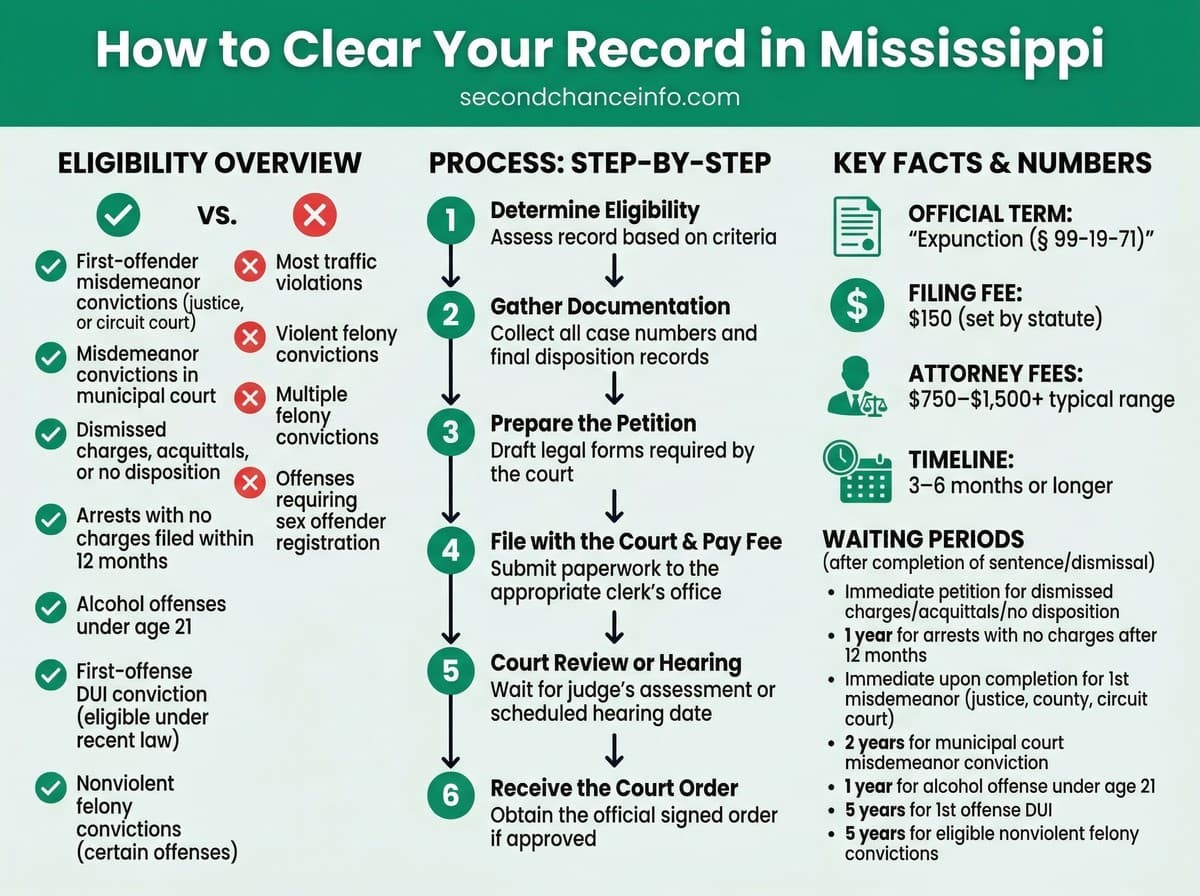
Mississippi allows expungement of certain criminal records under Miss. Code Ann. § 99-19-71. First-offender misdemeanor convictions (excluding traffic violations) can be expunged, and since the 2019 Criminal Justice Reform Act (HB 1352), most nonviolent felony convictions are also eligible — limited to one felony expungement per person. Dismissed charges, acquittals, and arrests with no disposition can be expunged with no waiting period. Mississippi also allows expungement of first-offense DUI convictions after a five-year waiting period.
Official term: Expunction (§ 99-19-71) — Mississippi uses the term "expunction" in the statute. Upon expungement, the record is removed from public databases, but the Mississippi Criminal Information Center (CIC) and district attorneys retain a confidential non-public copy for law enforcement purposes.
Routes and conditions to check
- ✓First-offender misdemeanor conviction (excluding traffic violations)
- ✓One nonviolent felony conviction, five years after completing the entire sentence (including probation, parole, fines, and court costs)
- ✓Dismissed charges, dropped charges, or cases with no disposition
- ✓Acquittals (found not guilty at trial)
- ✓First-offense DUI conviction (five years after completing the sentence, with restrictions)
- ✓Alcohol-related offense committed while under age 21 (one year after completing the sentence)
- ✓Charges resolved through pretrial diversion or drug court upon successful completion and dismissal
Exclusions and limits to check
- ✗Crimes of violence as defined in § 97-3-2 (murder, manslaughter, kidnapping, robbery, sexual battery, assault, carjacking, drive-by shooting, etc.)
- ✗Arson, first degree (§ 97-17-1 and § 97-17-3)
- ✗Trafficking in controlled substances (§ 41-29-139)
- ✗Third, fourth, or subsequent DUI offense (§ 63-11-30(2)(c) and (2)(d))
- ✗Felon in possession of a firearm (§ 97-37-5)
- ✗Failure to register as a sex offender (§ 45-33-33)
- ✗More than one felony conviction (only one felony expungement is allowed per person)
- ✗Traffic violations (not eligible for misdemeanor expungement)
Waiting Periods
| Dismissed charges, acquittals, or no disposition | No waiting period — petition immediately |
| Arrest with no charges filed within 12 months | 1 year after arrest |
| First-offender misdemeanor (justice, county, or circuit court) | Immediately upon completion of sentence |
| Misdemeanor conviction in municipal court | 2 years after completion of sentence |
| Alcohol offense committed under age 21 | 1 year after completion of sentence |
| First-offense DUI conviction | 5 years after completion of sentence |
| Felony conviction (nonviolent, eligible offenses) | 5 years after completion of all terms and conditions of sentence |
Step-by-Step Process
Determine eligibility
Confirm your conviction is eligible under § 99-19-71: first-offender misdemeanor (non-traffic), eligible nonviolent felony, dismissed case, or acquittal. Verify the applicable waiting period has passed and all fines, fees, and restitution are paid in full.
Gather documentation
Obtain a copy of your charging document, proof of disposition or sentencing order, and an account balance sheet showing a zero balance from the clerk's office where your case originated. You will also need personal identification.
Prepare the petition
Complete a Petition for Expungement and a proposed Order for Expungement. Attach the supporting documents from the clerk's office. File one petition per case.
File with the court and pay the fee
File the petition with the clerk of the court in the county where you were charged. Pay the $150 filing fee. For felony petitions, you must provide ten (10) days' written notice to the district attorney before any hearing.
Court review or hearing
The court reviews your petition. The judge may rule on the papers alone or schedule a hearing. For felony expungement, the court determines whether the applicant is rehabilitated. The judge will consider your criminal history, conduct since conviction, and rehabilitation efforts.
Receive the court order
If granted, the court enters an Order of Expunction. The order is sent to relevant law enforcement agencies and the Mississippi Department of Public Safety to remove the record from public databases. If denied, consult an attorney about refiling options.
Visual Guide
Automatic Relief in Mississippi
Mississippi does not currently have an automatic expungement law. All expungements require filing a petition with the court. However, legislative proposals (e.g., HB 497, 2025) have been introduced that would require automatic expungement of misdemeanor convictions by the Department of Public Safety seven years after completion of the sentence. As of March 2026, these proposals have not been enacted.
| Scenario | Timing and conditions |
|---|
Costs
- Filing fee
- $150 (set by statute)
- Fee waiver
- The Mississippi Center for Justice assists individuals who cannot afford fees in all 82 counties
- Attorney (optional)
- $750–$1,500+ typical range
Some attorneys offer payment plans starting at $350. The Mississippi Center for Justice and the Mississippi Volunteer Lawyers Project provide free legal assistance for eligible individuals.
Timeline
- With attorney
- 2–4 months
- Standard
- 3–6 months or longer
Timeline varies significantly by county, court backlog, and case complexity. Felony petitions that require a hearing generally take longer than misdemeanor or dismissal petitions.
Effects of the relief
- ✓Removes the conviction or arrest from all public criminal records and databases
- ✓Expunged record will not appear on most background checks
- ✓Allows you to legally deny being arrested or convicted in most situations
- ✓Can help with employment, housing, and loan applications
- ✓Can assist in obtaining professional licenses (record will not appear on most licensing board background checks)
- ✓Relevant law enforcement agencies and the Department of Public Safety are notified to remove the record
Limits of the relief
- ✗Does NOT destroy the record — the Mississippi Criminal Information Center (CIC) and district attorneys retain a confidential non-public copy
- ✗Does NOT prevent employers from asking whether you have an order of expunction entered
- ✗Does NOT eliminate the need to disclose when applying for law enforcement positions or the Mississippi National Guard
- ✗Does NOT eliminate the need to disclose when applying for certain professional licenses that specifically require it
- ✗Does NOT restore firearm rights for felony convictions (requires a Governor's Pardon)
- ✗Does NOT remove the obligation to register as a sex offender
- ✗Prior DUI convictions still count for enhancement purposes even if expunged
Other Relief Options in Mississippi
Governor's Pardon
Available 7 years after completion of sentence. Applicants must publish a notice in the newspaper 30 days before submitting the application to the Governor. A full pardon restores civil rights, including firearm rights and the right to vote and hold public office.
Pretrial Diversion / Intervention (PTI)
Allows eligible defendants to avoid a conviction by completing a court-supervised program. Upon successful completion, the case is dismissed and the individual may petition for expungement of the arrest and charge under § 99-15-123.
Drug Court
Court-supervised treatment program for substance abuse offenses. Successful completion results in discharge from probation, and the defendant may be eligible for expungement of the felony arrest and conviction.
Nonadjudication
For certain offenses, the court may withhold adjudication of guilt. Upon successful completion of the court-imposed conditions, the charge is dismissed, and the individual may petition for expungement.
Frequently Asked Questions
- How much does expungement cost in Mississippi?
- The court filing fee is $150, as set by statute. If you hire an attorney, expect to pay $750–$1,500 or more depending on the complexity of your case. Some attorneys offer payment plans. The Mississippi Center for Justice provides free assistance in all 82 counties for those who cannot afford the fees.
- Can a felony be expunged in Mississippi?
- Yes, but only one nonviolent felony conviction can be expunged per person. You must wait five years after completing your entire sentence (including probation, parole, and payment of all fines and costs). Felonies classified as crimes of violence, first-degree arson, drug trafficking, third or subsequent DUI, felon in possession of a firearm, and failure to register as a sex offender are not eligible.
- How long does the Mississippi expungement process take?
- The process typically takes 2–6 months depending on whether you have an attorney, the county, court backlog, and case complexity. Felony petitions requiring a hearing generally take longer. The waiting period before you can file (e.g., 5 years for felonies) is separate from the court processing time.
- Can I expunge a DUI in Mississippi?
- A first-offense DUI conviction can be expunged five years after completing the sentence, provided you meet all other eligibility requirements. However, you are not eligible if you had a commercial driver's license, refused a blood or breath test, had a BAC of .16% or above, or have pending DUI charges. Third and subsequent DUI offenses cannot be expunged.
- Do I have to disclose an expunged record to employers in Mississippi?
- In most cases you can legally deny having been arrested or convicted. However, Mississippi law allows employers to ask whether you have "an order of expunction entered." You must also disclose expunged records when applying for law enforcement positions, the Mississippi National Guard, and certain professional licenses that specifically require it.
- Can dismissed charges be expunged in Mississippi?
- Yes. Under § 99-19-71, if charges were dismissed, dropped, or you were found not guilty at trial, you can petition the court for expungement with no waiting period. There is no limit on the number of dismissed cases you can expunge. If no charges were filed after an arrest, you must wait one year before petitioning.
- Does Mississippi have automatic expungement?
- No. As of March 2026, Mississippi does not have automatic expungement. All expungements require filing a petition with the court, paying the $150 fee, and receiving a court order. Legislative proposals for automatic expungement have been introduced but not enacted.
- Does expungement restore gun rights in Mississippi?
- Expungement alone does not restore firearm rights for felony convictions. To restore gun rights, you would need a Governor's Pardon (available 7 years after completing your sentence) or a separate court order. Misdemeanor expungement generally does not affect firearm rights unless the original conviction triggered a firearms disability.
Take Action — Direct Links
- Expungement Petition Forms (4th District DA)
Downloadable petition forms for expungement of dismissed cases and criminal convictions, with step-by-step instructions from the Mississippi 4th District District Attorney's office.
- Request Your Criminal Background Check (Mississippi DPS)
Request your own criminal background check from the Mississippi Department of Public Safety Criminal Information Center using the Release Background Authorization Form.
- Mississippi Center for Justice — Free Expungement Help
Free expungement petition preparation in all 82 Mississippi counties from the Mississippi Center for Justice. Contact expungements@mscenterforjustice.org.
- Mississippi Volunteer Lawyers Project — Expungement Clinics
Free pro bono legal assistance for felony and misdemeanor expungement matters for Mississippians of limited means through the Mississippi Volunteer Lawyers Project.
- Miss. Code Ann. § 99-19-71 — Full Statute Text
Official full text of Mississippi Code § 99-19-71 on Justia, covering expunction of misdemeanor and felony convictions, dismissed cases, and acquittals.
Related Resources on This Site
More for your state
- Pardon & ClemencyPardon & clemency in Mississippi
- Jobs by CityFelony friendly jobs in Jackson, MS
- Jobs by StateJobs for felons in Mississippi
- HousingSecond chance apartments in Jackson, MS
- Voting RightsFelon voting rights in Mississippi
- Gun RightsFelon gun rights in Mississippi
- DUI RecoveryDUI license recovery in Mississippi
- ProbationProbation & parole in Mississippi
Helpful guides
- Background ChecksHow far back do background checks go?
- ToolsReentry organizations directory
- Free Legal AidFree legal aid by state