
Massachusetts (MA) — Expungement & Record Clearing
Massachusetts offers two paths to clear your criminal record: sealing and expungement. Sealing (the more common option) hides your record from most background checks after a 3-year wait for misdemeanors or 7 years for felonies — and there is no filing fee. Expungement permanently destroys the record but is limited to offenses committed before age 21 (or records created by error, identity theft, or decriminalized conduct). Acquittals are automatically sealed. After sealing, you can legally answer “no record” on job and housing applications. Firearms offenses and crimes against public justice can never be sealed. Below is the full guide with eligibility, step-by-step process, costs, timeline, and FAQ for both sealing and expungement in Massachusetts.
Prepare questions about a record-clearing process
Last updated:
Overview
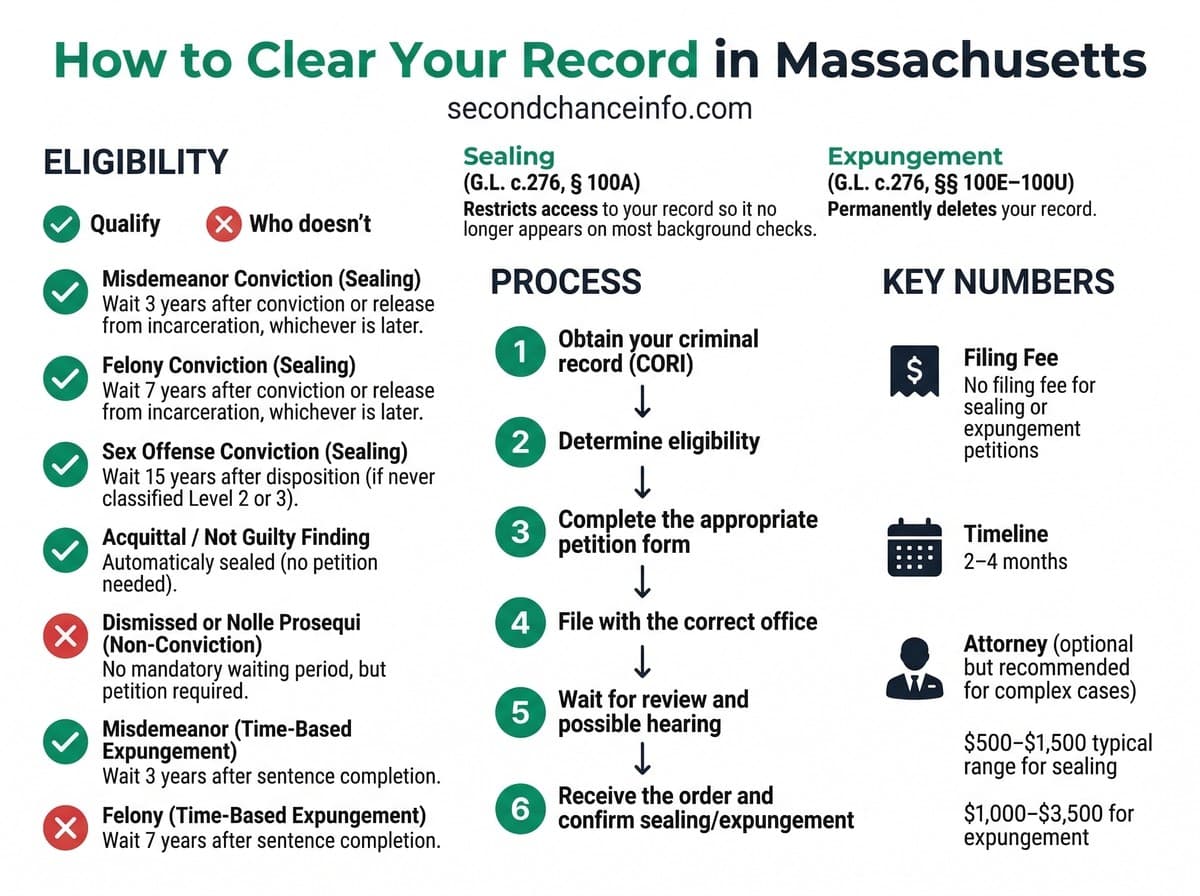
Massachusetts offers two distinct forms of criminal record relief: sealing and expungement. Sealing (G.L. c.276, § 100A) restricts access to the record so it no longer appears on most background checks, but the record still exists and remains available to law enforcement. Expungement (G.L. c.276, §§ 100E–100U), created by the Criminal Justice Reform Act of 2018, permanently destroys the record. Sealing is available to most people after waiting periods; expungement has strict eligibility requirements and is granted in limited circumstances.
Official term: Sealing (G.L. c.276, § 100A) / Expungement (G.L. c.276, §§ 100E–100U) — Massachusetts treats sealing and expungement as separate processes. Sealing hides the record from public view; expungement permanently destroys it. Most people will pursue sealing, as expungement eligibility is very narrow.
Routes and conditions to check
- ✓Misdemeanor convictions: sealable 3 years after conviction or release from incarceration, whichever is later
- ✓Felony convictions: sealable 7 years after conviction or release from incarceration, whichever is later
- ✓Non-convictions (not guilty, dismissed, nolle prosequi): sealable with no waiting period for acquittals (automatically sealed); dismissed/nol prossed cases require a petition
- ✓Resisting arrest convictions (specifically carved out as sealable)
- ✓Sex offenses: sealable 15 years after disposition if never classified as Level 2 or Level 3 sex offender
- ✓Expungement (time-based): offenses committed before age 21, maximum 2 records, 3-year wait (misdemeanor) or 7-year wait (felony) after sentence completion
- ✓Expungement (non-time-based): records created by false identification, identity theft, decriminalized offenses (e.g., marijuana), law enforcement or court error, or fraud on the court
Exclusions and limits to check
- ✗Firearms offenses (G.L. c.140, §§ 121–131H) — never sealable
- ✗Crimes against public justice: witness intimidation, bribery, perjury (G.L. c.268 and c.268A, except resisting arrest) — never sealable
- ✗Level 2 or Level 3 registered sex offenders — sex offenses never sealable
- ✗Expungement: offenses involving death or serious bodily injury
- ✗Expungement: offenses committed while armed with a dangerous weapon
- ✗Expungement: sex offenses or offenses requiring sex offender registration
- ✗Expungement: OUI/DUI convictions
- ✗Expungement: domestic violence (assault/battery on household member)
- ✗Expungement: restraining or harassment prevention order violations
- ✗Expungement: felony offenses under G.L. c.265 (crimes against the person)
- ✗Expungement: offenses against elderly or disabled persons
Waiting Periods
| Misdemeanor conviction (sealing) | 3 years after conviction or release from incarceration, whichever is later |
| Felony conviction (sealing) | 7 years after conviction or release from incarceration, whichever is later |
| Sex offense conviction (sealing) | 15 years after disposition (if never classified Level 2 or 3) |
| Acquittal / not guilty finding | Automatically sealed (no petition needed) |
| Dismissed or nolle prosequi (non-conviction) | No mandatory waiting period, but petition required |
| Misdemeanor (time-based expungement) | 3 years after sentence completion |
| Felony (time-based expungement) | 7 years after sentence completion |
Step-by-Step Process
Obtain your criminal record (CORI)
Request a copy of your Criminal Offender Record Information (CORI) from the Department of Criminal Justice Information Services (DCJIS). The fee is $25 by mail (fee waiver available with Affidavit of Indigency). You can also request it online through iCORI.
Determine eligibility
Review your CORI to identify which records are eligible for sealing or expungement. Confirm that the required waiting period has passed and that the offense is not in a never-sealable category (firearms offenses, crimes against public justice).
Complete the appropriate petition form
For conviction sealing, use the Petition to Seal Conviction Records form. For non-conviction sealing (dismissals/nolle prosequi), use the Petition to Seal Criminal Records for Nolle Prosequi or Dismissal form. For expungement, use the Time-Based Petition to Expunge form or the General Petition for Expungement form.
File with the correct office
For conviction sealing: mail the petition to the Commissioner of Probation at One Ashburton Place, Room 405, Boston, MA 02108. For non-conviction sealing in District Court: file at the clerk’s office where the case originated. For expungement: mail to the Commissioner of Probation. There is no filing fee for sealing or expungement.
Wait for review and possible hearing
For administrative sealing of convictions, Probation processes the request without a hearing if waiting periods are met. For judicial sealing (non-convictions), a judge reviews and may hold a hearing. For expungement, the Commissioner reviews within 60 days, then notifies the District Attorney, who has 65 days to respond. If the DA objects, a court hearing is held within 21 days.
Receive the order and confirm sealing/expungement
If approved, the court clerk provides signed orders to the Probation department. Records are removed from your CORI within approximately 30 days. For expungement, the record is permanently destroyed — save any copies you need before the order takes effect.
Visual Guide
Automatic Sealing of Non-Conviction Records
Massachusetts provides limited automatic sealing. Under a 2023 Supreme Judicial Court ruling, acquittals (not guilty findings), no-bill grand jury returns, and no probable cause findings must be automatically sealed by Probation without a petition. Dismissed and nolle prosequi cases are not automatically sealed and still require a petition. As of 2025, proposed legislation would expand automatic sealing to convictions that meet the waiting period, but this has not yet been enacted.
| Scenario | Timing and conditions |
|---|---|
| Acquittal (not guilty verdict) | Immediately and automatically sealed |
| Grand jury no-bill | Immediately and automatically sealed |
| Finding of no probable cause | Immediately and automatically sealed |
| Dismissed charges | Petition required (no mandatory waiting period) |
| Nolle prosequi | Petition required (no mandatory waiting period) |
Costs
- Filing fee
- No filing fee for sealing or expungement petitions
- Fee waiver
- CORI copy costs $25 (waived with Affidavit of Indigency)
- Attorney (optional)
- $500–$1,500 typical range for sealing; $1,000–$3,500 for expungement (optional but recommended for complex cases)
Greater Boston Legal Services (GBLS) and other legal aid organizations provide free assistance with CORI sealing for eligible individuals.
Timeline
- With attorney
- 2–3 months
- Standard
- 2–4 months
Administrative sealing of convictions is faster (often a few weeks). Judicial sealing and expungement take longer due to hearings. After approval, records are updated within approximately 30 days.
Effects of the relief
- ✓Sealed records do not appear on standard CORI background checks
- ✓You can legally answer “no record” to questions about criminal history on job, housing, and license applications
- ✓Sealed records cannot disqualify you from public employment, housing, or professional/occupational licenses
- ✓Sealed records cannot be used as evidence in most court proceedings
- ✓Expunged records are permanently destroyed and removed from all state databases
- ✓After expungement, you cannot be prosecuted for perjury or false statements for denying the record existed
Limits of the relief
- ✗Sealing does NOT destroy the record — law enforcement, courts, and criminal justice agencies retain access
- ✗Sealed records are still visible to firearms licensing authorities (but cannot be sole basis to deny a license)
- ✗Sealed records may still be accessible for employment involving vulnerable populations (schools, nursing homes)
- ✗Sealing does NOT help with federal background checks or immigration proceedings — sealed records may still appear
- ✗Non-citizen individuals and their attorneys cannot access sealed records for immigration defense purposes
- ✗Sealed records can still be used for sentencing enhancement in subsequent criminal cases
- ✗Sealing does NOT automatically restore firearm rights
Other Relief Options in Massachusetts
Governor’s Pardon (Executive Clemency)
Filed through the Parole Board acting as the Advisory Board of Pardons. The Board investigates and recommends to the Governor, who may grant a pardon with approval of the Governor’s Council. Removes or reduces barriers caused by a criminal record. Can restore right to hold public office and serve on a jury.
Commutation of Sentence
An extraordinary remedy granted by the Governor when no other relief is available. Reduces or modifies a sentence but does not erase the conviction. Filed through the same Advisory Board of Pardons process.
Marijuana Offense Expungement
Under G.L. c.276, § 100K¼, courts must expunge records of marijuana offenses that have been decriminalized within 30 days of a petition. A separate Petition for Expungement of Marijuana Offenses form is available.
Frequently Asked Questions
- What is the difference between sealing and expungement in Massachusetts?
- Sealing restricts access to your criminal record so it no longer appears on most background checks, but the record still exists and remains available to law enforcement. Expungement permanently destroys the record as if it never existed. Sealing is available to most people after waiting periods (3 years for misdemeanors, 7 years for felonies). Expungement has much stricter requirements — generally limited to offenses committed before age 21, records created by error or identity theft, or decriminalized offenses.
- How much does it cost to seal or expunge a record in Massachusetts?
- There is no filing fee for sealing or expungement petitions. Obtaining a copy of your CORI costs $25, but this fee can be waived with an Affidavit of Indigency. If you hire an attorney, expect to pay $500–$1,500 for sealing or $1,000–$3,500 for expungement. Legal aid organizations like Greater Boston Legal Services (GBLS) offer free assistance.
- How long does it take to seal a criminal record in Massachusetts?
- Administrative sealing of conviction records (filed by mail with the Commissioner of Probation) can be processed in a few weeks if waiting periods are met. Judicial sealing of non-convictions may take 2–4 months due to hearings. After a sealing order is granted, your CORI is updated within approximately 30 days.
- Can I seal a felony in Massachusetts?
- Yes. Most felony convictions can be sealed 7 years after the conviction or release from incarceration, whichever is later. However, firearms offenses (G.L. c.140, §§ 121–131H) and crimes against public justice (G.L. c.268, c.268A) can never be sealed. Sex offenses require a 15-year wait and are never sealable if you were classified as a Level 2 or Level 3 sex offender.
- Who can still see my sealed record in Massachusetts?
- Law enforcement agencies, courts, probation, District Attorneys, and firearms licensing authorities retain access to sealed records. Employers conducting background checks for positions involving vulnerable populations (schools, nursing homes) may also see certain sealed information. Federal agencies, including immigration authorities, are not bound by state sealing orders.
- Can I answer ‘no record’ on job applications after sealing?
- Yes. Under Massachusetts law, if your record is sealed, you may legally answer “no record” to any question about prior arrests, criminal court appearances, or convictions with respect to the sealed charges. Employers, landlords, and licensing boards cannot hold sealed records against you.
- Am I eligible for expungement in Massachusetts?
- Time-based expungement is limited to offenses committed before your 21st birthday, with a maximum of 2 records. You must wait 3 years (misdemeanor) or 7 years (felony) after sentence completion. The offense cannot involve death, serious bodily injury, weapons, sex offenses, OUI, domestic violence, or felonies under G.L. c.265. Separately, non-time-based expungement is available regardless of age if the record resulted from identity theft, a decriminalized offense, or law enforcement/court error.
- Are acquittals automatically sealed in Massachusetts?
- Yes. Following a 2023 Supreme Judicial Court ruling, records of acquittals (not guilty findings), grand jury no-bills, and no probable cause findings must be automatically sealed by Probation without any petition. However, dismissals and nolle prosequi cases are not automatically sealed and still require a petition.
Take Action — Direct Links
- Download Petition to Seal Conviction Records
Official Massachusetts petition form to seal criminal conviction records, filed by mail with the Commissioner of Probation.
- Request Your Criminal Record (CORI/iCORI)
Request your personal Criminal Offender Record Information (CORI) online through iCORI or by mail ($25 fee, waiver available for low-income individuals).
- Find Free Legal Help (Greater Boston Legal Services)
Greater Boston Legal Services CORI and record sealing self-help page with guides, forms, and information on free legal assistance for sealing and expungement.
- Massachusetts Courts Self-Help: Seal Your Record
Mass.gov step-by-step guide to sealing your criminal record, including eligibility, required forms, and filing instructions.
- G.L. c.276 § 100A — Full Statute Text
Official full text of Massachusetts General Laws Chapter 276, Section 100A (sealing of criminal records) on the Massachusetts Legislature website.
Related Resources on This Site
More for your state
- Pardon & ClemencyPardon & clemency in Massachusetts
- Jobs by CityFelony friendly jobs in Boston, MA
- Jobs by StateJobs for felons in Massachusetts
- HousingSecond chance apartments in Boston, MA
- Voting RightsFelon voting rights in Massachusetts
- Gun RightsFelon gun rights in Massachusetts
- DUI RecoveryDUI license recovery in Massachusetts
- ProbationProbation & parole in Massachusetts
Helpful guides
- Background ChecksHow far back do background checks go?
- ToolsReentry organizations directory
- Free Legal AidFree legal aid by state
Sources
- Mass. General Laws c.276 § 100A (Sealing)
- Mass. General Laws c.276 §§ 100E–100U (Expungement)
- Mass.gov — Seal Your Criminal Record
- Mass.gov — Expunge Your Criminal Record
- Mass.gov — Find Out If You Can Seal Your Criminal Record
- Mass.gov — Find Out If You Can Expunge Your Criminal Record
- Greater Boston Legal Services — Know Your CORI Rights (2024)
- Boston Bar Association — Sealing and Expungement in Massachusetts