
Arkansas (AR) — Expungement & Record Clearing
Yes, you can seal your criminal record in Arkansas under the Comprehensive Criminal Record Sealing Act of 2013 (Ark. Code Ann. § 16-90-1401 et seq.). Most misdemeanor convictions are eligible immediately after completing your sentence, and many felony convictions (nonviolent Class C/D felonies and Class A/B drug felonies) qualify as well. There is no filing fee. The process typically takes 1–6 months. Once sealed, you may legally state the conduct did not occur, and the record will not appear on most background checks. DWI convictions require a 10-year wait. Class Y, Class A/B (non-drug), and violent felonies are not eligible. Sealing does not restore gun rights — that requires a Governor’s Pardon. Below is the full guide with eligibility, step-by-step process, costs, timeline, and FAQ.
Prepare questions about a record-clearing process
Last updated:
Overview
Arkansas uses "sealing" rather than expungement for most criminal records. Under the Comprehensive Criminal Record Sealing Act of 2013 (Ark. Code Ann. § 16-90-1401 et seq.), eligible misdemeanor and certain felony convictions can be sealed after completion of sentence. Once sealed, the person may legally state that the underlying conduct did not occur. Arkansas does not have automatic sealing for adult records — a petition must be filed with the court.
Official term: Sealing (Comprehensive Criminal Record Sealing Act of 2013) — While many people refer to the process as "expungement," Arkansas law technically uses "sealing." The sealed record is not destroyed — it is moved to a private area within the clerk's office and removed from public databases.
Routes and conditions to check
- ✓Most misdemeanor convictions (eligible immediately after sentence completion)
- ✓Nonviolent Class C and D felonies (eligible immediately after sentence completion)
- ✓Class A and B drug felony convictions (eligible immediately after sentence completion)
- ✓Unclassified felonies with a maximum sentence of less than 10 years
- ✓Violent Class C and D felonies (eligible 5 years after sentence completion)
- ✓Certain misdemeanors with a 5-year wait: negligent homicide, third-degree battery, indecent exposure, public sexual indecency, fourth-degree sexual assault, third-degree domestic battering
- ✓Misdemeanor DWI convictions (eligible 10 years after sentence completion)
- ✓Non-conviction records: acquittals, dismissals, and dropped charges (eligible immediately)
- ✓Nolle prosequi or failure to file charges (eligible 1 year after arrest)
- ✓First-time felony offenders who completed deferred adjudication under the First Offender Act (§ 16-93-303)
- ✓Prostitution convictions stemming from human trafficking victimization (eligible anytime)
- ✓Non-violent felonies committed before age 18
Exclusions and limits to check
- ✗Class Y felonies
- ✗Class A felonies (except drug offenses)
- ✗Class B felonies (except drug offenses)
- ✗Felony manslaughter
- ✗Felony sex offenses
- ✗Felonies involving violence (Class A and B)
- ✗Unclassified felonies with a maximum sentence of 10 or more years
- ✗Motor vehicle felonies committed by commercial driver's license holders
- ✗Persons required to register as sex offenders
- ✗Persons with felony charges currently pending in any state or federal court
- ✗Persons who already have more than one prior sealed felony conviction
Waiting Periods
| Most misdemeanor convictions | Immediately upon completion of sentence |
| Negligent homicide, 3rd-degree battery, indecent exposure, public sexual indecency, 4th-degree sexual assault, 3rd-degree domestic battering | 5 years after completion of sentence |
| Misdemeanor DWI/BWI (driving or boating while intoxicated) | 10 years after completion of sentence |
| Nonviolent Class C and D felonies | Immediately upon completion of sentence |
| Class A and B drug felonies | Immediately upon completion of sentence |
| Violent Class C and D felonies | 5 years after completion of sentence |
| Acquittal, dismissal, or dropped charges | Immediately |
| Nolle prosequi or no charges filed | 1 year after arrest |
| First Offender Act (§ 16-93-303) deferred adjudication | Upon successful completion of probation and case dismissal |
Step-by-Step Process
Gather required documents
Obtain your Judgment and Commitment Order from the court clerk (small fee may apply), an ACIC background check with your arrest tracking number and SID number, and proof of sentence completion (receipt of fines paid or probation completion letter).
Complete the uniform Petition to Seal
Download the uniform Petition to Seal and Order to Seal forms from the Arkansas Department of Public Safety (ACIC) website. The petition must include a sworn statement about pending felony charges and sex offender registration status. Forms are available in English and Spanish.
File the petition with the court
File the completed Petition to Seal in the circuit or district court in the county where you were convicted. There is no filing fee as of July 2019 under Act 680.
Serve the prosecuting attorney
Provide a copy of the filed petition and order to the prosecuting attorney. The prosecutor then has 30 days (for misdemeanors) to file any objections.
Wait for the court's decision
For misdemeanors, if no objection is filed within 30 days, the court may grant the petition without a hearing. For felonies, the court must wait 90 days before the judge can sign the order, unless the prosecutor provides a written letter of no objection. If the prosecutor objects, a hearing will be scheduled.
Receive the order to seal
If granted, the clerk sends copies of the order to the prosecutor, arresting agency, ACIC, and the state courts office. Court records are moved to a separate, private area within the clerk's office and removed from public databases.
Visual Guide
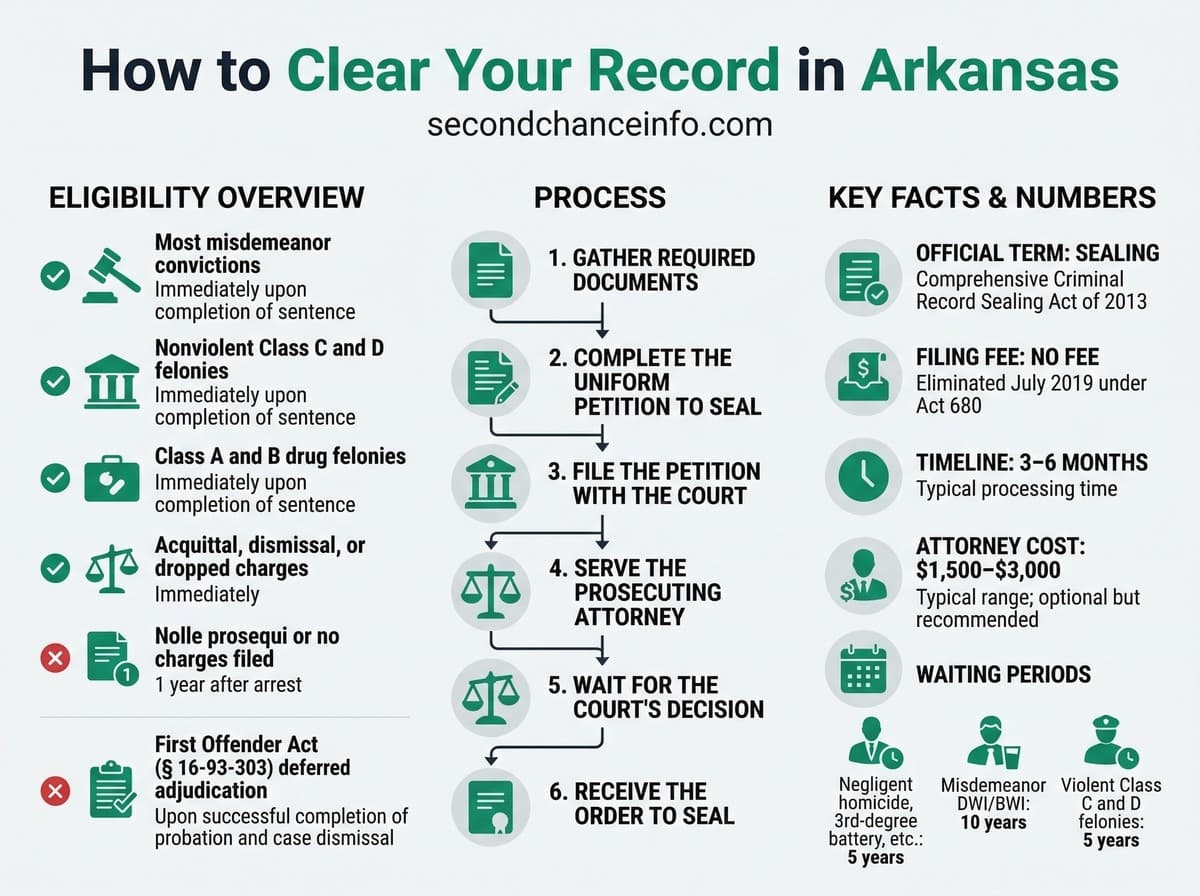
Automatic & Alternative Record Relief
Arkansas does not have automatic record sealing for adult criminal records. All sealing requires the individual to file a petition with the court. However, juvenile records are automatically expunged when the individual turns 21. The First Offender Act (§ 16-93-303) provides an alternative path where first-time felony offenders who complete deferred adjudication can have their case dismissed and records sealed.
| Scenario | Timing and conditions |
|---|---|
| Juvenile delinquency records | Automatically expunged at age 21 |
| First Offender Act (§ 16-93-303) deferred adjudication | Upon successful completion of probation |
| All other adult records | Must file a petition — no automatic sealing |
Costs
- Filing fee
- No filing fee (eliminated in July 2019 under Act 680)
- Fee waiver
- Not applicable — there is no filing fee to waive
- Attorney (optional)
- $1,500–$3,000 typical range (optional but recommended for complex cases)
You may need to pay a small fee (approximately $5) for a copy of your Judgment and Commitment Order from the court clerk. Legal Aid of Arkansas and the Center for Arkansas Legal Services offer free assistance through their Clean Slate Program for qualifying low-income individuals.
Timeline
- With attorney
- 1–3 months
- Standard
- 3–6 months
For misdemeanors without prosecutor objection, sealing can be granted in as little as 30 days. For felonies, there is a mandatory 90-day waiting period before the judge can sign the order (unless the prosecutor provides a no-objection letter). If the prosecutor objects, a hearing adds additional time depending on the county's caseload.
Effects of the relief
- ✓Records are removed from public court databases and most background checks
- ✓You may legally state that the underlying conduct did not occur
- ✓You can answer 'no' to criminal history questions on most job and housing applications
- ✓Improved access to employment, housing, and educational opportunities
- ✓Sealed records will not appear on most Arkansas State Police background checks
Limits of the relief
- ✗Does NOT restore firearm rights for felony convictions (requires a Governor's Pardon)
- ✗Does NOT prevent access by courts, law enforcement, or prosecutors in future proceedings
- ✗Does NOT prevent access by employers in law enforcement, education, childcare, or nursing home positions
- ✗Does NOT prevent the Arkansas Crime Information Center (ACIC) from retaining the record
- ✗Does NOT automatically restore voting rights (requires separate process)
- ✗Prior sealed convictions still count toward the limit of two sealed felonies
- ✗Commercial driver's license holders cannot seal traffic-related convictions
Other Relief Options in Arkansas
Governor's Pardon
A pardon from the Governor can remove conviction-related barriers to licensing and employment. Sealing follows automatically upon receipt of a pardon for most offenses. A pardon is the only way to restore firearm rights for felony convictions. Applications are processed by the Post-Prison Transfer Board at monthly hearings. Approximately 100 out of 400–500 annual applications are granted.
First Offender Act (§ 16-93-303)
First-time felony offenders who plead guilty or nolo contendere may receive deferred adjudication. After successfully completing probation, the case is dismissed without a conviction and the record may be sealed. Excludes serious violent felonies and offenses requiring sex offender registration.
Restoration of Citizenship
Through executive clemency, the Governor can restore the right to vote and hold elected office. A separate 'special restoration of citizenship' can restore firearm rights.
Commutation of Sentence
The Governor may reduce a sentence through executive clemency. This does not seal or expunge the record but may be a path toward earlier eligibility for pardon or sealing.
Frequently Asked Questions
- How much does it cost to seal a record in Arkansas?
- There is no filing fee to petition for record sealing in Arkansas — the fee was eliminated in July 2019 under Act 680. You may pay a small fee (around $5) for a copy of your Judgment and Commitment Order. If you hire an attorney, expect to pay $1,500–$3,000 depending on complexity. Legal Aid of Arkansas offers free assistance to qualifying low-income individuals through their Clean Slate Program.
- How long does it take to seal a record in Arkansas?
- For misdemeanors, if the prosecutor does not object within 30 days, the court may grant your petition without a hearing. For felonies, the court must wait 90 days before the judge can sign the order, unless the prosecutor provides a written letter of no objection. Overall, the process typically takes 1–6 months depending on whether objections are filed and the county's caseload.
- Can a felony be sealed in Arkansas?
- Yes, but only certain felonies. Nonviolent Class C and D felonies, Class A and B drug felonies, and unclassified felonies with a maximum sentence under 10 years are eligible immediately after sentence completion. Violent Class C and D felonies require a 5-year wait. Class Y, Class A (non-drug), and Class B (non-drug) felonies, manslaughter, and felony sex offenses cannot be sealed.
- Does sealing a record in Arkansas restore gun rights?
- No. Sealing a record under the Comprehensive Criminal Record Sealing Act does not restore firearm rights for felony convictions. The only ways to restore gun rights are through a Governor's Pardon with special restoration of citizenship, or if the original case was handled under the First Offender Act (§ 16-93-303) where no actual conviction was entered.
- Can I seal a DWI conviction in Arkansas?
- Yes, but you must wait 10 years after completing your sentence (including all fines, restitution, and probation). This applies to misdemeanor DWI and boating while intoxicated (BWI) convictions. If your petition is denied, you must wait 1 year before filing again. Commercial driver's license holders cannot seal any traffic-related offenses.
- Who can still see my sealed record in Arkansas?
- While sealed records are removed from public background checks, they remain accessible to the defendant and their attorney, courts (for subsequent cases), prosecutors, law enforcement agencies, the Arkansas Crime Information Center (ACIC), and certain employers in sensitive fields such as law enforcement, education, childcare, and nursing homes.
- Does Arkansas have automatic expungement?
- Not for adult records. Arkansas requires adults to file a petition with the court for record sealing — there is no automatic process. However, juvenile delinquency records are automatically expunged when the individual turns 21. Additionally, the First Offender Act (§ 16-93-303) allows first-time felony offenders to have their case dismissed and record sealed after completing deferred adjudication.
- What does 'completion of sentence' mean for sealing eligibility in Arkansas?
- Under Ark. Code Ann. § 16-90-1404, 'completion of sentence' means you have fully served all terms of incarceration and probation, paid all fines, court costs, restitution, and other monetary obligations in full (unless excused by the sentencing court), and met any other requirements such as reinstating a driver's license. You must also have no pending felony charges in any state or federal court.
Take Action — Direct Links
- ACIC Petition to Seal Forms (Arkansas DPS)
Official downloadable Petition to Seal and Order to Seal forms from the Arkansas Crime Information Center (ACIC) for misdemeanors, felonies, DWI, dismissed cases, and pardoned offenders.
- Request Your Arkansas Criminal Background Check (ASP)
Request your own criminal background check from the Arkansas State Police Identification Bureau using form ASP-122 ($25 fee).
- Legal Aid of Arkansas — Criminal Record Sealing
Free legal help for record sealing from Legal Aid of Arkansas, including eligibility information, petition instructions, and access to their helpline at 1-800-952-9243.
- Center for Arkansas Legal Services — Clean Slate Program
Free criminal record sealing clinics and assistance for qualifying low-income Arkansans through the Center for Arkansas Legal Services Clean Slate Program.
- Ark. Code Ann. §§ 16-90-1401 to 16-90-1419 — Full Statute Text
Official full text of the Comprehensive Criminal Record Sealing Act of 2013 on Justia, covering eligibility, procedure, and effect of sealing for all offense types.
Related Resources on This Site
More for your state
- Pardon & ClemencyPardon & clemency in Arkansas
- Jobs by CityFelony friendly jobs in Little Rock, AR
- Jobs by StateJobs for felons in Arkansas
- HousingSecond chance apartments in Little Rock, AR
- Voting RightsFelon voting rights in Arkansas
- Gun RightsFelon gun rights in Arkansas
- DUI RecoveryDUI license recovery in Arkansas
- ProbationProbation & parole in Arkansas
Helpful guides
- Background ChecksHow far back do background checks go?
- ToolsReentry organizations directory
- Free Legal AidFree legal aid by state
Sources
- Ark. Code Ann. §§ 16-90-1401 to 16-90-1419 (Comprehensive Criminal Record Sealing Act of 2013)
- Legal Aid of Arkansas — Criminal Record Sealing
- Legal Aid of Arkansas — Petition to Seal Instructions
- Criminal Defense Lawyer — Sealing Adult Criminal Records in Arkansas
- Cornell CJEI — Arkansas Sealing
- Arkansas DPS — ACIC Petition to Seal Forms
- Center for Arkansas Legal Services — Clean Slate Program