
District of Columbia (DC) — Expungement & Record Clearing
Yes, you can seal your criminal record in the District of Columbia under D.C. Code Title 16, Chapter 8. The Second Chance Amendment Act of 2022, fully effective as of January 1, 2026, significantly expanded eligibility and introduced automatic sealing for non-conviction records and eligible misdemeanor and felony convictions. There is no filing fee to petition for sealing, and the court must rule within 180 days. Eligible misdemeanors require a 5-year waiting period; eligible felonies require 8 years. Crimes of violence, sexual offenses, DUI, and domestic violence convictions are not eligible. Free legal help is available through Legal Aid DC and Rising for Justice. Below is the complete guide with eligibility, step-by-step process, costs, timeline, and FAQ.
Prepare questions about a record-clearing process
Last updated:
Overview
The District of Columbia allows criminal records to be sealed under D.C. Code Title 16, Chapter 8, and expunged in limited circumstances. The Second Chance Amendment Act of 2022 (D.C. Law 24-284), which took effect on March 1, 2025, significantly expanded eligibility for both petition-based and automatic sealing. As of January 1, 2026, automatic sealing and expungement provisions are in effect, meaning many non-conviction records and eligible misdemeanor and felony convictions are sealed without a petition. Expungement (complete destruction of the record) is available for decriminalized offenses, unconstitutional convictions, and on grounds of actual innocence.
Official term: Record Sealing / Expungement — D.C. distinguishes between "sealing" (record hidden from public view but retained in a non-public file) and "expungement" (record destroyed). Most relief is sealing; expungement is reserved for actual innocence, decriminalized offenses, and unconstitutional convictions.
Routes and conditions to check
- ✓Non-conviction records (arrests, charges dismissed, acquittals) for any offense
- ✓Eligible misdemeanor convictions (misdemeanors not on the ineligible list)
- ✓Felony conviction for failure to appear (the only felony conviction eligible for petition-based sealing under prior law)
- ✓Most felony convictions (except crimes of violence and sexual offenses) under the Second Chance Amendment Act, effective January 1, 2026
- ✓Decriminalized or legalized offenses (e.g., marijuana simple possession) — eligible for expungement
- ✓Convictions under laws later ruled unconstitutional — eligible for expungement
- ✓Any offense where actual innocence can be demonstrated — eligible for expungement
Exclusions and limits to check
- ✗Crimes of violence as defined in D.C. Code § 23-1331(4) (murder, assault with intent to kill, armed robbery, kidnapping, arson, etc.)
- ✗Sexual offenses (sexual abuse, child sexual abuse, sex trafficking)
- ✗Ineligible misdemeanors including: domestic violence offenses, driving under the influence (DUI/DWI/OWI), misdemeanor sexual abuse, cruelty to animals, stalking, and violations of civil protection orders
- ✗Offenses in Severity Group 1, 2, or 3 of the D.C. Sentencing Guidelines Master Grid (for automatic sealing)
- ✗Fugitive from justice arrests (not eligible for automatic sealing)
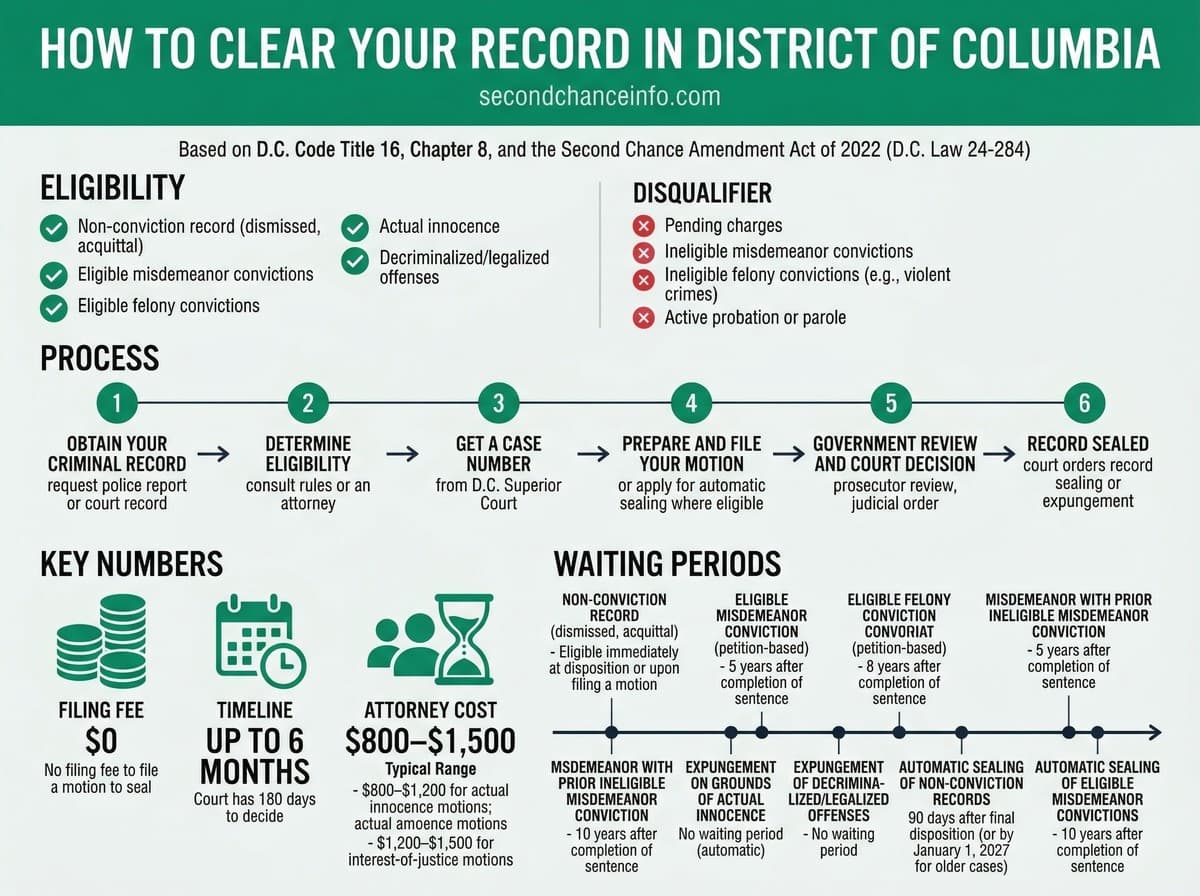
Waiting Periods
| Non-conviction record (charges dismissed, acquittal) | Eligible immediately at disposition or upon filing a motion |
| Eligible misdemeanor conviction (petition-based) | 5 years after completion of sentence |
| Eligible felony conviction (petition-based) | 8 years after completion of sentence |
| Misdemeanor with prior ineligible misdemeanor conviction | 5 years after completion of sentence |
| Eligible misdemeanor with prior felony conviction | 10 years after completion of sentence |
| Automatic sealing of non-conviction records | 90 days after final disposition (or by January 1, 2027 for older cases) |
| Automatic sealing of eligible misdemeanor convictions | 10 years after completion of sentence |
| Expungement on grounds of actual innocence | No waiting period |
| Expungement of decriminalized/legalized offenses | No waiting period (automatic) |
Step-by-Step Process
Obtain your criminal record
Request your criminal arrest history from the Metropolitan Police Department (MPD) at 441 4th St NW, Room 550 South. Ask for the "Sealing" form (Request for Criminal Arrest History for Determining Record Sealing Eligibility). The fee is approximately $3. Also obtain your Sentence Termination Release Record.
Determine eligibility
Review your record to confirm your offense is not on the ineligible list (D.C. Code § 16-801), that the required waiting period has elapsed, and that you have no disqualifying pending charges or subsequent convictions.
Get a case number from the court
Go to the Criminal Records Division at DC Superior Court (500 Indiana Ave NW, Room 4001, 4th floor) and ask the clerk to assign a case number for your Motion to Seal. Open Monday–Friday, 8:30 AM – 5:00 PM.
Prepare and file your motion
Draft a written Motion to Seal that includes all of your unsealed and unexpunged citations, arrests, charges, and convictions, and the legal grounds for sealing. File the motion in person at the Criminal Division clerk’s office on the 4th floor of DC Superior Court. There is no filing fee. You cannot file online.
Government review and court decision
The U.S. Attorney’s Office is served and may file an objection. The court has 180 days to grant, deny, or dismiss the motion. The decision is issued in writing with stated reasons. A hearing may be scheduled if the government objects.
Record sealed
If granted, the court orders the record sealed within 90 days. The sealed record is removed from public view but remains accessible to law enforcement, courts, prosecutors, and certain licensing agencies in a non-public file.
Visual Guide
Automatic Sealing & Expungement (Second Chance Amendment Act)
The Second Chance Amendment Act of 2022 introduced automatic sealing and expungement provisions effective January 1, 2026. Eligible records are sealed or expunged without the need to file a petition. The court has until January 1, 2027 to process older eligible records.
| Scenario | Timing and conditions |
|---|---|
| Non-conviction record (charges dismissed, no conviction) | 90 days after final disposition, or by January 1, 2027 for older cases |
| Eligible misdemeanor conviction | 10 years after completion of sentence, or by January 1, 2027 for older cases |
| Eligible felony conviction (not a crime of violence or sexual offense) | Waiting period based on offense severity, or by January 1, 2027 for older cases |
| Decriminalized/legalized marijuana offenses (simple possession) | Automatic expungement; court has until October 2027 to process older records |
| Convictions under unconstitutional laws | Automatic expungement; 90 days after case termination for new records |
Costs
- Filing fee
- No filing fee to file a motion to seal
- Fee waiver
- Not applicable — there is no filing fee in DC
- Attorney (optional)
- $800–$1,500 typical range ($800–$1,200 for actual innocence motions; $1,200–$1,500 for interest-of-justice motions)
Rising for Justice and Legal Aid DC offer free legal assistance for record sealing. You may need to pay approximately $3 for a copy of your criminal record from MPD.
Timeline
- With attorney
- 3–6 months
- Standard
- Up to 6 months (court has 180 days to decide)
After a motion is granted, records are sealed within 90 days. Automatic sealing of older eligible records is being processed through January 1, 2027.
Effects of the relief
- ✓Removes criminal record from public view (background checks, court databases)
- ✓Allows you to legally deny the arrest or conviction for any purpose without penalty of perjury
- ✓Helps with employment, housing, and education applications
- ✓Supports rehabilitation and community reintegration
- ✓Record is not disclosed in standard background checks
Limits of the relief
- ✗Does NOT destroy the record (sealing only) — sealed records remain in a non-public file
- ✗Does NOT prevent law enforcement, courts, and prosecutors from accessing the sealed record
- ✗Does NOT prevent licensing agencies, public employers, and schools/child care facilities from accessing sealed records for lawful purposes
- ✗Does NOT remove sex offender registration requirements
- ✗Does NOT prevent the sealed record from being used for gun offender registration or firearm possession background checks
- ✗Does NOT prevent the sealed conviction from being considered in future sentencing if convicted of a new offense
Other Relief Options in District of Columbia
Expungement on Grounds of Actual Innocence (D.C. Code § 16-802)
If you can prove the offense did not occur or that someone else committed it, the court can order complete expungement (destruction) of the record. No waiting period. Available for any offense, including felonies and ineligible misdemeanors.
Automatic Expungement of Decriminalized Offenses (D.C. Code § 16-803.02)
Records for offenses that have been decriminalized or legalized (such as marijuana simple possession) are automatically expunged without a petition.
Presidential Pardon
Because D.C. is a federal district, the President of the United States has pardon authority over D.C. Code offenses. A presidential pardon does not seal or expunge the record but restores civil rights and removes legal disabilities.
Restoration of Voting Rights
Since April 2021, conviction does not result in loss of the right to vote in the District of Columbia, even while incarcerated.
Frequently Asked Questions
- How much does it cost to seal a criminal record in DC?
- There is no filing fee for a motion to seal in DC. You may need to pay approximately $3 for a copy of your criminal record from the Metropolitan Police Department. If you hire a private attorney, expect to pay $800–$1,500 depending on the type of motion. Free legal help is available through Legal Aid DC and Rising for Justice.
- How long does it take to seal a record in DC?
- Once you file a motion to seal, the DC Superior Court has 180 days to grant, deny, or dismiss it. If granted, the record must be sealed within 90 days. With an attorney, the entire process typically takes 3–6 months.
- What is the difference between sealing and expungement in DC?
- Sealing removes the record from public view but keeps it in a non-public file accessible to law enforcement, prosecutors, and certain agencies. Expungement completely destroys the record. Sealing is available for most eligible offenses; expungement is reserved for actual innocence, decriminalized offenses, and unconstitutional convictions.
- Can felony convictions be sealed in DC?
- Under the original law, only felony failure-to-appear convictions could be sealed by petition. The Second Chance Amendment Act, effective January 1, 2026, expanded eligibility to most felony convictions except crimes of violence (murder, armed robbery, kidnapping, etc.) and sexual offenses. Eligible felonies require an 8-year waiting period after sentence completion.
- What is automatic sealing under the Second Chance Amendment Act?
- Effective January 1, 2026, D.C. automatically seals non-conviction records (90 days after disposition) and eligible misdemeanor convictions (10 years after sentence completion) without requiring a petition. The court has until January 1, 2027 to process older eligible records. Automatic expungement also applies to decriminalized offenses like marijuana simple possession.
- Can I seal a DUI or domestic violence conviction in DC?
- No. Driving under the influence (DUI/DWI/OWI) and domestic violence offenses are on the list of ineligible misdemeanors under D.C. Code § 16-801 and cannot be sealed. The only exception would be expungement on grounds of actual innocence if you can prove the offense did not occur or that someone else committed it.
- Can employers still see my sealed record in DC?
- Most private employers cannot see a sealed record, and you can legally deny the arrest or conviction on job applications without penalty. However, certain public employers, licensing agencies, law enforcement, schools, and child care facilities retain access to sealed records for lawful purposes under D.C. Code § 16-807.
- Where do I file a motion to seal in DC?
- You must file in person at the Criminal Division clerk’s office on the 4th floor of DC Superior Court, 500 Indiana Avenue NW, Washington, DC 20001. Online filing is not available for sealing motions. You can contact the Criminal Division at (202) 879-1362 or email criminalmotionsealteam@dcsc.gov with questions.
Take Action — Direct Links
- Court petition/form
DC Courts — How to Seal or Expunge Your Criminal Record (PDF guide). Step-by-step instructions for filing a motion to seal at DC Superior Court. File in person at 500 Indiana Ave NW, 4th floor; no filing fee.
- Criminal record request
Metropolitan Police Department — Arrest and Criminal History Section. Request your arrest history for record-sealing eligibility at 441 4th St NW, Room 550 South. Costs approximately $7; processing takes up to 10 business days. Call (202) 727-4245.
- Free legal aid
Legal Aid DC — Criminal Record Sealing. Free legal help for low-income DC residents seeking record sealing. Call (202) 628-1161 on Mondays and Wednesdays or apply online. Also see Rising for Justice for additional free services.
- Court self-help center
DC Courts — Sealing Criminal Records. Official information on eligibility, the motion process, the Second Chance Amendment Act, and contact for the Criminal Motions Seal Team (criminalmotionsealteam@dcsc.gov or (202) 879-1362).
- Statute full text
D.C. Code Title 16, Chapter 8 — Criminal Record Sealing and Expungement (full text from the D.C. Law Library). Includes all sections on automatic sealing, petition-based sealing, expungement, and effects.
Related Resources on This Site
More for your state
- Pardon & ClemencyPardon & clemency in District of Columbia
- Jobs by CityFelony friendly jobs in Washington, DC
- Jobs by StateJobs for felons in District of Columbia
- HousingSecond chance apartments in Washington, DC
- Voting RightsFelon voting rights in District of Columbia
- Gun RightsFelon gun rights in District of Columbia
- DUI RecoveryDUI license recovery in District of Columbia
- ProbationProbation & parole in District of Columbia
Helpful guides
- Background ChecksHow far back do background checks go?
- ToolsReentry organizations directory
- Free Legal AidFree legal aid by state
Sources
- D.C. Code Title 16, Chapter 8 — Criminal Record Sealing and Expungement
- D.C. Law 24-284 — Second Chance Amendment Act of 2022
- DC Courts — Sealing Criminal Records
- Legal Aid DC — Criminal Record Sealing
- Collateral Consequences Resource Center — District of Columbia
- D.C. Code § 16-807 — Effect of Sealing of Criminal Records