
Nevada (NV) — Expungement & Record Clearing
Yes, you can clear your criminal record in Nevada through record sealing under NRS 179.245. Waiting periods range from 1 year for misdemeanors to 10 years for Category A felonies and violent crimes. Dismissed charges and acquittals can be sealed immediately. Filing costs approximately $150 without an attorney ($1,000–$2,000 with one), and the process takes 3–12 months. Fee waivers are available. Sex offenses, crimes against children, felony DUI, and armed home invasion cannot be sealed. Sealed records are treated as if they never occurred — hidden from background checks and most employers — but do not restore gun rights (only a Governor’s Pardon can). Nevada does not have automatic sealing for adults. Below is the full guide with eligibility, step-by-step process, costs, timeline, and FAQ.
Prepare questions about a record-clearing process
Last updated:
Overview
Nevada does not offer expungement — instead, it uses "record sealing" under NRS 179.245 and NRS 179.255. A sealed record is treated as though it never occurred, but the record is not destroyed. Waiting periods range from 1 to 10 years depending on offense severity. Dismissed charges and acquittals can be sealed immediately. Certain sex offenses, crimes against children, felony DUI, and home invasion with a deadly weapon can never be sealed.
Official term: Record Sealing (NRS 179.245 / 179.255) — Nevada does not have true expungement. The correct legal term is "record sealing." Sealed records still exist but are hidden from public view and most background checks.
Routes and conditions to check
- ✓Completed all terms of sentence (jail/prison, probation, parole, fines, classes)
- ✓Dismissed charges or acquittals (no waiting period under NRS 179.255)
- ✓Misdemeanor convictions after 1-year waiting period
- ✓Gross misdemeanor convictions after 2-year waiting period
- ✓Category E felony convictions after 2-year waiting period
- ✓Category B, C, or D felony convictions after 5-year waiting period
- ✓Category A felony, crimes of violence, or residential burglary after 10-year waiting period
- ✓Sex trafficking victims convicted of prostitution or non-violent offenses (eligible immediately)
- ✓Honorably discharged probationers (rebuttable presumption in favor of sealing)
Exclusions and limits to check
- ✗Sexual offenses — rape, statutory sexual seduction, sexual abuse of children, child pornography, incest, lewdness with a child (NRS 179.245)
- ✗Crimes against children under 18 — kidnapping, false imprisonment, involuntary servitude, sex trafficking of a minor
- ✗Felony DUI — third DUI within 7 years, DUI causing injury or death, vehicular homicide
- ✗Invasion of the home with a deadly weapon (NRS 205.067)
- ✗Currently serving a sentence, on probation, or on parole for any offense
- ✗Have a new conviction during the required waiting period (resets the clock)
Waiting Periods
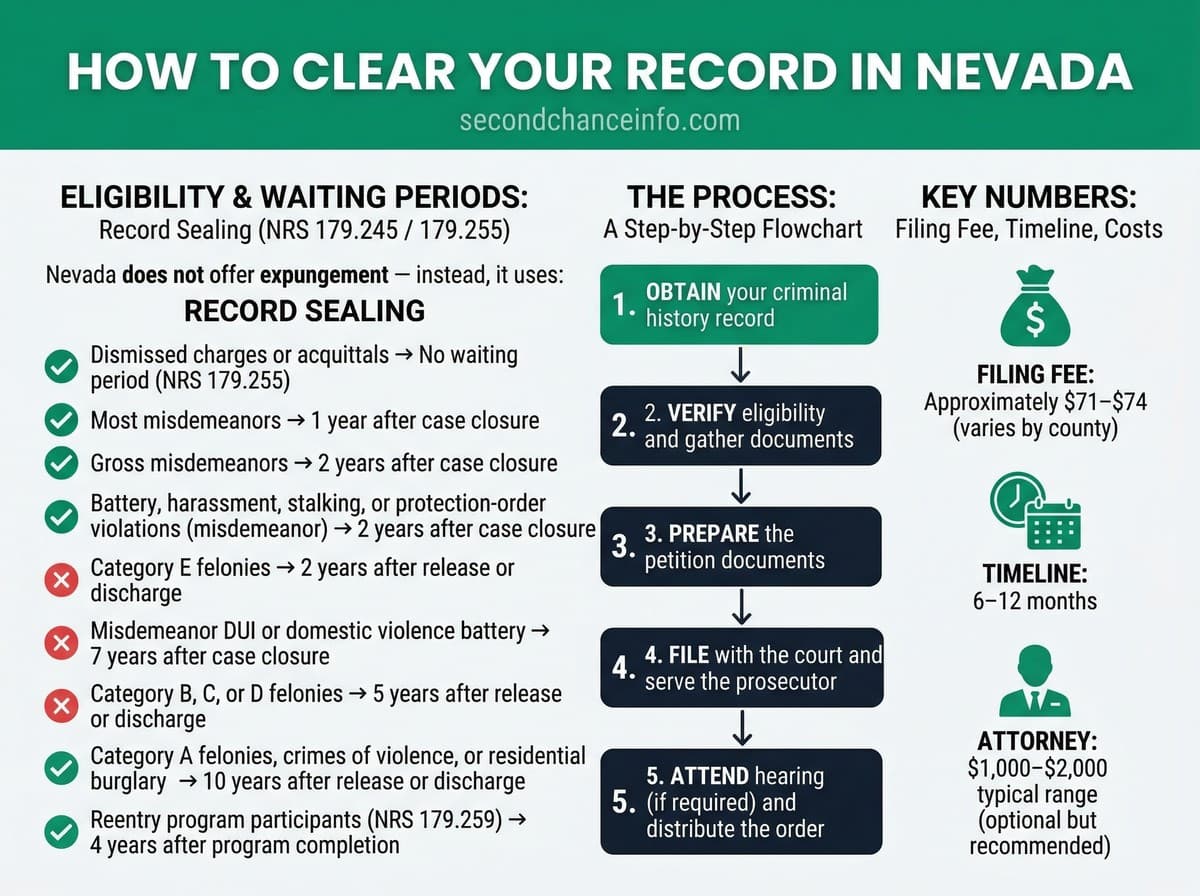
| Dismissed charges or acquittals | No waiting period (NRS 179.255) |
| Most misdemeanors | 1 year after case closure |
| Gross misdemeanors | 2 years after case closure |
| Battery, harassment, stalking, or protection-order violations (misdemeanor) | 2 years after case closure |
| Category E felonies | 2 years after release or discharge |
| Misdemeanor DUI or domestic violence battery | 7 years after case closure |
| Category B, C, or D felonies | 5 years after release or discharge |
| Category A felonies, crimes of violence, or residential burglary | 10 years after release or discharge |
| Reentry program participants (NRS 179.259) | 4 years after program completion |
Step-by-Step Process
Obtain your criminal history record
Request a Criminal History Record (CHR) from the Nevada Department of Public Safety, Records, Communications and Compliance Division. The fee is approximately $27. You can also request a SCOPE report from local law enforcement (e.g., Las Vegas Metro Police at 702-828-3475).
Verify eligibility and gather documents
Review your criminal history to confirm the required waiting period has passed for each conviction. Obtain the judgment of conviction and discharge from the District Court Clerk for each case. Confirm you have no new convictions during the waiting period (minor traffic violations excepted).
Prepare the petition documents
Draft the Petition to Seal Records, supporting Affidavit, and proposed Order to Seal. Include your identifying information, case number(s), court, sentencing date, and list all agencies holding records (law enforcement, courts, DPS, Nevada Highway Patrol, Department of Corrections). Prepare three copies of each document.
File with the court and serve the prosecutor
File the petition with the district court where the conviction occurred. Pay the filing fee (varies by county; approximately $74 in Clark County, $71 in Washoe County). Fee waivers are available for those who cannot afford it. The court notifies the prosecuting agency, which may stipulate to sealing or request a hearing.
Attend hearing (if required) and distribute the order
If the prosecutor stipulates, the judge may sign the order without a hearing. Otherwise, attend the hearing where the judge considers your rehabilitation. Once the order is signed, obtain certified copies and mail them to every agency listed in the order (DPS, courts, arresting agency, etc.) so they can seal their records.
Visual Guide
Automatic & Special Record Sealing Programs
Nevada does not currently have a general automatic record sealing mechanism for adult convictions. AB 160 (2023) would have created automatic sealing, but it was vetoed by the Governor. Juvenile records are sealed automatically at age 21 under NRS 62H.130 if there are no felony convictions, crimes of violence, or lewdness charges. Participants in the Nevada Department of Corrections reentry program may petition for sealing after 4 years under NRS 179.259.
| Scenario | Timing and conditions |
|---|---|
| Juvenile records — no disqualifying offenses | Automatically sealed at age 21 (NRS 62H.130) |
| Juvenile records — with disqualifying offenses | May petition at age 30 if rehabilitated |
| Adult reentry program completion (NRS 179.259) | 4 years after program completion (petition required) |
Costs
- Filing fee
- Approximately $71–$74 (varies by county)
- Fee waiver
- Available for those who cannot afford the fee; no fee for sex trafficking victims
- Attorney (optional)
- $1,000–$2,000 typical range (optional but recommended)
Additional costs include criminal history report ($27 from DPS), fingerprinting (~$25), and certified copies of the order (~$12). Total self-filing cost is approximately $150. Nevada Legal Services and Legal Aid Center of Southern Nevada offer free assistance to eligible individuals.
Timeline
- With attorney
- 3–6 months
- Standard
- 6–12 months
The Nevada Criminal History Repository is often backlogged. The District Attorney review period is typically the most time-consuming stage. A single error in the paperwork can reset the timeline substantially.
Effects of the relief
- ✓Sealed records are legally treated as if they never happened (NRS 179.285)
- ✓Records are removed from public databases and most background checks
- ✓Can legally answer 'No' to criminal history questions on job and housing applications
- ✓Restores the right to vote, hold public office, and serve on a jury
- ✓Employers cannot use sealed convictions in hiring decisions
- ✓Improves access to housing, education, and professional opportunities
Limits of the relief
- ✗Does NOT restore firearm rights — only a Governor's Pardon can do that (NRS 213.090)
- ✗Does NOT prevent deportation — ICE can still access sealed records
- ✗Does NOT destroy the record — law enforcement retains access for investigations
- ✗Does NOT hide records from the Nevada Gaming Control Board or Gaming Commission
- ✗Does NOT hide records from certain professional licensing boards
- ✗Does NOT allow partial sealing — all records for a case are sealed or none
- ✗A new conviction during the waiting period resets the clock for all pending sealing petitions
Other Relief Options in Nevada
Governor's Pardon (NRS 213.090)
Granted by the State Board of Pardons Commissioners. A full, unconditional pardon restores all civil rights including firearm rights. Requires significant time after discharge and demonstrated rehabilitation. Does not erase the conviction.
Reentry Program Sealing (NRS 179.259)
Participants who completed a Nevada Department of Corrections reentry program may petition to seal records 4 years after completion. Limited to a single non-violent felony conviction.
Sealing of Non-Conviction Records (NRS 179.255)
If charges were dismissed, prosecution was declined, or you were acquitted, you may petition to seal those records immediately with no waiting period. Acquittals must be sealed by the court upon petition.
Frequently Asked Questions
- How much does it cost to seal a criminal record in Nevada?
- If you handle it yourself, expect to pay approximately $150 total — including the criminal history report ($27), fingerprinting (~$25), court filing fee ($71–$74 depending on county), and certified copies (~$12). If you hire an attorney, fees typically range from $1,000 to $2,000. Fee waivers are available if you cannot afford the filing fee, and sex trafficking victims pay no fees.
- How long does record sealing take in Nevada?
- The process typically takes 3 to 12 months. With an attorney, it usually takes 3 to 6 months. Without one, expect 6 to 12 months. The District Attorney review and the Nevada Criminal History Repository processing are often the most time-consuming stages. Errors in paperwork can add significant delays.
- Can a felony be sealed in Nevada?
- Yes, most felonies can be sealed after the required waiting period: 2 years for Category E felonies, 5 years for Category B/C/D felonies, and 10 years for Category A felonies, crimes of violence, and residential burglary. However, sex offenses, crimes against children, felony DUI, and home invasion with a deadly weapon can never be sealed.
- Does Nevada have automatic record sealing?
- No. Nevada does not currently have automatic record sealing for adult convictions. AB 160 (2023), which would have created automatic sealing, was vetoed by the Governor. You must file a petition with the court. Juvenile records are automatically sealed at age 21 under NRS 62H.130, provided there are no disqualifying offenses.
- Does record sealing restore gun rights in Nevada?
- No. Record sealing does not restore firearm rights under Nevada law. The Nevada Attorney General has confirmed that sealing a record does not restore the right to bear arms. Only a full, unconditional pardon from the Governor through the Board of Pardons Commissioners can restore gun rights (NRS 213.090).
- Can I seal a DUI conviction in Nevada?
- It depends. A first or second misdemeanor DUI can be sealed after a 7-year waiting period from the date the case is closed. However, felony DUI convictions — including a third DUI within 7 years, DUI causing injury or death, and vehicular homicide — can never be sealed under Nevada law.
- What happens if my petition to seal is denied?
- If your petition is denied, you must wait 2 years before refiling. Nevada law permits only two petition attempts per conviction (NRS 179.265). Courts retain discretion to deny even eligible petitions, though in practice courts almost always grant sealing when the eligibility requirements are met.
- Will a sealed record show up on a background check in Nevada?
- No. Once sealed, the record is removed from public databases and will not appear on standard employer or landlord background checks. You can legally deny the arrest or conviction ever occurred. However, certain government agencies — including the Nevada Gaming Control Board, some professional licensing boards, and law enforcement — may still access sealed records.
Take Action — Direct Links
- Record Sealing Forms (Legal Aid Center of Southern Nevada)
Fillable petition, order, declaration, certificate of mailing, and notice of entry forms for sealing criminal records in Clark County, with instructions and examples.
- Request Your Nevada Criminal History (DPS Form DPS-006)
Instructions and form to request your own Nevada criminal history record from the Nevada State Police Records, Communications and Compliance Division ($27 fee).
- Nevada Legal Services — Criminal Record Sealing
Free record sealing classes, fact sheets, and the comprehensive Record Sealing Manual from Nevada Legal Services, available in English and Spanish.
- Civil Law Self-Help Center — Sealing Criminal Records
Clark County Civil Law Self-Help Center guide to sealing criminal records, with links to free classes, forms, and information on the record sealing process.
- NRS 179.245 — Full Statute Text (Sealing Records After Conviction)
Official full text of NRS Chapter 179 (Sealing Records of Criminal Proceedings) on the Nevada Legislature website, including sections 179.245, 179.255, and 179.259.
Related Resources on This Site
More for your state
- Pardon & ClemencyPardon & clemency in Nevada
- Jobs by CityFelony friendly jobs in Las Vegas, NV
- Jobs by StateJobs for felons in Nevada
- HousingSecond chance apartments in Las Vegas, NV
- Voting RightsFelon voting rights in Nevada
- Gun RightsFelon gun rights in Nevada
- DUI RecoveryDUI license recovery in Nevada
- ProbationProbation & parole in Nevada
Helpful guides
- Background ChecksHow far back do background checks go?
- ToolsReentry organizations directory
- Free Legal AidFree legal aid by state