
Utah (UT) — Expungement & Record Clearing
Yes, you can clear your criminal record in Utah through expungement under Utah Code § 77-40a. Utah offers two pathways: petition-based expungement for eligible felonies and misdemeanors, and automatic Clean Slate expungement for qualifying misdemeanors and infractions. Waiting periods range from 3 to 10 years depending on the offense. Government fees total $265–$280 for a single petition-based conviction (fee waivers available). As of January 1, 2026, courts automatically identify and clear Clean Slate–eligible cases monthly at no cost. Capital felonies, violent felonies, sex offenses, and felony DUI are not eligible. Below is the full guide with eligibility rules, step-by-step process, costs, timeline, and FAQ.
Prepare questions about a record-clearing process
Last updated:
Overview
Utah allows eligible criminal records to be expunged — meaning sealed so they are no longer publicly accessible. Utah offers two pathways: a petition-based process through the Bureau of Criminal Identification (BCI) and the courts, and automatic expungement under the Clean Slate law (HB 431, enacted 2019). As of January 1, 2026, courts automatically identify and clear eligible cases without requiring individuals to file a form.
Official term: Expungement (Utah Code § 77-40a) — Utah uses "expungement" to mean sealing or restricting access to criminal records. The record is not destroyed — law enforcement and certain agencies can still access it.
Routes and conditions to check
- ✓Completed all terms of probation or parole
- ✓No pending criminal charges
- ✓All fines, fees, and restitution paid in full
- ✓Eligible felony convictions (after 7-year waiting period)
- ✓Class A misdemeanor convictions (after 5-year waiting period)
- ✓Class B misdemeanor convictions (after 4-year waiting period)
- ✓Class C misdemeanor and infraction convictions (after 3-year waiting period)
- ✓Drug possession offenses (up to 4 convictions)
- ✓Acquittals (after 60 days) and dismissals with prejudice (after 180 days)
Exclusions and limits to check
- ✗Capital felonies and first-degree felonies
- ✗Violent felonies as defined in Utah Code § 76-3-203.5
- ✗Registerable sex offenses
- ✗Felony DUI/automobile homicide
- ✗Currently incarcerated, on probation, or on parole
- ✗Outstanding criminal protective orders
- ✗Two or more felony criminal episodes (with limited 10-year exception)
- ✗Exceeding conviction limits (e.g., 2+ Class A misdemeanors in 3+ episodes, 3+ Class B misdemeanors in 4+ episodes, or 5+ total misdemeanor/felony episodes)
Waiting Periods
| DUI/Impaired driving (misdemeanor) | 10 years |
| Eligible felonies | 7 years |
| Class A misdemeanors | 5 years |
| Class B misdemeanors | 4 years |
| Class C misdemeanors and infractions | 3 years |
| Acquittals | 60 days after order |
| Dismissals with prejudice | 180 days after order |
Step-by-Step Process
Obtain your criminal record
Get a copy of your criminal record through the Utah Courts MyCase system (free), by mail with a $15 fee and fingerprints to BCI, or in person at the BCI office in Taylorsville.
Determine eligibility
Confirm you have completed probation or parole, have no pending charges, have paid all fines and restitution, and your conviction type and number of convictions meet eligibility requirements.
Apply for a Certificate of Eligibility from BCI
Submit an application to the Bureau of Criminal Identification (BCI) with fingerprints, a valid government ID, and the $65 application fee. BCI processes applications in 1–2 months. If eligible, pay an additional $65 per conviction for the certificate.
File the petition with the court
Within 180 days of receiving the Certificate of Eligibility, file a Petition to Expunge Records with the court that handled your case. Pay the court filing fee ($135 in Justice Court, $150 in District Court). Fee waivers are available.
Prosecutor review and hearing
The prosecutor reviews your petition and may object. If there is no objection, the judge may grant the order without a hearing. If the prosecutor objects, a hearing is scheduled where you present your case.
Receive and distribute the expungement order
If granted, obtain certified copies of the expungement order within 28 days and deliver them to BCI and all relevant agencies. BCI updates its records and notifies the FBI.
Visual Guide
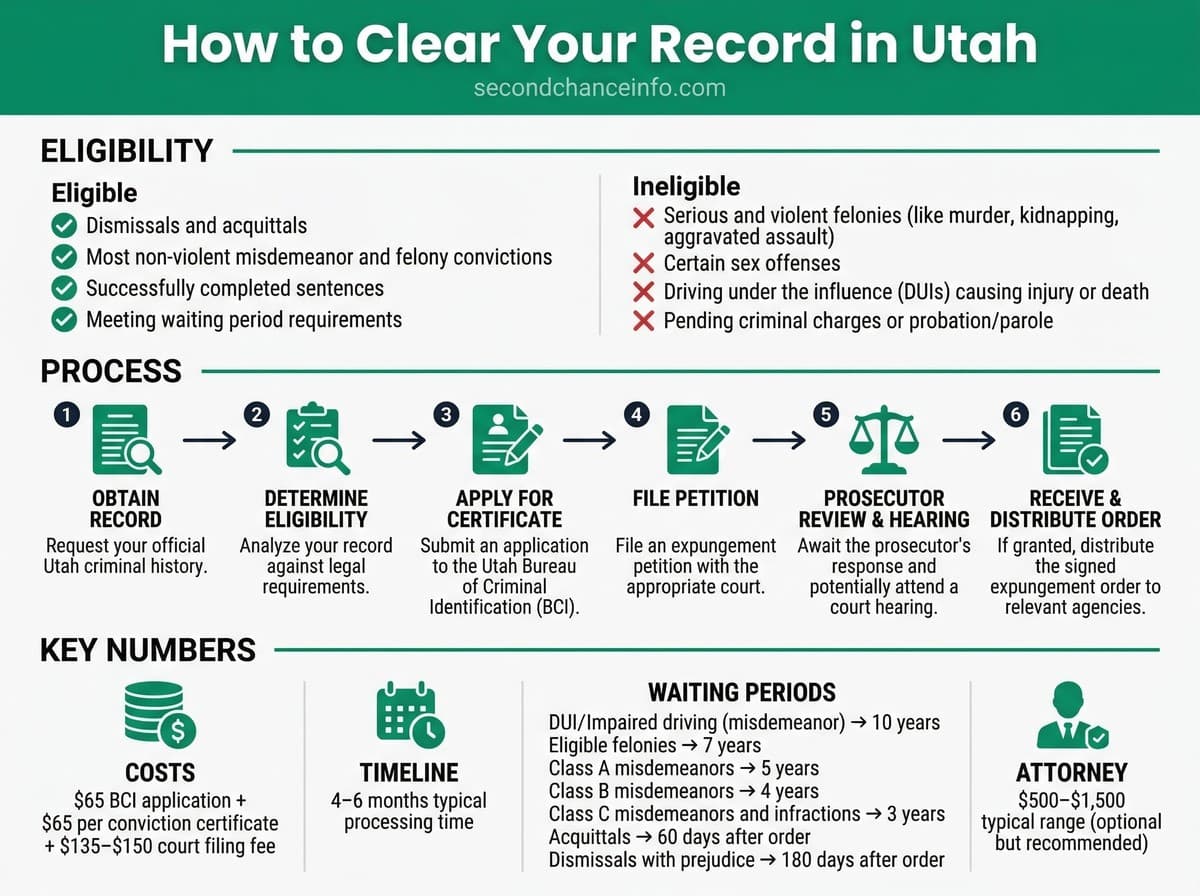
Automatic Expungement (Clean Slate Law — HB 431)
Utah's Clean Slate law (HB 431, enacted 2019, effective February 2022) provides automatic expungement for qualifying misdemeanor convictions. As of January 1, 2026, courts automatically identify and clear eligible cases on a monthly basis — no petition or form is required.
| Scenario | Timing and conditions |
|---|---|
| Acquittal | 60 days after order |
| Dismissal with prejudice | 180 days after order |
| Class A misdemeanor drug possession conviction | 7 years from adjudication |
| Class B misdemeanor conviction | 6 years from adjudication |
| Class C misdemeanor or infraction conviction | 5 years from adjudication |
Costs
- Filing fee
- $65 BCI application + $65 per conviction certificate + $135–$150 court filing fee
- Fee waiver
- Court filing fee waivers available for those who cannot afford it
- Attorney (optional)
- $500–$1,500 typical range (optional but recommended)
Total government fees for a single conviction typically run $265–$280. All fines, fees, and restitution from the original case must be paid before applying.
Timeline
- With attorney
- 3–4 months
- Standard
- 4–6 months
BCI application processing takes 1–2 months. Court processing adds several additional weeks. Clean Slate automatic expungement takes up to 120 days after eligibility is met.
Effects of the relief
- ✓Seals criminal records from public background checks
- ✓Allows you to respond to inquiries as though the arrest or conviction never occurred
- ✓Removes records from Utah court system, BCI database, and FBI records
- ✓Improves access to employment, housing, and educational opportunities
- ✓Government employees who unlawfully disclose expunged records face Class A misdemeanor charges
- ✓Public employers cannot disqualify applicants based on expunged criminal history during initial interviews (2025 law)
Limits of the relief
- ✗Does NOT destroy the record — law enforcement and certain agencies retain access
- ✗Does NOT guarantee restoration of firearm rights for felony convictions
- ✗Does NOT remove sex offender registration requirements
- ✗Does NOT prevent disclosure to the Board of Pardons and Parole
- ✗Does NOT prevent disclosure to occupational or professional licensing boards
- ✗Does NOT prevent records from being reopened for subsequent felony sentencing
- ✗Does NOT restrict individuals with independent knowledge from discussing the case
Other Relief Options in Utah
402 Reduction (Utah Code § 76-3-402)
Allows individuals who successfully completed probation or parole to petition the court to reduce the degree of their conviction (e.g., felony to misdemeanor). This can make previously ineligible records eligible for expungement and may help restore firearm rights.
Pardon (Board of Pardons and Parole)
Available for individuals not eligible for expungement, including those with violent felony convictions. A pardon results in expungement of the record. Applied for through the Utah Board of Pardons and Parole.
Cannabis Conviction Expungement
Individuals with cannabis-related convictions may petition the court directly if they can demonstrate a qualifying medical condition at the time of arrest and appropriate cannabis amounts under current law.
Frequently Asked Questions
- How much does expungement cost in Utah?
- For petition-based expungement, expect $65 for the BCI application, $65 per conviction for the Certificate of Eligibility, and $135–$150 for the court filing fee. Total government fees for a single conviction typically run $265–$280. Attorney fees range from $500–$1,500. Fee waivers are available for court filing fees. Clean Slate automatic expungement has no cost.
- How long does expungement take in Utah?
- The petition-based process typically takes 4–6 months total. BCI processes applications in 1–2 months, and the court process takes several additional weeks. With an attorney, the process may be completed in 3–4 months. Clean Slate automatic expungement takes up to 120 days after eligibility is met.
- What is Utah's Clean Slate law?
- Utah's Clean Slate law (HB 431, enacted 2019) requires the government to automatically identify and expunge qualifying misdemeanor criminal records. Eligible offenses include Class A misdemeanor drug possession, Class B and C misdemeanors, and infractions — after required waiting periods of 5–7 years. As of January 1, 2026, courts automatically find and clear eligible cases monthly without any action required from the individual.
- Can a felony be expunged in Utah?
- Yes, some felonies can be expunged after a 7-year waiting period, but there are strict limits. Capital felonies, first-degree felonies, violent felonies, registerable sex offenses, and felony DUI cannot be expunged. You also cannot have two or more felony criminal episodes. A 402 reduction can lower a felony to a misdemeanor, making it easier to expunge.
- Does expungement restore gun rights in Utah?
- Expungement does not guarantee restoration of firearm rights. However, under federal law, a conviction that has been expunged generally does not trigger the federal firearm prohibition. A 402 reduction combined with expungement may help restore gun rights depending on the specific offense. Consult an attorney for your specific situation.
- What is the difference between automatic and petition-based expungement in Utah?
- Automatic (Clean Slate) expungement applies only to qualifying misdemeanors, infractions, acquittals, and dismissals — the court identifies and clears these records automatically at no cost. Petition-based expungement covers a broader range of offenses including eligible felonies, but requires obtaining a Certificate of Eligibility from BCI, filing a petition with the court, and paying fees totaling $265–$280 or more.
- What offenses are excluded from Clean Slate automatic expungement?
- Automatic expungement excludes all felonies, registerable sex offenses, domestic violence convictions, DUI and reckless driving, certain weapons offenses, and simple assault. These offenses may still be eligible for petition-based expungement or a pardon depending on the severity.
- Do I need an attorney for expungement in Utah?
- No, an attorney is not required, and many people complete the process on their own. BCI does not provide legal advice but will process your application. Resources like Clean Slate Utah, the Utah Courts Self-Help Center, and Salt Lake County's free expungement toolkit can guide you. However, an attorney can be helpful for complex cases, felonies, or if the prosecutor objects.
Take Action — Direct Links
- Download Expungement Petition Forms (Utah Courts)
Utah Courts self-help page for expunging adult criminal records with step-by-step instructions, downloadable petition forms, and links to the Certificate of Eligibility application.
- Request Your Criminal Record (Utah BCI)
Utah Bureau of Criminal Identification page with instructions and forms for obtaining a copy of your own criminal history record ($20 fee for Utah criminal record).
- Find Free Legal Help (Clean Slate Utah)
Clean Slate Utah legal resources page with free monthly expungement clinics, Salt Lake County's expungement toolkit, and referrals to Utah Legal Services for low-income individuals.
- Utah Courts Self-Help: Expungement Guide
Official Utah Courts self-help center guide covering the full expungement process, BCI Certificate of Eligibility, filing instructions, fees, and Clean Slate automatic expungement.
- Utah Code § 77-40a — Full Statute Text
Official full text of Utah Code Chapter 77-40a (Expungement of Criminal Records) on the Utah Legislature website.
Related Resources on This Site
More for your state
- Pardon & ClemencyPardon & clemency in Utah
- Jobs by CityFelony friendly jobs in Salt Lake City, UT
- Jobs by StateJobs for felons in Utah
- HousingSecond chance apartments in Salt Lake City, UT
- Voting RightsFelon voting rights in Utah
- Gun RightsFelon gun rights in Utah
- DUI RecoveryDUI license recovery in Utah
- ProbationProbation & parole in Utah
Helpful guides
- Background ChecksHow far back do background checks go?
- ToolsReentry organizations directory
- Free Legal AidFree legal aid by state