
New Jersey (NJ) — Expungement & Record Clearing
New Jersey offers multiple expungement pathways under N.J.S.A. 2C:52-1 et seq., including Regular (5-year wait), Early Pathway (3–4 years with compelling circumstances), and Clean Slate (10 years, covers entire record). Filing fees are $50–$75 (waiver available) and attorney fees run $750–$3,000. The process takes 3–8 months, with the NJSP required to process orders within 90–120 days. Sex offenses, certain violent crimes, and DUI/DWI (Title 39) are not eligible. As of 2025, you can file in your county of residence and track orders through the NJSP portal. Below is the full guide with eligibility, step-by-step process, costs, timeline, and FAQ.
Prepare questions about a record-clearing process
Last updated:
Overview
New Jersey offers one of the most comprehensive expungement systems in the country, with multiple pathways including Regular Expungement, Early Pathway Expungement, Clean Slate Expungement, Marijuana/Hashish Expungement, Juvenile Expungement, and Recovery Court Expungement. The Clean Slate pathway is particularly broad — after 10 years, it covers your entire criminal record regardless of the number of convictions. As of 2025, New Jersey allows filing in the county of residence and the NJSP has launched a processing portal to streamline the process.
Official term: Expungement (N.J.S.A. 2C:52-1 et seq.) — New Jersey uses the term "expungement" to mean the isolation and extraction of records from public access. Records are not physically destroyed but are removed from public databases and background checks.
Routes and conditions to check
- ✓Indictable offenses (felony-equivalent): eligible after 5 years (regular) or 4 years (early pathway)
- ✓Disorderly persons offenses (misdemeanor-equivalent): eligible after 5 years (regular) or 3 years (early pathway)
- ✓Clean Slate: entire record eligible after 10 years regardless of number of convictions
- ✓Marijuana/hashish offenses: eligible for expedited expungement
- ✓Juvenile adjudications: eligible for expungement
- ✓Recovery Court graduates: eligible upon completion of the program
- ✓Dismissed charges, acquittals, and arrests without conviction: immediately eligible
Exclusions and limits to check
- ✗Sex offenses (sexual assault, criminal sexual contact, endangering welfare of a child, etc.)
- ✗Certain violent crimes (murder, manslaughter, kidnapping, human trafficking)
- ✗DUI/DWI offenses (Title 39 motor vehicle violations — these are not criminal offenses in NJ and are not expungable)
- ✗Crimes committed by public officials in their official capacity
- ✗Other motor vehicle offenses (handled under Title 39, not the criminal code)
- ✗Persons with pending charges or currently under supervision for an ineligible offense
Waiting Periods
| Regular — indictable offense (felony) | 5 years from completion of sentence, probation, or parole |
| Regular — disorderly persons (misdemeanor) | 5 years from completion of sentence |
| Early Pathway — indictable offense | 4 years with "compelling circumstances" |
| Early Pathway — disorderly persons | 3 years with "compelling circumstances" |
| Clean Slate — entire record | 10 years from most recent conviction, completion of sentence, or release |
| Marijuana/hashish offenses | Expedited process (shorter waiting period) |
| Dismissed/acquitted charges | Immediately eligible |
Step-by-Step Process
Determine the appropriate pathway
Identify which expungement pathway applies to your situation: Regular, Early Pathway, Clean Slate (10 years), Marijuana/Hashish, Juvenile, or Recovery Court. Each has different eligibility criteria and waiting periods.
Gather your records
Obtain your criminal history from the New Jersey State Police (NJSP) and certified court dispositions from each court where you were convicted. You will need case numbers, charge details, and dates for all records to be expunged.
Prepare the expungement petition
Complete the appropriate petition form (available from the NJ Courts website). Include a verified petition, proposed order, and all supporting documentation. As of 2025, you may file in the county where you reside.
File the petition and serve required parties
File the petition with the Superior Court. Serve copies on the county prosecutor, the Attorney General, the NJSP, and any other relevant law enforcement agencies. Pay the applicable court filing fee.
Court review and hearing
The court reviews the petition. The prosecutor or Attorney General may object. If there are no objections, the court may grant the expungement without a hearing. If contested, a hearing is scheduled where you must demonstrate eligibility.
Order granted and records processed
If granted, the court issues an expungement order. The NJSP processes the order within 90 to 120 days (per the 2025 settlement agreement). Records are removed from public databases and background checks. The NJSP processing portal tracks the status of your order.
Visual Guide
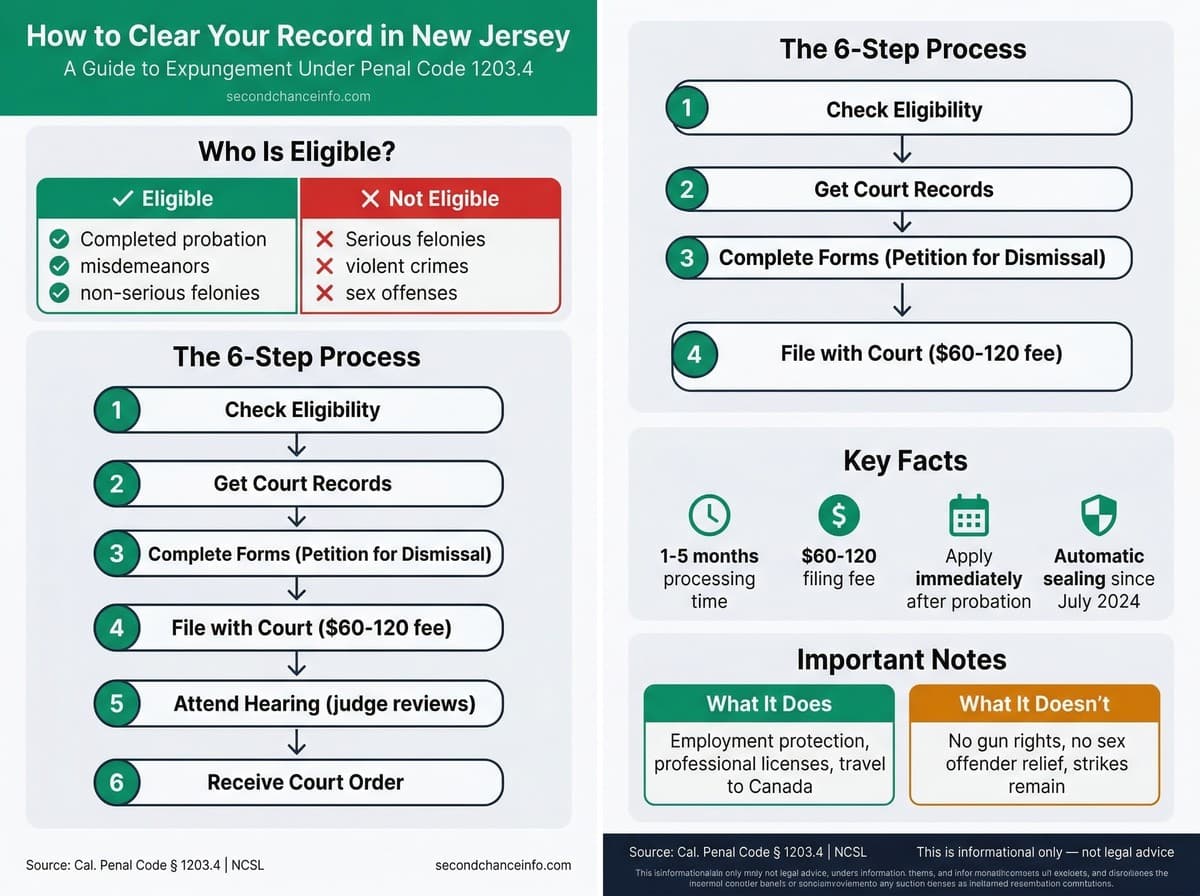
Automatic Relief in New Jersey
New Jersey has discussed implementing an automatic expungement system but it is not yet fully operational. Currently, all expungement in New Jersey requires filing a petition. The Clean Slate pathway (10 years) covers the broadest range of offenses but still requires an application.
| Scenario | Timing and conditions |
|---|
Costs
- Filing fee
- Court filing fees vary by county (typically $50–$75)
- Fee waiver
- Fee waiver available for those who cannot afford the filing fee
- Attorney (optional)
- $750–$3,000 typical range
Costs vary by county and the complexity of the case. Some legal aid organizations in New Jersey provide free expungement assistance.
Timeline
- With attorney
- 3–6 months
- Standard
- 4–8 months
Under the 2025 settlement agreement, the NJSP must process expungement orders within 90 to 120 days. The pre-filing preparation and court process add additional time.
Effects of the relief
- ✓Removes criminal records from public background checks and databases
- ✓Allows you to lawfully deny the arrest and conviction on most applications
- ✓Prevents most employers, landlords, and educational institutions from accessing the record
- ✓Removes records from NJ Courts public access system
- ✓Covers the entire record under the Clean Slate pathway (after 10 years)
Limits of the relief
- ✗Does NOT expunge DUI/DWI records — these are motor vehicle offenses (Title 39) and cannot be expunged
- ✗Does NOT expunge other motor vehicle offenses
- ✗Law enforcement agencies retain access to expunged records
- ✗Must still disclose to certain employers (law enforcement, judiciary, corrections)
- ✗Federal agencies and immigration authorities may still access the records
- ✗Does NOT automatically restore firearm rights in all cases
Other Relief Options in New Jersey
Marijuana/Hashish Specific Expungement
An expedited expungement pathway specifically for marijuana and hashish offenses, reflecting New Jersey's legalization of recreational cannabis.
Recovery Court Expungement
Graduates of New Jersey's Recovery Court (drug court) program may be eligible for expungement upon successful completion, without the standard waiting periods.
Juvenile Expungement
Juvenile adjudications have a separate expungement process with different eligibility criteria and generally shorter waiting periods.
Frequently Asked Questions
- What is Clean Slate expungement in New Jersey?
- Clean Slate is a pathway that allows expungement of your entire criminal record after 10 years from your most recent conviction, sentence completion, or release from incarceration. Unlike regular expungement, Clean Slate has no limit on the number of convictions that can be expunged, making it the broadest pathway available in New Jersey.
- Can a DUI/DWI be expunged in New Jersey?
- No. DUI/DWI offenses in New Jersey are classified as motor vehicle violations under Title 39, not criminal offenses under Title 2C. Since expungement only applies to criminal offenses under the criminal code, DUI/DWI records cannot be expunged.
- How much does expungement cost in New Jersey?
- Court filing fees vary by county, typically $50 to $75. Fee waivers are available. Attorney fees generally range from $750 to $3,000 depending on the complexity of the case. Some legal aid organizations offer free assistance.
- How long does the expungement process take in New Jersey?
- The total process typically takes 3 to 8 months. Under the 2025 settlement, the NJSP must process orders within 90 to 120 days after the court grants the expungement. Preparation, filing, and the court process add additional time before that.
- Can I file for expungement in the county where I live?
- Yes. As of 2025, New Jersey allows you to file for expungement in the county where you reside, in addition to the county where the conviction occurred. This makes the process more accessible for individuals who have moved since their conviction.
- What is the difference between regular and early pathway expungement?
- Regular expungement requires a 5-year waiting period for both indictable offenses and disorderly persons offenses. The early pathway reduces this to 4 years for indictable offenses and 3 years for disorderly persons offenses, but you must demonstrate "compelling circumstances" that justify early filing.
- Do I need an attorney for expungement in New Jersey?
- While not legally required, an attorney is strongly recommended given the complexity of the process — especially when dealing with multiple convictions, multiple pathways, or potential objections from the prosecutor. Attorney fees typically range from $750 to $3,000. Legal aid organizations may provide free assistance.
Take Action — Direct Links
- Court petition/form
Official NJ Courts expungement kit (CN 10557) — includes petition forms, instructions, and proposed order for all expungement pathways
- Criminal record request
New Jersey State Police criminal history record check — request your own fingerprint-based criminal history through the NJSP Criminal Information Unit
- Free legal aid
Legal Services of New Jersey (LSNJ) — free expungement information, eligibility tools, and the Clearing Your Record Online guided form creator
- Court self-help center
NJ Courts self-help expungement page — eCourts electronic filing system, eligibility guidance, and links to all expungement forms
- Statute full text
N.J.S.A. 2C:52-1 et seq. — full text of New Jersey's expungement statute on Justia (all sections linked)
Related Resources on This Site
More for your state
- Pardon & ClemencyPardon & clemency in New Jersey
- Jobs by CityFelony friendly jobs in Newark, NJ
- Jobs by StateJobs for felons in New Jersey
- HousingSecond chance apartments in Newark, NJ
- Voting RightsFelon voting rights in New Jersey
- Gun RightsFelon gun rights in New Jersey
- DUI RecoveryDUI license recovery in New Jersey
- ProbationProbation & parole in New Jersey
Helpful guides
- Background ChecksHow far back do background checks go?
- ToolsReentry organizations directory
- Free Legal AidFree legal aid by state