
North Carolina (NC) — Expungement & Record Clearing
Yes, you can clear your criminal record in North Carolina through expunction — the legal process of removing and sealing arrest, charge, and conviction records. Dismissed charges and acquittals can be expunged immediately with no filing fee, and many are now cleared automatically within 180 days. A single nonviolent misdemeanor conviction can be expunged after 3 years (reduced from 5 years in July 2025), while nonviolent Class H/I felonies require a 10-year wait. Filing costs $175 for convictions (fee waivers available), and the process typically takes 6–12 months. DWI convictions, Class A–G felonies, sex offenses, and assault-based crimes are not eligible. Below is the full guide with eligibility by statute, step-by-step process, costs, timeline, and FAQ.
Prepare questions about a record-clearing process
Last updated:
Overview
North Carolina uses the term "expunction" to describe the legal process of removing a criminal charge or conviction from a person's record and sealing or destroying the state's records of the arrest, charge, or conviction. NC has over 15 distinct expunction statutes covering dismissals, acquittals, and various conviction types. As of July 2024, certain dismissed charges are expunged automatically under G.S. 15A-146(a4) without requiring a petition.
Official term: Expunction — North Carolina statutes use "expunction" and "expungement" interchangeably. Both refer to the same legal process — the destruction or sealing of criminal records under Chapter 15A, Article 5.
Routes and conditions to check
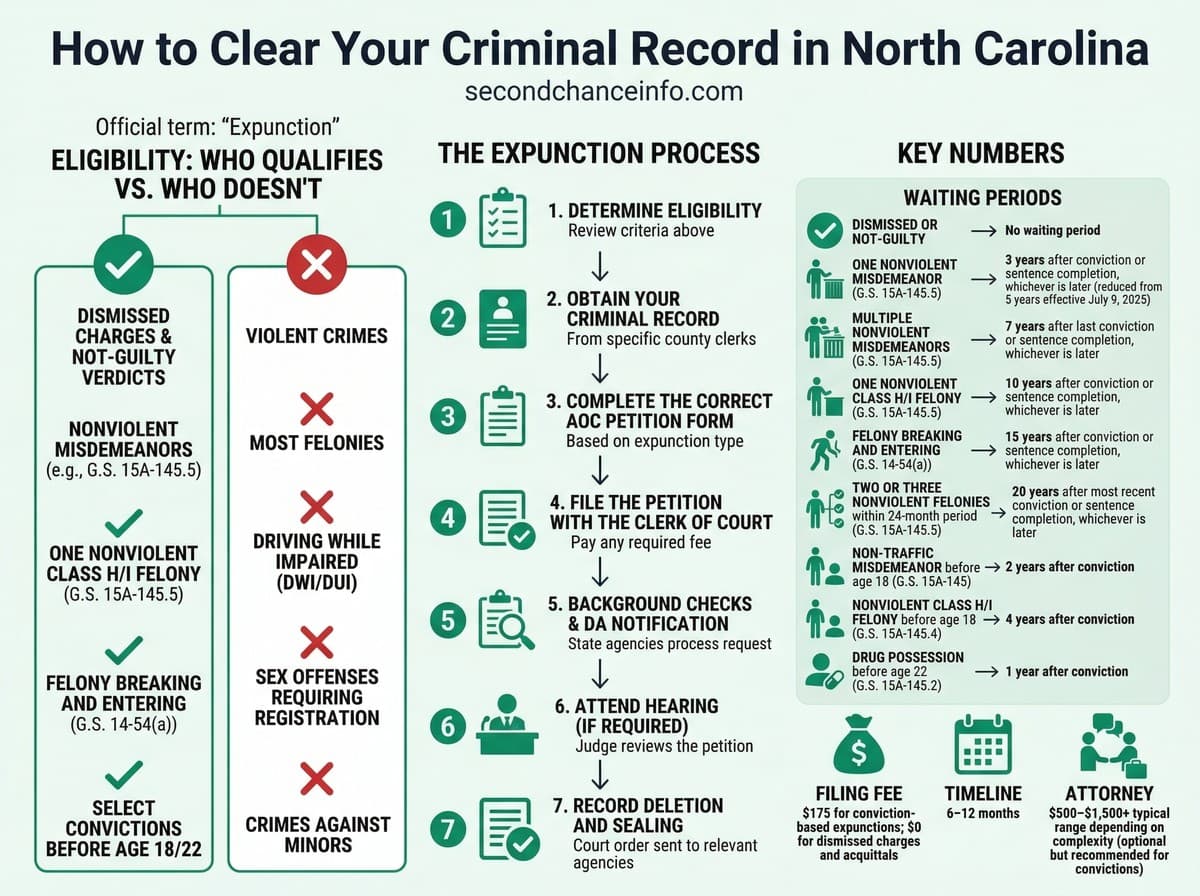
- ✓Dismissed charges or not-guilty verdicts (G.S. 15A-146) — no limit on number, no waiting period
- ✓One nonviolent misdemeanor conviction (Class 1, 2, or 3) — 3-year waiting period (G.S. 15A-145.5)
- ✓Multiple nonviolent misdemeanor convictions — 7-year waiting period (G.S. 15A-145.5)
- ✓One nonviolent felony conviction (Class H or I) — 10-year waiting period (G.S. 15A-145.5)
- ✓Felony breaking and entering (G.S. 14-54(a)) — 15-year waiting period (G.S. 15A-145.5)
- ✓Two or three nonviolent felony convictions within a 24-month period — 20-year waiting period (G.S. 15A-145.5)
- ✓Non-traffic misdemeanor committed before age 18 — 2-year waiting period (G.S. 15A-145)
- ✓Nonviolent Class H or I felony committed before age 18 — 4-year waiting period (G.S. 15A-145.4)
- ✓Certain drug possession offenses committed before age 22 — 1-year waiting period (G.S. 15A-145.2)
- ✓Prostitution offenses by trafficking victims (G.S. 15A-145.6)
Exclusions and limits to check
- ✗Class A through G felonies (serious/violent felonies)
- ✗Class A1 misdemeanors (assault-related, sexual battery, stalking, etc.)
- ✗Sex offenses requiring registration under the Sex Offender Registry
- ✗Impaired driving (DWI/DUI) convictions
- ✗Assault-based offenses (assault on a female, assault by strangulation, etc.)
- ✗Possession with intent to sell/deliver cocaine
- ✗Methamphetamine or heroin felonies
- ✗Indecent exposure or stalking convictions
- ✗Hate crimes
- ✗More than three felony convictions total
- ✗Two or three felonies with offenses separated by more than 24 months
- ✗Federal or out-of-state convictions (NC courts cannot expunge these)
Waiting Periods
| Dismissed charges or not-guilty verdicts | No waiting period |
| One nonviolent misdemeanor (G.S. 15A-145.5) | 3 years after conviction or sentence completion, whichever is later (reduced from 5 years effective July 9, 2025) |
| Multiple nonviolent misdemeanors (G.S. 15A-145.5) | 7 years after last conviction or sentence completion, whichever is later |
| One nonviolent Class H/I felony (G.S. 15A-145.5) | 10 years after conviction or sentence completion, whichever is later |
| Felony breaking and entering — G.S. 14-54(a) | 15 years after conviction or sentence completion, whichever is later |
| Two or three nonviolent felonies within 24-month period (G.S. 15A-145.5) | 20 years after most recent conviction or sentence completion, whichever is later |
| Non-traffic misdemeanor committed before age 18 (G.S. 15A-145) | 2 years after conviction |
| Nonviolent Class H/I felony committed before age 18 (G.S. 15A-145.4) | 4 years after conviction |
| Drug possession before age 22 (G.S. 15A-145.2) | 1 year after conviction |
Step-by-Step Process
Determine eligibility
Confirm your charge or conviction qualifies under one of the NC expunction statutes. Check the offense class, your age at the time of offense, waiting period, and whether you have any disqualifying prior convictions or pending charges. Multiple statutes may apply — choose the one most favorable to your situation.
Obtain your criminal record
Get a copy of your criminal record through the NC Courts online portal or at the courthouse in the county where you were charged or convicted. You will need the exact case number(s) for your petition.
Complete the correct AOC petition form
Download and fill out the AOC-approved petition form specific to your expunction type from nccourts.gov. Each statute has its own form (e.g., AOC-CR-298 for G.S. 15A-145.5 misdemeanors). Some petitions require affidavits of good character.
File the petition with the clerk of court
File the completed petition at the clerk of court's office in the county where you were charged or convicted. Pay the $175 filing fee (no fee for dismissed charges or acquittals; fee waiver available for indigency). The clerk will forward orders for background checks to the AOC and SBI.
Background checks and DA notification
The AOC checks for prior expunctions and the SBI checks for prior convictions. The district attorney must be served with the petition for most conviction-based expunctions. The DA may support or oppose the petition.
Attend hearing (if required)
Some expunctions (especially felonies) require a hearing where the judge assesses good character and rehabilitation. Dismissed-charge and single-misdemeanor expunctions often proceed on the paperwork alone. If the court finds you meet all statutory requirements, the judge must grant the expunction (mandatory for most types; discretionary for felony convictions).
Record deletion and sealing
Once granted, the court order directs agencies to purge their records. Court records are electronically sealed. The SBI, law enforcement, DMV, and other agencies must delete entries related to the expunged case. Processing may take several months after the order is issued.
Visual Guide
Automatic Expunction of Dismissed Charges (G.S. 15A-146(a4))
Since December 1, 2021 (with a suspension from August 2022 to July 2024 for technical fixes), North Carolina automatically expunges certain dismissed charges and acquittals under G.S. 15A-146(a4) without requiring a petition.
| Scenario | Timing and conditions |
|---|---|
| All charges in a case dismissed without leave or result in not-guilty verdict (disposed on or after Dec. 1, 2021) | Within 180 days after final disposition |
| Charges dismissed by the court | Within 180 days after final disposition |
| Not-guilty or not-responsible findings | Within 180 days after final disposition |
Costs
- Filing fee
- $175 for conviction-based expunctions; $0 for dismissed charges and acquittals
- Fee waiver
- Available for indigent petitioners — file an Affidavit of Indigency with the court
- Attorney (optional)
- $500–$1,500+ typical range depending on complexity (optional but recommended for convictions)
Legal Aid of North Carolina offers free assistance through the Second Chance Project (1-866-219-5262). Additional costs may include certified record copies, notary fees, and mailing expenses. The filing fee is non-refundable even if the petition is denied.
Timeline
- With attorney
- 3–6 months
- Standard
- 6–12 months
Timeline varies by county and depends on the time required for SBI and AOC background checks and scheduling a hearing. Dismissed-charge expunctions may be faster; felony expunctions typically take longer.
Effects of the relief
- ✓Restores the person to the legal status they held before the arrest, charge, or conviction occurred
- ✓Requires deletion or sealing of government records (court, SBI, law enforcement, DMV)
- ✓Allows you to legally deny the arrest, charge, or conviction ever happened without committing perjury (with limited exceptions)
- ✓Prohibits employers and educational institutions from asking about expunged matters
- ✓Employers who violate the prohibition are subject to fines from the NC Commissioner of Labor
- ✓May restore firearm rights for expunged felony convictions under both state and federal law
- ✓Private companies receiving bulk criminal data from AOC must delete expunged information upon notice
Limits of the relief
- ✗Does NOT prevent federal immigration authorities from considering the expunged conviction
- ✗Does NOT remove digital remnants from private websites, news articles, or non-governmental databases (you must contact those entities separately)
- ✗Does NOT prevent prosecutors from using expunged convictions to calculate prior record level at sentencing
- ✗Does NOT prevent expunged convictions from being used for habitual-offender determinations
- ✗Does NOT require destruction of DNA records or fingerprints taken after a conviction (only after dismissals/acquittals)
- ✗Does NOT apply to federal or out-of-state convictions — only NC state charges
- ✗Does NOT guarantee that other states or jurisdictions will honor the expunction
Other Relief Options in North Carolina
Certificate of Relief (G.S. 15A-173.2)
Available 12 months after sentence completion for those with no more than three Class H/I felonies and any number of misdemeanors. Relieves certain collateral consequences (licensing bars, employment restrictions) but does NOT expunge the record, restore gun rights, or remove sex offender registration.
Governor's Pardon
The Governor may issue a Pardon of Innocence (which authorizes an expunction), a Pardon of Forgiveness, or an Unconditional Pardon. Pardons are rare and typically require years of demonstrated rehabilitation.
Motion for Appropriate Relief (MAR)
A court motion to reopen and potentially dismiss old convictions based on legal errors or new evidence. Not an expunction itself, but a successful MAR may result in a dismissal that is then eligible for expunction.
Frequently Asked Questions
- How much does an expunction cost in North Carolina?
- The court filing fee is $175 for conviction-based expunctions. There is no filing fee for expunging dismissed charges or not-guilty verdicts. Fee waivers are available for those who cannot afford the filing fee by submitting an Affidavit of Indigency. If you hire an attorney, expect to pay $500–$1,500 or more depending on case complexity. Legal Aid of North Carolina's Second Chance Project offers free help (call 1-866-219-5262).
- How long does an expunction take in North Carolina?
- Most expunctions take 6–12 months from filing to completion. The process includes background checks by the SBI and AOC, possible DA review, and potential court hearings. Simple dismissed-charge expunctions may be faster (3–6 months). With an attorney, the process is often more efficient. Automatic expunctions of dismissed charges occur within 180 days of final disposition.
- Can a felony be expunged in North Carolina?
- Yes, but only nonviolent Class H or I felonies — the two lowest felony classes. You must wait 10 years after conviction or sentence completion (15 years for breaking and entering). Two or three nonviolent felonies committed within a 24-month period can be expunged after 20 years. Class A through G felonies, sex offenses, and violent crimes are not eligible. Unlike misdemeanor expunctions, felony expunctions are discretionary — the judge decides whether to grant them.
- What is the difference between expunction and expungement in North Carolina?
- There is no difference — North Carolina law uses both terms interchangeably. The state's official statutes (G.S. 15A-145 et seq.) use 'expunction,' but 'expungement' is equally common in everyday usage. Both refer to the same legal process of removing and sealing criminal records.
- Does North Carolina have automatic expunction?
- Yes. Since December 2021 (resumed July 2024 after a technical pause), dismissed charges and not-guilty verdicts are automatically expunged within 180 days under G.S. 15A-146(a4) — no petition required. This applies only to cases where ALL charges were dismissed or resulted in not-guilty findings. Cases with felony charges dismissed pursuant to plea agreements are excluded.
- Does expunction restore gun rights in North Carolina?
- Generally yes. NC felony expunction statutes remove state-law disabilities, which includes the state firearms ban. Under federal law, an expunged conviction does not count as a conviction for the federal felony firearms ban if the expunction fully nullifies the conviction. However, the interaction between state expunction and federal firearms law can be complex, so consult an attorney for your specific situation.
- Can I expunge a DWI (DUI) in North Carolina?
- No. Impaired driving convictions (DWI/DUI) are explicitly excluded from expunction eligibility under G.S. 15A-145.5. However, if a DWI charge was dismissed or you were found not guilty, the charge itself can be expunged under G.S. 15A-146.
- What changed in 2025 for NC expunction law?
- Effective July 9, 2025, S.L. 2025-71 reduced the waiting period for expunging a single nonviolent misdemeanor conviction from 5 years to 3 years under G.S. 15A-145.5. Additionally, effective December 1, 2025, S.L. 2025-93 excluded dismissals based on a defendant's incapacity to proceed from automatic expunction eligibility.
Take Action — Direct Links
- Court petition/form
NC Judicial Branch expunction forms — all AOC petition forms and instruction sheets organized by statute (AOC-CR-287, AOC-CR-298, etc.)
- Criminal record request
NC State Bureau of Investigation personal review — request your own non-certified criminal record via fingerprint card and mail ($14 fee)
- Free legal aid
Legal Aid of North Carolina Second Chance Project — free expunction assistance and driver's license restoration for eligible low-income residents (call 1-866-219-5262)
- Court self-help center
NC Judicial Branch expunctions help topic — complete guide to all expunction statutes, eligibility requirements, forms table, and filing instructions
- Statute full text
G.S. 15A-145.5 — full text of North Carolina's primary expunction statute for nonviolent misdemeanors and felonies (PDF from ncleg.gov)
Related Resources on This Site
More for your state
- Pardon & ClemencyPardon & clemency in North Carolina
- Jobs by CityFelony friendly jobs in Charlotte, NC
- Jobs by StateJobs for felons in North Carolina
- HousingSecond chance apartments in Raleigh, NC
- Voting RightsFelon voting rights in North Carolina
- Gun RightsFelon gun rights in North Carolina
- DUI RecoveryDUI license recovery in North Carolina
- ProbationProbation & parole in North Carolina
Helpful guides
- Background ChecksHow far back do background checks go?
- ToolsReentry organizations directory
- Free Legal AidFree legal aid by state
Sources
- NC Judicial Branch — Expunctions
- UNC School of Government — Types of Expunctions and Their Requirements
- UNC School of Government — Procedure to Obtain an Expunction
- UNC School of Government — Effect of Expunction
- NC Criminal Law Blog — Expunction Changes for 2026
- Legal Aid of North Carolina — Criminal Record Expunction
- G.S. 15A-145.5 — Expunction of Certain Misdemeanors and Felonies
- NC Justice Center — Summary of North Carolina Expunctions