
New Mexico (NM) — Expungement & Record Clearing
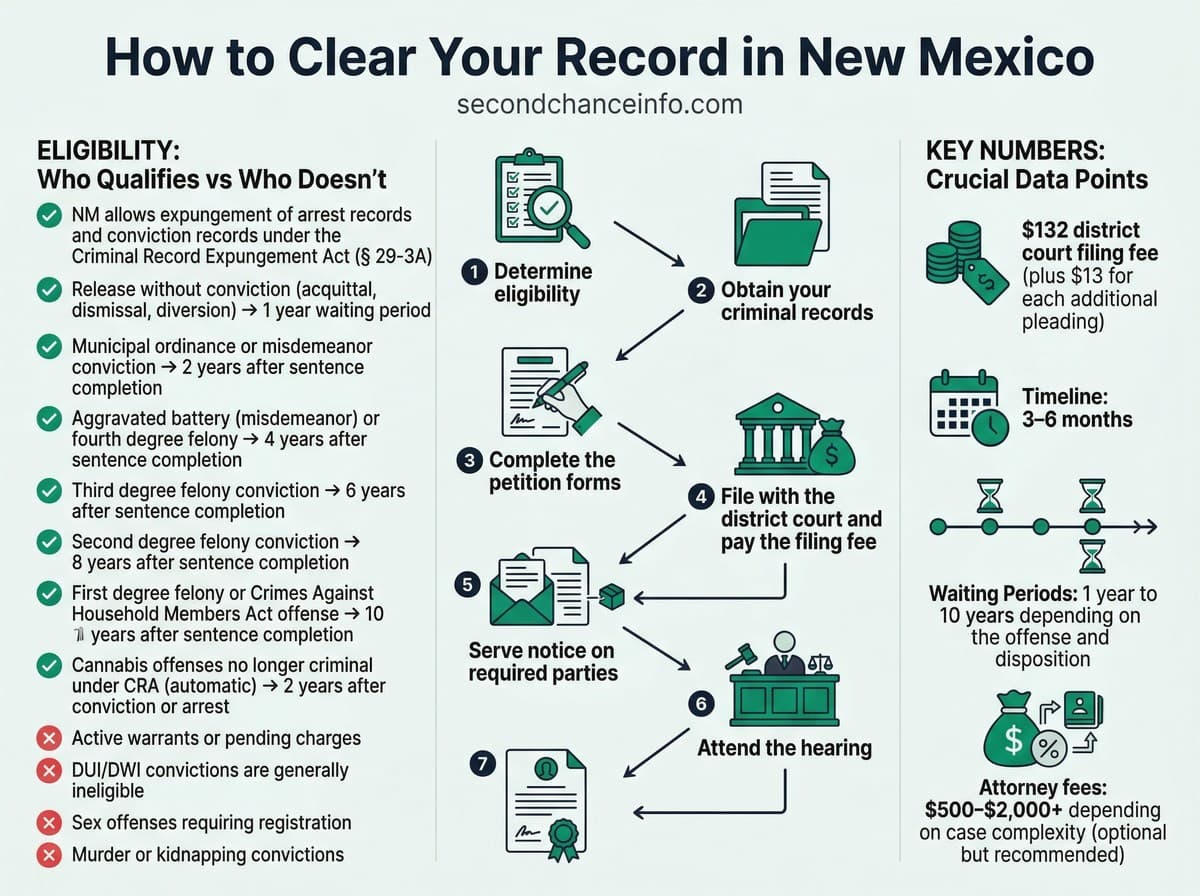
Yes, you can expunge your criminal record in New Mexico under the Criminal Record Expungement Act (NMSA 1978, § 29-3A). If your case ended without a conviction, you can petition after 1 year. For convictions, waiting periods range from 2 years (misdemeanors) to 10 years (first degree felonies) with no new convictions. Filing costs $132 (fee waivers available) and the process takes 3–6 months. DWI, sex offenses, crimes against children, embezzlement, and offenses causing great bodily harm or death are not eligible. Cannabis offenses that are no longer crimes are automatically expunged under the 2021 Cannabis Regulation Act. Expungement removes records from public view and background checks, but does not automatically restore firearm rights. Below is the full guide with eligibility, step-by-step process, costs, timeline, and FAQ.
Prepare questions about a record-clearing process
Last updated:
Overview
New Mexico allows expungement of both arrest records and conviction records under the Criminal Record Expungement Act (NMSA 1978, § 29-3A-1 to 29-3A-9), effective January 1, 2020. Expungement removes public records from court files and background checks. Cases that ended without a conviction can be expunged after a one-year waiting period. Conviction records can be expunged after waiting periods ranging from two to ten years depending on the offense, provided the person has completed their sentence, paid all fines and restitution, and has no new convictions. Certain serious offenses — crimes against children, sex offenses, DWI, embezzlement, and offenses causing great bodily harm or death — are not eligible. Cannabis offenses that are no longer crimes under the 2021 Cannabis Regulation Act are subject to automatic expungement.
Official term: Expungement (§ 29-3A) — New Mexico uses the term "expungement" officially. Once granted, arrest records and public records related to the case are removed from public view, though law enforcement and certain agencies may still access them under limited exceptions.
Routes and conditions to check
- ✓Cases that ended without a conviction (acquittal, dismissal, nolle prosequi, no bill, diversion referral, or conditional discharge) — after 1 year
- ✓Municipal ordinance violations — after 2 years with no new convictions
- ✓Misdemeanor convictions — after 2 years with no new convictions
- ✓Aggravated battery (misdemeanor) or fourth degree felony — after 4 years with no new convictions
- ✓Third degree felony convictions — after 6 years with no new convictions
- ✓Second degree felony convictions — after 8 years with no new convictions
- ✓First degree felony or Crimes Against Household Members Act offenses — after 10 years with no new convictions
- ✓Cannabis offenses that are no longer crimes under the 2021 Cannabis Regulation Act (automatic expungement)
Exclusions and limits to check
- ✗Offenses committed against a child
- ✗Offenses that caused great bodily harm or death to another person
- ✗Sex offenses requiring registration (as defined in § 29-11A-3 NMSA 1978)
- ✗Embezzlement (§ 30-16-8 NMSA 1978)
- ✗Driving while under the influence of intoxicating liquor or drugs (DWI/DUI)
Waiting Periods
| Release without conviction (acquittal, dismissal, diversion) | 1 year from final disposition |
| Municipal ordinance violation or misdemeanor conviction | 2 years after sentence completion |
| Aggravated battery (misdemeanor) or fourth degree felony | 4 years after sentence completion |
| Third degree felony conviction | 6 years after sentence completion |
| Second degree felony conviction | 8 years after sentence completion |
| First degree felony or Crimes Against Household Members Act offense | 10 years after sentence completion |
| Cannabis offenses no longer criminal under CRA (automatic) | 2 years after conviction or arrest |
Step-by-Step Process
Determine eligibility
Confirm that the required waiting period has passed since your final disposition (non-conviction) or sentence completion (conviction). Verify you have no pending charges and no new convictions during the waiting period. Check that your offense is not excluded (DWI, sex offense, crimes against children, embezzlement, or offenses causing great bodily harm or death).
Obtain your criminal records
Request your rap sheet from the New Mexico Department of Public Safety (DPS) and your FBI criminal history. Contact the court clerk for records of the case(s) you want to expunge. There are nominal fees for printing these records.
Complete the petition forms
Fill out the appropriate petition form: Form 4-952 NMRA for release without conviction, or Form 4-953 NMRA for conviction. Forms are available on the New Mexico Courts website at nmcourts.gov.
File with the district court and pay the filing fee
File your petition with the district court in the judicial district where the charges originated — even if the original case was in municipal, metropolitan, or magistrate court. Pay the $132 filing fee. If you cannot afford it, file an affidavit of indigency to request a fee waiver.
Serve notice on required parties
Send copies of the filed petition by certified mail (return receipt requested) to the district attorney for the district where the charges originated, the NM Department of Public Safety, and the law enforcement agency that arrested or investigated you. File a certificate of service with the court.
Attend the hearing
The court will schedule a hearing after the notice period has passed and any objections have been filed. Be prepared to answer questions about your petition and address any objections from the district attorney or other parties.
Receive the court order
If you are eligible and the court finds that justice will be served, the court shall issue a written order within 30 days of the hearing requiring that all arrest records and public records related to the case be expunged. If denied, you may refile after the court specifies the conditions.
Visual Guide
Automatic Cannabis Expungement (Cannabis Regulation Act, HB 2)
Under the 2021 Cannabis Regulation Act (HB 2), cannabis offenses that are no longer crimes — such as possession of 2 ounces or less — are subject to automatic expungement. An estimated 150,000+ New Mexico residents are eligible. Simple cases (cannabis-only charges in the court database) are expunged automatically by the state. More complex cases involving additional charges may require the individual to petition the court.
| Scenario | Timing and conditions |
|---|---|
| Cannabis conviction no longer a crime under CRA | 2 years after conviction date |
| Cannabis arrest with no conviction (no longer a crime) | 2 years after arrest date |
| Cannabis offense that would be a lesser offense under CRA | 2 years after conviction, reduced to lesser offense |
Costs
- Filing fee
- $132 district court filing fee (plus $13 for each additional pleading)
- Fee waiver
- Available by filing an affidavit of indigency if you cannot afford the fee
- Attorney (optional)
- $500–$2,000+ depending on case complexity (optional but recommended)
Additional costs may include certified mail for service (~$50), DPS rap sheet fee, and FBI criminal history report fee. Some legal aid organizations and the ACLU of New Mexico offer free assistance.
Timeline
- With attorney
- 2–4 months
- Standard
- 3–6 months
After the hearing, the court must issue its order within 30 days. Total timeline depends on court docket, whether objections are filed, and case complexity.
Effects of the relief
- ✓Removes arrest records and public records from court files and the court's website
- ✓Expunged records will not appear on standard employment background checks
- ✓Petitioner may answer 'no' when asked if they have been arrested or convicted
- ✓Helps remove barriers to employment, housing, and immigration clearance
- ✓Court clerk removes public records from their office
- ✓DPS updates its records to reflect the expungement
Limits of the relief
- ✗Does NOT automatically restore firearm rights — federal law may still prohibit possession
- ✗Does NOT prevent access by district attorneys and law enforcement under certain exceptions
- ✗Does NOT remove records from federal databases (e.g., NCIC for federal firearms checks)
- ✗Does NOT apply to DWI, sex offenses, crimes against children, embezzlement, or offenses causing great bodily harm or death
- ✗Does NOT guarantee the expunged record is invisible to employers requiring security clearance
- ✗SB 66 (2025) exempts early childhood education, public education, child protective services, and caregivers from expungement protections
Other Relief Options in New Mexico
Governor's Pardon (Executive Clemency)
The Governor can grant pardons and reprieves for state-law convictions. A pardon restores civil rights and may help with firearm rights. Applications are submitted through the Governor's office. Does not expunge or seal records.
Certificate of Restoration of Full Rights of Citizenship
An alternative to a full pardon, this certificate from the Governor restores a person's full rights of citizenship, including the right to vote, hold public office, serve on a jury, and possess firearms.
Automatic Restoration of Rights (Deferred Sentence)
Upon successful completion of all conditions of a deferred sentence and dismissal of charges, civil rights — including voting, holding office, jury service, and firearm possession — are restored automatically by operation of law.
Automatic Firearm Rights Restoration (10-year waiting period)
New Mexico law provides automatic restoration of firearm rights 10 years after completion of sentence or probation, provided no other prohibitions apply. Federal restrictions may still apply.
Frequently Asked Questions
- How much does expungement cost in New Mexico?
- The district court filing fee is $132, plus $13 for each additional pleading. You may also incur costs for certified mail (~$50), DPS rap sheet printing, and FBI criminal history report fees. If you cannot afford the filing fee, you can request a fee waiver by filing an affidavit of indigency. Attorney fees typically range from $500 to $2,000 or more depending on case complexity.
- How long does the expungement process take in New Mexico?
- The process typically takes 3 to 6 months from filing to completion. With an attorney, it may be completed in 2 to 4 months. After the hearing, the court must issue a written order within 30 days. Delays can occur if the district attorney files objections or the court docket is busy.
- Can a felony be expunged in New Mexico?
- Yes, most felonies can be expunged after the required waiting period (4 years for a fourth degree felony, 6 years for third degree, 8 years for second degree, 10 years for first degree) with no new convictions. However, felonies involving crimes against children, sex offenses, great bodily harm or death, embezzlement, and DWI are not eligible for expungement.
- Can a DWI be expunged in New Mexico?
- No. DWI/DUI convictions are specifically excluded from expungement under NMSA 1978, § 29-3A-5. This exclusion applies regardless of how much time has passed or how minor the offense was.
- Does expungement restore gun rights in New Mexico?
- Not automatically. While expungement removes records from public view, it does not guarantee restoration of firearm rights. Federal law may still prohibit firearm possession, especially for offenses involving violence, drugs, or domestic abuse. New Mexico does provide automatic restoration of state firearm rights 10 years after sentence completion, and a Governor's Pardon can also restore gun rights. Consult an attorney for your specific situation.
- What is automatic cannabis expungement in New Mexico?
- Under the 2021 Cannabis Regulation Act (HB 2), cannabis offenses that are no longer crimes — such as possession of 2 ounces or less — are automatically expunged 2 years after the conviction or arrest date. Simple cannabis-only cases are handled automatically by the state. If your case involved additional non-cannabis charges, you may need to petition the court to have the cannabis portion expunged.
- Do I need a lawyer for expungement in New Mexico?
- No, you can file for expungement on your own using free forms available on the New Mexico Courts website (nmcourts.gov). The courts provide step-by-step self-help instructions. However, an attorney can help navigate complex cases, ensure all forms are correctly completed, and represent you at the hearing. Legal aid organizations and the ACLU of New Mexico may offer free assistance.
- Where do I file my expungement petition in New Mexico?
- You must file in the district court in the judicial district where the charges originated — even if your original case was handled in municipal, metropolitan, or magistrate court. District courts have exclusive jurisdiction over expungement petitions.
Take Action — Direct Links
- New Mexico Courts — Expungement Forms & Instructions
Official expungement self-help page with downloadable petition forms (Form 4-952 NMRA for non-conviction, Form 4-953 NMRA for conviction), step-by-step filing instructions, and FAQs.
- Request Your Criminal Record (NM DPS)
Request your own rap sheet from the New Mexico Department of Public Safety Law Enforcement Records Bureau using the Authorization for Release of Information form ($15 fee).
- New Mexico Legal Aid — Free Expungement Assistance
Free expungement legal assistance through New Mexico Legal Aid's Volunteer Attorney Program for individuals with household income at or below 200% of the Federal Poverty Level.
- NM DPS Expungement Unit
New Mexico Department of Public Safety Expungement Unit page with information on how DPS processes expungement orders and updates criminal history records.
- NMSA 1978, § 29-3A — Full Statute Text (Criminal Record Expungement Act)
Official full text of the New Mexico Criminal Record Expungement Act (§§ 29-3A-1 to 29-3A-9) on Justia, covering eligibility, waiting periods, procedure, and exclusions.
Related Resources on This Site
More for your state
- Pardon & ClemencyPardon & clemency in New Mexico
- Jobs by CityFelony friendly jobs in Albuquerque, NM
- Jobs by StateJobs for felons in New Mexico
- HousingSecond chance apartments in Albuquerque, NM
- Voting RightsFelon voting rights in New Mexico
- Gun RightsFelon gun rights in New Mexico
- DUI RecoveryDUI license recovery in New Mexico
- ProbationProbation & parole in New Mexico
Helpful guides
- Background ChecksHow far back do background checks go?
- ToolsReentry organizations directory
- Free Legal AidFree legal aid by state
Sources
- NMSA 1978, § 29-3A-5 — Expungement of records upon conviction
- NMSA 1978, § 29-3A-4 — Expungement of records upon release without conviction
- NMSA 1978, § 29-3A-8 — Expungement procedure
- New Mexico Courts — Expungement Self-Help & Forms
- CCRC — New Mexico Restoration of Rights & Record Relief
- NM Department of Public Safety — Expungements