
Ohio (OH) — Expungement & Record Clearing
Yes, you can seal your criminal record in Ohio under ORC § 2953.32. Eligible misdemeanors can be sealed after 1 year; fourth/fifth-degree felonies after 1 year; third-degree felonies after 3 years. The filing fee is only $50 (poverty waiver available), and attorney fees range from $500–$2,000. The court must hold a hearing within 45–90 days of filing. First/second-degree felonies, sex offenses, and most violent crimes are not eligible. Ohio expanded eligibility through HB 96 (June 2025). Sealing removes the record from public view but law enforcement retains access. Below is the full guide with eligibility, step-by-step process, costs, timeline, and FAQ.
Prepare questions about a record-clearing process
Last updated:
Overview
Ohio allows both sealing and expungement of criminal records under ORC § 2953.32. While commonly referred to as expungement, the legal process in Ohio is technically sealing — the record is hidden from public view rather than destroyed. Eligibility depends on the severity of the offense and a mandatory waiting period after completing the sentence. Ohio expanded eligibility significantly in recent years, including through HB 96 (signed June 2025), which broadened the range of eligible offenses.
Official term: Sealing / Expungement (ORC § 2953.32) — Ohio uses both "sealing" and "expungement" but the practical effect is the same: the record is sealed from public view. The record is not physically destroyed — law enforcement and the Bureau of Criminal Investigation (BCI) retain access.
Routes and conditions to check
- ✓Minor misdemeanors (after 6-month waiting period)
- ✓Misdemeanors of the 1st through 4th degree (after 1-year waiting period)
- ✓Fourth-degree and fifth-degree felonies (after 1-year waiting period)
- ✓Third-degree felonies — up to 2 convictions (after 3-year waiting period)
- ✓Multiple eligible convictions can be sealed (no strict numerical cap for most offenses)
- ✓Completed all terms of sentence, including probation and restitution
Exclusions and limits to check
- ✗First-degree felonies
- ✗Second-degree felonies
- ✗Most violent offenses (assault, robbery, etc., with some exceptions)
- ✗Sex offenses, especially those requiring registration
- ✗Offenses against minors
- ✗Convictions where the victim was under 18
- ✗Repeat OVI (DUI) offenses within a certain timeframe
- ✗Bail forfeiture cases in some circumstances
Waiting Periods
| Minor misdemeanors | 6 months after final discharge |
| Misdemeanors (1st–4th degree) | 1 year after final discharge |
| Fourth-degree and fifth-degree felonies | 1 year after final discharge |
| Third-degree felonies (up to 2 convictions) | 3 years after final discharge |
| Not guilty / dismissed charges | Immediately eligible |
Step-by-Step Process
Check eligibility
Determine whether your conviction qualifies for sealing under ORC § 2953.32. Confirm the offense level, verify you have completed all terms of your sentence (including probation and restitution), and calculate the applicable waiting period.
Obtain your criminal record
Request a copy of your criminal history from the Ohio Bureau of Criminal Investigation (BCI) or check online through the Ohio Attorney General's website. Identify all cases you want to seal.
Prepare the application
Complete the Application to Seal Record of Conviction (standard form available from the court). Include a certified copy of the case docket, proof of sentence completion, and any supporting documentation of rehabilitation.
File the application and pay the fee
File the application with the court that handled the original case. Pay the $50 application fee. If you cannot afford the fee, you may file a poverty affidavit to request a fee waiver.
Hearing
The court schedules a hearing within 45 to 90 days of filing. The prosecutor is notified and may object. At the hearing, the judge weighs your interest in sealing against any legitimate government need to maintain the record.
Court order and record update
If the judge grants the application, a sealing order is issued. The record is sealed from public databases and background checks. BCI updates its records. You may lawfully deny the conviction on most applications.
Visual Guide
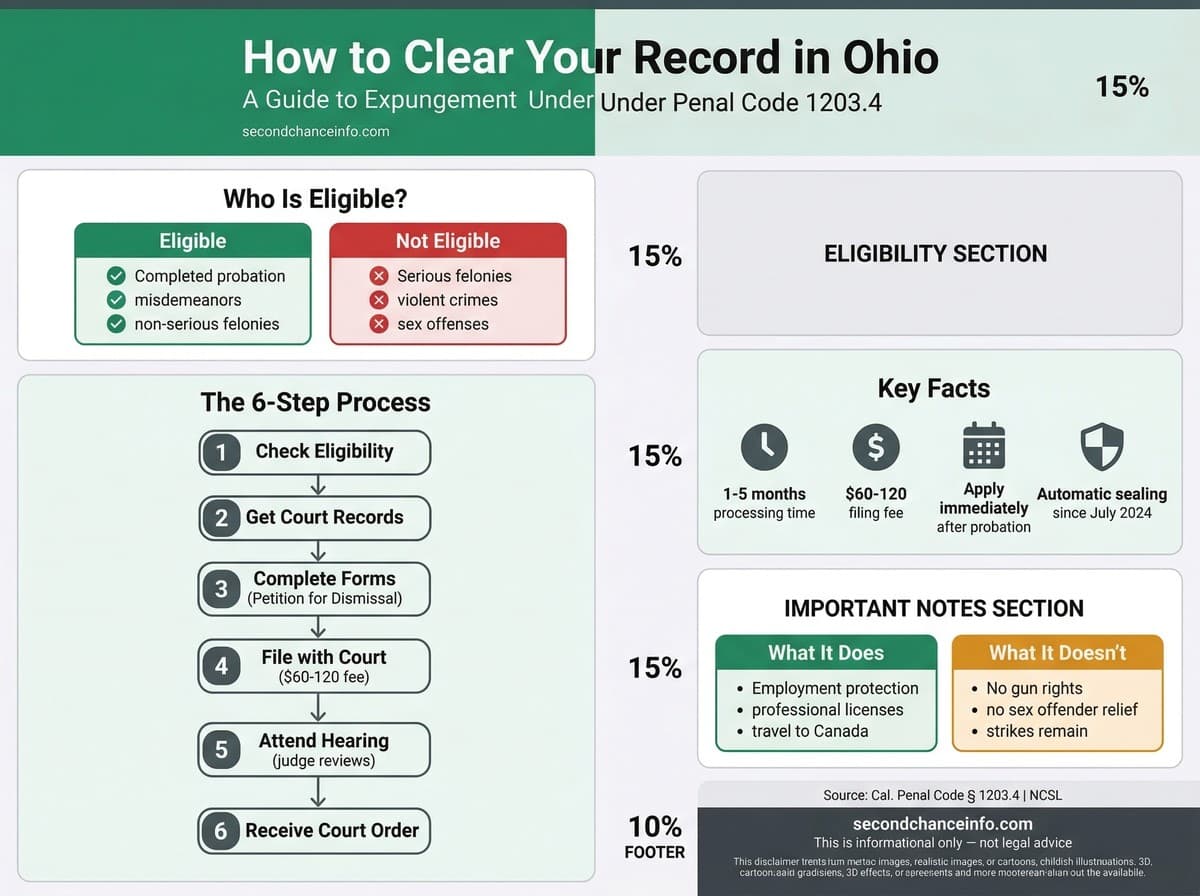
Automatic Relief in Ohio
Ohio does not currently have a comprehensive automatic expungement or sealing program for convictions. However, certain non-conviction records (dismissals, not-guilty verdicts) may be sealed automatically or upon simple request without a hearing.
| Scenario | Timing and conditions |
|---|
Costs
- Filing fee
- $50 application fee
- Fee waiver
- Poverty affidavit available — fee waived if you cannot afford it
- Attorney (optional)
- $500–$2,000 typical range
Ohio's filing fee is among the lowest in the country. The poverty waiver makes this accessible even for those with limited resources.
Timeline
- With attorney
- 2–4 months
- Standard
- 3–6 months
The court must schedule a hearing within 45 to 90 days of filing. Total timeline depends on county court schedules and whether the prosecutor contests the application.
Effects of the relief
- ✓Seals the record from public background checks and court databases
- ✓Allows you to lawfully deny the conviction on most job, housing, and education applications
- ✓Removes the record from commercial background check databases
- ✓Improves access to employment, housing, and professional opportunities
- ✓Record is treated as if the conviction never occurred for most civil purposes
Limits of the relief
- ✗Does NOT destroy the record — it still exists in sealed form
- ✗Law enforcement and the Bureau of Criminal Investigation (BCI) retain full access
- ✗Sealed records may still be considered for sentencing in future criminal cases
- ✗Certain professional licensing boards may access sealed records
- ✗Does NOT automatically restore firearm rights
- ✗Federal background checks may still reveal the conviction
Other Relief Options in Ohio
Certificate of Qualification for Employment (CQE)
Available to individuals who are ineligible for sealing. A CQE lifts automatic bars to employment and licensing caused by a conviction. Does not seal the record but removes the legal barrier.
Governor's Pardon
The Governor of Ohio can grant a pardon, which forgives the offense and may restore civil rights. Does not seal or destroy the record.
Frequently Asked Questions
- Can a felony be expunged in Ohio?
- Yes, certain felonies can be sealed in Ohio. Fourth-degree and fifth-degree felonies are eligible after 1 year. Up to 2 third-degree felony convictions can be sealed after 3 years. First-degree and second-degree felonies are not eligible for sealing.
- How much does it cost to expunge a record in Ohio?
- The court filing fee is $50. If you cannot afford it, you can file a poverty affidavit to have the fee waived. Attorney fees typically range from $500 to $2,000 depending on the complexity of the case.
- How long does the expungement process take in Ohio?
- The court must schedule a hearing within 45 to 90 days after you file the application. Including preparation time, the entire process typically takes 2 to 6 months.
- Can I seal multiple convictions in Ohio?
- Yes. Ohio does not impose a strict numerical cap on most eligible offenses. You can seal multiple misdemeanor and eligible felony convictions, though each must independently qualify and meet the waiting period. Third-degree felonies are limited to 2.
- What did Ohio HB 96 change?
- HB 96, signed in June 2025, expanded the range of offenses eligible for sealing in Ohio. It broadened eligibility criteria and updated the list of qualifying offenses, making record sealing available to more individuals.
- Can a DUI/OVI be expunged in Ohio?
- A single OVI (Ohio's term for DUI) conviction may be eligible for sealing, depending on the circumstances. However, repeat OVI offenses within a certain timeframe are generally not eligible. Consult an attorney for your specific situation.
- Who can still see my sealed record in Ohio?
- Law enforcement agencies, the Bureau of Criminal Investigation (BCI), prosecutors, and certain licensing boards retain access to sealed records. Courts can also unseal records if there is a legitimate reason. The sealed record may still be considered for sentencing enhancement in future criminal cases.
Take Action — Direct Links
- Ohio Legal Help: How to Seal a Criminal Record
Step-by-step self-help guide with eligibility information, instructions, and links to county-specific application forms for sealing records in Ohio.
- Request Your Own Criminal Records (Ohio AG / BCI)
Request a copy of your Ohio criminal history from the Bureau of Criminal Investigation (BCI) through the Ohio Attorney General's office.
- Ohio Legal Aid — Free Record Sealing Help
Opportunity Port connects Ohio residents with free legal assistance to apply to seal or expunge a criminal record — complete a 5-minute eligibility survey to get started.
- Hamilton County Clerk: Record Sealing/Expungement Self-Help
Self-help resources including downloadable application forms and instructions for sealing or expunging records in Hamilton County (Cincinnati), Ohio.
- ORC § 2953.32 — Full Statute Text
Official full text of Ohio Revised Code Section 2953.32 (sealing of conviction record or bail forfeiture record) on the Ohio Laws website.
Related Resources on This Site
More for your state
- Pardon & ClemencyPardon & clemency in Ohio
- Jobs by CityFelony friendly jobs in Columbus, OH
- Jobs by StateJobs for felons in Ohio
- HousingSecond chance apartments in Columbus, OH
- Voting RightsFelon voting rights in Ohio
- Gun RightsFelon gun rights in Ohio
- DUI RecoveryDUI license recovery in Ohio
- ProbationProbation & parole in Ohio
Helpful guides
- Background ChecksHow far back do background checks go?
- ToolsReentry organizations directory
- Free Legal AidFree legal aid by state