
Delaware (DE) — Expungement & Record Clearing
Yes, you can expunge your criminal record in Delaware. Delaware offers mandatory expungement through the State Bureau of Identification for violations (3-year wait), misdemeanors (5-year wait), and certain felonies (10-year wait) with no other convictions. Discretionary expungement is available by court petition for additional offenses. Since August 2024, the Clean Slate Act (SB 111) automatically expunges qualifying records monthly. Filing costs $52 (SBI) or $70 (court). DUI, domestic violence, sex offenses, and violent felonies are not eligible. Expungement deletes your record from public view — only judges and law enforcement retain access. Below is the full guide with eligibility, step-by-step process, costs, timeline, and FAQ.
Prepare questions about a record-clearing process
Last updated:
Overview
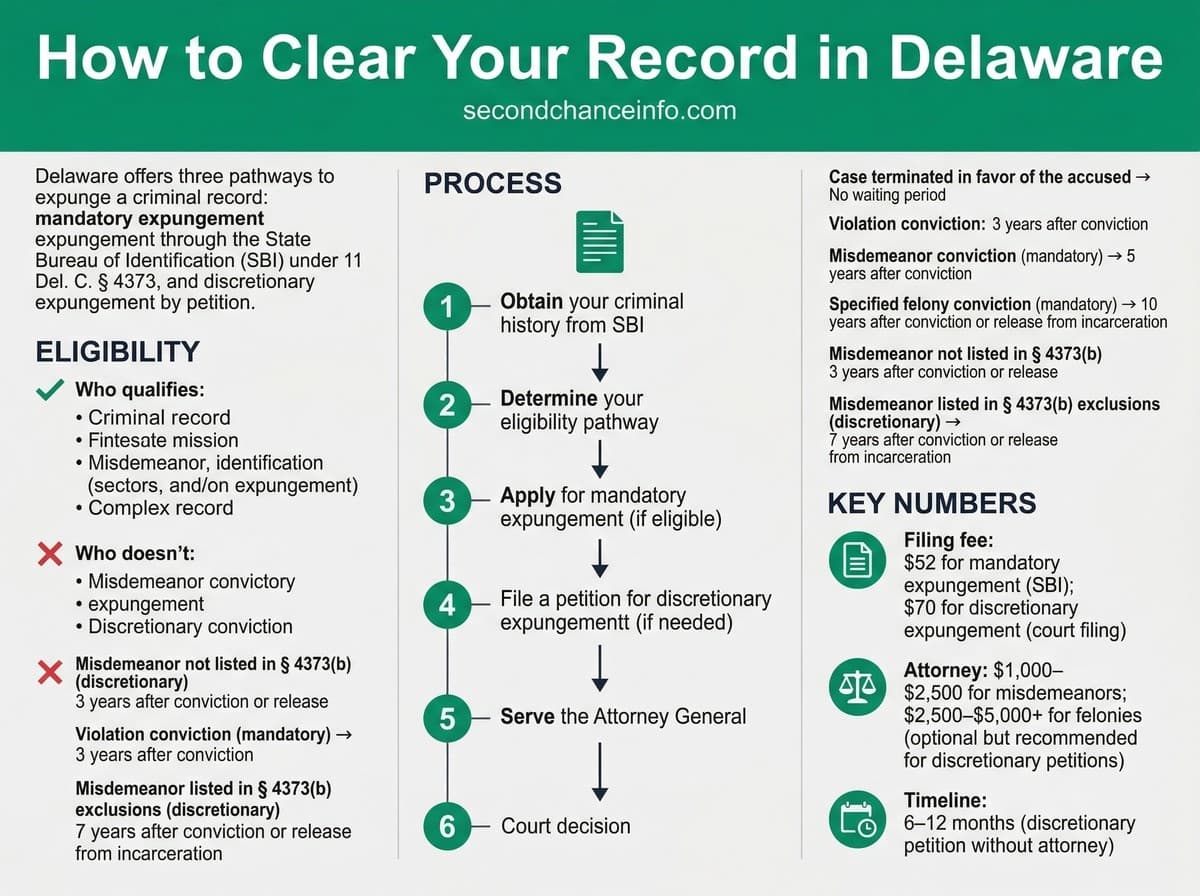
Delaware offers three pathways to expunge a criminal record: mandatory expungement through the State Bureau of Identification (SBI) under 11 Del. C. § 4373, discretionary expungement by petition to Superior Court or Family Court under § 4374, and automatic expungement under the Clean Slate Act (SB 111), which took effect August 1, 2024. Expungement in Delaware deletes the record and restores the person to the status they held before the offense.
Official term: Expungement (11 Del. C. §§ 4371–4375) — Delaware uses the term "expungement" in statute. Unlike sealing in other states, Delaware expungement removes the record so that only judges and law enforcement can access it.
Routes and conditions to check
- ✓Cases terminated in favor of the accused (acquittal, nolle prosequi, dismissal)
- ✓Violations where 3 or more years have passed since conviction with no other convictions
- ✓Misdemeanors (or combined misdemeanor/violation same case) where 5 or more years have passed since conviction with no other convictions
- ✓Certain specified felonies where 10 or more years have passed since conviction or release from incarceration with no other convictions
- ✓Marijuana possession or drug paraphernalia convictions (mandatory expungement eligible)
- ✓Underage possession or consumption of alcohol convictions (mandatory expungement eligible)
- ✓Charges 7 or more years old with no disposition indicated, listed as unknown, unobtainable, or pending (treated as dismissed)
- ✓One nonviolent felony conviction (discretionary) with 7+ years since conviction or release and no other convictions
Exclusions and limits to check
- ✗First- or second-degree murder
- ✗First- or second-degree rape
- ✗Manslaughter
- ✗Felonies involving physical or sexual assault
- ✗Sex offenses requiring registration
- ✗Crimes of domestic violence
- ✗DUI / driving under the influence offenses
- ✗Offenses where the victim was a child or vulnerable adult
- ✗Currently pending charges or subsequent convictions during the waiting period
Waiting Periods
| Case terminated in favor of the accused | No waiting period |
| Violation conviction (mandatory) | 3 years after conviction |
| Misdemeanor conviction (mandatory) | 5 years after conviction |
| Specified felony conviction (mandatory) | 10 years after conviction or release from incarceration |
| Misdemeanor not listed in § 4373(b) (discretionary) | 3 years after conviction or release |
| Misdemeanor listed in § 4373(b) exclusions (discretionary) | 7 years after conviction or release |
| One nonviolent felony (discretionary) | 7 years after conviction or release from incarceration |
Step-by-Step Process
Obtain your criminal history from SBI
Contact the Delaware State Bureau of Identification (SBI) at (302) 739-5884 to request a copy of your criminal history. You will need this to determine eligibility and to attach to any petition.
Determine your eligibility pathway
Review your record to determine whether you qualify for mandatory expungement (through SBI), discretionary expungement (petition to court), or whether your record may be automatically expunged under the Clean Slate Act. The SBI can confirm mandatory eligibility.
Apply for mandatory expungement (if eligible)
If SBI determines you are eligible for mandatory expungement under § 4373, they will provide a letter with instructions. Pay the $52 SBI processing fee. SBI is required to expunge qualifying records.
File a petition for discretionary expungement (if needed)
If your case requires discretionary expungement under § 4374, file a petition in Superior Court (or Family Court if all charges were disposed of there) in the county where the most recent case was terminated. Attach your SBI criminal history to the petition. Pay the $70 filing fee.
Serve the Attorney General
After filing, serve a copy of the petition on the Delaware Attorney General's office. The AG has 120 days to file an objection or answer. If the AG files an answer, you have 30 days to file a reply.
Court decision
The court decides most petitions without a hearing unless it determines one is necessary. The court grants expungement if it finds the continued existence of the record causes or may cause manifest injustice. If granted, SBI notifies all courts and law enforcement agencies to expunge the record.
Visual Guide
Automatic Expungement (Clean Slate Act — SB 111)
Under the Clean Slate Act (SB 111), effective August 1, 2024, the SBI identifies and expunges records eligible for mandatory expungement on a monthly basis without requiring a petition. Over 290,000 Delawareans may qualify, though implementation has been gradual as SBI reviews records individually.
| Scenario | Timing and conditions |
|---|---|
| Case terminated in favor of the accused | Eligible immediately (processed monthly by SBI) |
| Violation conviction, no other convictions | 3 years after conviction |
| Misdemeanor conviction, no other convictions | 5 years after conviction |
| Marijuana possession or drug paraphernalia conviction | Per mandatory eligibility criteria |
| Underage alcohol possession/consumption conviction | Per mandatory eligibility criteria |
| Specified felony, no other convictions | 10 years after conviction or release |
| Charges with no disposition (7+ years old) | Treated as dismissed and eligible |
Costs
- Filing fee
- $52 for mandatory expungement (SBI); $70 for discretionary expungement (court filing)
- Fee waiver
- Financial assistance available through the Office of Defense Services and legal aid organizations for those who qualify
- Attorney (optional)
- $1,000–$2,500 for misdemeanors; $2,500–$5,000+ for felonies (optional but recommended for discretionary petitions)
Mandatory expungement through SBI does not require an attorney. The ODS expungement hotline at (302) 577-5142 provides free guidance.
Timeline
- With attorney
- 4–6 months (discretionary petition)
- Standard
- 6–12 months (discretionary petition without attorney)
Mandatory expungement through SBI can be faster. The Attorney General has 120 days to respond to discretionary petitions. Automatic expungement under the Clean Slate Act is processed monthly by SBI but rollout has been gradual.
Effects of the relief
- ✓Deletes the criminal record and restores the person to pre-offense status
- ✓Record is hidden from employers, landlords, banks, and the general public
- ✓Employers cannot request information about expunged records
- ✓Consumer reporting agencies will not report expunged records
- ✓You can legally answer “no” to questions about criminal history for expunged offenses
- ✓Removes barriers to employment, housing, and education opportunities
Limits of the relief
- ✗Does NOT destroy the record entirely — judges and law enforcement can still access it
- ✗Does NOT automatically restore firearm rights for all convictions (a pardon may be needed)
- ✗Does NOT expunge DUI convictions, domestic violence crimes, or sex offenses
- ✗Does NOT apply to convictions with subsequent or pending charges during the waiting period
- ✗Does NOT guarantee restoration of professional licenses — licensing boards may have separate rules
- ✗Does NOT remove the obligation to disclose to certain government agencies when specifically required by law
Other Relief Options in Delaware
Governor’s Pardon
A pardon fully restores all civil rights including the right to vote, serve on a jury, purchase or possess firearms, and hold public office. A pardon does not remove the conviction from the record but adds that a pardon was granted. Apply through the Delaware Board of Pardons.
Pardon Followed by Expungement
For convictions not otherwise eligible for expungement, obtaining a Governor’s Pardon may open the door to subsequent expungement proceedings to remove the record entirely.
Office of Defense Services (ODS) Assistance
The ODS provides free expungement guidance and assistance. Contact the ODS expungement hotline at (302) 577-5142. Financial assistance for fees is available for eligible individuals.
Frequently Asked Questions
- How much does expungement cost in Delaware?
- Mandatory expungement through the SBI costs $52. Discretionary expungement filed with the court costs $70 in filing fees. If you hire an attorney, expect to pay $1,000–$2,500 for misdemeanors or $2,500–$5,000+ for felonies. Financial assistance is available through the Office of Defense Services for those who qualify.
- What is Delaware’s Clean Slate Act?
- The Clean Slate Act (SB 111) took effect August 1, 2024. It requires the State Bureau of Identification to automatically identify and expunge records that qualify for mandatory expungement on a monthly basis, without requiring the individual to file a petition. Over 290,000 Delawareans may qualify, though implementation has been gradual.
- Can a felony be expunged in Delaware?
- Yes, but only limited felonies. Certain specified nonviolent felonies are eligible for mandatory expungement after 10 years with no other convictions. One nonviolent felony may also qualify for discretionary expungement after 7 years. Felonies involving physical or sexual assault, murder, rape, and manslaughter cannot be expunged.
- What is the difference between mandatory and discretionary expungement in Delaware?
- Mandatory expungement (§ 4373) means the SBI must expunge the record if all eligibility criteria are met — no judge’s discretion is involved. Discretionary expungement (§ 4374) requires filing a petition with Superior Court or Family Court, where a judge decides whether expungement is warranted based on a “manifest injustice” standard.
- How long does expungement take in Delaware?
- Mandatory expungement through SBI can take a few weeks to several months. Discretionary expungement typically takes 4–12 months because the Attorney General has 120 days to respond. Automatic expungement under the Clean Slate Act is processed monthly by SBI but rollout has been gradual since August 2024.
- Can I expunge a DUI in Delaware?
- No. DUI convictions are not eligible for expungement in Delaware. However, if the DUI charge was dismissed or you were acquitted, the arrest record may be eligible for expungement as a case terminated in favor of the accused.
- Does expungement restore gun rights in Delaware?
- Expungement can remove firearm prohibitions tied to certain expunged convictions. However, for felony convictions that are not eligible for expungement, a Governor’s Pardon is typically required to restore firearm rights. Consult an attorney for your specific situation.
- Do I need an attorney for expungement in Delaware?
- For mandatory expungement through SBI, you do not need an attorney — SBI handles the process once eligibility is confirmed. For discretionary expungement, an attorney is not required but is recommended, especially for felony cases, since you must demonstrate “manifest injustice” to the court. The Office of Defense Services offers free guidance at (302) 577-5142.
Take Action — Direct Links
- Download Adult Expungement Petition and Instructions
Official Delaware Courts adult expungement instruction packet with petition form and step-by-step filing instructions for Superior Court.
- Request Your Criminal History Record (Delaware SBI)
Delaware State Police page for obtaining a certified personal criminal history report through IdentoGO fingerprinting. SBI is located at 600 S. Bay Road, Dover, DE 19901; call (302) 739-5884.
- Free Expungement Help (Office of Defense Services)
Delaware Office of Defense Services expungement page with free clinics, eligibility guidance, and contact information. Call the ODS expungement hotline at (302) 577-5142.
- Delaware Courts — Expungement Help and Information
Delaware Courts self-help page explaining mandatory vs. discretionary expungement, filing instructions, and links to all expungement forms.
- 11 Del. C. Ch. 43, Subchapter VII — Full Statute Text
Official full text of Delaware's expungement statutes (sections 4371-4375) on the Delaware Code Online website.
Related Resources on This Site
More for your state
- Pardon & ClemencyPardon & clemency in Delaware
- Jobs by StateJobs for felons in Delaware
- HousingSecond chance apartments in Wilmington, DE
- Voting RightsFelon voting rights in Delaware
- Gun RightsFelon gun rights in Delaware
- DUI RecoveryDUI license recovery in Delaware
- ProbationProbation & parole in Delaware
- SR22 InsuranceSR22 insurance in Delaware
Helpful guides
- Background ChecksHow far back do background checks go?
- ToolsReentry organizations directory
- Free Legal AidFree legal aid by state
Sources
- 11 Del. C. Ch. 43, Subchapter VII (Expungement of Criminal Records)
- Delaware Courts — Expungement/Pardon Help
- Office of Defense Services — Expungements
- ACLU Delaware — Clean Slate Delaware
- SB 111 (Clean Slate Act) — Delaware General Assembly
- Board of Pardons — How to Apply for Expungement
- 11 Del. C. § 4373 (Mandatory Expungement) — Justia
- 11 Del. C. § 4374 (Discretionary Expungement) — Justia