
Colorado (CO) — Expungement & Record Clearing
Yes, you can seal your criminal record in Colorado under CRS §§ 24-72-701 et seq. Eligible offenses include petty offenses, most misdemeanors, and Class 4–6 felonies after waiting periods of 1–5 years. The filing fee is $65 (fee waiver available), and the process takes 2–6 months. Since July 2024, the Clean Slate Act (SB 22-099) automatically seals many records after 4–10 years — over 100,000 records sealed so far. DUI, domestic violence, violent felonies, and sex offenses are not eligible. Sealing hides records from public view but does not destroy them or restore gun rights. Below is the full guide with eligibility, step-by-step process, costs, timeline, and FAQ.
Prepare questions about a record-clearing process
Last updated:
Overview
Colorado primarily uses "record sealing" rather than expungement for adult criminal records. Sealed records are hidden from public view but not destroyed — law enforcement and courts retain access. True expungement (destruction of records) is available only for juvenile offenses and certain underage drinking-and-driving convictions. Since July 2024, the Colorado Clean Slate Act (SB 22-099) has enabled automatic sealing of many eligible records, with felony automatic sealing beginning July 2025.
Official term: Record Sealing (CRS §§ 24-72-701 et seq.) — Colorado distinguishes between "sealing" (hiding records from public view) and "expungement" (physical destruction). Adults are eligible for sealing; true expungement applies only to juvenile records and certain underage DUI convictions.
Routes and conditions to check
- ✓Arrests where no charges were filed (automatic sealing after 1 year for post-2022 arrests)
- ✓Cases resulting in dismissal or acquittal (immediate sealing available)
- ✓Civil infractions and petty offenses (1-year waiting period)
- ✓Class 2 and Class 3 misdemeanors and drug misdemeanors (2-year waiting period)
- ✓Class 1 misdemeanors (3-year waiting period)
- ✓Class 4, 5, and 6 felonies (3-year waiting period)
- ✓Level 3 and Level 4 drug felonies (3-year waiting period)
- ✓Level 2 drug felonies (5-year waiting period)
- ✓Pardoned convictions
- ✓Convictions for conduct that is no longer criminalized under Colorado law
- ✓Successfully completed deferred judgments and diversion agreements
Exclusions and limits to check
- ✗Class 1, 2, or 3 felonies
- ✗Level 1 drug felonies
- ✗Crimes of violence (CRS § 18-1.3-406)
- ✗Unlawful sexual behavior offenses
- ✗DUI and DWAI convictions
- ✗Domestic violence convictions (unless DA consents or court finds exceptional circumstances)
- ✗Class 1 and Class 2 misdemeanor traffic offenses
- ✗Class A and Class B traffic infractions
- ✗Extraordinary risk crimes
- ✗Child abuse convictions
- ✗Victim Rights Act (VRA) crimes with named victims (with limited exceptions)
- ✗Cases with outstanding restitution obligations
Waiting Periods
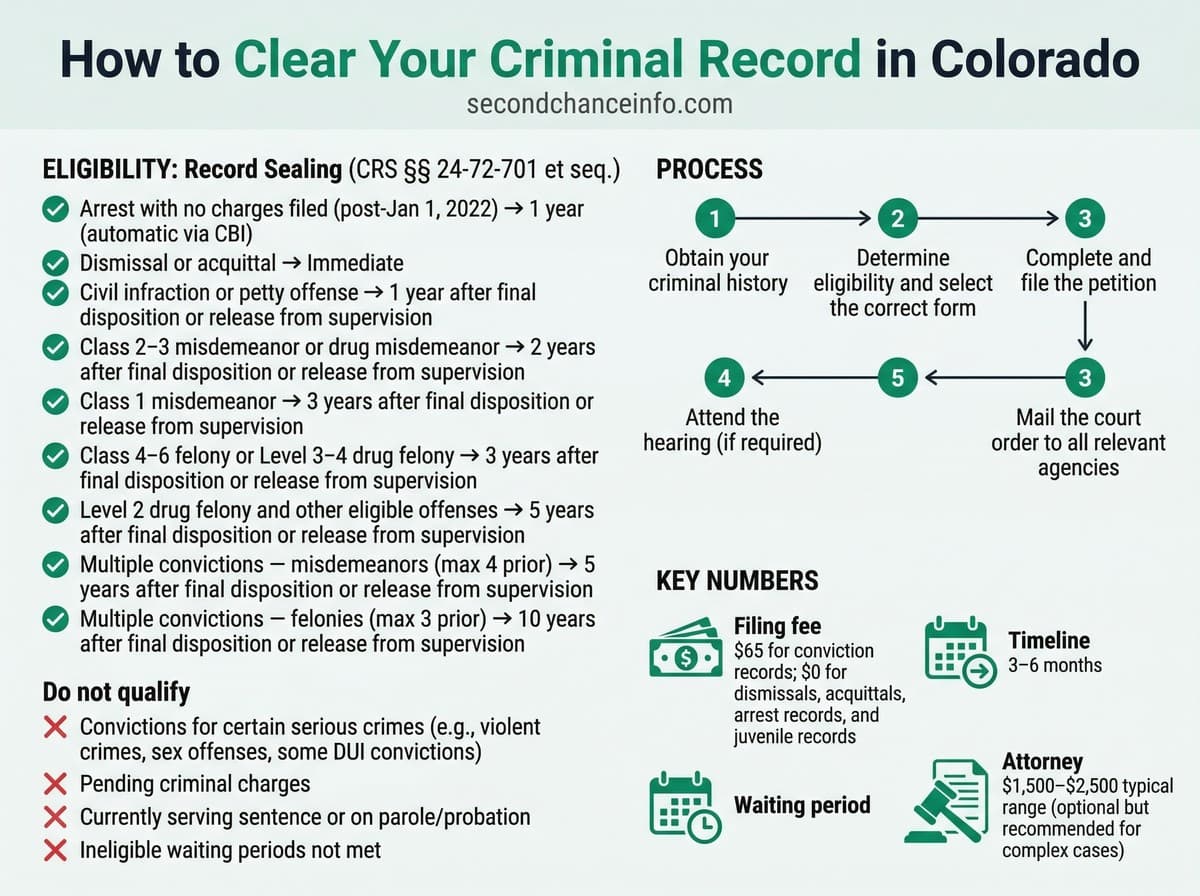
| Arrest with no charges filed (post-Jan 1, 2022) | 1 year (automatic via CBI) |
| Dismissal or acquittal | Immediate |
| Civil infraction or petty offense | 1 year after final disposition or release from supervision |
| Class 2–3 misdemeanor or drug misdemeanor | 2 years after final disposition or release from supervision |
| Class 1 misdemeanor | 3 years after final disposition or release from supervision |
| Class 4–6 felony or Level 3–4 drug felony | 3 years after final disposition or release from supervision |
| Level 2 drug felony and other eligible offenses | 5 years after final disposition or release from supervision |
| Multiple convictions — misdemeanors (max 4 prior) | 5 years after final disposition or release from supervision |
| Multiple convictions — felonies (max 3 prior) | 10 years after final disposition or release from supervision |
Step-by-Step Process
Obtain your criminal history
Request your criminal history from the Colorado Bureau of Investigation (CBI) — the report costs approximately $13. You may also request records from the arresting police department. This step confirms your eligibility and identifies the case numbers you need.
Determine eligibility and select the correct form
Review your records against the eligibility criteria in CRS § 24-72-706. The Colorado Judicial Branch provides specific JDF forms: JDF 417 for arrest records, JDF 612 for single convictions, JDF 641 for multiple convictions, and others depending on your situation. Forms and instructions are available at coloradojudicial.gov.
Complete and file the petition
Fill out the appropriate petition or motion form and file it with the court where your case was heard. Pay the $65 filing fee (fee waiver available via JDF 205 for those who qualify as indigent). Serve the district attorney with a copy of your petition.
Attend the hearing (if required)
The court sets a hearing date, typically 4–6 weeks after filing. The DA may object. As of HB 24-1133, hearings can be conducted remotely. The judge considers your rehabilitation, time elapsed, and public safety factors. For non-conviction cases, a hearing may not be required.
Mail the court order to all relevant agencies
If the judge grants your petition, you receive a court order to seal. You must mail certified copies of the order to all agencies that hold your records (CBI, arresting agency, etc.). Records are typically sealed within 30 days of agency receipt.
Visual Guide
Automatic Record Sealing (Clean Slate Act — SB 22-099 / HB 24-1133)
The Colorado Clean Slate Act (SB 22-099, effective July 1, 2024) and HB 24-1133 provide automatic record sealing without filing a petition. The State Court Administrator compiles lists of eligible cases, and District Attorneys have 45 days to object. Over 100,000 records were automatically sealed in the first year of the program.
| Scenario | Timing and conditions |
|---|---|
| Arrest with no charges filed (post-Jan 1, 2022) | Automatic via CBI, 60 days after 1 year from arrest |
| Dismissal or acquittal | Automatic upon case disposition |
| Civil infractions | 4 years after final disposition |
| Petty offenses and misdemeanors | 7 years after final disposition |
| Eligible felonies (Class 4–6, Level 2–4 drug felonies) | 10 years after final disposition or release from supervision |
| Deferred judgments and diversion agreements (HB 24-1133) | Automatic upon successful completion |
Costs
- Filing fee
- $65 for conviction records; $0 for dismissals, acquittals, arrest records, and juvenile records
- Fee waiver
- Available for indigent individuals via form JDF 205; also waived for pardoned convictions and cases that should have been automatically sealed
- Attorney (optional)
- $1,500–$2,500 typical range (optional but recommended for complex cases)
Additional costs include a CBI criminal history report (~$13), postage (~$5), and process service ($90–$110 in the Denver metro area). The Colorado State Public Defender cannot file sealing petitions, but courthouse Self-Help Centers offer free guidance.
Timeline
- With attorney
- 2–4 months
- Standard
- 3–6 months
Courts typically set hearing dates 4–6 weeks after filing. After approval, agencies seal records within about 30 days. Processing time varies by judicial district. Do not wait for automatic sealing if you are eligible to petition — automatic timelines are significantly longer (4–10 years).
Effects of the relief
- ✓Hides criminal records from public view, including most background checks
- ✓Allows you to legally deny the existence of the sealed record on most applications
- ✓Government agencies must respond that no public record exists
- ✓Removes barriers to employment for most private-sector jobs
- ✓Removes barriers to housing applications
- ✓Can improve eligibility for professional licensing in many fields
Limits of the relief
- ✗Does NOT destroy the record — law enforcement and courts retain access
- ✗Does NOT restore firearm rights for felony convictions (requires Governor's Pardon)
- ✗Does NOT vacate or overturn the conviction
- ✗Does NOT prevent use of sealed records in future criminal proceedings
- ✗Does NOT prevent disclosure to certain employers (law enforcement, schools, childcare agencies)
- ✗Does NOT prevent disclosure when applying for the Colorado Bar or certain professional licenses
- ✗Prior sealed DUI/DWAI convictions still count for sentencing enhancement purposes
Other Relief Options in Colorado
Governor's Pardon
A pardon is public forgiveness for a crime granted by the Governor after completion of the sentence. It is the only way to restore firearm rights after a felony conviction in Colorado. Applications are submitted to the Office of Executive Clemency. Pardons are rarely granted.
Commutation of Sentence
The Governor may reduce a criminal sentence. Applications require documentation from correctional facilities and evidence of rehabilitation. Submitted to the Office of Executive Clemency at 940 Broadway, Denver, CO 80203.
Juvenile Record Expungement
Unlike adult record sealing, juvenile delinquency records can be truly expunged (physically destroyed) under CRS § 19-1-306. This is the only true expungement available in Colorado.
Frequently Asked Questions
- How much does it cost to seal your record in Colorado?
- The court filing fee is $65 for conviction records. Dismissals, acquittals, and arrest records with no charges are free to seal. Additional costs include the CBI criminal history report (~$13) and postage (~$5). If you hire an attorney, expect $1,500–$2,500 depending on complexity. Fee waivers are available for those who qualify as indigent (form JDF 205).
- How long does record sealing take in Colorado?
- The petition-based process typically takes 2–6 months from filing to completion. Courts set hearing dates about 4–6 weeks after filing, and agencies seal records within about 30 days after receiving the court order. Automatic sealing under the Clean Slate Act takes significantly longer — 4 years for civil infractions, 7 years for misdemeanors, and 10 years for eligible felonies.
- Can a felony be sealed in Colorado?
- Yes, but only certain felonies. Class 4, 5, and 6 felonies and Level 2–4 drug felonies can be sealed after the applicable waiting period (3–5 years). Class 1, 2, and 3 felonies, Level 1 drug felonies, crimes of violence, and sex offenses cannot be sealed. You must have no outstanding restitution and no intervening convictions.
- Does Colorado have automatic record sealing?
- Yes. The Colorado Clean Slate Act (SB 22-099) took effect July 1, 2024 for misdemeanors and petty offenses, and July 1, 2025 for eligible felonies. Records are automatically sealed after 4 years (civil infractions), 7 years (misdemeanors), or 10 years (felonies) from the final disposition. Over 100,000 records were sealed in the first year. District Attorneys can object within 45 days.
- Can a DUI be sealed in Colorado?
- No. DUI and DWAI convictions are permanently ineligible for sealing in Colorado. The only exception is underage DUI convictions (BAC .02%–.05%), which can be sealed after the person turns 21. DUI charges that were dismissed or resulted in acquittal can be sealed.
- Can domestic violence convictions be sealed in Colorado?
- Generally no — domestic violence convictions are classified as ineligible. However, there is a narrow exception: the court may seal an otherwise ineligible misdemeanor if the District Attorney consents or if the court finds by clear and convincing evidence that the need for sealing is significant and substantial, the person is no longer a public safety threat, and public access is no longer necessary.
- What is the difference between sealing and expungement in Colorado?
- Sealing hides records from public view but does not destroy them — courts, law enforcement, and certain agencies retain access. Expungement physically destroys the record entirely. In Colorado, only juvenile delinquency records and certain underage DUI records qualify for true expungement. All other eligible adult records can only be sealed.
- Does record sealing restore gun rights in Colorado?
- No. Sealing a felony conviction does not restore firearm rights in Colorado. You remain a convicted felon even after sealing. The only way to restore gun rights after a felony conviction is through a Governor's Pardon, which is rarely granted.
Take Action — Direct Links
- Court petition/form
JDF 612 — Motion to Seal Conviction Records (County/District). Additional forms (JDF 417 for arrest records, JDF 641 for multiple convictions) are available at the Seal My Case page.
- Criminal record request
Colorado Bureau of Investigation (CBI) Internet Criminal History Check (ICHC) — request your own Colorado criminal history online for $13.
- Free legal aid
Expunge Colorado — nonprofit providing free pro bono legal services and annual record sealing clinics for eligible Coloradans.
- Court self-help center
Colorado Judicial Branch — Seal My Case self-help page with forms, instructions, and eligibility information for record sealing.
- Statute full text
CRS § 24-72-706 — Sealing of criminal conviction and criminal justice records (full text via Justia).
Related Resources on This Site
More for your state
- Pardon & ClemencyPardon & clemency in Colorado
- Jobs by CityFelony friendly jobs in Denver, CO
- Jobs by StateJobs for felons in Colorado
- HousingSecond chance apartments in Denver, CO
- Voting RightsFelon voting rights in Colorado
- Gun RightsFelon gun rights in Colorado
- DUI RecoveryDUI license recovery in Colorado
- ProbationProbation & parole in Colorado
Helpful guides
- Background ChecksHow far back do background checks go?
- ToolsReentry organizations directory
- Free Legal AidFree legal aid by state