
Oklahoma (OK) — Expungement & Record Clearing
Yes, you can clear your criminal record in Oklahoma through expungement under 22 O.S. § 18. Misdemeanor convictions with fines of $500 or less can be expunged immediately; deferred misdemeanors qualify after 1 year; nonviolent felony convictions qualify after 5 years (single) or 10 years (up to two). Government fees total about $329+, and the process takes 60–120 days. Oklahoma’s Clean Slate Act (HB 3316) is also rolling out automatic record sealing for many eligible categories starting in 2025–2026. Violent felonies, sex offenses, and cases with more than two felony convictions are not eligible. Expungement seals records from public view and lets you legally deny the arrest or conviction, but it does not restore gun rights or voting rights — a Governor’s pardon is needed for that. Below is the full guide with eligibility, step-by-step process, costs, timeline, and FAQ.
Prepare questions about a record-clearing process
Last updated:
Overview
Oklahoma allows expungement — the sealing of criminal records — under 22 O.S. § 18. Expungement removes records from public view and most background checks, though law enforcement may retain access depending on the category. Oklahoma also enacted the Clean Slate Act (HB 3316) in 2022, which directs OSBI to automatically seal eligible records beginning in 2025–2026 without requiring a petition.
Official term: Expungement (22 O.S. § 18) — Oklahoma uses "expungement" to mean sealing records from public access. Under 22 O.S. § 19, expunged actions are "deemed never to have occurred" and the person may lawfully state that no such action took place.
Routes and conditions to check
- ✓Acquitted (found not guilty) at trial
- ✓Conviction reversed on appeal and case dismissed
- ✓Factual innocence established by DNA evidence
- ✓Received a full pardon from the Governor with a written finding of actual innocence
- ✓Arrested but no charges filed and the statute of limitations has expired
- ✓Charged with a misdemeanor or felony that was dismissed and the statute of limitations for refiling has expired (or the DA confirms charges will not be refiled), with no other felony convictions or pending cases
- ✓Misdemeanor dismissed after successful completion of a deferred sentence (1-year waiting period; no prior felony convictions or pending charges)
- ✓Nonviolent felony dismissed after successful completion of a deferred sentence (5-year waiting period; no prior felony convictions or pending charges)
- ✓Misdemeanor conviction with fine of $500 or less and no jail time (no waiting period after fine is paid; no felony convictions or pending charges)
- ✓Misdemeanor conviction with fine over $500 or jail/suspended sentence (5-year waiting period; no felony convictions or pending charges)
- ✓Single nonviolent felony conviction (5-year waiting period; no other felony convictions; no misdemeanor conviction in the last 7 years; no pending charges)
- ✓Up to two nonviolent felony convictions (10-year waiting period; not listed in 57 O.S. § 571; no sex offender registration required; no pending charges)
- ✓Nonviolent felony reclassified as a misdemeanor (30 days after sentence completion; restitution paid; treatment programs completed)
- ✓Arrested for a crime committed by someone else using your identity (identity theft victim)
Exclusions and limits to check
- ✗Violent felony convictions listed in 57 O.S. § 571 (e.g., murder, rape, robbery, assault and battery with a dangerous weapon)
- ✗Offenses requiring sex offender registration
- ✗More than two felony convictions
- ✗Currently serving a sentence or on probation/parole
- ✗Pending felony or misdemeanor charges
- ✗Felony convictions where the offense is listed in 21 O.S. § 13.1 (serious violent crimes)
Waiting Periods
| Acquittal, reversal, DNA exoneration, or Governor's pardon | No waiting period |
| Arrest with no charges filed (statute of limitations expired) | No waiting period |
| Charges dismissed (statute of limitations expired or DA confirms no refiling) | No waiting period |
| Misdemeanor conviction — fine $500 or less, no jail | No waiting period (after fine is paid) |
| Misdemeanor dismissed after deferred sentence | 1 year after dismissal |
| Nonviolent felony reclassified as misdemeanor | 30 days after sentence completion |
| Misdemeanor conviction — fine over $500 or jail/suspended sentence | 5 years after sentence completion |
| Single nonviolent felony conviction | 5 years after sentence completion |
| Nonviolent felony dismissed after deferred sentence | 5 years after dismissal |
| Up to two nonviolent felony convictions | 10 years after sentence completion |
Step-by-Step Process
Determine eligibility
Review your criminal record and identify which category under 22 O.S. § 18 applies. Confirm you meet the waiting period, have no pending charges, and your offense is not excluded. Obtain an OSBI criminal history report ($15) to verify your record.
File the petition
File a Petition for Expungement at the court clerk's office in the county where the charges were filed. You will need to pay the district court filing fee (approximately $164). If you have cases in multiple counties, you must file a separate petition in each county.
Serve required parties
Before the hearing, serve a copy of your petition on the district attorney (or prosecutor), the arresting law enforcement agency, and the OSBI. Service must be completed at least 30 days before the hearing date.
Attend the court hearing
A judge will review your petition and determine whether you meet the statutory requirements. The court weighs the harm to your privacy against the public interest in keeping the record open. The district attorney or OSBI may object.
Receive the court order
If granted, the judge issues an Order to Expunge. Send certified copies of the order to all parties served (DA, arresting agency, OSBI). The OSBI charges a $150 processing fee to seal the arrest record.
Records are sealed
The court record is sealed and removed from public databases (including OSCN). The OSBI seals the arrest record, which also updates the FBI database. Processing typically takes about 30 days after the OSBI receives the order and fee.
Visual Guide
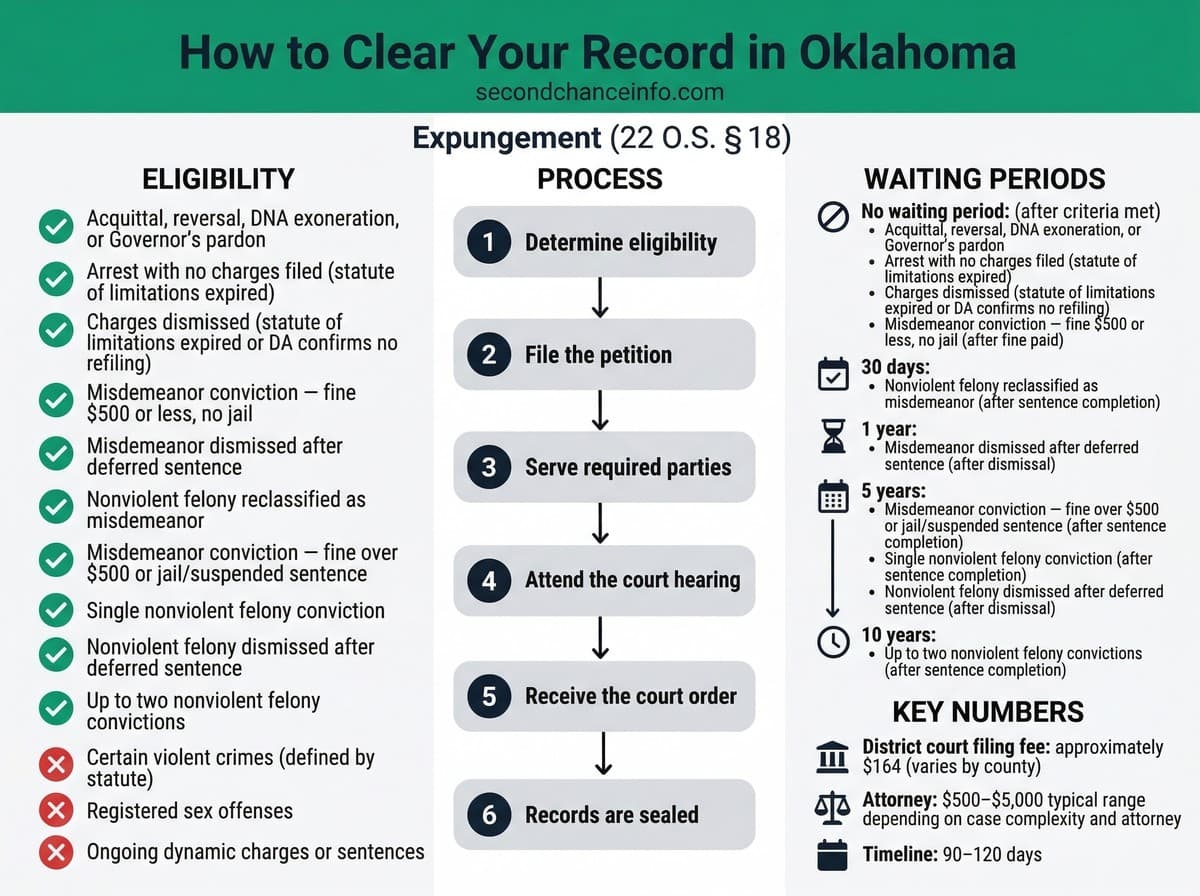
Automatic Record Sealing (Clean Slate Act — HB 3316)
Oklahoma's Clean Slate Act (HB 3316, signed 2022) directs the OSBI to automatically identify and seal eligible criminal records without requiring a petition. The system launched in phases beginning November 2025, with full implementation underway in 2026. Each month, the OSBI identifies eligible records and provides them to the prosecuting and arresting agencies, which have 45 days to review and object. Records with no objections are sent to courts for expungement orders.
| Scenario | Timing and conditions |
|---|---|
| Acquittal or not-guilty finding | Automatic upon eligibility identification |
| Conviction reversed and case dismissed | Automatic upon eligibility identification |
| DNA exoneration | Automatic upon eligibility identification |
| Arrest with no charges filed (statute of limitations expired) | Automatic upon eligibility identification |
| Charges dismissed (statute of limitations expired) | Automatic upon eligibility identification |
| Misdemeanor dismissed after deferred sentence (1+ year passed) | Automatic upon eligibility identification |
| Misdemeanor conviction — fine under $501, no jail | Automatic upon eligibility identification |
| Misdemeanor conviction — fine over $500 or jail (5+ years passed) | Automatic upon eligibility identification |
| Nonviolent felony reclassified as misdemeanor (30+ days passed) | Automatic upon eligibility identification |
| Identity theft victim | Automatic upon eligibility identification |
Costs
- Filing fee
- District court filing fee: approximately $164 (varies by county)
- Fee waiver
- Fee waivers may be available for indigent petitioners; ask the court clerk
- Attorney (optional)
- $500–$5,000 typical range depending on case complexity and attorney
Additional costs: $150 OSBI processing fee (to seal the arrest record), $15 OSBI criminal history report, and possible local law enforcement fees ($50–$150). Court record sealing itself is free. Section 991(c) deferred-sentence expungements have no cost. Legal Aid Services of Oklahoma may provide free assistance to qualifying individuals.
Timeline
- With attorney
- 60–90 days
- Standard
- 90–120 days
Varies by county and whether the DA or OSBI objects. After the judge signs the order, OSBI typically processes the record sealing within about 30 additional days.
Effects of the relief
- ✓Seals criminal records from public view and most background checks
- ✓Under 22 O.S. § 19, expunged actions are legally deemed never to have occurred
- ✓Allows you to lawfully state that no such arrest or conviction ever took place
- ✓Employers, landlords, and educational institutions cannot require disclosure of expunged records
- ✓Removes records from public court databases (OSCN) and OSBI reports
- ✓Updates FBI records simultaneously with OSBI expungement
Limits of the relief
- ✗Does NOT restore firearm rights — a Governor's pardon is required for that
- ✗Does NOT restore voting rights for felony convictions — a pardon is needed
- ✗Does NOT remove records from private databases, newspapers, or online articles
- ✗Does NOT prevent law enforcement from seeing certain expunged records (categories 8–12 remain open to law enforcement)
- ✗Does NOT destroy fingerprint cards — identifying information remains on file
- ✗Does NOT erase records from other states or federal systems (beyond the FBI update)
Other Relief Options in Oklahoma
Section 991(c) Deferred Sentence Expungement
Available immediately upon successful completion of a deferred sentence. Removes the plea from court records and changes the disposition to 'pled not guilty, case dismissed.' However, it does NOT seal the arrest record with OSBI — only the court record is affected. No filing fee is required. A full Section 18 expungement can be pursued later.
Governor's Pardon
Applied for through the Oklahoma Pardon and Parole Board. A pardon does not erase a criminal record, but it restores civil rights including the right to vote, serve on a jury, and possess firearms. After receiving a pardon, you may also qualify for a full Section 18 expungement.
Clean Slate Automatic Sealing (HB 3316)
Beginning in 2025–2026, the OSBI automatically identifies and seals eligible records without requiring a petition. Covers 11 of the 15 expungement categories. The OSBI, arresting agency, and prosecutor each have 45 days to review and object before a court issues the expungement order.
Frequently Asked Questions
- How much does expungement cost in Oklahoma?
- Government fees total approximately $329 or more: a district court filing fee (~$164), an OSBI processing fee ($150 to seal the arrest record), and an OSBI criminal history report ($15). Local law enforcement agencies may charge additional fees ($50–$150). If you hire an attorney, expect $500–$5,000 depending on case complexity. Legal Aid Services of Oklahoma offers free help to those who qualify.
- How long does expungement take in Oklahoma?
- The process typically takes 60–120 days from filing to completion. After filing, you must wait at least 30 days for the hearing. Once the judge signs the expungement order, OSBI processes the record sealing within about 30 additional days. Timelines vary by county and whether any party objects.
- Can a felony be expunged in Oklahoma?
- Yes, if it is a nonviolent felony not listed in 57 O.S. § 571 or 21 O.S. § 13.1. A single nonviolent felony conviction can be expunged after 5 years with no other felony convictions and no misdemeanor convictions in the last 7 years. Up to two nonviolent felony convictions can be expunged after 10 years. Violent felonies and sex offenses requiring registration are not eligible.
- Does Oklahoma have automatic expungement?
- Yes. Oklahoma's Clean Slate Act (HB 3316, signed 2022) directs the OSBI to automatically identify and seal eligible records without a petition. Implementation began in phases starting November 2025, with full rollout underway in 2026. It covers 11 of the 15 expungement categories, including acquittals, dismissed charges, deferred sentences, and certain misdemeanor and reclassified-felony convictions.
- Does expungement restore gun rights in Oklahoma?
- No. Expungement seals your record from public view but does not restore the right to possess firearms. Under both state and federal law, a felony conviction — even if expunged — may still bar firearm ownership. To restore gun rights, you need a Governor's pardon. This also applies to misdemeanor domestic assault and battery convictions.
- What is the difference between a Section 18 and Section 991(c) expungement?
- A Section 18 expungement is a full expungement that seals both the court record and the arrest record with OSBI. A Section 991(c) expungement is available immediately after completing a deferred sentence and removes the plea from court records, but it does NOT seal the arrest record. Many people pursue a 991(c) first and then file for a full Section 18 expungement once the waiting period has passed.
- Can I legally deny my criminal record after expungement in Oklahoma?
- Yes. Under 22 O.S. § 19, once records are sealed, the official actions are deemed never to have occurred. You may lawfully state on job, housing, or school applications that no such arrest or conviction took place. Employers, landlords, and government agencies cannot require you to disclose expunged information or penalize you for refusing to do so.
- What crimes cannot be expunged in Oklahoma?
- Violent felonies listed in 57 O.S. § 571 — including murder, rape, robbery, kidnapping, and assault and battery with a dangerous weapon — are not eligible. Offenses requiring sex offender registration are also excluded. Additionally, you cannot expunge more than two felony convictions, and you must have no pending charges at the time of filing.
Take Action — Direct Links
- Download Expungement Petition Forms (22 O.S. § 18a)
Official Oklahoma statutory forms for Petition to Expunge Records and Order to Expunge Records pursuant to 22 O.S. §§ 18 and 19, hosted on the Oklahoma State Courts Network (OSCN).
- Request Your Criminal Record (OSBI — $15)
Oklahoma State Bureau of Investigation page with instructions for requesting your own criminal history record ($15 fee) online via CHIRP, by mail, or in person.
- Find Free Legal Help (Legal Aid Services of Oklahoma)
Legal Aid Services of Oklahoma expungement Q&A with eligibility guidance, step-by-step instructions, and access to free legal assistance and pro bono attorneys for qualifying individuals.
- OSBI Expungement Guide
Oklahoma State Bureau of Investigation criminal history record expungement page with process overview, required documents, the $150 OSBI processing fee, and contact information.
- 22 O.S. § 18 — Full Statute Text
Official full text of 22 O.S. § 18 (Expungement of Criminal Records) on the Oklahoma State Courts Network, including all 15 eligibility categories.
Related Resources on This Site
More for your state
- Pardon & ClemencyPardon & clemency in Oklahoma
- Jobs by CityFelony friendly jobs in Oklahoma City, OK
- Jobs by StateJobs for felons in Oklahoma
- HousingSecond chance apartments in Oklahoma City, OK
- Voting RightsFelon voting rights in Oklahoma
- Gun RightsFelon gun rights in Oklahoma
- DUI RecoveryDUI license recovery in Oklahoma
- ProbationProbation & parole in Oklahoma
Helpful guides
- Background ChecksHow far back do background checks go?
- ToolsReentry organizations directory
- Free Legal AidFree legal aid by state