
South Carolina (SC) — Expungement & Record Clearing
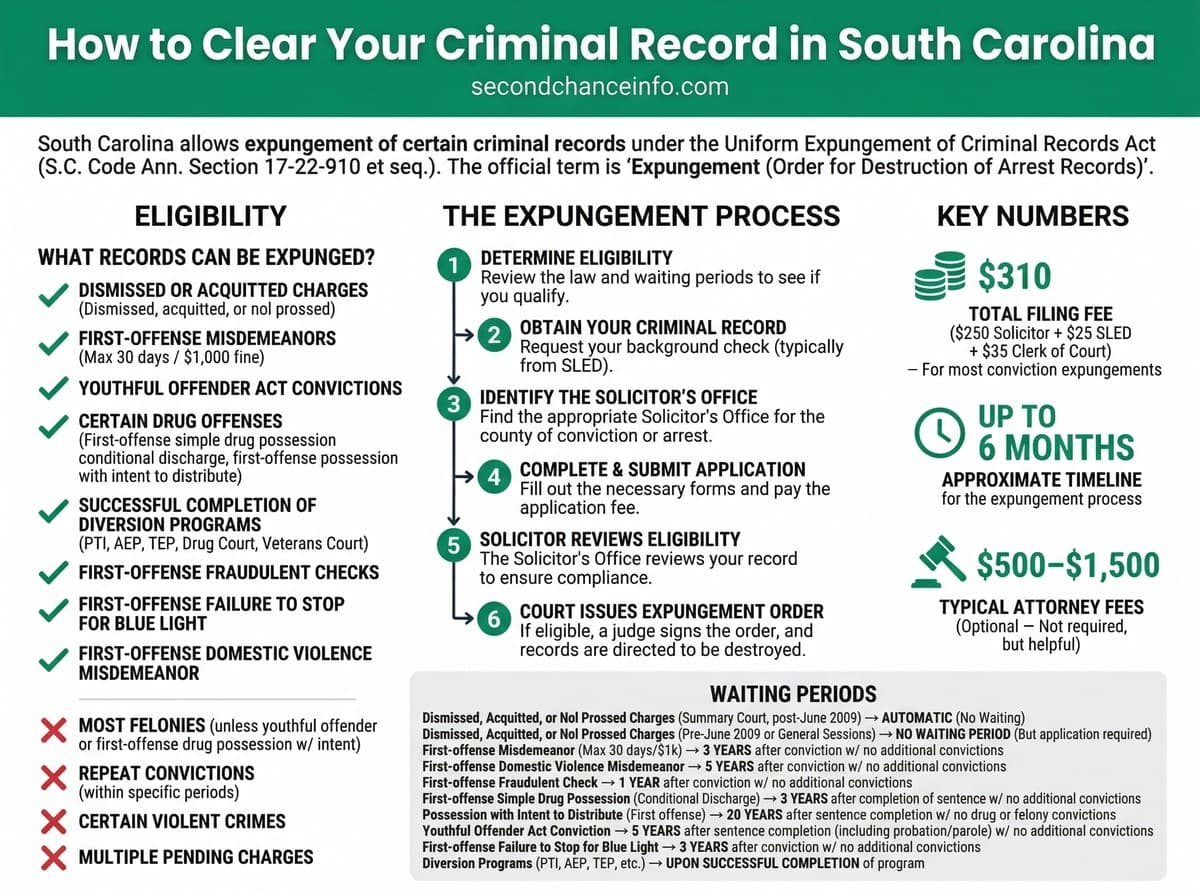
Yes, you can clear your criminal record in South Carolina through expungement under the Uniform Expungement of Criminal Records Act (S.C. Code Section 17-22-910). Dismissed charges in summary courts are automatically expunged at no cost since June 2009. For eligible convictions — including first-offense misdemeanors (max 30 days/$1,000 fine), first-offense drug possession with conditional discharge, and Youthful Offender Act convictions — you can apply through the Solicitor’s Office after the required waiting period (typically 3–5 years). Total filing costs are $310 for conviction expungements, and the process takes up to 6 months. Violent crimes, DUIs, sex offenses, and most felonies are not eligible. Expungement destroys your records from public view, allowing you to legally deny the offense on job and housing applications. Below is the full guide with eligibility, step-by-step process, costs, timeline, and FAQ.
Prepare questions about a record-clearing process
Last updated:
Overview
South Carolina allows expungement of certain criminal records under the Uniform Expungement of Criminal Records Act (S.C. Code Ann. Section 17-22-910 et seq.). Expungement in South Carolina means the destruction of arrest and conviction records so the offense no longer appears on a background check. Eligibility is limited to specific categories including dismissed charges, first-offense misdemeanors carrying no more than 30 days in jail or a $1,000 fine, first-offense drug possession with conditional discharge, Youthful Offender Act convictions, and certain other offenses. Since June 2, 2009, dismissed charges in summary courts (magistrate and municipal) are automatically expunged at no cost under Section 17-22-950.
Official term: Expungement (Order for Destruction of Arrest Records) — South Carolina uses the term "expungement" which legally means destruction of records. Unlike some states that merely seal records, SC law calls for the destruction of arrest and booking records, mug shots, and fingerprints. However, SLED and law enforcement retain a nonpublic record under seal per S.C. Code Section 17-1-40.
Routes and conditions to check
- ✓Charges dismissed, discharged, nol prossed, no-billed, or resulting in a not guilty verdict
- ✓Charges dismissed after completing Pre-Trial Intervention (PTI), Alcohol Education Program (AEP), or Traffic Education Program (TEP)
- ✓First-offense misdemeanor convictions carrying a maximum of 30 days jail and/or $1,000 fine (3-year waiting period; 5 years for domestic violence)
- ✓First-offense fraudulent check convictions (1-year waiting period)
- ✓First-offense simple drug possession or prescription drug possession with conditional discharge (3-year waiting period after sentence completion)
- ✓Possession with intent to distribute — first offense only (20-year waiting period after sentence completion, no drug or felony convictions during that time)
- ✓Youthful Offender Act convictions for non-violent offenses (ages 17-24 at conviction, 5-year waiting period after sentence completion including probation/parole)
- ✓First-offense failure to stop for a blue light (3-year waiting period)
- ✓Nonviolent juvenile offenses (applicant must be 18+ with no prior or subsequent convictions)
- ✓Offenses resulting from human trafficking victimization
- ✓Convictions after completing SC Youth Challenge Academy and SC Jobs Challenge Program
Exclusions and limits to check
- ✗Violent crimes as classified under S.C. Code Section 16-1-60 (murder, attempted murder, armed robbery, arson, kidnapping, etc.)
- ✗Sex offenses requiring registration as a sex offender
- ✗Traffic convictions (except first-offense failure to stop for a blue light)
- ✗Fish and wildlife convictions
- ✗DUI / drunk driving convictions
- ✗Felonies with sentences exceeding 30 days jail or $1,000 fine (unless eligible under YOA or drug possession provisions)
- ✗Convictions where the person has additional convictions during the required waiting period
- ✗Child abuse convictions
- ✗Voluntary manslaughter
Waiting Periods
| Dismissed, acquitted, or nol prossed charges (summary court, post-June 2009) | Automatic — no waiting period |
| Dismissed, acquitted, or nol prossed charges (pre-June 2009 or General Sessions) | No waiting period, but application required |
| First-offense misdemeanor (max 30 days / $1,000) | 3 years after conviction with no additional convictions |
| First-offense domestic violence misdemeanor | 5 years after conviction with no additional convictions |
| First-offense fraudulent check | 1 year after conviction with no additional convictions |
| First-offense simple drug possession (conditional discharge) | 3 years after completion of sentence with no additional convictions |
| Possession with intent to distribute (first offense) | 20 years after sentence completion with no drug or felony convictions |
| Youthful Offender Act conviction | 5 years after sentence completion (including probation/parole) with no additional convictions |
| First-offense failure to stop for blue light | 3 years after conviction with no additional convictions |
| Diversion programs (PTI, AEP, TEP, Drug Court, Veterans Court) | Upon successful completion of program |
Step-by-Step Process
Determine eligibility
Review your criminal record and confirm your offense falls into one of the eligible categories under South Carolina law. Your eligibility is based on the offense you pled guilty to or were convicted of, not the original charge.
Obtain your criminal record
Request a copy of your criminal history from the South Carolina Law Enforcement Division (SLED) for $25. You will also need a certified copy of the disposition from the court where your case was heard.
Identify the correct Solicitor's Office
All expungement applications (except automatic summary court dismissals) must be filed through the Solicitor's Office in the judicial circuit where the charge originated. South Carolina has 16 judicial circuits.
Complete and submit the application
Obtain the expungement application from the appropriate Solicitor's Office. Complete all required sections, attach the certified disposition, and submit with the required fees via separate U.S. Postal Money Orders ($250 to Solicitor, $25 to SLED, $35 to Clerk of Court).
Solicitor reviews eligibility
The Solicitor's Office reviews your application to determine eligibility, coordinates with SLED for a background verification, and forwards eligible applications to a Circuit Court judge for approval.
Court issues expungement order
If approved by the Solicitor and the Circuit Court judge, an Order for Destruction of Arrest Records is issued. SLED, the arresting agency, and the court destroy the records. The process can take up to 6 months from application to completion.
Visual Guide
Automatic Relief in South Carolina
Since June 2, 2009, South Carolina provides automatic expungement for certain non-conviction dispositions in summary courts (magistrate and municipal courts) under S.C. Code Section 17-22-950, at no cost to the individual.
| Scenario | Timing and conditions |
|---|---|
| Not guilty verdict in summary court (post-June 2, 2009) | Immediately — court issues order automatically |
| Charges dismissed in summary court (post-June 2, 2009) | Immediately — court issues order automatically |
| Charges nol prossed in summary court (post-June 2, 2009) | Immediately — court issues order automatically |
| Dismissed charges in General Sessions court | No automatic expungement — application required (no fee) |
| Pre-June 2, 2009 dismissals or acquittals | No automatic expungement — application required |
Costs
- Filing fee
- $310 total ($250 Solicitor + $25 SLED + $35 Clerk of Court) for most conviction expungements
- Fee waiver
- No fee for dismissed charges, acquittals, or not guilty verdicts (unless dismissed as part of a plea agreement, which costs $250). Fee waiver available only for identity theft victims with documentation.
- Attorney (optional)
- $500–$1,500 typical range (optional — an attorney is not required but can be helpful)
All fees must be paid via separate U.S. Postal Money Orders made out to the appropriate agency. Fees are non-refundable. Some legal aid organizations such as South Carolina Legal Services (1-888-346-5592) offer free assistance.
Timeline
- With attorney
- 2–8 weeks in some circuits
- Standard
- Up to 6 months
Processing times vary significantly by judicial circuit. Some Solicitor's Offices process applications faster than others. The 11th Judicial Circuit states up to 6 months from receipt of application.
Effects of the relief
- ✓Destroys arrest and booking records, mug shots, fingerprints, and bench warrants from public records
- ✓Removes the offense from SLED background checks visible to the general public and employers
- ✓Restores the person to the legal status they held before being taken into custody
- ✓Allows the person to legally deny the expunged arrest or conviction occurred on most job and housing applications
- ✓Removes barriers to employment — expunged records do not appear on routine private-sector background checks
- ✓Removes barriers to housing — landlords will not see expunged records on background checks
Limits of the relief
- ✗Does NOT completely destroy all records — law enforcement retains records under seal for 3 years and 120 days per S.C. Code Section 17-1-40
- ✗Does NOT remove records from the FBI database — federal records of arrest and conviction are retained
- ✗Does NOT remove information already published on non-government websites or social media
- ✗Does NOT apply to traffic convictions (except first-offense failure to stop for blue light)
- ✗Does NOT apply to violent crimes classified under S.C. Code Section 16-1-60
- ✗Must still disclose when applying for certain government jobs, law enforcement positions, or military service
- ✗SLED maintains a nonpublic record of the expungement to ensure the one-time-use limitation is enforced
Other Relief Options in South Carolina
Pardon (SC Department of Probation, Parole and Pardon Services)
A pardon does not seal or destroy records but represents the state's forgiveness and restores all civil rights lost due to conviction, including firearm rights and occupational licensing eligibility. Requires completion of sentence (including probation) or 5+ years on parole, payment of all restitution, three non-relative reference letters, and a $100 filing fee. The investigation process takes 7–9 months before a hearing is scheduled.
Pending Legislation: H. 3730 (2025-2026 Session)
A bill referred to the House Judiciary Committee in January 2025 that would create a new expungement pathway under Section 17-22-915 for first nonviolent offense convictions after a 10-year waiting period, and for drug treatment court program completions after a 3-year waiting period. As of March 2026, this bill has not been enacted.
Frequently Asked Questions
- How much does expungement cost in South Carolina?
- For most conviction expungements, the total cost is $310: $250 to the Solicitor's Office, $25 to SLED for background verification, and $35 to the Clerk of Court. Each fee requires a separate U.S. Postal Money Order. There is no fee for expungement of dismissed charges, acquittals, or not guilty verdicts (unless the dismissal was part of a plea agreement, which costs $250). If you hire an attorney, expect an additional $500-$1,500, though an attorney is not required.
- How long does expungement take in South Carolina?
- The expungement process can take up to 6 months from the date the Solicitor's Office receives your completed application. Processing times vary by judicial circuit — some circuits process applications in 2-8 weeks, while others take longer. Automatic expungement of dismissed charges in summary courts (post-June 2009) happens immediately at the time of disposition.
- Can a felony be expunged in South Carolina?
- Most felonies cannot be expunged in South Carolina. However, there are limited exceptions: Youthful Offender Act convictions (for non-violent Class D-F felonies committed between ages 17-24) can be expunged after 5 years with no additional convictions, and first-offense possession with intent to distribute can be expunged after 20 years with no drug or felony convictions. Felony charges that were dismissed or resulted in acquittal can always be expunged.
- Can I expunge a DUI in South Carolina?
- No. DUI and drunk driving convictions cannot be expunged in South Carolina. Traffic convictions are generally not eligible for expungement, with the sole exception being a first-offense failure to stop for a blue light (after a 3-year waiting period). If you were charged with DUI but the charges were dismissed or you were found not guilty, the non-conviction record can be expunged.
- Do I need a lawyer to get an expungement in South Carolina?
- No, an attorney is not required to apply for expungement in South Carolina. You can file the application yourself through the Solicitor's Office in the judicial circuit where your charge originated. However, the process can be confusing, and an attorney can help ensure your application is completed correctly and advocate on your behalf if issues arise. South Carolina Legal Services (1-888-346-5592) may offer free assistance for those who qualify.
- What is the difference between expungement and a pardon in South Carolina?
- Expungement destroys your criminal records so the offense no longer appears on background checks, and you can legally deny the arrest or conviction occurred. A pardon does not remove or seal any records — instead, it adds a notation that the conviction was pardoned and represents the state's forgiveness. A pardon restores civil rights including firearm rights and occupational licensing eligibility. Pardons are handled by the SC Department of Probation, Parole and Pardon Services, while expungements are handled by the Solicitor's Office.
- Can I expunge more than one conviction in South Carolina?
- South Carolina generally limits a person to one expungement per eligible conviction category. However, multiple eligible misdemeanors sentenced together from the same incident may count as a single offense for expungement purposes. There is no limit on expunging dismissed charges or not guilty verdicts. SLED maintains a nonpublic record of prior expungements to enforce these limitations.
- Will my expunged record still be visible to law enforcement?
- Yes, to a limited extent. Under S.C. Code Section 17-1-40, law enforcement and prosecution agencies retain expunged records under seal for 3 years and 120 days. Investigative files may be retained indefinitely for ongoing or future investigations. SLED also keeps a nonpublic record of the expungement order. Additionally, FBI records of arrest and conviction are not affected by a state expungement order. However, expunged records are not visible to the general public, employers, or landlords.
Take Action — Direct Links
- Court petition/form
SC Judicial Branch — Expungement Application Process page with instructions for General Sessions, Magistrate/Municipal, and Juvenile cases. Applications are filed through the Solicitor's Office in each judicial circuit.
- Criminal record request
SLED CATCH (Citizens Access to Criminal Histories) — online search of South Carolina criminal records for $25.
- Free legal aid
South Carolina Legal Services — Second Chances program providing free expungement assistance to eligible low-income residents. Call 1-888-346-5592.
- Court self-help center
SC Judicial Branch — Self Help Resources page with links to expungement FAQs, forms, and legal aid referrals.
- Statute full text
S.C. Code Ann. Title 17, Chapter 22 — full text of South Carolina's expungement statutes from the SC Legislature Online.
Related Resources on This Site
More for your state
- Pardon & ClemencyPardon & clemency in South Carolina
- Jobs by CityFelony friendly jobs in Charleston, SC
- Jobs by StateJobs for felons in South Carolina
- HousingSecond chance apartments in Columbia, SC
- Voting RightsFelon voting rights in South Carolina
- Gun RightsFelon gun rights in South Carolina
- DUI RecoveryDUI license recovery in South Carolina
- ProbationProbation & parole in South Carolina
Helpful guides
- Background ChecksHow far back do background checks go?
- ToolsReentry organizations directory
- Free Legal AidFree legal aid by state
Sources
- S.C. Code Ann. Section 17-22-910 et seq. (Uniform Expungement of Criminal Records Act)
- S.C. Code Ann. Section 22-5-910 (Magistrate court expungement)
- SC Judicial Branch — Expungement Application Process
- SC Appleseed Legal Justice Center — Expungement Reference Guide
- South Carolina Legal Services — Overcoming A Criminal Record
- S.C. Code Ann. Section 17-1-40 (Record retention after expungement)