
Texas (TX) — Expungement & Record Clearing
Texas offers two ways to clear your criminal record: expunction (complete destruction for non-convictions like dismissals and acquittals) and orders of nondisclosure (sealing for deferred adjudication cases). Expunction is available immediately for acquittals; nondisclosure requires a 2-year wait for misdemeanors or 5 years for felonies after completing deferred adjudication. Court costs run $400–$500 plus $1,000–$3,000 for an attorney, and the process takes 2–6 months. Convictions cannot be expunged. Sex offenses and family violence are ineligible for nondisclosure. As of 2025, Texas expanded eligibility for certain misdemeanor convictions. Below is the full guide with eligibility, step-by-step process, costs, timeline, and FAQ.
Prepare questions about a record-clearing process
Last updated:
Overview
Texas offers two primary paths to clear a criminal record: expunction (complete destruction of records for non-convictions) and orders of nondisclosure (sealing records from public view for deferred adjudication cases). Expunction is the strongest remedy but is only available when charges did not result in a conviction. Nondisclosure applies when a person successfully completed deferred adjudication probation.
Official term: Expunction / Order of Nondisclosure — Texas uses "expunction" for complete record destruction (non-convictions only) and "order of nondisclosure" for sealing records from public view. These are two distinct legal processes.
Routes and conditions to check
- ✓Acquittals — charges where you were found not guilty
- ✓Dismissals — charges that were dismissed or dropped
- ✓Certain Class C misdemeanors after successful deferred adjudication (expunction)
- ✓Completed deferred adjudication probation (nondisclosure)
- ✓Arrests where no charges were filed and the statute of limitations has expired
- ✓Pardoned offenses
- ✓Certain misdemeanor convictions (expanded eligibility as of 2025)
Exclusions and limits to check
- ✗Any conviction (for expunction — only non-convictions qualify)
- ✗Sex offenses requiring registration (for nondisclosure)
- ✗Family violence offenses (for nondisclosure)
- ✗Murder, capital murder, aggravated kidnapping
- ✗Offenses involving child victims
- ✗Stalking offenses
- ✗Cases where you jumped bail and the case is still pending
Waiting Periods
| Acquittal or pardon | Immediately eligible |
| Dismissal (misdemeanor) | Immediately or after statute of limitations expires |
| Class C misdemeanor — deferred adjudication (expunction) | 180 days after completion |
| Misdemeanor — deferred adjudication (nondisclosure) | 2 years after completing probation |
| Felony — deferred adjudication (nondisclosure) | 5 years after completing probation |
| Certain DWI (first offense, BAC < 0.15, nondisclosure) | 2 years (or immediately with interlock device) |
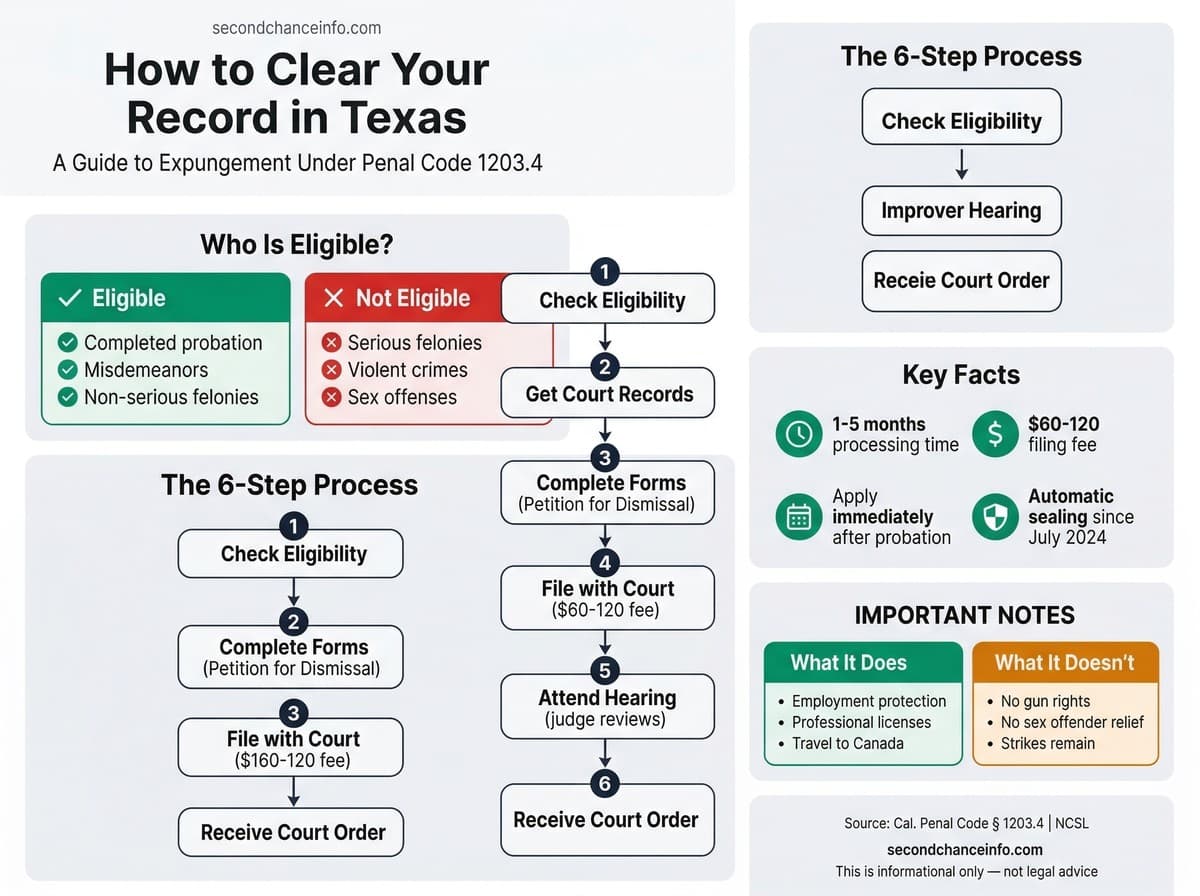
Step-by-Step Process
Determine which remedy applies
Identify whether your case qualifies for expunction (non-conviction) or an order of nondisclosure (deferred adjudication). Obtain your criminal history from the Texas Department of Public Safety.
Gather case documentation
Collect court records, case numbers, arrest dates, and disposition information for each case you want to clear. You will need the exact charges and outcomes.
Prepare and file the petition
Draft a Petition for Expunction or Petition for Order of Nondisclosure. File it in the district court where the offense occurred. Pay the court filing fee.
Serve all required parties
For expunction, serve the petition on every agency that may have records (DPS, arresting agency, prosecutor, FBI). For nondisclosure, serve the prosecutor's office.
Attend the court hearing
A judge will review your petition. The prosecutor may object. For nondisclosure, the judge considers whether granting the order is in the best interest of justice. Bring evidence of rehabilitation.
Receive the court order
If granted, the court issues an order directing agencies to destroy records (expunction) or seal them from public access (nondisclosure). DPS updates its records, and the information is removed from public background checks.
Visual Guide
Automatic Orders of Nondisclosure
Texas provides automatic orders of nondisclosure for certain misdemeanor offenses completed through deferred adjudication, without requiring a petition. As of 2025, eligibility has been expanded for certain misdemeanor convictions with reduced waiting periods.
| Scenario | Timing and conditions |
|---|---|
| Certain misdemeanor deferred adjudication (non-violent, non-DWI) | Automatic upon successful completion |
| Class C misdemeanor deferred adjudication | 180 days after successful completion |
Costs
- Filing fee
- $400–$500 (court filing costs)
- Fee waiver
- Indigency affidavit may be available in some counties
- Attorney (optional)
- $1,000–$3,000 typical range
Costs vary by county. Expunction tends to be more expensive than nondisclosure due to the number of agencies that must be served.
Timeline
- With attorney
- 2–4 months
- Standard
- 3–6 months
Timeline depends on the county, court scheduling, and whether the petition is contested by the prosecutor.
Effects of the relief
- ✓Expunction: completely destroys all records of the arrest and charge as if it never happened
- ✓Nondisclosure: removes records from public background checks and databases
- ✓Allows you to legally deny the arrest or charge occurred (expunction) or deny the record on most applications (nondisclosure)
- ✓Prevents most private employers from accessing sealed records
- ✓Removes records from commercial background check databases
Limits of the relief
- ✗Nondisclosure does NOT destroy records — law enforcement and certain government agencies can still access them
- ✗Nondisclosure records remain visible to licensing agencies (medical, law, real estate, etc.)
- ✗Does NOT restore firearm rights if lost due to a felony conviction
- ✗Does NOT remove the obligation to disclose to federal agencies
- ✗Cannot expunge a conviction — only non-convictions qualify for expunction
- ✗Does NOT prevent use of the record for sentencing enhancement in future cases
Other Relief Options in Texas
Governor's Pardon
A full pardon from the Governor of Texas restores civil rights and may serve as a basis for expunction of the pardoned offense.
Judicial Clemency
Under certain circumstances, a judge may set aside a conviction and dismiss the case after the defendant has completed community supervision.
Frequently Asked Questions
- What is the difference between expunction and nondisclosure in Texas?
- Expunction completely destroys all records of an arrest and charge — it is as if the event never happened. It is only available for non-convictions (acquittals, dismissals, etc.). An order of nondisclosure seals the record from public view but does not destroy it. Law enforcement and certain agencies can still access nondisclosure records. Nondisclosure is available for completed deferred adjudication cases.
- Can I expunge a conviction in Texas?
- No. Texas does not allow expunction of convictions. Expunction is reserved for cases that did not result in a conviction, such as acquittals, dismissals, and cases where no charges were filed. If you completed deferred adjudication (which is not a conviction), you may be eligible for an order of nondisclosure instead.
- How much does it cost to expunge a record in Texas?
- Court filing costs typically range from $400 to $500. Attorney fees generally run $1,000 to $3,000 depending on the complexity of the case and the county. Some counties may allow an indigency affidavit to waive filing fees.
- How long does the expunction process take in Texas?
- The process typically takes 2 to 6 months from filing to the court order. With an attorney, it can be on the shorter end. Timelines vary by county and whether the petition is contested.
- Can a DWI be sealed in Texas?
- A first-offense DWI with a BAC under 0.15 may be eligible for an order of nondisclosure after completing deferred adjudication. The waiting period is 2 years, or it may be immediate if an ignition interlock device was installed. Repeat DWI offenses and those with a BAC of 0.15 or higher are not eligible.
- Who can still see my record after a nondisclosure order?
- Even after a nondisclosure order, your record remains accessible to law enforcement agencies, prosecutors, certain licensing boards (medical, legal, real estate, education), the Texas Lottery Commission, and certain government entities. Private employers and the general public cannot access the sealed record.
- Does Texas have automatic record sealing?
- Yes. Texas provides automatic orders of nondisclosure for certain misdemeanor offenses completed through deferred adjudication without requiring a petition. As of 2025, eligibility has expanded to cover additional misdemeanor convictions with reduced waiting periods.
Take Action — Direct Links
- Expunction & Nondisclosure Forms (Texas State Law Library)
Official collection of petition forms and instructions for expunction and nondisclosure orders from the Texas State Law Library.
- Request Your Criminal History (Texas DPS)
Texas Department of Public Safety Crime Records page — request a personal criminal history review via fingerprint or online name search.
- Texas Fair Defense Project — Free Record Clearing
Free legal assistance for Texans who are entitled to have their criminal records cleared through expunction or nondisclosure.
- TexasLawHelp: Expunction Guide
Step-by-step self-help guide from TexasLawHelp.org on how to clear an arrest from your record through expunction.
- Code of Criminal Procedure Chapter 55A — Full Statute Text
Official full text of Texas Code of Criminal Procedure Chapter 55A (Expunction of Criminal Records) on the Texas Legislature website.
Related Resources on This Site
More for your state
- Pardon & ClemencyPardon & clemency in Texas
- Jobs by CityFelony friendly jobs in Houston, TX
- Jobs by StateJobs for felons in Texas
- HousingSecond chance apartments in Houston, TX
- Voting RightsFelon voting rights in Texas
- Gun RightsFelon gun rights in Texas
- DUI RecoveryDUI license recovery in Texas
- ProbationProbation & parole in Texas
Helpful guides
- Background ChecksHow far back do background checks go?
- ToolsReentry organizations directory
- Free Legal AidFree legal aid by state