
Alabama (AL) — Expungement & Record Clearing
Yes, you can clear your criminal record in Alabama through expungement under Title 15, Chapter 27 of the Alabama Code. The 2021 REDEEMER Act expanded eligibility to include nonviolent misdemeanor convictions (up to 2, after a 3-year wait) and pardoned felony convictions (1, after 180 days). Non-conviction records such as dismissals and acquittals are eligible after 90 days. The filing fee is $500 per petition (fee waiver available), and the process typically takes 2–6 months. Alabama does not offer automatic expungement — you must file a petition in circuit court. Violent offenses, sex offenses, crimes of moral turpitude, and serious traffic offenses including DUI are not eligible. After expungement, the record is legally deemed never to have occurred and is removed from public background checks, though law enforcement retains limited access. Below is the full guide with eligibility, step-by-step process, costs, timeline, and FAQ.
Prepare questions about a record-clearing process
Last updated:
Overview
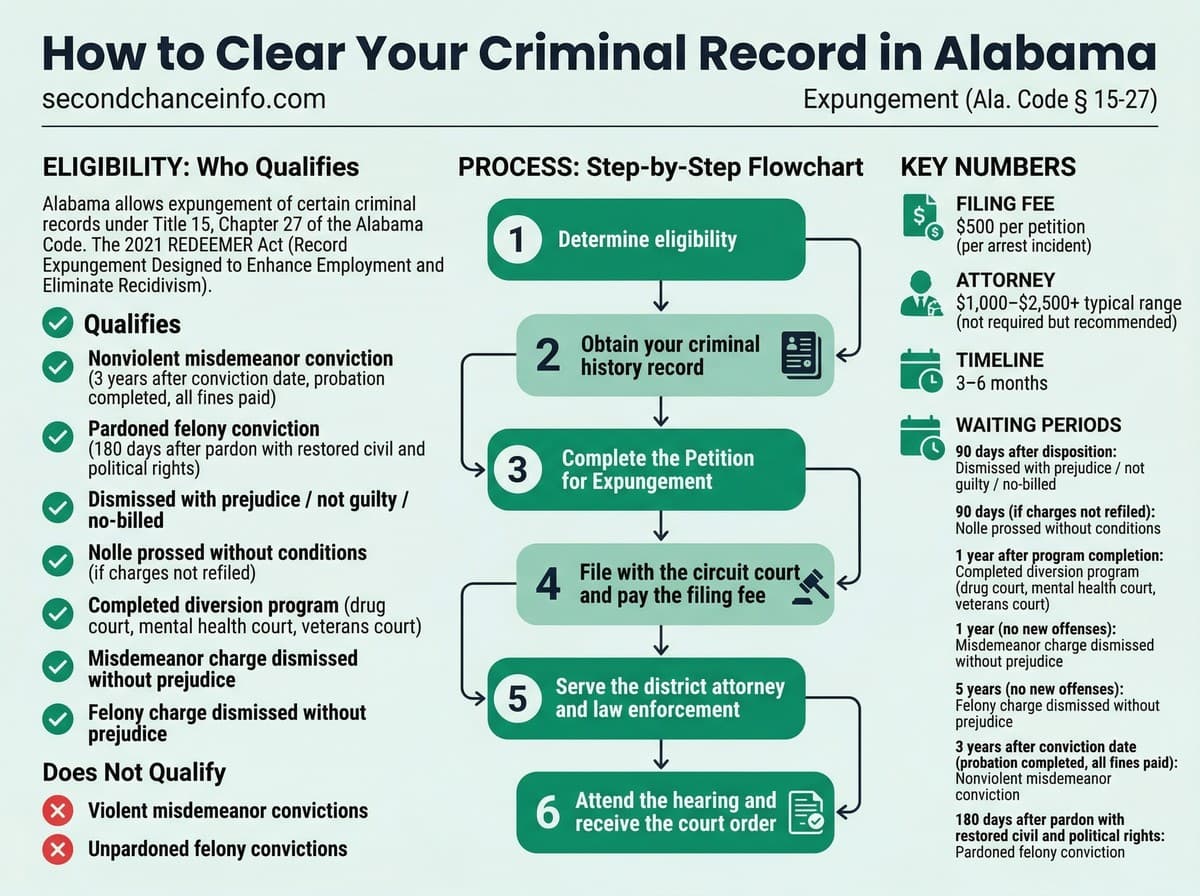
Alabama allows expungement of certain criminal records under Title 15, Chapter 27 of the Alabama Code. The 2021 REDEEMER Act (Record Expungement Designed to Enhance Employment and Eliminate Recidivism) significantly expanded eligibility beyond the original 2014 law, allowing individuals with certain nonviolent misdemeanor convictions and pardoned felony convictions to petition for expungement in addition to non-conviction records.
Official term: Expungement (Ala. Code § 15-27) — Alabama uses the term "expungement," and upon granting, the proceeding is deemed never to have occurred. However, law enforcement retains limited access to expunged records.
Routes and conditions to check
- ✓Charges dismissed with prejudice (after 90-day waiting period)
- ✓Charges no-billed by a grand jury (after 90-day waiting period)
- ✓Found not guilty at trial (after 90-day waiting period)
- ✓Charges nolle prossed without conditions (after 90 days, if not refiled)
- ✓Indictment quashed and statute of limitations expired or prosecutor confirms no refiling
- ✓Successful completion of a diversion program (drug court, mental health court, veterans court) — after 1 year
- ✓Misdemeanor charges dismissed without prejudice (after 1 year without new offenses)
- ✓Felony charges dismissed without prejudice (after 5 years without new offenses)
- ✓Nonviolent misdemeanor convictions (up to 2 convictions, after 3-year waiting period, all conditions met)
- ✓Pardoned felony convictions with restored civil and political rights (1 conviction, after 180 days from pardon issuance)
- ✓Human trafficking victims convicted of felonies committed while being trafficked (§ 15-27-2(a)(6))
Exclusions and limits to check
- ✗Violent offenses (as defined in Ala. Code § 12-25-32)
- ✗Sex offenses (except human trafficking victims)
- ✗Crimes of moral turpitude (as defined in Ala. Code § 17-3-30.1) — including murder, assault, kidnapping, rape, domestic violence, elder abuse, and others
- ✗Serious traffic offenses, including DUI (effective July 1, 2023)
- ✗Offenses related to operating a commercial vehicle
- ✗More than 2 misdemeanor convictions (lifetime limit)
- ✗More than 1 pardoned felony conviction (lifetime limit)
- ✗Currently serving a sentence, on probation, or on parole
- ✗Outstanding fines, fees, restitution, or court costs not paid in full
Waiting Periods
| Dismissed with prejudice / not guilty / no-billed | 90 days after disposition |
| Nolle prossed without conditions | 90 days (if charges not refiled) |
| Completed diversion program (drug court, mental health court, veterans court) | 1 year after program completion |
| Misdemeanor charge dismissed without prejudice | 1 year (no new offenses) |
| Felony charge dismissed without prejudice | 5 years (no new offenses) |
| Nonviolent misdemeanor conviction | 3 years after conviction date (probation completed, all fines paid) |
| Pardoned felony conviction | 180 days after pardon with restored civil and political rights |
Step-by-Step Process
Determine eligibility
Confirm your charge or conviction qualifies under Alabama Code § 15-27. Verify the offense is not excluded (violent, sexual, moral turpitude, serious traffic). Check that the applicable waiting period has passed and all conditions are met.
Obtain your criminal history record
Request a certified copy of your criminal history from the Alabama Law Enforcement Agency (ALEA) using Form 46 (Application to Review/Challenge Alabama CHRI). The fee is $25 payable to ALEA. Also obtain a certified case action summary from the court where the case was heard.
Complete the Petition for Expungement
Fill out Form CR-65 (Petition for Expungement of Records), available from the Alabama Administrative Office of Courts website (alacourt.gov). One petition is filed per arrest incident. Attach certified ALEA records and court records.
File with the circuit court and pay the filing fee
File the petition in the circuit court of the county where the charges were originally filed (not your county of residence). Pay the $500 administrative filing fee. If you cannot afford the fee, submit an Affidavit of Substantial Hardship to request a fee waiver.
Serve the district attorney and law enforcement
Serve copies of the petition on the district attorney's office, the arresting law enforcement agency, the booking/jail facility, and the court clerk via certified mail. The district attorney has 45 days to file an objection.
Attend the hearing and receive the court order
If the district attorney does not object, the court may grant the expungement without a hearing. If an objection is filed, a hearing will be scheduled. If granted, the court issues an expungement order and all agencies must seal the records. ALEA withdraws the records from the national criminal records repository.
Visual Guide
Automatic Relief
Alabama does not have an automatic expungement or record sealing process. All expungements require filing a petition in circuit court, even when the person is clearly eligible. The district attorney retains the right to object within 45 days, and a circuit court judge has final discretion.
| Scenario | Timing and conditions |
|---|
Costs
- Filing fee
- $500 per petition (per arrest incident)
- Fee waiver
- Available upon demonstration of indigency via Affidavit of Substantial Hardship; also waived when the court previously found the arrest lacked probable cause
- Attorney (optional)
- $1,000–$2,500+ typical range (not required but recommended)
Additional costs include $25 for ALEA criminal history record, certified court record copies, and any local court docket fees. The $500 filing fee is distributed among the State Judicial Administrative Fund, Alabama Department of Forensic Sciences, the DA's office, the circuit court clerk, and the Public Safety Fund.
Timeline
- With attorney
- 2–4 months
- Standard
- 3–6 months
Obtaining records from ALEA and the court can take 2–4 weeks. The DA has 45 days to object after service. If no objection is filed, the court may rule more quickly. Contested petitions requiring a hearing take longer.
Effects of the relief
- ✓The proceeding is deemed never to have occurred (Ala. Code § 15-27-6(b))
- ✓No longer required to disclose the record on applications for employment or credit
- ✓Record is removed from public background checks and FBI fingerprint-based screenings
- ✓Court and agencies must reply to inquiries that no record exists
- ✓ALEA withdraws the record from the national criminal records repository
- ✓Intentional unauthorized disclosure of expunged records is a Class B misdemeanor (§ 15-27-16)
Limits of the relief
- ✗Does NOT automatically restore firearm rights — a full pardon is needed for gun rights restoration
- ✗Does NOT remove the duty to disclose to government regulatory or licensing agencies
- ✗Does NOT remove the duty to disclose to banks, financial institutions, or utilities and their affiliates
- ✗Law enforcement retains limited access to expunged records
- ✗Does NOT guarantee approval — the DA can object and the judge has discretion
- ✗Does NOT apply to violent offenses, sex offenses, crimes of moral turpitude, or serious traffic offenses
Other Relief Options in Alabama
Pardon from the Alabama Board of Pardons and Paroles
Required before a felony conviction can be expunged. The Board investigates and holds a hearing. A pardon may restore civil and political rights (voting, holding office). A pardon with firearm rights restoration can also restore gun rights. No fixed timeline; processing depends on case circumstances.
Certificate of Eligibility to Register to Vote (§ 15-22-36.1)
Issued by the Board of Pardons and Paroles to persons who have completed their sentence, paid all fines and restitution, and have no pending charges. Restores the right to vote without requiring a full pardon.
Youthful Offender Act (§ 15-19-7)
Individuals adjudicated as youthful offenders (under age 21 at the time of the offense) may have their records sealed. A youthful offender adjudication is not considered a conviction.
Frequently Asked Questions
- How much does expungement cost in Alabama?
- The mandatory administrative filing fee is $500 per petition, plus $25 for your ALEA criminal history record and fees for certified court copies. If you cannot afford the fee, you can request a waiver by filing an Affidavit of Substantial Hardship. If you hire an attorney, expect to pay $1,000–$2,500 or more depending on case complexity. Some legal aid organizations may offer free or low-cost assistance.
- How long does expungement take in Alabama?
- The process typically takes 2–6 months. Gathering records from ALEA and the court takes 2–4 weeks. After filing, the district attorney has 45 days to object. If no objection is filed, the court may rule relatively quickly. Contested petitions requiring a hearing take longer. This does not include the waiting period you must complete before you are eligible to file.
- Can a felony conviction be expunged in Alabama?
- Yes, but only if the felony was nonviolent and you have received a full pardon with restoration of civil and political rights from the Alabama Board of Pardons and Paroles. You must then wait 180 days after the pardon is issued before filing for expungement. Only one pardoned felony conviction may be expunged in a lifetime. Violent felonies, sex offenses, and crimes of moral turpitude are never eligible.
- Does Alabama have automatic expungement?
- No. Alabama does not have automatic expungement or record sealing. Even if you are clearly eligible, you must file a petition in circuit court, pay the $500 filing fee (or obtain a waiver), and serve the district attorney and law enforcement. The DA has 45 days to object, and the judge has final discretion.
- How many convictions can be expunged in Alabama?
- Alabama limits conviction expungements to a maximum of two nonviolent misdemeanor convictions and one pardoned felony conviction per lifetime. There is no limit on the number of non-conviction records (dismissals, acquittals, no-bills) that can be expunged.
- What is the REDEEMER Act?
- The REDEEMER Act (Record Expungement Designed to Enhance Employment and Eliminate Recidivism) was signed into law in 2021 by Governor Kay Ivey. It significantly expanded Alabama's 2014 expungement law to include certain nonviolent misdemeanor convictions and pardoned felony convictions, in addition to non-conviction records. It also added eligibility for participants who completed diversion programs such as drug court, mental health court, and veterans court.
- Do I have to disclose an expunged record to employers in Alabama?
- Generally, no. After expungement, the proceeding is legally deemed never to have occurred, and you are not required to disclose it on employment or credit applications. However, there are important exceptions: you must still disclose to government regulatory or licensing agencies, banks and financial institutions, and utilities. Intentional unauthorized disclosure of an expunged record by others is a Class B misdemeanor.
- Does expungement restore gun rights in Alabama?
- No. Expungement alone does not restore firearm rights if you were prohibited from possessing firearms due to a conviction. To restore gun rights, you generally need a full pardon from the Alabama Board of Pardons and Paroles that specifically includes restoration of the right to possess firearms.
Take Action — Direct Links
- Court petition/form
Form CR-65 — Petition for Expungement of Records (Rev. 10/2024), from the Alabama Administrative Office of Courts.
- Criminal record request
Alabama Law Enforcement Agency (ALEA) — Alabama Background Check page with instructions and Form 46 to request your own criminal history ($25 fee).
- Free legal aid
Legal Services Alabama — free legal aid including Road to Redemption expungement clinics for eligible low-income residents. Call 1-866-456-4995.
- Court self-help center
AlabamaLegalHelp.org — step-by-step self-help guide for expungement in Alabama, including eligibility information, required documents, and fee waiver instructions.
- Statute full text
Alabama Code Title 15, Chapter 27 — full text of Alabama's expungement statute (2024 edition via Justia).
Related Resources on This Site
More for your state
- Pardon & ClemencyPardon & clemency in Alabama
- Jobs by CityFelony friendly jobs in Birmingham, AL
- Jobs by StateJobs for felons in Alabama
- HousingSecond chance apartments in Birmingham, AL
- Voting RightsFelon voting rights in Alabama
- Gun RightsFelon gun rights in Alabama
- DUI RecoveryDUI license recovery in Alabama
- ProbationProbation & parole in Alabama
Helpful guides
- Background ChecksHow far back do background checks go?
- ToolsReentry organizations directory
- Free Legal AidFree legal aid by state