
Missouri (MO) — Expungement & Record Clearing
Yes, you can expunge your criminal record in Missouri under RSMo 610.140. As of January 2025, you may expunge up to two felonies and three misdemeanors in your lifetime. The waiting period is 3 years for felonies and 1 year for misdemeanors after completing your sentence. Filing costs approximately $348–$598 including the mandatory $250 surcharge (fee waivers available for those who cannot afford it). The process takes 2–6 months and fully restores civil rights, seals records from public view, and allows you to legally deny the conviction on most applications. Class A felonies, dangerous felonies, sex offenses, domestic assault, and most DWI offenses are not eligible. Below is the full guide with eligibility, step-by-step process, costs, timeline, and FAQ.
Prepare questions about a record-clearing process
Last updated:
Overview
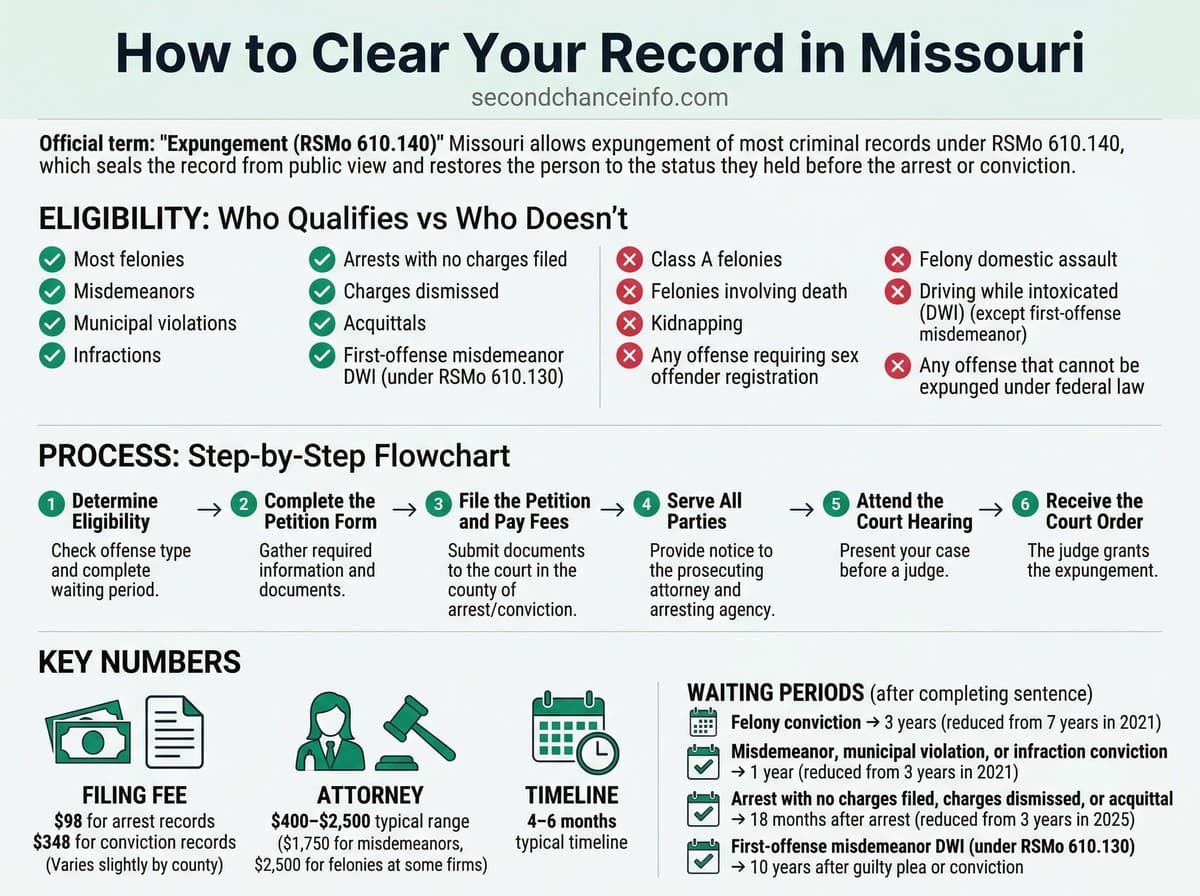
Missouri allows expungement of most criminal records under RSMo 610.140, which seals the record from public view and restores the person to the status they held before the arrest or conviction. The law was significantly expanded in 2018 (SB 588), 2021 (SBs 53 and 60), and again in 2025 (SB 754). Today, more than 1,900 offenses qualify for expungement. As of January 1, 2025, individuals may expunge up to two felonies and three misdemeanors in their lifetime, with reduced waiting periods of three years for felonies and one year for misdemeanors.
Official term: Expungement (RSMo 610.140) — Missouri uses the term "expungement," but the practical effect is sealing — the record is not destroyed. An expunged record is not publicly accessible and would require a court order to reopen.
Routes and conditions to check
- ✓Completed all terms of the sentence, including probation, parole, fines, and restitution
- ✓No new misdemeanor or felony convictions during the required waiting period (traffic violations under chapters 301-304 and 307 excluded)
- ✓No pending criminal charges at the time of filing
- ✓Offense is not on the list of permanently ineligible crimes
- ✓Person's habits and conduct demonstrate they are not a threat to public safety
- ✓Expungement is consistent with the public welfare and interests of justice
- ✓Arrest records where charges were dismissed, acquitted, nolle prossed, or never filed
Exclusions and limits to check
- ✗Class A felonies
- ✗Dangerous felonies as defined in RSMo 556.061
- ✗Any offense where death is an element of the crime
- ✗Felony assault offenses (RSMo chapter 565)
- ✗Domestic assault offenses (misdemeanor or felony)
- ✗Felony kidnapping offenses
- ✗Offenses requiring sex offender registration
- ✗Most intoxication-related traffic, boating, and aircraft offenses (except first-offense DWI under RSMo 610.130)
- ✗Offenses committed while operating a commercial vehicle under the influence
- ✗Sexual conduct with a nursing facility resident (RSMo 566.116)
- ✗Use of a child in sexual performance (RSMo 573.200)
- ✗Promoting sexual performance by a child (RSMo 573.205)
- ✗Cross burning (RSMo 574.140)
Waiting Periods
| Felony conviction | 3 years after completing sentence (reduced from 7 years in 2021) |
| Misdemeanor, municipal violation, or infraction conviction | 1 year after completing sentence (reduced from 3 years in 2021) |
| Arrest with no charges filed, charges dismissed, or acquittal | 18 months after arrest (reduced from 3 years in 2025) |
| First-offense misdemeanor DWI (under RSMo 610.130) | 10 years after guilty plea or conviction |
Step-by-Step Process
Determine eligibility
Confirm your offense qualifies for expungement, the required waiting period has passed, you have no pending charges, and all fines, restitution, and probation terms are completed. Obtain your criminal history from the Missouri State Highway Patrol to identify all records.
Complete the petition form
Fill out the Petition for Expungement (Form CR360) available from Missouri Courts. Include the case number, court name, county, and municipality for each offense. If multiple offenses arose from the same course of criminal conduct, they may be combined in one petition.
File the petition and pay fees
File the petition in the court where you were charged or convicted. Pay the court filing fee (approximately $98 for arrest records or $348 for convictions) plus the $250 statutory surcharge under RSMo 488.650. If you cannot afford the fees, file a Motion to Proceed as a Poor Person to request a waiver.
Serve all parties
Name all agencies that possess records of the arrest or conviction as defendants in the petition. The court clerk notifies the prosecuting attorney. All named parties must be served. The prosecutor has 30 days after service to file a written objection.
Attend the court hearing
If the prosecutor objects, the court holds a hearing within 60 days of the objection. The judge evaluates whether you meet all statutory criteria, including public safety and the interests of justice. Your sworn statement about meeting these criteria creates a rebuttable presumption in your favor. Victim testimony alone cannot be the sole basis for denial.
Receive the court order
The court must issue a decision within 6 months of filing. If granted, your records are sealed under RSMo 610.120 and the Missouri State Highway Patrol requests the FBI to expunge federal records. If denied, you may refile after one year or appeal the decision.
Visual Guide
Automatic Relief in Missouri
Missouri does not have an automatic expungement system. All expungements require filing a petition with the court and obtaining a judicial order. However, arrest records where no charges were filed may be eligible for expungement with a reduced waiting period of 18 months.
| Scenario | Timing and conditions |
|---|
Costs
- Filing fee
- $98 for arrest records; $348 for conviction records (varies slightly by county)
- Fee waiver
- The $250 surcharge and filing fees may be waived if the judge finds the petitioner is indigent and unable to pay (file Motion to Proceed as a Poor Person under RSMo 514.040)
- Attorney (optional)
- $400–$2,500 typical range ($1,750 for misdemeanors, $2,500 for felonies at some firms)
A $250 statutory surcharge (RSMo 488.650) is assessed on all petitions in addition to the filing fee. Some legal aid organizations, such as Clear My Record Missouri, offer free assistance.
Timeline
- With attorney
- 2–4 months
- Standard
- 4–6 months
By statute, all expungement cases must be concluded within 6 months of filing. The prosecutor has 30 days to object, and if objections are filed, a hearing must occur within 60 days. Older cases may take longer due to record retrieval.
Effects of the relief
- ✓Seals the record from public view — it no longer appears on most background checks
- ✓Restores the person to the status they held before the arrest or conviction, as if it never occurred
- ✓Fully restores civil rights including voting, eligibility for public office, and jury service (as of 2025)
- ✓Allows the person to legally answer 'no' to questions about arrests or convictions on most employment and housing applications
- ✓Restores firearm rights under state law (RSMo 610.140)
- ✓Missouri State Highway Patrol requests the FBI to remove the record from federal databases
Limits of the relief
- ✗Does NOT destroy the record — a court order can reopen it
- ✗Does NOT automatically remove records from the FBI's NICS database (attorney must submit proof separately)
- ✗Does NOT eliminate the obligation to disclose expunged offenses for professional licenses, liquor permits, firearms permits, or law enforcement employment
- ✗Does NOT apply to immigration proceedings — federal authorities may still access the record
- ✗Does NOT remove sex offender registration requirements (these offenses are ineligible)
- ✗Does NOT expunge intoxication-related traffic offenses (except first-offense misdemeanor DWI under RSMo 610.130)
- ✗Must still disclose when applying to work for federally insured financial institutions, insurance companies, or emergency services entities
Other Relief Options in Missouri
Governor's Pardon (Executive Clemency)
Available 3 years after discharge from sentence with no intervening convictions. A full pardon restores all rights of citizenship and removes disqualifications from the conviction but does not erase the criminal record. Apply through the Missouri Department of Corrections.
DWI Expungement (RSMo 610.130)
First-offense misdemeanor DWI offenders may petition for expungement after a 10-year waiting period. Must have no subsequent intoxication-related offenses, no pending DWI charges, and no alcohol-related enforcement contacts. Requires a court hearing.
Partial Pardon / Restoration of Rights
A partial pardon from the Governor can provide limited relief, such as restoring specific civil rights, without the full scope of a complete pardon.
Frequently Asked Questions
- How much does expungement cost in Missouri?
- The court filing fee is approximately $98 for arrest records or $348 for conviction records, plus a mandatory $250 statutory surcharge (RSMo 488.650). If you cannot afford the fees, you may request a waiver by filing a Motion to Proceed as a Poor Person. Attorney fees typically range from $400 to $2,500 depending on the complexity of the case. Some legal aid organizations offer free assistance.
- How long does expungement take in Missouri?
- The process typically takes 2 to 6 months from filing to completion. By statute, all expungement cases must be resolved within 6 months of filing. The prosecutor has 30 days to object after being served, and if an objection is filed, a hearing must occur within 60 days. Older cases may take longer because retrieving records can be more difficult.
- Can a felony be expunged in Missouri?
- Yes, most felonies can be expunged in Missouri. As of January 1, 2025, you may expunge up to two felony offenses in your lifetime. However, Class A felonies, dangerous felonies, offenses where death is an element, felony assault, domestic assault, felony kidnapping, and sex offenses requiring registration are permanently ineligible. The waiting period for felony expungement is 3 years after completing your sentence.
- What changed in Missouri's expungement law in 2025?
- SB 754, effective January 1, 2025, made several changes: lifetime limits increased to two felonies and three misdemeanors (up from one and two); the arrest record waiting period dropped from 3 years to 18 months; the cap on infraction expungements was eliminated; expungement now fully restores civil rights including voting, public office eligibility, and jury service; victim testimony alone can no longer be the sole basis for denying a petition; and four new offenses were added to the ineligible list.
- Does expungement restore gun rights in Missouri?
- Yes, under state law, expungement fully restores firearm rights. However, the FBI's NICS background check system may not automatically reflect the expungement. Your attorney should submit proof of the expungement order to the FBI and open a Voluntary Appeal File (VAF) to ensure federal records are updated. Note that expungement does not override federal firearm prohibitions for misdemeanor domestic violence convictions.
- Can I expunge a DWI in Missouri?
- First-offense misdemeanor DWI convictions may be expunged under a separate statute (RSMo 610.130) after a 10-year waiting period. You must have no subsequent intoxication-related offenses, no pending DWI charges, and no other alcohol-related enforcement contacts. Multiple DWI offenses and felony DWI convictions are not eligible for expungement.
- Can I do my own expungement without a lawyer in Missouri?
- Yes, you can file a pro se (self-represented) expungement petition. Missouri Courts provides free forms including the Petition for Expungement (CR360) at courts.mo.gov. However, the process requires correctly identifying all agencies holding your records, properly serving all parties, and potentially attending a hearing. For felony expungements or complex cases, consulting an attorney is recommended.
- What happens if my expungement petition is denied?
- If your petition is denied, you may refile after one year or appeal the court's decision. Common reasons for denial include unmet waiting periods, outstanding fines or restitution, new criminal activity during the waiting period, or the court determining that expungement is not in the interest of justice or public safety.
Take Action — Direct Links
- Petition for Expungement Form (CR360)
Official Missouri Courts Petition for Expungement form (CR360) under Section 610.140 RSMo — downloadable and fillable PDF for filing with the court.
- Request Your Criminal Record (Missouri Highway Patrol)
Missouri State Highway Patrol criminal record check page — request your criminal history online through MACHS ($15 name-based search) or by fingerprint ($20+).
- Free Legal Help — Clear My Record Missouri
Clear My Record Missouri pro se guide — free step-by-step instructions, forms, and resources for filing your own expungement petition without an attorney.
- Missouri Courts — Expungement Forms & Instructions
Missouri Courts official expungement forms page — all available forms for expungement, correction of records, and marijuana-related expungement petitions.
- RSMo § 610.140 — Full Statute Text
Full text of RSMo Section 610.140 (Expungement of certain criminal records) from the Missouri Revisor of Statutes — the primary expungement statute.
Related Resources on This Site
More for your state
- Pardon & ClemencyPardon & clemency in Missouri
- Jobs by CityFelony friendly jobs in Kansas City, MO
- Jobs by StateJobs for felons in Missouri
- HousingSecond chance apartments in Kansas City, MO
- Voting RightsFelon voting rights in Missouri
- Gun RightsFelon gun rights in Missouri
- DUI RecoveryDUI license recovery in Missouri
- ProbationProbation & parole in Missouri
Helpful guides
- Background ChecksHow far back do background checks go?
- ToolsReentry organizations directory
- Free Legal AidFree legal aid by state