
Michigan (MI) — Expungement & Record Clearing
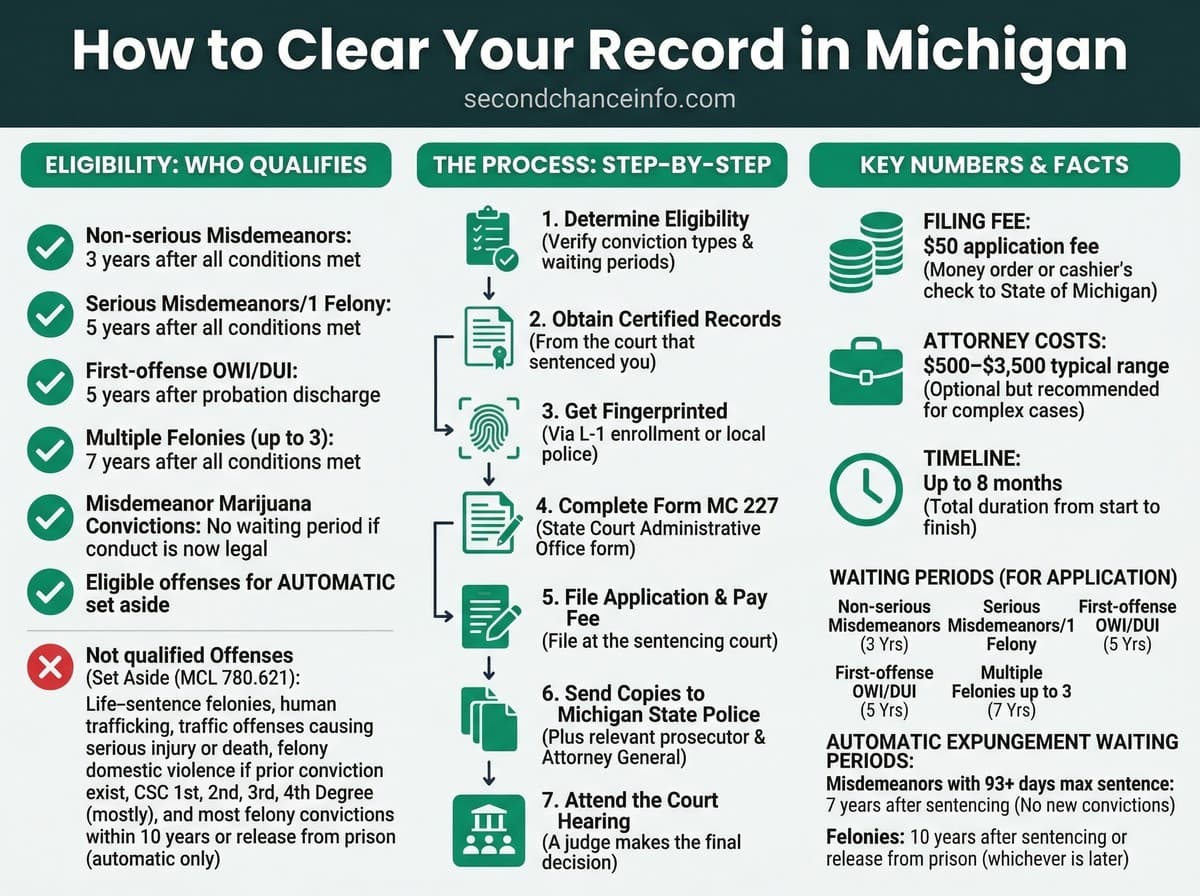
Yes, you can clear your criminal record in Michigan through the set aside process under MCL 780.621. Michigan's Clean Slate laws allow you to petition to set aside up to 3 felonies and unlimited misdemeanors, with waiting periods of 3–7 years depending on the offense. The filing fee is $50, and the process takes 3–8 months. Since April 2023, Michigan also offers automatic expungement — the first state in the nation to auto-expunge felonies — clearing eligible misdemeanors after 7 years and felonies after 10 years with no application needed. First-offense DUI/OWI, marijuana offenses, and most traffic violations are also eligible. Life felonies, most sex offenses, and crimes causing death are not eligible. Once set aside, your record becomes nonpublic and will not appear on most background checks. Below is the full guide with eligibility, step-by-step process, costs, automatic expungement details, and FAQ.
Prepare questions about a record-clearing process
Last updated:
Overview
Michigan uses the term "set aside" rather than expungement. Under the Clean Slate laws (effective April 11, 2021, with automatic expungement beginning April 11, 2023), eligible convictions can be set aside either by petition or automatically. Michigan was the first state to implement automatic felony expungement. Since 2023, over 5 million convictions have been automatically sealed by the Michigan State Police and courts.
Official term: Set Aside (MCL 780.621) — Michigan officially calls the process "setting aside" a conviction. The record is not destroyed — it becomes a nonpublic record accessible only to law enforcement, courts, prosecutors, and the governor.
Routes and conditions to check
- ✓Up to 3 felony convictions (application-based)
- ✓Unlimited misdemeanor convictions (application-based)
- ✓Up to 2 assaultive crime convictions (lifetime limit)
- ✓First-offense OWI/DUI (5-year waiting period required)
- ✓Misdemeanor marijuana convictions for conduct now legal under recreational marijuana law (no waiting period)
- ✓Most traffic offenses (except those causing injury/death or CDL violations)
- ✓Multiple offenses within 24 hours of the same incident may count as one conviction
- ✓Human trafficking victims may petition to set aside prostitution-related convictions
Exclusions and limits to check
- ✗Felonies punishable by life imprisonment (e.g., first-degree murder)
- ✗Most criminal sexual conduct offenses (CSC 1st, 2nd, 3rd degree)
- ✗Child abuse in the first or second degree
- ✗Felony domestic violence with a prior misdemeanor DV conviction
- ✗Traffic offenses causing injury or death
- ✗Commercial driver's license (CDL) violations
- ✗Human trafficking offenses
- ✗Multiple OWI/DUI convictions (only first offense eligible)
- ✗More than 3 felony convictions total
- ✗More than 2 assaultive crime convictions (lifetime)
Waiting Periods
| Non-serious misdemeanors (application) | 3 years after sentencing, imprisonment, or probation completion |
| Serious misdemeanors or 1 felony (application) | 5 years after sentencing, probation, parole, or imprisonment completion |
| First-offense OWI/DUI (application) | 5 years after discharge from probation |
| Multiple felonies (up to 3) (application) | 7 years after sentencing, probation, parole, or imprisonment completion |
| Misdemeanor marijuana convictions (application) | No waiting period if conduct is now legal |
| Misdemeanors 93+ days max sentence (automatic) | 7 years after sentencing with no new convictions |
| Felonies (automatic) | 10 years after sentencing or release from prison, whichever is later |
Step-by-Step Process
Determine eligibility
Verify your conviction qualifies under MCL 780.621, check your criminal history through Michigan ICHAT, and confirm you have met the required waiting period. You must have no pending criminal charges.
Obtain certified records
Get a certified copy of each conviction from the clerk of the court where you were convicted. Note the exact charge, case number, conviction date, and sentence completion date.
Get fingerprinted
Go to your local law enforcement agency and get fingerprinted on an applicant fingerprint card (RI-008). Most agencies charge $10–$25 per card.
Complete Form MC 227
Fill out the Application to Set Aside Conviction(s) (Form MC 227). You must swear to the truth of the statements and sign the form before a court clerk or notary public.
File application and pay fee
File six copies of Form MC 227 and six copies of the certified conviction record with the convicting court. Pay the $50 application fee (money order or cashier's check payable to the State of Michigan).
Send copies to Michigan State Police
Mail a copy of the application, the $50 fee, and the fingerprint card to Michigan State Police, Criminal Justice Information Center, PO Box 30266, Lansing, MI 48909.
Attend the court hearing
The court schedules a hearing typically 45–90 days after filing (up to 160 days in busy courts). The judge considers the nature of the offense, your criminal history, post-conviction conduct, and reasons for seeking relief. The prosecutor may object.
Receive the court order
If granted, the court issues an Order Setting Aside Conviction (Form MC 228). Michigan State Police updates your record to nonpublic status. If denied, you may refile, though there is no statutory waiting period before refiling.
Visual Guide
Automatic Expungement (Clean Slate Act)
Michigan's Clean Slate automatic expungement, launched April 11, 2023, was the first program in the nation to include automatic felony expungement. The Michigan State Police system runs daily, checking the Criminal Historical Record database for newly eligible convictions. No petition, application, or fee is required. Over 5 million convictions have been automatically sealed to date.
| Scenario | Timing and conditions |
|---|---|
| Misdemeanors with max sentence of 92 days or less | 7 years after sentencing (unlimited number eligible) |
| Misdemeanors with max sentence of 93+ days | 7 years after sentencing (up to 4 convictions) |
| Felony convictions | 10 years after sentencing or release from prison, whichever is later (up to 2 convictions) |
| First-offense OWI/DUI | 10 years after sentencing or release (1 lifetime conviction) |
Costs
- Filing fee
- $50 application fee (money order or cashier's check to State of Michigan)
- Fee waiver
- Fee waiver available through Michigan courts Form MC 20 for those who qualify based on financial hardship
- Attorney (optional)
- $500–$3,500 typical range (optional but recommended for complex cases)
Additional costs include fingerprinting ($10–$25) and certified copies of convictions (varies by court). The Michigan Attorney General's office provides free expungement assistance. Legal aid organizations such as Michigan Legal Help and Lakeshore Legal Aid also offer free services.
Timeline
- With attorney
- 3–6 months
- Standard
- Up to 8 months
After filing, courts typically schedule a hearing within 45–90 days (up to 160 days in busy jurisdictions). The Michigan State Police may take up to 2 months to process the Criminal History Report. Automatic expungements require no action and happen on a rolling basis.
Effects of the relief
- ✓Makes the conviction record nonpublic — no longer visible on standard background checks
- ✓Allows you to legally deny the conviction on job, housing, and school applications
- ✓Improves employment prospects (studies show a 23% average wage increase within one year)
- ✓Removes barriers to housing and educational opportunities
- ✓May restore firearm rights under both state and federal law (depending on the offense)
- ✓Removes obligation to register under the Sex Offender Registry if the set-aside offense was a listed SORA offense (after presenting the order to MSP)
Limits of the relief
- ✗Does NOT destroy the record — it remains on a nonpublic file accessible to law enforcement, courts, prosecutors, and the governor
- ✗Does NOT release you from paying fines, costs, fees, or restitution still owed
- ✗Does NOT prevent the conviction from being used to charge a crime as a second or subsequent offense
- ✗Does NOT prevent prosecutors from using it in plea bargaining or sentencing for future offenses
- ✗Does NOT prevent its use in future set-aside applications or pardon decisions
- ✗Does NOT protect against civil lawsuits by crime victims
- ✗Does NOT automatically restore all gun rights — federal prohibitions may still apply depending on the offense
Other Relief Options in Michigan
Governor's Pardon
Filed through the Michigan Parole Board. The governor has constitutional power to grant pardons, which erase the conviction entirely. The Parole Board will not process a pardon application if expungement is available as a remedy. Typically reserved for cases where set aside is not an option.
Governor's Commutation
Replaces the original sentence with a less severe one. Also filed through the Michigan Parole Board. Does not erase the conviction but can reduce or end imprisonment.
Michigan Attorney General Expungement Assistance
The Michigan AG's office provides free assistance with the expungement process, including eligibility review and help preparing applications. Available at michigan.gov/ag.
Frequently Asked Questions
- How much does expungement cost in Michigan?
- The state filing fee is $50, payable by money order or cashier's check. Additional costs include fingerprinting ($10–$25) and certified copies of convictions (varies by court). If you hire an attorney, fees typically range from $500 to $3,500. Fee waivers are available through Form MC 20 for those with financial hardship. The Michigan Attorney General's office and legal aid organizations offer free assistance.
- How long does the expungement process take in Michigan?
- The application-based process typically takes 3–8 months from filing to final court decision. Courts usually schedule hearings 45–90 days after filing, though busy courts may take up to 160 days. Automatic expungement under the Clean Slate program requires no action — the Michigan State Police system checks for eligible convictions daily.
- What is Michigan's Clean Slate automatic expungement?
- Launched April 11, 2023, Michigan's Clean Slate program automatically sets aside eligible convictions without any application or fee. Eligible misdemeanors are cleared after 7 years and felonies after 10 years, provided there are no new convictions. The system has sealed over 5 million convictions to date. You can check your record through Michigan ICHAT to see if your conviction was automatically expunged.
- Can a felony be expunged in Michigan?
- Yes. By application, up to 3 felony convictions can be set aside after a 5-year waiting period (for a single felony) or 7-year waiting period (for multiple felonies). Felonies punishable by life imprisonment, most criminal sexual conduct offenses, and certain other serious offenses are not eligible. Up to 2 felonies can also be automatically expunged after 10 years under Clean Slate.
- Can a DUI or OWI be expunged in Michigan?
- Yes, but only a first-offense OWI. You must wait 5 years after discharge from probation to apply. The court will consider whether you benefited from rehabilitative or educational programs. OWI convictions causing injury or death, CDL violations, and second or subsequent OWI offenses are not eligible. A single first-offense OWI may also qualify for automatic expungement after 10 years.
- Does expungement restore gun rights in Michigan?
- It depends on the offense. Under Michigan law, a person whose felony conviction has been set aside may not be denied a concealed pistol license solely based on that conviction. Under federal law (27 CFR § 478.11), an expunged or set-aside conviction generally does not disqualify you from firearm ownership unless the expungement expressly maintains a firearm prohibition. However, certain offenses (such as domestic violence) may carry permanent federal firearm prohibitions regardless of state-level expungement.
- Will an expunged record show up on a background check in Michigan?
- For most standard employment and housing background checks, no — a set-aside conviction becomes a nonpublic record. However, law enforcement, courts, prosecutors, and the governor can still access the record. Certain government positions and professional licenses (such as law enforcement) may also require disclosure of set-aside convictions.
- What is the difference between application-based and automatic expungement in Michigan?
- Application-based expungement requires filing Form MC 227, paying a $50 fee, getting fingerprinted, and attending a court hearing — but has shorter waiting periods (3–7 years) and higher conviction limits (up to 3 felonies, unlimited misdemeanors). Automatic expungement under Clean Slate requires no action but has longer waiting periods (7 years for misdemeanors, 10 for felonies) and lower conviction limits (up to 2 felonies, 4 serious misdemeanors). Many people benefit from applying rather than waiting for automatic relief.
Take Action — Direct Links
- Download Form MC 227 (Application to Set Aside Conviction)
Official Michigan SCAO form to petition the court to set aside (expunge) an adult criminal conviction.
- Request Your Criminal Record (Michigan ICHAT)
Michigan State Police Internet Criminal History Access Tool (ICHAT) — search public criminal history records online ($10 per search).
- Find Free Legal Help (Michigan Legal Help)
Michigan Legal Help self-help guide and do-it-yourself tools for setting aside adult criminal convictions, plus links to free legal aid organizations.
- Michigan Courts Self-Help: Expungement
Step-by-step guide from Michigan Legal Help covering eligibility, forms, filing instructions, and the court hearing process for expungement.
- MCL § 780.621 — Full Statute Text
Official full text of Michigan Compiled Laws Section 780.621 (setting aside convictions) on the Michigan Legislature website.
Related Resources on This Site
More for your state
- Pardon & ClemencyPardon & clemency in Michigan
- Jobs by CityFelony friendly jobs in Detroit, MI
- Jobs by StateJobs for felons in Michigan
- HousingSecond chance apartments in Detroit, MI
- Voting RightsFelon voting rights in Michigan
- Gun RightsFelon gun rights in Michigan
- DUI RecoveryDUI license recovery in Michigan
- ProbationProbation & parole in Michigan
Helpful guides
- Background ChecksHow far back do background checks go?
- ToolsReentry organizations directory
- Free Legal AidFree legal aid by state