
Maine (ME) — Expungement & Record Clearing
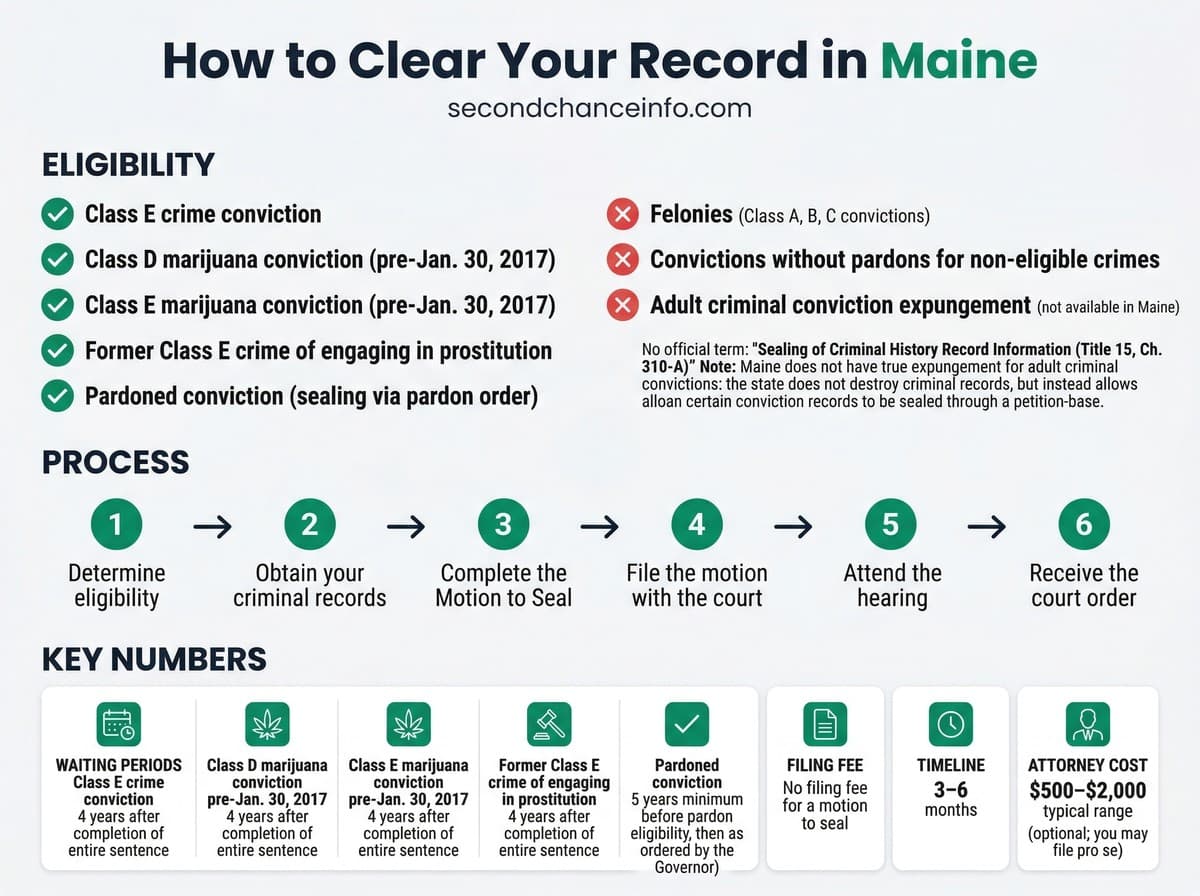
Maine does not offer true expungement — criminal records cannot be destroyed. However, since August 2024, you can petition to seal Class E misdemeanor convictions (e.g., theft under $500, driving to endanger) after waiting 4 years from completion of your sentence. Pre-legalization marijuana convictions (Class D and E, before January 30, 2017) are also eligible. There is no filing fee. The process requires a court hearing where you must prove eligibility by a preponderance of the evidence. For felonies and most Class D crimes, the only relief available is a Governor's Pardon (5-year wait after sentence completion). A "Clean Slate" automatic sealing bill (LD 1911) for misdemeanors is under consideration but has not yet become law. Below is the full guide with eligibility, step-by-step process, costs, timeline, and FAQ.
Prepare questions about a record-clearing process
Last updated:
Overview
Maine does not have true expungement for adult criminal convictions — the state does not destroy criminal records. Instead, Maine allows certain conviction records to be sealed through a petition-based process under Title 15, Chapter 310-A. As of August 2024, all Class E crimes (the least serious misdemeanors) are eligible for sealing regardless of the person's age at the time of the offense, and certain pre-legalization marijuana convictions (Class D and E) can also be sealed. A "Clean Slate" automatic sealing bill (LD 1911) for misdemeanors is under consideration in the 132nd Legislature but has not yet been enacted.
Official term: Sealing of Criminal History Record Information (Title 15, Ch. 310-A) — Maine uses "sealing" rather than expungement. Sealed records are not destroyed — they are hidden from public view and non-criminal-justice agencies, but law enforcement and courts can still access them.
Routes and conditions to check
- ✓Conviction for any Class E crime (least serious misdemeanor, e.g., theft under $500, driving to endanger) — no age restriction as of August 2024
- ✓Conviction for a Class E or Class D marijuana offense committed before January 30, 2017 (date of legalization)
- ✓Conviction for the former Class E crime of engaging in prostitution
- ✓At least 4 years have passed since completion of entire sentence (including fines, fees, and restitution)
- ✓No new criminal convictions since the eligible conviction
- ✓No pending criminal charges or charges dismissed via deferred disposition
- ✓Pardoned convictions (the pardon order may include a sealing provision)
Exclusions and limits to check
- ✗Class D crimes (misdemeanors) — unless it is a pre-legalization marijuana offense
- ✗Class A, B, or C crimes (felonies)
- ✗Class E sexual assault convictions (Title 17-A, Chapter 11)
- ✗Any conviction where the person has a subsequent criminal conviction
- ✗Any conviction where the person has pending criminal charges
- ✗Convictions where fines, fees, or restitution have not been fully paid
Waiting Periods
| Class E crime conviction | 4 years after completion of entire sentence |
| Class D marijuana conviction (pre-Jan. 30, 2017) | 4 years after completion of entire sentence |
| Class E marijuana conviction (pre-Jan. 30, 2017) | 4 years after completion of entire sentence |
| Former Class E crime of engaging in prostitution | 4 years after completion of entire sentence |
| Pardoned conviction (sealing via pardon order) | 5 years minimum before pardon eligibility, then as ordered by the Governor |
Step-by-Step Process
Determine eligibility
Confirm your conviction is for an eligible offense (Class E crime, pre-legalization marijuana Class D/E, or former prostitution offense). Verify that at least 4 years have passed since you completed your entire sentence, including payment of all fines, fees, and restitution. Confirm you have no subsequent convictions or pending charges.
Obtain your criminal records
Request a copy of your criminal history from the Maine State Bureau of Identification (SBI) and obtain the case number(s) for the conviction(s) you want sealed from the court where your case was heard.
Complete the Motion to Seal
Fill out the Motion to Seal Criminal History Record Information form (CR-218), available from the Maine Judicial Branch website or the clerk's office. You may file the motion yourself (pro se) or hire an attorney.
File the motion with the court
File your completed motion at the court where your conviction was entered. There is no filing fee for a motion to seal in Maine. The State (prosecutor's office that handled the original case) will be served and may respond.
Attend the hearing
The court will schedule a hearing on your motion. You must demonstrate by a preponderance of the evidence that you meet all statutory requirements under Title 15, Chapter 310-A. The prosecutor may support or oppose the motion.
Receive the court order
If the court grants the motion, it issues a written order sealing the conviction. The court transmits notice to the State Bureau of Identification, which seals the record and sends you written confirmation. If denied, you may refile when circumstances change.
Visual Guide
Automatic Record Sealing (LD 1911 — Pending Legislation)
Maine does not currently have automatic record sealing or expungement. All record sealing requires filing a petition with the court. However, LD 1911 (the "Clean Slate" bill), introduced in the 132nd Legislature (2025-2026), would create automatic sealing for eligible misdemeanor convictions (Class D and E, excluding assault, domestic violence, sex offenses, and certain other crimes). As of March 2026, the bill has been reported out of the Judiciary Committee in amended form and carried over for further consideration.
| Scenario | Timing and conditions |
|---|---|
| Class E crime convictions (if LD 1911 passes) | Automatic sealing after waiting period — bill pending |
| Class D crime convictions (if LD 1911 passes) | Automatic sealing after waiting period — bill pending |
| Arrests with no conviction | No automatic sealing under current law |
| Dismissed charges | No automatic sealing under current law |
Costs
- Filing fee
- No filing fee for a motion to seal
- Fee waiver
- Not applicable — no filing fee is charged
- Attorney (optional)
- $500–$2,000 typical range (optional; you may file pro se)
You must have fully paid all fines, fees, and restitution from your original sentence before you are eligible to petition for sealing. Pine Tree Legal Assistance and other legal aid organizations may offer free help to qualifying individuals.
Timeline
- With attorney
- 2–4 months
- Standard
- 3–6 months
Timelines vary by court. In 2024, only 15 out of 47 sealing petitions filed statewide were granted, so outcomes are not guaranteed. Proper preparation of the petition is important.
Effects of the relief
- ✓Sealed records are hidden from public view and background checks
- ✓Employers, landlords, lenders, and schools cannot access sealed records
- ✓You may legally answer 'no' to questions about criminal history regarding a sealed conviction (except to criminal justice agencies)
- ✓The State Bureau of Identification amends its records to reflect the sealing
- ✓May improve employment, housing, and educational opportunities
Limits of the relief
- ✗Does NOT destroy the criminal record — law enforcement and courts retain access
- ✗Does NOT apply to Class D or higher crimes (except pre-legalization marijuana offenses)
- ✗Does NOT restore firearm rights
- ✗Does NOT seal the record from federal agencies or federal background checks
- ✗Record must be unsealed if you are convicted of a new crime
- ✗Does NOT prevent use of the sealed conviction for sentencing enhancement in future criminal cases
Other Relief Options in Maine
Governor's Pardon (Executive Clemency)
Available 5 years after completing your entire sentence. Petition is filed with the Department of Corrections and reviewed by the Governor's Board on Executive Clemency, which holds public hearings at least 3 times per year. The process takes a minimum of 6 months. A pardon does not erase the conviction but may include a sealing provision. DUI pardons are generally not considered as a matter of policy.
Commutation of Sentence
The Governor may commute (reduce) a sentence through the same clemency board process. This does not clear the conviction but can reduce incarceration or supervision terms.
Juvenile Record Sealing
Maine juvenile records are confidential by default. After age 21 (or earlier in some cases), individuals may petition to have juvenile adjudication records sealed under separate provisions of Maine law.
Frequently Asked Questions
- Can you get a criminal record expunged in Maine?
- No, Maine does not have true expungement — criminal records cannot be destroyed. However, Maine does allow certain conviction records to be sealed, which hides them from public view, employers, landlords, and other non-criminal-justice entities. The primary mechanism is the post-judgment motion to seal under Title 15, Chapter 310-A.
- What crimes are eligible for record sealing in Maine?
- As of August 2024, all Class E crimes (the least serious misdemeanors, such as theft under $500, driving to endanger, or disorderly conduct) are eligible for sealing, except Class E sexual assaults. Pre-legalization marijuana convictions (Class D and E offenses committed before January 30, 2017) are also eligible. Class D and higher crimes (other than marijuana) are not eligible for sealing.
- How long do you have to wait to seal a criminal record in Maine?
- You must wait at least 4 years after completing your entire sentence, which includes serving any incarceration, completing probation, and paying all fines, fees, and restitution in full. You also must have no new criminal convictions and no pending criminal charges during that period.
- How much does it cost to seal a record in Maine?
- There is no filing fee for a motion to seal in Maine. However, if you choose to hire an attorney, fees typically range from $500 to $2,000. You must have fully paid all fines, fees, and restitution from your original conviction before you are eligible. Legal aid organizations like Pine Tree Legal Assistance may provide free help.
- Does Maine have automatic record sealing?
- Not yet. As of March 2026, all record sealing in Maine requires filing a petition with the court. LD 1911, the 'Clean Slate' bill introduced in the 132nd Legislature, would create automatic sealing for eligible misdemeanor convictions (Class D and E, excluding assault, sex offenses, domestic violence, and certain other crimes). The bill has been amended by the Judiciary Committee and is still under legislative consideration.
- Can a felony be sealed in Maine?
- No. Under current Maine law, only Class E crimes (the least serious misdemeanors) and certain pre-legalization marijuana Class D offenses are eligible for sealing. Class A, B, and C crimes (felonies) and most Class D crimes (other misdemeanors) cannot be sealed. The only path to relief for a felony conviction is a Governor's Pardon, which requires waiting at least 5 years after completing your sentence.
- What happens if I get a new conviction after my record is sealed?
- If you are convicted of a new crime after your record has been sealed, the sealed record must be unsealed. This means the previously sealed conviction will become visible again on background checks and to the public. Maintaining a clean record after sealing is essential to preserving the benefit.
- Can employers see a sealed criminal record in Maine?
- No. Once a conviction is sealed, it is not disclosed to employers, landlords, lenders, or school admissions offices. You may legally answer 'no' when asked about criminal history regarding the sealed conviction. However, criminal justice agencies (law enforcement, courts, prosecutors) can still access sealed records.
Take Action — Direct Links
- Download Motion to Seal Criminal History (Form CR-218)
Official Maine Judicial Branch form to petition for sealing of a criminal conviction under Title 15, Chapter 310-A.
- Request Your Criminal History Record (Maine SBI)
Online service from the Maine State Police, State Bureau of Identification to request your own criminal history record. Most results returned via email within two hours.
- Find Free Legal Help (Maine Volunteer Lawyers Project)
The Maine Volunteer Lawyers Project provides free legal assistance to low-income individuals in all sixteen Maine counties, including help with record sealing.
- Maine Courts — Sealing Your Criminal Record
Maine Judicial Branch self-help page with eligibility requirements, instructions, and links to forms for sealing a criminal record.
- Title 15, Chapter 310-A — Full Statute Text
Official full text of Maine's Post-Judgment Motion to Seal Criminal History Record statute on the Maine Legislature website.
Related Resources on This Site
More for your state
- Pardon & ClemencyPardon & clemency in Maine
- Jobs by StateJobs for felons in Maine
- Voting RightsFelon voting rights in Maine
- Gun RightsFelon gun rights in Maine
- DUI RecoveryDUI license recovery in Maine
- ProbationProbation & parole in Maine
- SR22 InsuranceSR22 insurance in Maine
- License ReinstatementLicense reinstatement in Maine
Helpful guides
- Background ChecksHow far back do background checks go?
- ToolsReentry organizations directory
- Free Legal AidFree legal aid by state
Sources
- Maine Judicial Branch — Sealing Your Criminal Record
- Me. Rev. Stat. tit. 15, ch. 310-A (Post-Judgment Motion to Seal)
- Collateral Consequences Resource Center — Maine Guide
- Maine Governor's Board on Executive Clemency (Pardon Board)
- Maine Morning Star — Clean Slate Automatic Sealing (LD 1911)
- NORML — Maine Marijuana Expungement Legislation