
Kentucky (KY) — Expungement & Record Clearing
Yes, you can clear your criminal record in Kentucky through expungement. Most Class D felony convictions and unlimited misdemeanor convictions are eligible after a 5-year waiting period with a clean record. Filing costs range from $0 for dismissed charges to $340 total for felonies ($40 certificate + $50 filing + $250 upon approval), with fee waivers available. Since July 2020, acquittals and dismissals with prejudice are automatically expunged within 30 days. The process typically takes 4–12 months. Expunged records are deleted from state databases, and you can legally deny the conviction on job applications. Sex offenses, crimes against children, and Class A/B/C felonies (unless pardoned) are not eligible. Below is the full guide with eligibility, step-by-step process, costs, timeline, and FAQ.
Prepare questions about a record-clearing process
Last updated:
Overview
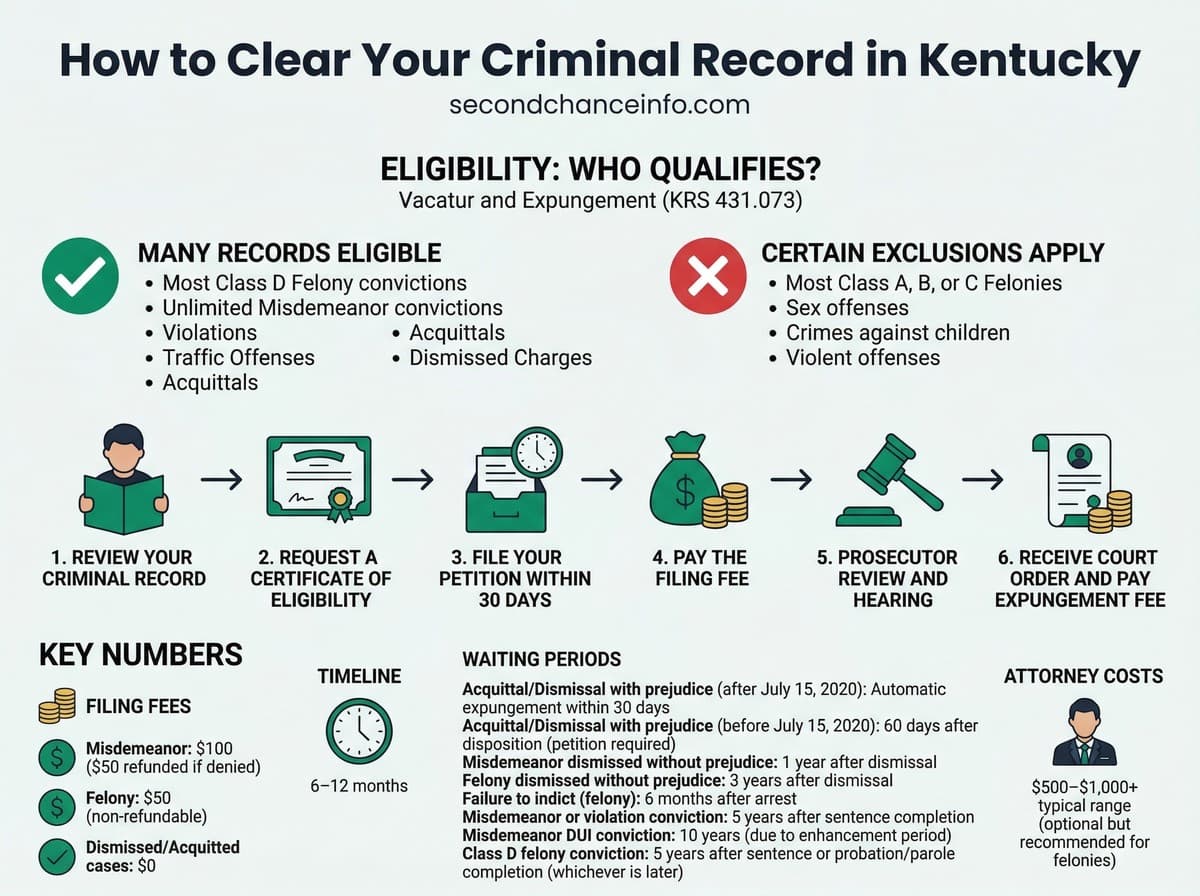
Kentucky allows expungement of many criminal records, including most Class D felony convictions, unlimited misdemeanor convictions, violations, traffic offenses, acquittals, and dismissed charges. For felonies, the court "vacates" the conviction and then expunges the record. Since July 2020, acquittals and dismissals with prejudice are automatically expunged within 30 days. Kentucky expanded Class D felony expungement through SB 57 (2019) and HB 369 (2023), which broadened eligible offenses and allowed expungement of multiple felonies in limited circumstances.
Official term: Vacatur and Expungement (KRS 431.073) — Kentucky uses "vacated and expunged" for felonies — the conviction is vacated, charges dismissed, and records expunged. For drug possession offenses, a separate "void and seal" process applies under KRS 218A.275/276.
Routes and conditions to check
- ✓Most Class D felony convictions (5-year waiting period after sentence completion)
- ✓Unlimited misdemeanor convictions (5-year waiting period after sentence completion)
- ✓Violations and traffic offense convictions (5-year waiting period)
- ✓Misdemeanor DUI convictions (10-year waiting period due to enhancement window)
- ✓Acquittals and dismissals with prejudice (automatic after July 15, 2020)
- ✓Charges dismissed without prejudice (1-year wait for misdemeanors, 3-year wait for felonies)
- ✓Failure to indict within 6 months
- ✓First-time controlled substance possession (void and seal under KRS 218A.275)
- ✓Marijuana, synthetic, or salvia convictions (void and seal under KRS 218A.276)
- ✓Any pardoned conviction, regardless of felony class
Exclusions and limits to check
- ✗Class A, B, or C felonies (unless pardoned by the Governor)
- ✗Sex offenses
- ✗Offenses committed against a child
- ✗Offenses that caused serious bodily injury or death
- ✗Felony DUI (KRS 189A.010)
- ✗Fourth-degree assault (domestic violence)
- ✗Impersonating a peace officer
- ✗Abuse of public office
- ✗Anyone with a pending criminal charge
- ✗Anyone with a misdemeanor or felony conviction within the past 5 years
Waiting Periods
| Acquittal or dismissal with prejudice (after July 15, 2020) | Automatic — expunged within 30 days |
| Acquittal or dismissal with prejudice (before July 15, 2020) | 60 days after disposition (petition required) |
| Misdemeanor dismissed without prejudice | 1 year after dismissal |
| Felony dismissed without prejudice | 3 years after dismissal |
| Failure to indict (felony) | 6 months after arrest |
| Misdemeanor or violation conviction | 5 years after sentence completion |
| Misdemeanor DUI conviction | 10 years (due to enhancement period) |
| Class D felony conviction | 5 years after sentence or probation/parole completion (whichever is later) |
Step-by-Step Process
Review your criminal record
Obtain your criminal history and identify each case you want to expunge. Note the case numbers, counties, and disposition types (conviction, dismissal, acquittal).
Request a Certificate of Eligibility
Submit form RU009 to the Kentucky Court of Justice (online, in person, or by mail) with a $40 fee. The certificate confirms which charges are eligible. Processing takes up to 60 days.
File your petition within 30 days
Once you receive your certificate, you have 30 days to file before it expires. Use form AOC-496.2 for misdemeanors or AOC-496.3 for felonies. File at the circuit court clerk's office in the county where the conviction occurred.
Pay the filing fee
Misdemeanor filing fee is $100 ($50 refunded if denied). Felony filing fee is $50 (non-refundable). Fee waivers are available for those who cannot afford to pay.
Prosecutor review and hearing
The prosecutor has 60 days to respond. If the prosecutor objects, a hearing is scheduled. For misdemeanors from a single incident, expungement is mandatory if you meet eligibility. For felonies, the court has discretion and may require a hearing.
Receive the court order and pay expungement fee
If granted, pay the $250 expungement fee for felonies (installment plans available over up to 18 months). The conviction is not officially expunged until the fee is paid in full. Records are then deleted from state databases.
Visual Guide
Automatic Expungement for Acquittals & Dismissals (July 2020)
Since July 15, 2020, Kentucky automatically expunges acquittals and dismissals with prejudice within 30 days — no petition or fee required. The court sends notice to prosecutors, law enforcement, and state agencies to delete the records. Proposed legislation (SB 290, HB 569 / SB 218) would expand automatic expungement to eligible misdemeanor and Class D felony convictions, potentially taking effect in July 2027 if passed.
| Scenario | Timing and conditions |
|---|---|
| Acquittal (on or after July 15, 2020) | Automatic within 30 days |
| Dismissal with prejudice (on or after July 15, 2020) | Automatic within 30 days |
| Acquittal (before July 15, 2020) | Petition required, 60 days after disposition, no fee |
| Dismissal with prejudice (before July 15, 2020) | Petition required, 60 days after disposition, no fee |
Costs
- Filing fee
- Misdemeanor: $100 ($50 refunded if denied); Felony: $50 (non-refundable); Dismissed/acquitted cases: $0
- Fee waiver
- Available for indigent individuals — the Kentucky Supreme Court has ordered that expungement fees be waived for those who cannot afford to pay
- Attorney (optional)
- $500–$1,000+ typical range (optional but recommended for felonies)
Felony expungement requires an additional $250 fee upon approval (installment plans available). Certificate of Eligibility costs $40. Medicaid plans (Anthem, Humana) may cover some fees. Free legal clinics available through Goodwill Kentucky and Legal Aid of the Bluegrass.
Timeline
- With attorney
- 4–8 months
- Standard
- 6–12 months
The Certificate of Eligibility alone takes up to 60 days. After filing, the prosecutor has 60 days to respond and the court has an additional 60 days to rule. Removal from KSP and FBI databases can take up to 6 months after the order is granted.
Effects of the relief
- ✓Records are deleted from state computer systems and official background checks
- ✓Court and agencies must respond that no record exists upon inquiry
- ✓You can legally deny the conviction on employment, credit, and other applications
- ✓Restores voting rights (if no other felonies remain on your record)
- ✓Restores eligibility for public office and jury service (felony expungement)
- ✓May restore firearm rights at the state level (if no other restrictions apply)
- ✓Restores eligibility for student loans (for drug convictions)
- ✓Restores eligibility for professional licenses
Limits of the relief
- ✗Does NOT remove records from private background-check databases or cached internet records
- ✗Does NOT guarantee removal of mugshots from third-party websites (separate process under KRS 61.8746)
- ✗Does NOT affect federal government records or FBI databases immediately (removal can take months)
- ✗Does NOT eliminate disclosure requirements for federal job applications
- ✗Does NOT automatically remove records from other states' databases
- ✗May be harmful to immigration status — non-citizens should consult an immigration attorney before filing
- ✗Does NOT restore firearm rights if federal law independently prohibits possession
Other Relief Options in Kentucky
Void and Seal — Drug Possession (KRS 218A.275)
First-time controlled substance possession conviction may be voided and sealed. Discretionary, no filing fee, no Certificate of Eligibility required.
Void and Seal — Marijuana (KRS 218A.276)
Unlimited marijuana, synthetic, or salvia convictions may be voided and sealed. Discretionary, no filing fee, no Certificate of Eligibility required.
Governor's Pardon
A full pardon from the Governor restores all civil rights including firearm rights. Any pardoned conviction — regardless of class — becomes eligible for expungement. Requires application with employment history, statement of reasons, and three recommendation letters.
Restoration of Civil Rights (Executive Order)
Governor Beshear's 2019 executive order automatically restores voting rights and public office eligibility for individuals who completed sentences for nonviolent, nonsexual, non-treasonous felonies. Those with violent or sexual offenses must apply directly to the Governor.
Frequently Asked Questions
- How much does expungement cost in Kentucky?
- For misdemeanors: $40 for the Certificate of Eligibility plus a $100 filing fee ($50 refunded if denied). For Class D felonies: $40 certificate fee, $50 filing fee, plus $250 upon approval (installment plans available). Acquittals and dismissed charges cost nothing. Fee waivers are available for those who cannot afford to pay, and some Medicaid plans cover expungement costs.
- How long does expungement take in Kentucky?
- The Certificate of Eligibility takes up to 60 days to process. After filing, the prosecutor has 60 days to respond and the court has 60 more days to rule. Total timeline is typically 4–12 months. Removal from all databases, including KSP and FBI, can take up to 6 additional months after the court order.
- Can a felony be expunged in Kentucky?
- Yes, most Class D felony convictions (the lowest felony class) can be expunged after 5 years with no new convictions. Excluded offenses include sex crimes, crimes against children, offenses causing serious bodily injury or death, felony DUI, domestic violence assault, impersonating a peace officer, and abuse of public office. Class A, B, and C felonies cannot be expunged unless pardoned by the Governor.
- Can I expunge multiple felonies in Kentucky?
- It is limited. You can expunge multiple Class D felonies arising from a single incident. Under HB 369 (effective June 2023), you may also petition for multiple qualifying felony convictions from separate incidents, but a mandatory hearing is required and you must demonstrate rehabilitation by clear and convincing evidence. Anyone who expunged a felony before June 27, 2019 may petition for a second.
- Does Kentucky have automatic expungement?
- Partially. Since July 15, 2020, acquittals and dismissals with prejudice are automatically expunged within 30 days — no petition or fee required. Convictions still require a petition and fees. Proposed legislation (SB 290, HB 569/SB 218) would automate expungement for eligible misdemeanor and felony convictions, potentially starting in July 2027.
- Does expungement restore gun rights in Kentucky?
- Expungement may restore state-level firearm rights if the expunged conviction was the only legal barrier. However, federal firearms law is separate — if your conviction triggers a federal prohibition (e.g., felony conviction or domestic violence misdemeanor), expungement may not resolve the federal restriction. Consult an attorney for your specific situation.
- Can I expunge a DUI in Kentucky?
- Misdemeanor DUI convictions can be expunged, but you must wait 10 years (not the standard 5) because DUIs are enhanceable offenses with a 10-year lookback window. Felony DUI convictions are not eligible for expungement under KRS 431.073.
- Will expungement remove my record from background checks?
- Expungement removes records from official Kentucky state background checks — agencies must respond that no record exists. However, private background-check companies may retain cached data. Under the Fair Credit Reporting Act (FCRA), compliant companies must not report expunged records, but non-compliant databases may still show them.
Take Action — Direct Links
- Download Expungement Petition Forms (AOC-496)
Official Kentucky Court of Justice legal forms library with downloadable expungement petition forms including AOC-496.2 (misdemeanor), AOC-496.3 (felony), and RU-009 (Certificate of Eligibility application).
- Request Your Criminal Record (Kentucky State Police)
Kentucky State Police background check forms page where you can download forms to request your own criminal history record for personal review.
- Find Free Legal Help (Kentucky Department of Public Advocacy)
Clean Slate Kentucky program through the Department of Public Advocacy offering free expungement information sessions, eligibility guidance, and step-by-step resources.
- Kentucky Courts Self-Help: Expungement
Kentucky Court of Justice expungement certification process page with instructions on obtaining a Certificate of Eligibility and filing your petition.
- KRS 431.073 — Full Statute Text
Official full text of KRS 431.073 (felony vacatur and expungement) on the Kentucky Legislature website.
Related Resources on This Site
More for your state
- Pardon & ClemencyPardon & clemency in Kentucky
- Jobs by CityFelony friendly jobs in Louisville, KY
- Jobs by StateJobs for felons in Kentucky
- HousingSecond chance apartments in Louisville, KY
- Voting RightsFelon voting rights in Kentucky
- Gun RightsFelon gun rights in Kentucky
- DUI RecoveryDUI license recovery in Kentucky
- ProbationProbation & parole in Kentucky
Helpful guides
- Background ChecksHow far back do background checks go?
- ToolsReentry organizations directory
- Free Legal AidFree legal aid by state