
Tennessee (TN) — Expungement & Record Clearing
Yes, you can clear your criminal record in Tennessee through expunction under T.C.A. § 40-32-101 (reorganized in 2025 to §§ 40-32-106–108). Dismissed charges, acquittals, and nolle prosequi cases can be expunged at no cost with no waiting period. Eligible non-violent misdemeanor and Class E felony convictions can be expunged after 5 years; certain Class C and D felonies after 10 years. The filing fee is $100 for conviction cases. You may expunge up to two convictions total. Tennessee expunction actually deletes your record from TBI and FBI databases — it is not just sealed. Expungement restores gun rights and allows you to legally deny the conviction to employers. DUI, sexual offenses, violent crimes, and offenses against children are not eligible. Below is the full guide with eligibility, step-by-step process, costs, timeline, and FAQ.
Prepare questions about a record-clearing process
Last updated:
Overview
Tennessee allows the expungement (called "expunction") of certain criminal records under T.C.A. § 40-32-101, which was reorganized in 2025 into §§ 40-32-106 through 40-32-108. Dismissed charges, acquittals, and nolle prosequi cases can be expunged at no cost. Since 2017, certain non-violent misdemeanor and felony convictions are also eligible, subject to waiting periods, conviction limits, and a filing fee. Tennessee expungement results in the actual deletion — not just sealing — of records from the TBI criminal history repository.
Official term: Expunction (T.C.A. § 40-32-101 et seq.) — Tennessee uses "expunction" in its statutes. Unlike sealing, Tennessee expunction results in the actual destruction and deletion of the record from TBI and FBI databases.
Routes and conditions to check
- ✓Charges dismissed, nolle prosequi, no true bill, or not guilty verdict (no cost)
- ✓Successful completion of pretrial or judicial diversion programs
- ✓Non-violent Class E felony convictions on the statutory inclusion list (5-year wait after sentence completion)
- ✓Certain Class D felony convictions on the inclusion list (10-year wait after sentence completion)
- ✓Certain Class C felony convictions on the inclusion list (10-year wait after sentence completion)
- ✓Most misdemeanor convictions not on the statutory exclusion list (5-year wait after sentence completion)
- ✓Up to two eligible convictions total (two misdemeanors, or one felony and one misdemeanor)
- ✓Multiple charges from the same criminal incident may qualify together under 2025 reforms
- ✓Convictions before November 1, 1989 with sentences of 3 years or less (5-year wait)
Exclusions and limits to check
- ✗Class A or Class B felonies
- ✗Violent felonies or offenses involving serious bodily injury
- ✗Sexual offenses (T.C.A. § 40-15-105(a)(1)(B)(ii))
- ✗DUI / driving under the influence convictions
- ✗Domestic violence offenses
- ✗Stalking, public indecency, or indecent exposure
- ✗Child abuse, neglect, or endangerment
- ✗Offenses involving minors as victims
- ✗Violations of protective or restraining orders
- ✗Three or more total convictions (including out-of-state and federal)
- ✗Unpaid fines, restitution, or court costs
Waiting Periods
| Dismissed, acquitted, nolle prosequi, or no true bill | No waiting period |
| Successful completion of pretrial or judicial diversion | No waiting period after completion |
| Eligible misdemeanor conviction | 5 years after sentence completion |
| Eligible Class E felony conviction | 5 years after sentence completion |
| Eligible Class D felony conviction | 10 years after sentence completion |
| Eligible Class C felony conviction | 10 years after sentence completion |
| Conviction before November 1, 1989 (≤3-year sentence) | 5 years after sentence completion |
Step-by-Step Process
Determine eligibility
Confirm your charge or conviction qualifies for expunction. For convictions, verify the offense is on the inclusion list (felonies) or not on the exclusion list (misdemeanors), that you have two or fewer total convictions, and that the waiting period has passed. All fines, restitution, and court costs must be paid in full.
Gather your case information
Obtain your case docket number, the county where the arrest occurred, the court where the case was heard, and certified copies of the disposition. Contact the criminal court clerk in the county of your arrest.
Obtain and complete expungement forms
Download the expungement petition packet from your county's criminal court clerk website or pick up forms in person. Complete one form per charge you wish to expunge.
File the petition with the court
File your completed petition at the court clerk's office in the county where the arrest occurred. Pay the filing fee if applicable ($100 for conviction or diversion cases; no fee for dismissals/acquittals). Include a self-addressed stamped envelope for each charge.
TBI certification (conviction cases)
Under the 2025 reforms (T.C.A. § 40-32-102), the court submits a certification request to the TBI before entering the expunction order. The TBI verifies eligibility and returns a certification to the court.
District Attorney review and court ruling
The District Attorney reviews the petition. For eligible misdemeanor and Class E felony convictions, there is a rebuttable presumption in favor of granting expungement. The court cannot rule within 61 days of service. If the DA objects, a hearing is scheduled.
Court order and agency processing
If granted, the court issues an expunction order and sends it to the arresting agency, county jail, Tennessee Department of Correction, and TBI within 30 days. The TBI deletes the record and notifies the FBI. Keep a certified copy of the order for your records.
Visual Guide
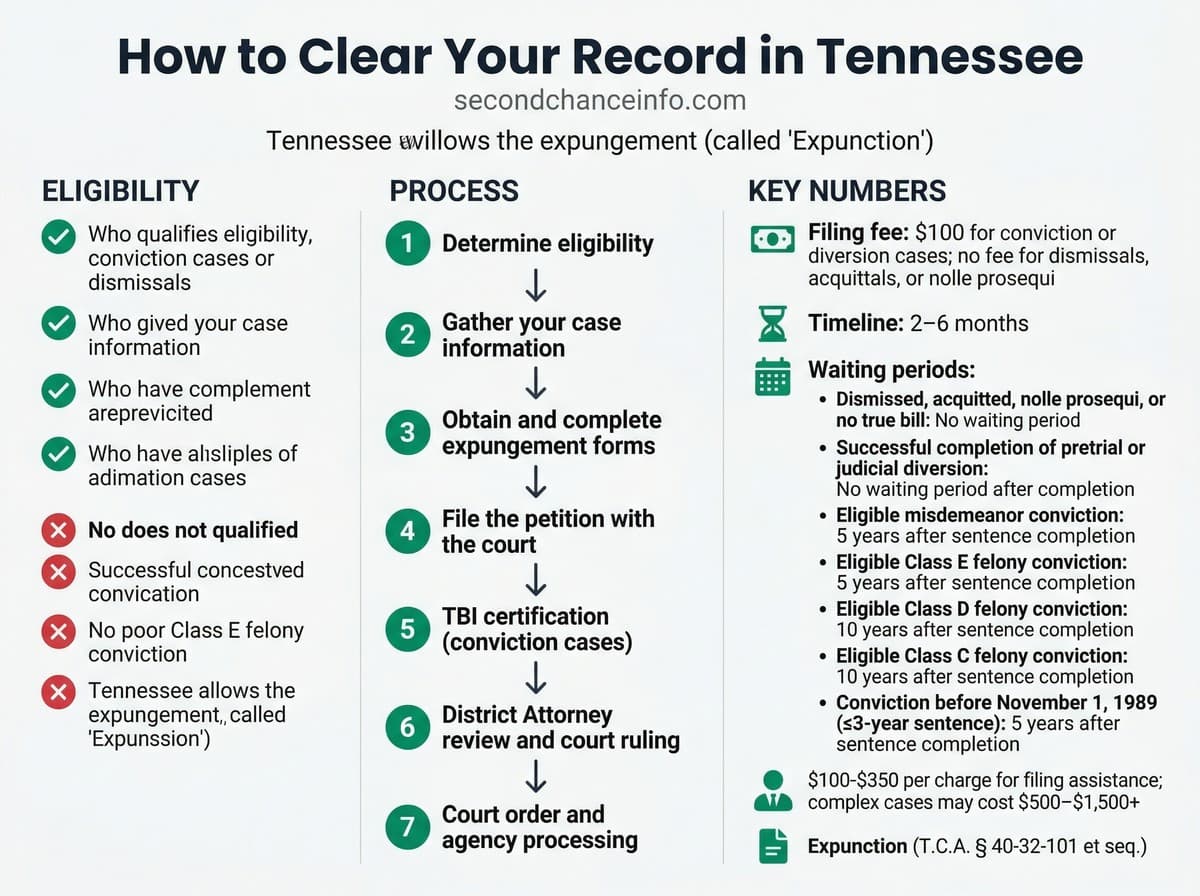
Free Expunction for Non-Conviction Records
Tennessee does not have a broad automatic expungement system. However, certain categories of records are eligible for expunction without the individual needing to petition, primarily arrest records where no charges were filed or prosecution was not pursued. For most cases, individuals must file a petition with the court.
| Scenario | Timing and conditions |
|---|---|
| Arrest with no charges filed | Eligible upon request (no waiting period) |
| Charges dismissed or nolle prosequi | Eligible upon request (no waiting period) |
| Grand jury returns no true bill | Eligible upon request (no waiting period) |
| Not guilty verdict at trial | Eligible upon request (no waiting period) |
Costs
- Filing fee
- $100 for conviction or diversion cases; no fee for dismissals, acquittals, or nolle prosequi
- Fee waiver
- Some counties waive fees for financially disadvantaged petitioners, though Tennessee law does not guarantee a fee waiver for indigent individuals
- Attorney (optional)
- $100–$350 per charge for filing assistance; complex cases may cost $500–$1,500+
All fines, restitution, court costs, and probation fees must be paid in full before the petition is accepted. Some legal aid organizations and law school clinics offer free expungement assistance.
Timeline
- With attorney
- 6 weeks–3 months
- Standard
- 2–6 months
Dismissed charges may be processed in a few weeks. Conviction-based petitions take longer due to DA review, the mandatory 61-day waiting period, and TBI processing (4–6 weeks after the court order). Timelines vary by county.
Effects of the relief
- ✓Completely deletes the criminal record from TBI and FBI databases — not just sealed
- ✓Allows you to legally deny the existence of the expunged arrest or conviction to employers
- ✓Removes the conviction from official background checks (TBI, FBI, state agencies)
- ✓Restores firearm/gun rights for expunged felony convictions (removes T.C.A. § 39-17-1307 and 18 U.S.C. § 922(g)(1) prohibitions)
- ✓May assist in obtaining a Tennessee handgun carry permit
- ✓Restores eligibility to vote (if felony conviction caused loss of voting rights)
- ✓Improves opportunities for employment, housing, professional licensing, and education
Limits of the relief
- ✗Does NOT automatically remove records from private background check company databases — you must contact them directly
- ✗Does NOT expunge DUI convictions (explicitly excluded by statute)
- ✗Does NOT apply to sexual offenses, violent felonies, or crimes against children
- ✗Does NOT waive the requirement to pay all fines, restitution, and court costs first
- ✗Does NOT apply if you have three or more total convictions (including out-of-state)
- ✗Does NOT guarantee removal from all internet-based record aggregators
Other Relief Options in Tennessee
Certificate of Employability
Available under T.C.A. § 40-29-107. A judge issues a certificate attesting to your rehabilitation to assist in obtaining employment or occupational licensing. Can be filed in the circuit court where you reside or where the conviction occurred.
Restoration of Citizenship Rights
Under T.C.A. § 40-29-101 et seq., individuals who have completed their sentence may petition for restoration of full citizenship rights, including voting, jury duty, and holding public office.
Governor's Pardon (Clemency)
A gubernatorial pardon for a non-violent offense allows you to then petition for expungement of the pardoned conviction, even if it would not otherwise qualify. The Board of Parole reviews pardon applications.
Frequently Asked Questions
- How much does expungement cost in Tennessee?
- Dismissed charges, acquittals, and nolle prosequi cases can be expunged at no cost. For conviction and diversion cases, the filing fee is $100, though some counties may waive it. If you hire an attorney, expect to pay $100–$350 per charge for simple matters, or $500–$1,500+ for complex cases. All fines, restitution, and court costs must be paid in full before filing.
- How long does the expungement process take in Tennessee?
- Simple dismissal cases may be processed in a few weeks. Conviction-based petitions typically take 2–6 months due to DA review, a mandatory 61-day waiting period before the court can rule, and TBI processing (4–6 weeks after the order). Timelines vary significantly by county and court backlog.
- Can a felony be expunged in Tennessee?
- Yes, certain non-violent felonies can be expunged. Eligible Class E felonies on the statutory inclusion list can be expunged after a 5-year waiting period. Certain Class C and D felonies on the inclusion list require a 10-year wait. You must have no more than two total convictions (one felony and one misdemeanor). Violent felonies, sexual offenses, DUIs, and crimes involving minors are not eligible.
- Does expungement in Tennessee restore gun rights?
- Yes. Unlike some other states, Tennessee expungement of a felony conviction removes the firearms prohibition under both state law (T.C.A. § 39-17-1307) and federal law (18 U.S.C. § 922(g)(1)). The expunged conviction will not appear on background checks used for firearms purchases, and you may be eligible for a Tennessee handgun carry permit.
- What is the difference between expungement and sealing in Tennessee?
- Tennessee uses expunction (deletion) rather than sealing. When a record is expunged in Tennessee, the TBI actually deletes the charges from the defendant's criminal history record — including fingerprints when no other charges exist. The FBI is also notified to remove the record. This is a more complete remedy than sealing, where records still exist but are hidden from public view.
- Will my expunged record still show up on background checks?
- After expungement, your record will not appear on official TBI or FBI background checks. However, private background check companies may still have cached data from before the expungement. If a private company reports an expunged record, you must contact them directly to request removal. Keep a certified copy of your expunction order as proof.
- What changed with Tennessee expungement laws in 2025?
- In 2025, Tennessee reorganized its expungement statutes. Dismissed offense provisions moved from § 40-32-101 to § 40-32-106. Conviction-based provisions moved to §§ 40-32-107 and 40-32-108. A new TBI certification process was added under § 40-32-102, requiring courts to verify eligibility with the TBI before entering expunction orders. Eligibility was also broadened for multiple offenses from the same criminal incident.
- Can I expunge more than one conviction in Tennessee?
- Yes, but with strict limits. You may expunge up to two eligible convictions total — either two misdemeanors, or one felony and one misdemeanor. Under the 2025 reforms, courts may also approve petitions involving multiple qualifying offenses from the same criminal incident. If you have three or more total convictions (including out-of-state and federal), none of your convictions are eligible for expungement.
Take Action — Direct Links
- Expungement Petition Forms & Instructions
Tennessee Administrative Office of the Courts self-help center for expungement — includes petition forms, eligibility information, and step-by-step filing instructions.
- Request Your Criminal Record (TBI TORIS)
Tennessee Bureau of Investigation background check page — request your own criminal history online through TORIS or by mail ($29 per request).
- Free Legal Help — Help4TN
Help4TN provides free legal help and referrals for criminal record expungement in Tennessee, including links to legal aid organizations, expungement clinics, and a free legal helpline (1-844-HELP4TN).
- TN Courts Self-Help Center
Tennessee court system self-help center — provides forms, guides, and resources for people representing themselves in expungement and other court matters.
- T.C.A. § 40-32-101 — Full Statute Text
Full text of Tennessee Code Annotated § 40-32-101 (Destruction or release of records) — the primary expunction statute.
Related Resources on This Site
More for your state
- Pardon & ClemencyPardon & clemency in Tennessee
- Jobs by CityFelony friendly jobs in Nashville, TN
- Jobs by StateJobs for felons in Tennessee
- HousingSecond chance apartments in Memphis, TN
- Voting RightsFelon voting rights in Tennessee
- Gun RightsFelon gun rights in Tennessee
- DUI RecoveryDUI license recovery in Tennessee
- ProbationProbation & parole in Tennessee
Helpful guides
- Background ChecksHow far back do background checks go?
- ToolsReentry organizations directory
- Free Legal AidFree legal aid by state
Sources
- T.C.A. § 40-32-101 et seq. (reorganized 2025 to §§ 40-32-106–108)
- Tennessee Administrative Office of the Courts — Expungements
- Tennessee Bureau of Investigation — Diversions, Expungements, & Dispositions
- UT County Technical Assistance Service — Expunging Court Records
- Nashville District Attorney — Expungements
- Supreme Court of Tennessee Blog — Summary of Tennessee's Expungement Law