
Nebraska (NE) — Expungement & Record Clearing
Nebraska does not offer true expungement, but you can petition to "set aside" a conviction under Neb. Rev. Stat. § 29-2264. Eligible individuals include those who completed probation, paid a fine, finished community service, or served a jail sentence of one year or less. A set-aside nullifies the conviction and removes most civil disabilities, but the record is not erased — it remains visible on background checks alongside the set-aside order. Dismissed charges and acquittals can be sealed under § 29-3523, and post-2016 cases are sealed automatically. For prison sentences over one year, a pardon from the Board of Pardons (3–10 year wait) is the only path to relief. Legal Aid of Nebraska offers free Clean Slate clinics. Below is the full guide with eligibility, step-by-step process, costs, and FAQ.
Prepare questions about a record-clearing process
Last updated:
Overview
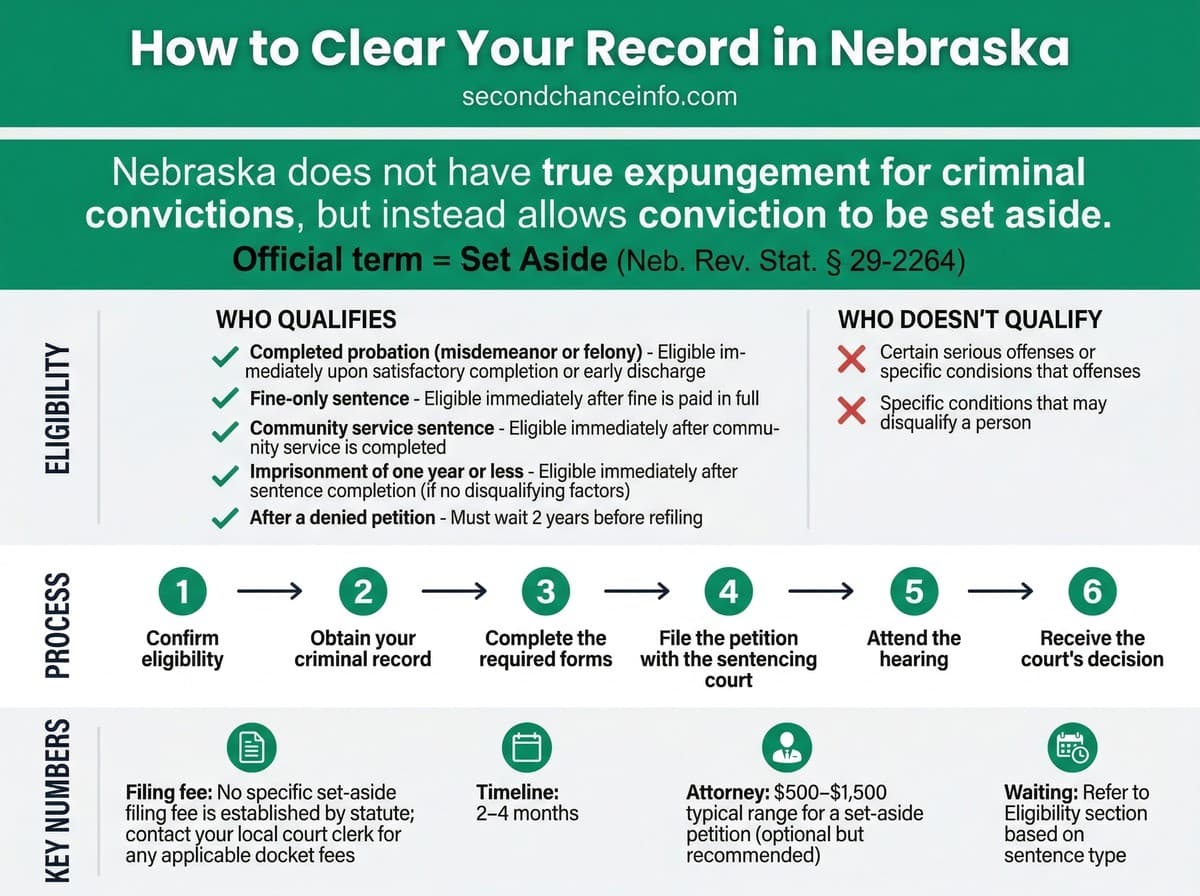
Nebraska does not have true expungement for criminal convictions. Instead, the state allows convictions to be "set aside" under Neb. Rev. Stat. § 29-2264, which nullifies the conviction and removes most civil disabilities but does not erase the record. The conviction and the set-aside order both remain visible on background checks. Separately, Nebraska allows record sealing for dismissed or acquitted charges (§ 29-3523), pardoned convictions, and sex-trafficking survivors. For sentences exceeding one year of imprisonment, a pardon from the Board of Pardons is the only available path to relief.
Official term: Set Aside (Neb. Rev. Stat. § 29-2264) — Nebraska uses "set aside" rather than expungement. A set-aside nullifies the conviction but does not erase or seal it — the conviction and the court order remain on the public record. Record sealing under § 29-3523 is a separate process available only for dismissed/acquitted charges, pardoned convictions, and sex-trafficking survivors.
Routes and conditions to check
- ✓Completed probation satisfactorily (or received early discharge from probation)
- ✓Sentenced to a fine only and paid the fine in full
- ✓Sentenced to community service only and completed it
- ✓Sentenced to imprisonment of one year or less and completed the sentence
- ✓Any felony, misdemeanor, infraction, traffic infraction, city/village ordinance violation, or county resolution violation (per § 29-2264(7))
- ✓Convictions from any date — the law applies retroactively (Laws 2018, LB 146; Laws 2020, LB 881)
Exclusions and limits to check
- ✗Sentences exceeding one year of imprisonment (pardon is the only option)
- ✗Persons required to register under the Sex Offender Registration Act
- ✗Misdemeanor or felony motor vehicle homicide offenses under § 28-306
- ✗Persons with any pending criminal charge in any U.S. or foreign court
- ✗Persons whose set-aside petition was denied within the previous two years
- ✗Currently serving a sentence, on probation, or on parole
Waiting Periods
| Completed probation (misdemeanor or felony) | Immediately upon satisfactory completion or early discharge |
| Fine-only sentence | Immediately after fine is paid in full |
| Community service sentence | Immediately after community service is completed |
| Imprisonment of one year or less | Immediately after sentence completion (if no disqualifying factors) |
| After a denied petition | Must wait 2 years before refiling |
Step-by-Step Process
Confirm eligibility
Verify you have completed your sentence (probation, fine, community service, or imprisonment of one year or less), have no pending charges, are not a registered sex offender, and your offense is not vehicular homicide. Use the Nebraska Judicial Branch Clean Slate Eligibility Questionnaire to check.
Obtain your criminal record
Request your criminal history from the Nebraska State Patrol or the court where your case was heard. Identify the case number(s) for each conviction you want to set aside.
Complete the required forms
Fill out the Petition to Set Aside Criminal Conviction (Form CC 6:11) and the Order Setting Aside a Criminal Conviction (Form CC 6:11.2). Forms are available from the court clerk or online through the Nebraska Judicial Branch website. One petition per conviction.
File the petition with the sentencing court
File your petition in the court where your case was originally heard. You may file in person, by mail, or by fax (if self-represented). Check local court rules — failure to follow them may affect your request.
Attend the hearing
For county court, the clerk schedules the hearing and mails notice to you and the prosecutor. For district court, contact the assigned judge's bailiff for a hearing date and file a Notice of Hearing (DC 1:15). You must appear and testify under oath about your rehabilitation, behavior since conviction, and reasons for requesting the set-aside.
Receive the court's decision
The judge considers your behavior since sentencing, likelihood of future law-abiding conduct, and whether the set-aside serves your interests and the public welfare. If granted, you receive a signed order nullifying the conviction. The court record and criminal history are updated within a few days. Keep a copy of the order for employment and housing applications.
Visual Guide
Automatic Record Sealing for Dismissed & Acquitted Cases (§ 29-3523)
Nebraska does not have automatic set-aside of convictions. However, under § 29-3523, certain records are sealed automatically without filing a petition. Since January 1, 2017, cases where charges were dismissed or resulted in acquittal are sealed automatically. For dismissals or acquittals before that date, you must file a motion to seal.
| Scenario | Timing and conditions |
|---|---|
| Charges dismissed after December 31, 2016 | Sealed automatically upon dismissal |
| Acquittal after December 31, 2016 | Sealed automatically upon acquittal |
| Charges dismissed or acquittal before January 1, 2017 | Must file a motion to seal with the court |
| Completion of drug court or problem-solving court program | Sealed automatically upon successful completion (post-2016 cases) |
| Deferred judgment completed successfully | Sealed automatically upon completion (post-2016 cases) |
Costs
- Filing fee
- No specific set-aside filing fee is established by statute; contact your local court clerk for any applicable docket fees
- Fee waiver
- In forma pauperis (fee waiver) petitions may be available for those who cannot afford fees — ask the court clerk
- Attorney (optional)
- $500–$1,500 typical range for a set-aside petition (optional but recommended)
Legal Aid of Nebraska offers free Clean Slate clinics and assistance for eligible individuals. The UNL College of Law Clean Slate Project also provides free help.
Timeline
- With attorney
- 1–3 months
- Standard
- 2–4 months
Timeline varies by court. County courts typically schedule hearings faster than district courts. The judge decides at the hearing, and it takes a few days for records to be updated afterward.
Effects of the relief
- ✓Nullifies the conviction — the court order states the conviction is void
- ✓Removes most civil disabilities and disqualifications imposed by the conviction
- ✓Restores voting rights (also restored automatically upon completion of sentence)
- ✓Can show the set-aside order to employers and landlords as proof of nullification
- ✓May improve chances for professional licensing under Nebraska's 2024 licensing reform (LB 16)
- ✓Applies retroactively to convictions from any date
Limits of the relief
- ✗Does NOT erase or seal the conviction — it remains visible on background checks alongside the set-aside order
- ✗Does NOT restore gun rights lost due to a felony or domestic violence conviction (only a pardon can do that)
- ✗Does NOT require reinstatement of any employment or position lost due to the conviction
- ✗Does NOT prevent the conviction from being used to enhance sentencing in future cases
- ✗Does NOT prevent use of the conviction for witness impeachment in court
- ✗Does NOT eliminate Sex Offender Registration Act obligations
- ✗Does NOT remove records from privately maintained databases or third-party background check websites
- ✗Does NOT prevent use of the conviction for law enforcement training certification decisions
Other Relief Options in Nebraska
Record Sealing (§ 29-3523)
Available for dismissed charges, acquittals, pardoned convictions, and sex-trafficking survivors. Sealed records are not available to the public. Post-2016 dismissals and acquittals are sealed automatically. You may answer inquiries as though the case never occurred.
Pardon (Board of Pardons)
The only option for sentences exceeding one year of imprisonment. Requires a 3-year wait after sentence completion for misdemeanors or 10 years for felonies. The Board (Governor, Secretary of State, Attorney General) holds hearings 3–4 times per year. A pardon restores rights that a set-aside cannot, including firearm rights. Once pardoned, the conviction record can also be sealed.
Clean Slate Project
A free service provided by Legal Aid of Nebraska and the UNL College of Law that helps eligible individuals navigate the set-aside, record sealing, and pardon processes. Includes clinics and an online eligibility questionnaire through the Nebraska Judicial Branch.
Frequently Asked Questions
- What is a set-aside in Nebraska?
- A set-aside is a court order under Neb. Rev. Stat. § 29-2264 that nullifies (voids) a criminal conviction. Unlike expungement, it does not erase the record. Instead, the conviction and the set-aside order both appear on your criminal record. A background check will show the original conviction and the court order setting it aside.
- Can a felony be set aside in Nebraska?
- Yes, if you were sentenced to probation, a fine only, community service, or imprisonment of one year or less. Felonies with prison sentences exceeding one year are not eligible for a set-aside — a pardon from the Board of Pardons is the only option for those convictions. The law applies retroactively, so older felony convictions may qualify.
- Does Nebraska have true expungement?
- No. Nebraska does not allow criminal convictions to be erased or expunged. The state offers set-asides (which nullify but do not erase convictions), record sealing (for dismissed charges, acquittals, and pardoned convictions), and pardons. Even with a set-aside, the conviction remains on your record with a notation that it was set aside.
- How much does a set-aside cost in Nebraska?
- Nebraska statute does not establish a specific filing fee for set-aside petitions. Contact your local county or district court clerk for any applicable docket fees. If you hire an attorney, expect to pay $500–$1,500. Legal Aid of Nebraska and the UNL College of Law Clean Slate Project offer free assistance to eligible individuals.
- Does a set-aside restore gun rights in Nebraska?
- No. A set-aside does not restore firearm rights lost due to a felony conviction or a misdemeanor domestic violence conviction. Only a pardon from the Nebraska Board of Pardons can restore gun rights. The Board consists of the Governor, Secretary of State, and Attorney General.
- Can I get a DUI set aside in Nebraska?
- It depends on the sentence. If you received probation, a fine only, or imprisonment of one year or less for a DUI, you may petition for a set-aside. However, vehicular homicide convictions under § 28-306 are specifically excluded. The conviction will still appear on your record with the set-aside notation, and prior DUI convictions may still be used for sentencing enhancement in future cases.
- What is the difference between a set-aside and record sealing in Nebraska?
- A set-aside (§ 29-2264) nullifies a conviction but leaves it visible on your record. Record sealing (§ 29-3523) removes information from public view entirely — sealed records cannot be seen by employers or the public. However, sealing is only available for dismissed charges, acquittals, pardoned convictions, and sex-trafficking survivors — not for active convictions. You would need a set-aside or pardon first, and then sealing may become available after a pardon.
- Do I need a lawyer to get a set-aside in Nebraska?
- No, you can file a petition yourself using the forms available from the Nebraska Judicial Branch (Form CC 6:11 and CC 6:11.2). However, an attorney can help ensure your petition is complete and argue on your behalf at the hearing. Legal Aid of Nebraska offers free Clean Slate clinics, and the UNL College of Law Clean Slate Project provides free legal help for eligible individuals.
Take Action — Direct Links
- Download Petition to Set Aside Criminal Conviction (Form CC 6:11)
Official Nebraska court form to petition for a set-aside of a criminal conviction under Neb. Rev. Stat. § 29-2264. One petition per conviction.
- Request Your Own Criminal History Record (Nebraska State Patrol)
Request a copy of your Nebraska criminal history from the State Patrol Criminal Identification Division ($30 fee). Needed to identify case numbers for your set-aside petition.
- Find Free Legal Help — Legal Aid of Nebraska Clean Slate Project
Legal Aid of Nebraska's Clean Slate Project provides free assistance with set-asides, record sealing, and pardons for eligible low-income individuals across all 93 Nebraska counties.
- Nebraska Judicial Branch Self-Help: Set-Aside of a Criminal Conviction
Step-by-step self-help guide from the Nebraska Judicial Branch covering eligibility, forms, and the set-aside process.
- Neb. Rev. Stat. § 29-2264 — Full Statute Text
Official full text of Nebraska Revised Statute § 29-2264 (set-aside of criminal convictions) on the Nebraska Legislature website.
Related Resources on This Site
More for your state
- Pardon & ClemencyPardon & clemency in Nebraska
- Jobs by CityFelony friendly jobs in Omaha, NE
- Jobs by StateJobs for felons in Nebraska
- HousingSecond chance apartments in Omaha, NE
- Voting RightsFelon voting rights in Nebraska
- Gun RightsFelon gun rights in Nebraska
- DUI RecoveryDUI license recovery in Nebraska
- ProbationProbation & parole in Nebraska
Helpful guides
- Background ChecksHow far back do background checks go?
- ToolsReentry organizations directory
- Free Legal AidFree legal aid by state