
How to Check Your Own Criminal Record
Last updated:
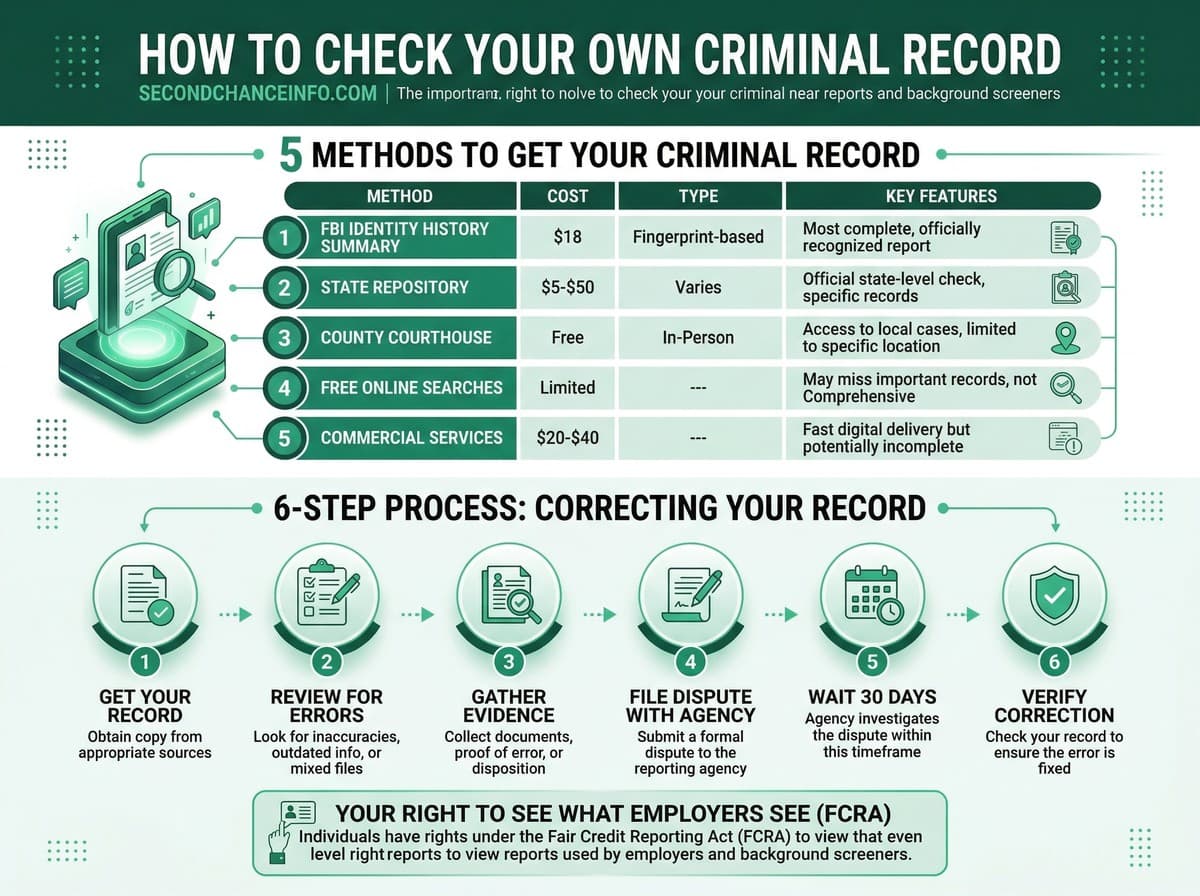
You can check your own criminal record through several methods: request your FBI Identity History Summary (rap sheet) for $18, search your state's criminal records repository, visit your local county courthouse, or use a commercial background check service. Checking your own record is legal, confidential, and does not affect your credit score or create any negative consequences. We recommend checking before applying for jobs or housing so you know exactly what employers and landlords will see.
Methods to Check Your Record — Comparison
| Method | Cost | Turnaround | Coverage | Accuracy |
|---|---|---|---|---|
| FBI Identity History Summary (rap sheet) | $18 (FBI fee) + possible fingerprinting fees ($10-$50) | 3-5 business days (electronic) or 12-16 weeks (mail) | Nationwide — all arrests and convictions reported to FBI by federal, state, and local agencies | Most comprehensive and accurate option — fingerprint-based, eliminates name-matching errors |
| State criminal records repository | Free to $25+ depending on state | Instant to 4 weeks depending on state | Statewide — all records reported to the state central repository | Good for state-level records, but may miss county records not reported to the state |
| County courthouse records search | Usually free for in-person searches; $5-$25 for copies | Same day (in person) or 1-2 weeks (by mail) | Single county only | Highest accuracy for that specific county — direct courthouse records |
| Free online court record searches | Free | Instant | Varies — some states have statewide portals, others are county-by-county | Good for finding case information, but may not be complete |
| Commercial background check services | $20-$40 per report | Instant to 3 business days | Varies — national database searches cover multiple states but have gaps | Useful for seeing what employers/landlords will see, but may have errors |
FBI Identity History Summary (rap sheet)
$18 (FBI fee) + possible fingerprinting fees ($10-$50)
3-5 business days (electronic) or 12-16 weeks (mail)
How To
- Visit the FBI's electronic submission portal at www.edo.cjis.gov
- Create an account and pay the $18 fee
- Go to a participating U.S. Post Office or IdentoGO location to submit fingerprints electronically
- Receive your results via secure email within 3-5 business days
- Alternative: mail Form FD-1164 with a fingerprint card to FBI CJIS Division, 1000 Custer Hollow Road, Clarksburg, WV 26306 (12-16 week processing)
Limitations
- •Only for personal review — cannot be used for employment or licensing purposes
- •May include expunged or sealed records (FBI maintains records even after state-level sealing)
- •Does not include traffic infractions or civil records
- •May have incomplete information if local agencies did not report to the FBI
State criminal records repository
Free to $25+ depending on state
Instant to 4 weeks depending on state
How To
- Find your state's criminal records agency (usually state police or department of justice)
- Many states offer online name-based searches for free or a small fee
- Some states require fingerprints for a complete record check (more accurate)
- Request a copy of your own record — this is your legal right in all states
Limitations
- •Only covers one state — you need to check each state where you have lived
- •Name-based searches may produce false positives (matching someone with a similar name)
- •Some states have incomplete databases because not all counties report consistently
- •May not include federal crimes (those go to the FBI, not the state)
County courthouse records search
Usually free for in-person searches; $5-$25 for copies
Same day (in person) or 1-2 weeks (by mail)
How To
- Visit the clerk of court at the county courthouse where you were arrested or charged
- Request a search of your criminal case records by name and date of birth
- Many counties now offer free online case search portals
- Request certified copies if you need official documentation
Limitations
- •Only covers one county — you need to check each county where you have a record
- •Not all counties have online search systems
- •You must know which counties to search
- •Does not include federal crimes or records from other jurisdictions
Free online court record searches
Free
Instant
How To
- Search for '[your state] court records search' or '[your county] case search'
- Many states offer free public access to court records through web portals
- Federal court records are available through PACER (Public Access to Court Electronic Records) at pacer.uscourts.gov
- Some states like Minnesota offer completely free statewide criminal history searches
Limitations
- •Coverage varies dramatically by state and county
- •May only show case information (charges, dispositions) without full criminal history context
- •Name-based searches can return results for other people with similar names
- •Not all courts have digitized older records
Commercial background check services
$20-$40 per report
Instant to 3 business days
How To
- Use a reputable FCRA-compliant service (Checkr, GoodHire, Sterling, etc.)
- Some services offer self-background checks specifically for consumers
- Provide your personal information (name, DOB, SSN) and consent to the search
- Review the report carefully for accuracy
Limitations
- •National database searches have gaps — they aggregate records from various sources but may miss records from counties that do not contribute to commercial databases
- •May contain errors (wrong person's records, outdated information, unreported expungements)
- •The report you get may not be identical to what an employer receives
- •Ongoing subscription fees can add up if using monitoring services
State Criminal Record Portals
Direct links to check your criminal record in the most populated states. Each state has its own process, cost, and method.
| State | Agency | Cost | Method | Link |
|---|---|---|---|---|
| California | DOJ Bureau of Criminal Information and Analysis | $25 | Fingerprint (Live Scan) | Visit |
| Texas | DPS Crime Records Service | Free (name search) / $24.95 (fingerprint) | Online or fingerprint | Visit |
| Florida | FDLE | $24 | Online | Visit |
| New York | Division of Criminal Justice Services | $17.50 (IdentoGO) | Fingerprint (IdentoGO) | Visit |
| Pennsylvania | State Police Central Repository | $22 | Online (PATCH) | Visit |
| Ohio | Bureau of Criminal Investigation | $22 + fingerprinting fee | Fingerprint (WebCheck) | Visit |
| Illinois | State Police Bureau of Identification | Free (name search) / $16 (fingerprint) | Online or fingerprint | Visit |
| Michigan | State Police ICHAT | $10 | Online | Visit |
| Georgia | Crime Information Center | $15 (online) / $20 (fingerprint) | Online or fingerprint | Visit |
| North Carolina | State Bureau of Investigation | $14 | Online or fingerprint | Visit |
| Virginia | State Police | $15 (name) / $34 (fingerprint) | Online or fingerprint | Visit |
| Minnesota | Bureau of Criminal Apprehension | Free | Online | Visit |
| Washington | State Patrol WATCH | $11 (online) | Online (WATCH) | Visit |
How to Dispute Errors on Your Record
If you find errors on your criminal record or background check, you have legal rights to dispute and correct them.
Identify the error
Compare your background check report to your actual records. Common errors include: records belonging to someone with a similar name, convictions listed as pending (or vice versa), expunged records still showing, incorrect charges or dispositions, and duplicate entries for the same offense.
Gather supporting documentation
Collect court documents that prove the error: certified copies of dismissal orders, expungement orders, proof of case disposition, or identity documents showing you are not the person in the record. The more official documentation you have, the faster the correction process.
Dispute with the background check company (CRA)
Contact the consumer reporting agency that produced the report. Submit your dispute in writing (certified mail creates a paper trail). Under the FCRA, the CRA must investigate within 30 days, contact the source of the information, and correct or remove inaccurate data. Send disputes to the CRA's designated dispute address.
Dispute with the source (court or agency)
If the error originates from the court or a criminal justice agency, contact them directly to request a correction. For state records, contact your state's central repository. For FBI records, submit a challenge through the FBI's Identity History Summary Review process.
Follow up and verify the correction
After the investigation, the CRA must send you the results in writing. Request a new copy of your report to verify the correction was made. If the error is not corrected, you can add a 100-word consumer statement to your file explaining your dispute.
File a complaint if needed
If the CRA does not correct the error, file a complaint with the Consumer Financial Protection Bureau (CFPB) at consumerfinance.gov/complaint. You may also have the right to sue under the FCRA for willful or negligent noncompliance — consult a consumer rights attorney.
Challenging Your FBI Record
If your FBI Identity History Summary contains errors, you can challenge it through the FBI's official review process.
- Visit forms.fbi.gov to submit a challenge online, or mail your challenge to FBI CJIS Division — Record Modification, 1000 Custer Hollow Road, Clarksburg, WV 26306
- Include a copy of the incorrect Identity History Summary
- Provide documentation supporting the correction (court orders, disposition records)
- The FBI will contact the contributing agency to verify the information
- Processing takes approximately 60-90 days
- If the contributing agency confirms the error, the FBI will update the record
Take Action — Direct Links
- Request your FBI Identity History Summary ($18)
Official FBI electronic submission portal — fastest method (3-5 business days)
- FBI record challenge / correction form
Dispute errors on your FBI rap sheet
- PACER — search federal court records
Search federal district court records for federal criminal cases
- File a CFPB complaint about a background check error
Report a consumer reporting agency that will not correct errors
- Find your state expungement eligibility
Check if you can clear your record permanently
- Free annual credit report
Check your credit report for free — separate from criminal record but part of many background checks
Visual Guide
Frequently Asked Questions
- How do I check my own criminal record?
- The most comprehensive way is to request your FBI Identity History Summary (rap sheet) for $18. You can also search your state's criminal records repository, visit your county courthouse, or use a commercial background check service. We recommend checking multiple sources since no single source captures everything.
- Is it free to check your own criminal record?
- Some states offer free online name-based searches (Minnesota, Illinois, Texas). County courthouse searches are usually free in person. However, the most comprehensive check — the FBI Identity History Summary — costs $18. Commercial services typically charge $20-$40. The small cost is worth it to know exactly what shows up before employers or landlords see it.
- Does checking my own record show up anywhere?
- No. Checking your own criminal record is completely confidential and does not appear on any background check. It does not affect your credit score or create any record that employers or landlords can see. It is your legal right to review your own records.
- What is the FBI Identity History Summary?
- The FBI Identity History Summary (commonly called a 'rap sheet') is a record of all criminal justice information reported to the FBI, including arrests, convictions, and some dispositions. It is based on fingerprints, so it is more accurate than name-based searches. It costs $18 and is available to any U.S. citizen or legal resident for personal review.
- How do I dispute an error on my criminal record?
- Contact the organization that produced the report (consumer reporting agency, state repository, or FBI). Submit your dispute in writing with supporting documentation (court orders, certified records). Under the FCRA, consumer reporting agencies must investigate within 30 days and correct or remove inaccurate information. If the error is not corrected, file a complaint with the CFPB.
- Should I check my record before applying for jobs?
- Absolutely. Checking your record beforehand lets you know exactly what employers will see, identify and correct any errors, determine if you are eligible for expungement, and prepare to explain your history if needed. Being surprised by your own background check results during the hiring process is avoidable and can cost you opportunities.
- How long does it take to get my FBI rap sheet?
- Electronic submissions through the FBI portal (edo.cjis.gov) are typically processed within 3-5 business days. Using an approved channeler like IdentoGO or Certifix can provide results in 1-3 business days. Mail submissions using Form FD-1164 take 12-16 weeks.
- Can I see what a specific employer's background check will show?
- Not exactly, because different employers use different background check companies and different levels of screening. However, you can get a close approximation by: (1) requesting your FBI rap sheet for the most comprehensive view, (2) checking your state repository, and (3) using a commercial self-check service. The results may not be identical, but they will cover the vast majority of what any employer check will find.
- What if my record has someone else's information on it?
- Mistaken identity is a common background check error, especially with name-based searches. If someone else's records appear on your background check, dispute it immediately with the consumer reporting agency. Provide identification documents (government ID, SSN verification) proving you are not the person listed. The CRA must investigate and remove the incorrect records within 30 days.
- Can expunged records still show up on my record?
- On state-level checks and commercial background checks, expunged records should not appear. However, the FBI may still have the original record in their database even after state-level expungement. If an expunged record appears on a commercial background check, you can dispute it and the CRA must remove it. For FBI records, you may need to submit a challenge through the FBI's record modification process.
Related Resources on This Site
Helpful guides
- ExpungementClean Slate laws — automatic expungement
- HousingNo credit check apartments & rentals
- ToolsReentry organizations directory
- Free Legal AidFree legal aid by state