
Can a Felon Travel Abroad?
Last updated:
Yes, most felons with a valid U.S. passport can travel abroad. No U.S. law broadly prevents convicted felons from leaving the country (unless you are on probation, parole, or supervised release with travel restrictions). However, each destination country sets its own entry rules. Some countries like Mexico, most of the Caribbean, and much of Southeast Asia rarely check criminal records. Others like Canada, the UK, Australia, and Japan actively screen for convictions and may deny entry. When Europe's ETIAS system launches (originally targeted for late 2026, now expected to slip to 2027 while the EU finishes its Entry/Exit System rollout), it will ask about criminal history for the first time. The key is to research your destination before you book.
First things first: you need a valid U.S. passport before any international travel. Most felons can get one. See our complete passport guide to check your eligibility and learn how to apply.
You CAN travel abroad if you...
- ✓Completed your sentence (prison, probation, parole) with no remaining restrictions
- ✓Have a valid U.S. passport (most felons can get one — see our passport guide)
- ✓Not subject to any court order restricting travel
- ✓Not on the no-fly list or subject to an active Interpol notice
- ✓Off probation/parole with no supervision conditions limiting travel
You CANNOT travel abroad if you...
- ✗Currently on probation or parole without travel permission
You must get written permission from your probation/parole officer AND often court approval before any international travel. Leaving without permission is a violation that can result in re-incarceration. Requests must typically be submitted at least 6 weeks in advance.
- ✗Court order prohibiting departure from the U.S.
If a federal or state court has issued an order forbidding you to leave the United States, you cannot travel internationally until the order is lifted.
- ✗Active felony warrant or pending charges with travel restrictions
If there is an outstanding felony warrant in the NCIC database, or you are on pre-trial release with travel conditions, you cannot leave the country.
- ✗Passport denied or revoked (drug trafficking, child support, tax debt)
If you cannot obtain a passport due to a felony drug conviction involving a passport or border crossing, child support arrears over $2,500, or tax debt over $66,000, you cannot travel internationally.
- ✗Active Interpol Red Notice
If you are the subject of an Interpol Red Notice, border control officers in most countries have real-time access to INTERPOL's database and you risk immediate detention upon crossing any international border.
Traveling on Probation or Parole
If you are currently under supervision, international travel is heavily restricted but not always impossible.
Get written permission first
You must obtain written approval from your probation/parole officer before any international travel. For federal supervision, the request must also be approved by the Court or the U.S. Parole Commission. Submit requests at least 6 weeks before your planned departure.
Leisure travel is harder to get approved
Officers are more likely to approve travel for family emergencies, work requirements, or medical treatment. Leisure/vacation travel may be denied, especially if you owe restitution or fines, or are not in full compliance with your supervision conditions.
You may need to surrender your passport
Some supervision conditions require you to surrender your passport to the court. If so, you must request its return before traveling, which requires a letter from your officer confirming approval.
Consequences of traveling without permission
Unauthorized international travel is a serious violation that can result in revocation of probation/parole and re-incarceration. Ports of entry and airlines share data with law enforcement, so attempts to travel undetected are very likely to be flagged.
Visual Guide
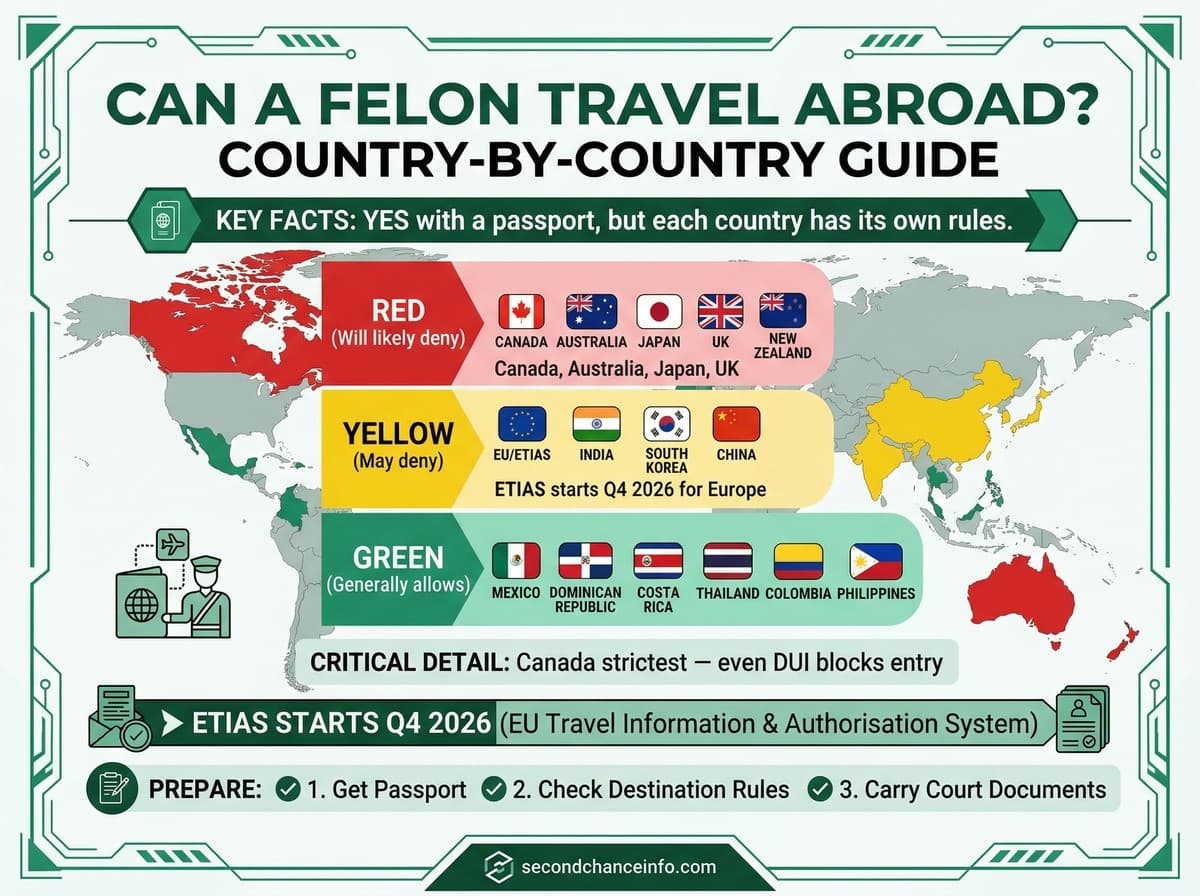
Country-by-Country Travel Restrictions (25 Countries)
Countries are grouped by how strictly they screen for criminal records. Rules change frequently — always verify with the destination country's embassy before booking.
Will Likely Deny (7 countries)
| Country | Restriction | Details |
|---|---|---|
| Canada | Strict — even a misdemeanor DUI blocks entry | Canada treats any criminal conviction as potential inadmissibility. Under Canadian law, your foreign offense is compared to its Canadian equivalent — if that equivalent is an indictable offense, you are inadmissible. Even a single DUI is classified as a serious offense. You will be flagged at the border through shared databases with the U.S. Waiver/Workaround: Temporary Resident Permit (TRP): allows entry for a specific trip, valid up to 3 years, costs CAD $246.25. Criminal Rehabilitation: permanent solution, available 5+ years after completing your full sentence, costs CAD $246.25-$1,231.00, commonly takes over a year to process. Deemed Rehabilitated: automatic if 10+ years since completing sentence for a non-serious offense. |
| Australia | Character test — 12+ month sentence = automatic fail | Australia's Migration Act requires all visitors to pass a 'character test.' A sentence of 12 months or more (including suspended sentences) is an automatic fail. Two or more shorter sentences totaling 12+ months also fail. Sex offenders convicted of offenses against children are permanently barred. You must declare your full criminal history on the visa application. Waiver/Workaround: Character Waiver: you can apply, but approval is not guaranteed. If a visa is refused or cancelled on character grounds, review at the Administrative Review Tribunal is possible, but there is no published overall approval figure. A standard ETA or eVisitor visa will not be available — you must apply for a full visa. |
| Japan | Zero tolerance for drug offenses; 1+ year sentence denied | Japan has one of the strictest policies in the world. Under the Immigration Control and Refugee Recognition Act, entry is denied to anyone: (1) sentenced to 1+ year imprisonment for any offense, or (2) convicted of ANY drug offense, regardless of sentence length, including marijuana possession. Even old or minor drug convictions can result in permanent denial. The final decision rests with immigration officers at the port of entry. Waiver/Workaround: No formal waiver process. You may apply for a special landing permission, but approval is extremely rare. Contact the Japanese embassy before booking travel. |
| United Kingdom | 12+ month custodial sentence = ETA refused; visa required | Since 8 January 2025, U.S. citizens must have a UK Electronic Travel Authorisation (ETA, costs 20 GBP). The ETA application asks about criminal convictions. A custodial sentence of 12+ months results in mandatory ETA refusal regardless of when the conviction occurred. A conviction within the last 12 months (any sentence length) also triggers refusal — and a March 2026 Immigration Rules change extended this 12-month refusal to suspended sentences of 12+ months. Sentences of 12 months to 4 years: entry refused unless 10 years have passed. Sentences of 4+ years: permanent refusal. Waiver/Workaround: If your ETA is refused, you must apply for a full UK visa. There is no formal criminal record waiver, but you can present your case to the Entry Clearance Officer. A sentence under 12 months with 12+ months elapsed since conviction may still get ETA approval. |
| New Zealand | 5+ year sentence = permanent ban; 12+ months = reviewed | Anyone sentenced to 5+ years imprisonment at any point in their life is automatically denied entry. Sentences of 12 months to 5 years within the last 10 years are reviewed on a case-by-case basis. You must declare your full criminal history on the visa application. Waiver/Workaround: Special Direction waiver: can be applied for through Immigration New Zealand. Processing takes several weeks. Approval depends on the nature of the offense, time elapsed, and evidence of rehabilitation. |
| China | Visa required — criminal history may block issuance | China requires a visa for all U.S. citizens. The visa application directly asks about criminal history. Convictions for drug trafficking, terrorism, smuggling, prostitution, and violent offenses are likely to result in visa denial. Other felonies are reviewed on a case-by-case basis. Waiver/Workaround: No formal waiver. You can reapply with additional documentation of rehabilitation, but denial is final for that application. |
| Russia | Visa required — conviction in last 10 years with 12+ month sentence blocks entry | Russia requires a visa for U.S. citizens, and the application asks about criminal history. If you were convicted within the last 10 years and sentenced to 12 months or more, you will likely be denied. Note: U.S.-Russia relations may further restrict travel; check current State Department advisories. Waiver/Workaround: No formal waiver process. |
May Deny Entry (9 countries)
| Country | Restriction | Details |
|---|---|---|
| EU / Schengen Area (ETIAS) | ETIAS screening when it launches (expected 2027) — asks about criminal history | When ETIAS launches (originally targeted for late 2026, now expected to slip to 2027 while the EU completes its Entry/Exit System rollout — check the official EU site for the current date), U.S. citizens will need ETIAS authorization (EUR 20, valid 3 years) to enter any of the 30 Schengen countries. The application asks about serious criminal offenses in the past 10 years (20 years for terrorism). A conviction does not automatically deny ETIAS — decisions are case-by-case based on severity and recency. During the first 6 months after launch (transitional period), travelers can still enter without ETIAS. After that, it becomes mandatory and airlines will deny boarding without it. Each Schengen country can also refuse entry at the border independently. Waiver/Workaround: If ETIAS is denied, you can apply for a standard Schengen visa at any EU member state's consulate, where you can present additional documentation. |
| India | Visa required — application asks about criminal convictions | India's e-Visa application asks whether you have ever been convicted of any crimes in any country. Sexual offenses, especially involving minors, are treated with extreme seriousness and very likely to result in denial. Other convictions are reviewed case-by-case. Minor offenses may not block approval. Waiver/Workaround: No formal waiver. If the e-Visa is denied, you can apply at an Indian consulate with supporting documentation. |
| South Africa | Must declare criminal history in detail on entry | South Africa requires travelers to declare their criminal histories in detail, including pending legal actions in addition to convictions. Immigration officers can deny entry based on the nature of offenses. Drug and violent crime convictions are most likely to trigger denial. Waiver/Workaround: No formal waiver. Entry decisions are made at the discretion of the immigration officer. |
| Brazil | Visa required since 2025 — e-Visa blocked if convicted of any offense | Since 2025, U.S. citizens must obtain a visa to visit Brazil. If you have ever been arrested or convicted for 'any offense or willful crime,' you do not qualify for the e-Visa. You must instead apply in person at the nearest Brazilian Consulate, which takes longer and requires additional documentation. Waiver/Workaround: Apply in person at a Brazilian Consulate. Bring court documents showing conviction details and sentence completion. Approval is at the consul's discretion. |
| South Korea | Drug offenses strictly enforced; others generally okay | South Korea, like Japan, is very strict on drug convictions. Drug-related offenses can result in denial of entry. Other felonies are generally not grounds for denial unless there is an active Interpol notice or the offense involves national security. U.S. citizens can enter visa-free for up to 90 days for tourism, but immigration officers retain discretion to deny entry. Waiver/Workaround: No formal waiver. Contact the Korean embassy for guidance specific to your situation. |
| Taiwan | Article 18 allows denial for criminal history | Under Article 18 of Taiwan's Immigration Act, the government can bar foreign nationals for criminal history. U.S. citizens can enter visa-free for up to 90 days, but customs officials may still deny entry or require a permit if they discover a felony conviction. Drug offenses and violent crimes are most likely to trigger issues. Waiver/Workaround: No formal waiver. You may be asked to obtain a special permit at the border. |
| Israel | Thorough security screening at entry — case-by-case | Israel conducts thorough security screenings at all points of entry. Criminal records may trigger extensive additional questioning but do not automatically deny entry. The decision depends on the nature of the offense and perceived security risk. Drug and terrorism-related convictions are most likely to result in denial. Waiver/Workaround: No formal waiver. Entry is at the discretion of security officers. |
| UAE / Dubai | Short tourist stays generally okay; longer stays require disclosure | U.S. citizens can visit the UAE for up to 30 days visa-free for tourism. Criminal history is not routinely asked during short tourist visits. However, applications for longer stays or residency require full criminal history disclosure, and serious convictions may result in denial. UAE has strict laws around drug offenses and morality crimes. Waiver/Workaround: No formal waiver for visa denials. |
| Egypt | Does not check for tourist visas, but can deny if discovered | Egypt does not routinely run criminal background checks for tourist visa-on-arrival applicants. However, Egyptian law allows denial of entry to convicted felons if discovered. Drug trafficking and terrorism convictions are most likely to cause issues. Waiver/Workaround: No formal waiver process. |
Generally Allows (9 countries)
| Country | Restriction | Details |
|---|---|---|
| Mexico | Generally lenient — most felons enter without issues | Mexico does not typically screen for foreign criminal records at entry. Mexican immigration law technically allows denial for 'serious crimes,' but in practice, most felons enter Mexico without issues for short-term tourist visits. Drug trafficking convictions may attract more scrutiny if you travel to border regions. Waiver/Workaround: Not needed for most travelers. |
| Dominican Republic | No criminal background check for tourists | The Dominican Republic offers visa-free tourist entry for U.S. citizens (tourist card on arrival) and does not ask about criminal history or conduct background checks on short-term tourists. One of the most accessible destinations for travelers with a criminal record. |
| Costa Rica | No criminal background check for tourists | U.S. citizens can stay up to 90 days without a visa. Costa Rica does not conduct criminal background checks on short-term tourists and does not ask about criminal history at entry. Generally one of the easiest countries for felons to visit. |
| Philippines | Visa-free for 30 days — no routine criminal check | U.S. citizens may enter visa-free for up to 30 days for tourism with generally no formal criminal background check at entry. However, the Philippine Immigration Act bars entry for 'crimes involving moral turpitude.' If officers become aware of such a conviction, they may refuse entry. |
| Thailand | No self-declaration required — but officials can still deny | Thailand does not require visitors to declare criminal history on arrival, and no routine background checks are conducted for short-term tourists. U.S. citizens can enter visa-free for up to 60 days. However, immigration officers retain discretion to deny entry. Drug offenses may attract scrutiny. |
| Turkey | Generally welcoming — no significant restrictions for felons | Turkey is relatively accommodating for travelers with criminal records. U.S. citizens need an e-Visa (approximately $50), which does not ask about criminal history. Most felons can visit Turkey without issues. |
| Colombia | No criminal background check for tourists | U.S. citizens can enter Colombia visa-free for up to 90 days. Colombia does not conduct criminal background checks on tourists and does not ask about criminal history at entry. However, drug trafficking convictions could theoretically cause issues. |
| Morocco | No criminal history disclosure required for tourists | U.S. citizens can enter Morocco visa-free for up to 90 days. Morocco does not ask about criminal history during the entry process and does not routinely check criminal records. However, Moroccan law does allow denial of entry to convicted felons if the information becomes known. |
| Singapore | No self-declaration, but very strict domestic laws | Singapore does not require self-declaration of criminal history for short tourist visits (visa-free for up to 90 days for U.S. citizens). However, Singapore has extremely strict domestic laws, particularly around drugs (death penalty for trafficking). Immigration officers can deny entry at their discretion if they discover a criminal record. |
ETIAS: What Felons Need to Know About Europe Travel (2026+)
- •ETIAS (European Travel Information and Authorisation System) was targeted to launch in late 2026 for 30 European countries in the Schengen Area, but is now expected to slip to 2027 while the EU completes the Entry/Exit System rollout — check the official EU site for the current start date.
- •U.S. citizens will need an approved ETIAS (EUR 20, valid 3 years) before boarding flights to Europe.
- •The application asks about serious criminal offenses in the past 10 years (20 years for terrorism offenses).
- •A conviction does NOT automatically deny your ETIAS. Decisions are case-by-case based on severity and recency of the offense.
- •Minor offenses and traffic violations are unlikely to affect approval. Violent crimes, drug trafficking, and terrorism-related offenses are most likely to trigger denial or additional review.
- •During the first 6 months after launch (transitional period), you can still enter Europe without ETIAS.
- •If your ETIAS is denied, you can apply for a standard Schengen visa at an EU consulate, where you can present additional documentation of rehabilitation.
- •Each individual Schengen country can still refuse entry at the border independently, even with an approved ETIAS.
How to Prepare — Step by Step
Confirm you have a valid U.S. passport
Most felons can get a passport. If you don't have one, apply 8-10 weeks before your trip (or pay $60 extra for expedited 2-3 week processing). See our full passport guide for details on eligibility and exceptions.
Research your destination country's entry rules
Check the country's embassy website or consulate for criminal record policies. Look at visa application forms to see if they ask about criminal history. The U.S. State Department's country information pages also list entry requirements.
Gather documentation about your conviction
Carry certified copies of court documents showing your conviction, sentence, and proof of completion. If your record is expunged, bring the expungement order. Some countries may accept these as evidence of rehabilitation.
Apply for waivers or permits if needed
Countries like Canada (TRP or Criminal Rehabilitation), Australia (Character Waiver), and New Zealand (Special Direction) offer formal waiver processes. These can take months to process, so apply well in advance.
Contact the destination country's embassy
If you are unsure whether your conviction will affect entry, contact the embassy or consulate directly. They can provide guidance specific to your situation and the type of offense.
Get travel permission if on supervision
If you are on probation, parole, or supervised release, get written permission from your officer and any required court approval at least 6 weeks before departure.
Purchase travel insurance with trip cancellation coverage
Standard travel insurance typically does not cover being denied entry at a border. Look for policies that include trip cancellation/interruption coverage, and read the fine print. Being turned away due to missing documentation is usually excluded.
Be honest at the border
If asked about your criminal history, always answer truthfully. Lying to an immigration officer can result in a permanent ban from that country and potential criminal charges. In most cases, honesty combined with evidence of rehabilitation gives you the best chance of entry.
Interpol Notices and International Travel
If you are the subject of an Interpol notice (especially a Red Notice), your ability to travel internationally is severely limited.
- •A Red Notice is a request to law enforcement worldwide to locate and provisionally arrest a person pending extradition. It is not an arrest warrant, but most countries treat it as one.
- •Border control officers in most countries have real-time access to INTERPOL's I-24/7 database. Crossing any border risks immediate detention.
- •Airlines may deny boarding if they discover an Interpol listing.
- •Even countries that do not extradite to the requesting state may question, temporarily detain, or deny entry to a person with a Red Notice.
- •Red Notices can also trigger visa refusals, cancellation of residency permits, and denial of citizenship applications.
- •If you believe you have an Interpol notice in error, you can file a request with the Commission for the Control of INTERPOL's Files (CCF) to have it reviewed and potentially removed.
Take Action — Direct Links
- U.S. State Department — Country Information Pages
Official entry requirements, visa info, and travel advisories for every country
- Canada — Temporary Resident Permit (TRP) application
Apply for temporary entry to Canada despite a criminal record
- Canada — Criminal Rehabilitation application
Permanent solution for entering Canada — available 5+ years after completing sentence
- UK ETA application — GOV.UK
Apply for UK Electronic Travel Authorisation (required for U.S. citizens since 2025)
- Australia — Character requirements for visas
Understand Australia's character test and apply for a Character Waiver if needed
- EU ETIAS — Official site
Apply for European travel authorization (launch expected 2027 — see site for current date)
- INTERPOL — Check and challenge a notice
Contact INTERPOL if you believe a notice has been issued in error
- Can a felon get a passport? — SecondChanceInfo guide
Our complete guide to getting a U.S. passport with a criminal record
Frequently Asked Questions
- Can a felon travel abroad?
- Yes, most felons with a valid U.S. passport can travel abroad. No U.S. law broadly prevents felons from leaving the country after completing their sentence. However, each destination country has its own entry rules, and some countries actively screen for criminal records and may deny entry. You must also have no probation/parole travel restrictions, no outstanding warrants, and no court orders preventing departure.
- Do foreign countries know about my criminal record?
- It depends on the country. The U.S. shares criminal records with Canada through an NCIC/CPIC database link, so Canada can see U.S. convictions in real time. The UK, Australia, and New Zealand ask about criminal history on visa/ETA applications and can verify through law enforcement channels. Most countries in Latin America, Southeast Asia, and Africa do not routinely access U.S. criminal databases. However, any country can request information through Interpol or diplomatic channels if they have reason to investigate.
- Can I travel to Canada with a felony?
- Canada is one of the hardest countries to enter with a criminal record. Under Canadian law, your U.S. conviction is compared to its Canadian equivalent. If the equivalent is an indictable offense, you are inadmissible. Even a DUI can block entry. Options include: a Temporary Resident Permit (TRP, CAD $246.25, valid up to 3 years), Criminal Rehabilitation (CAD $246.25-$1,231.00, permanent, available 5+ years after sentence completion), or waiting 10+ years after completing your sentence to be 'deemed rehabilitated' automatically.
- Will ETIAS prevent felons from visiting Europe?
- Not necessarily. ETIAS, launching for 30 European Schengen countries (originally late 2026, now expected to slip to 2027), will ask about serious criminal offenses in the past 10 years (20 years for terrorism). However, a conviction does not automatically deny your ETIAS. Decisions are case-by-case. Minor offenses are unlikely to cause issues. If denied, you can still apply for a standard Schengen visa at a consulate. During the first 6 months after ETIAS launches, entry is still possible without it.
- Can I travel internationally while on probation or parole?
- Only with explicit written permission from your probation/parole officer and, in many cases, court approval. For federal supervision, requests must be submitted at least 6 weeks in advance and approved by the Court or U.S. Parole Commission. Leisure travel is harder to get approved than travel for work, family emergencies, or medical reasons. Traveling without permission is a serious violation that can result in re-incarceration.
- What happens if I lie about my criminal record at a foreign border?
- Lying to an immigration officer is a serious offense in virtually every country. If discovered, you will be denied entry and likely banned from that country, sometimes permanently. In some countries, making false statements to immigration officials is a criminal offense that can result in fines or imprisonment. Many countries share information through databases and cross-reference records. Always answer truthfully when asked about your criminal history.
- Which countries are easiest for felons to visit?
- Countries that do not routinely check criminal records for short-term tourists include Mexico, the Dominican Republic, Costa Rica, Colombia, Thailand, the Philippines, Turkey, and Morocco. These countries generally allow visa-free or visa-on-arrival entry for U.S. citizens without asking about criminal history. However, immigration officers in any country can deny entry at their discretion.
- Does a DUI affect international travel?
- A DUI has the biggest impact on travel to Canada, which classifies DUI as a serious criminal offense (equivalent to an indictable offense) and can deny entry. The UK ETA also asks about criminal convictions, which includes DUI. Most other countries do not specifically screen for DUI. A DUI alone does not prevent you from getting a U.S. passport.
- Can I go on a cruise with a felony conviction?
- Yes, you can board a cruise ship with a felony conviction. Cruise lines do not typically run criminal background checks on passengers (except for sex offenses on some lines). However, if the cruise stops at foreign ports, you must meet each port country's entry requirements. Choose itineraries that visit felon-friendly countries like Mexico, the Caribbean, and Central America. Avoid cruises that stop in Canada or British territories with strict screening.
- Does expungement help with international travel?
- Expungement may help but is not guaranteed to solve travel issues. Canada, for example, may still consider a conviction even if expunged under U.S. law, since Canadian law determines admissibility based on Canadian legal standards. Australia and the UK may accept an expungement as evidence that the conviction no longer exists. If your record is expunged, carry the expungement order when traveling. Each country treats expungement differently.
- What documents should I carry when traveling internationally with a criminal record?
- Carry: (1) your valid U.S. passport, (2) certified copies of court records showing your conviction and sentence, (3) proof of sentence completion (discharge papers, probation termination letter), (4) expungement order if applicable, (5) any approved waivers or permits (Canadian TRP, Australian Character Waiver, etc.), and (6) written travel permission from your probation/parole officer if on supervision. Having these documents ready shows preparation and good faith to immigration officers.
- Will travel insurance cover me if I am denied entry to a country?
- Standard travel insurance typically does NOT cover being denied entry at a border due to a criminal record. This is usually excluded as a pre-existing condition or failure to meet entry requirements. Some comprehensive trip cancellation policies may cover trip interruption, but read the fine print carefully. Consider purchasing 'cancel for any reason' (CFAR) coverage, which reimburses a percentage (typically 75%) of your trip cost regardless of the reason.
- How does the UK ETA affect felons traveling to the UK in 2026?
- Since 8 January 2025, U.S. citizens need a UK Electronic Travel Authorisation (ETA, 20 GBP). The ETA asks about criminal convictions. A custodial sentence of 12+ months results in mandatory ETA refusal — and since a March 2026 rules change, suspended sentences of 12+ months are also refused. Any conviction within the last 12 months also triggers refusal. If your ETA is refused, you must apply for a full UK visa. Sentences under 12 months with more than 12 months elapsed since conviction may still get ETA approval.
Related Resources on This Site
Helpful guides
- ExpungementClean Slate laws — automatic expungement
- Criminal LawFelony vs. misdemeanor — what's the difference?
- Free Legal AidFree legal aid by state
- ToolsReentry Checklist — Preparation Steps After Release
Video Guides
Sources
- U.S. Department of State — Country Information
- Canada — Criminal Rehabilitation Application Guide (IRCC)
- Canada — Temporary Resident Permit (TRP)
- UK Home Office — Grounds for Refusal: Criminality
- UK Electronic Travel Authorisation (ETA) — GOV.UK
- Australia — Character Requirements for Visas
- EU ETIAS — Official Information
- Japan — Immigration Control and Refugee Recognition Act
- New Zealand Immigration — Character Waiver Requirements
- INTERPOL — About Red Notices
- Wikipedia — List of Countries That Regulate the Immigration of Felons