
Can a Felon Get a Passport?
Last updated:
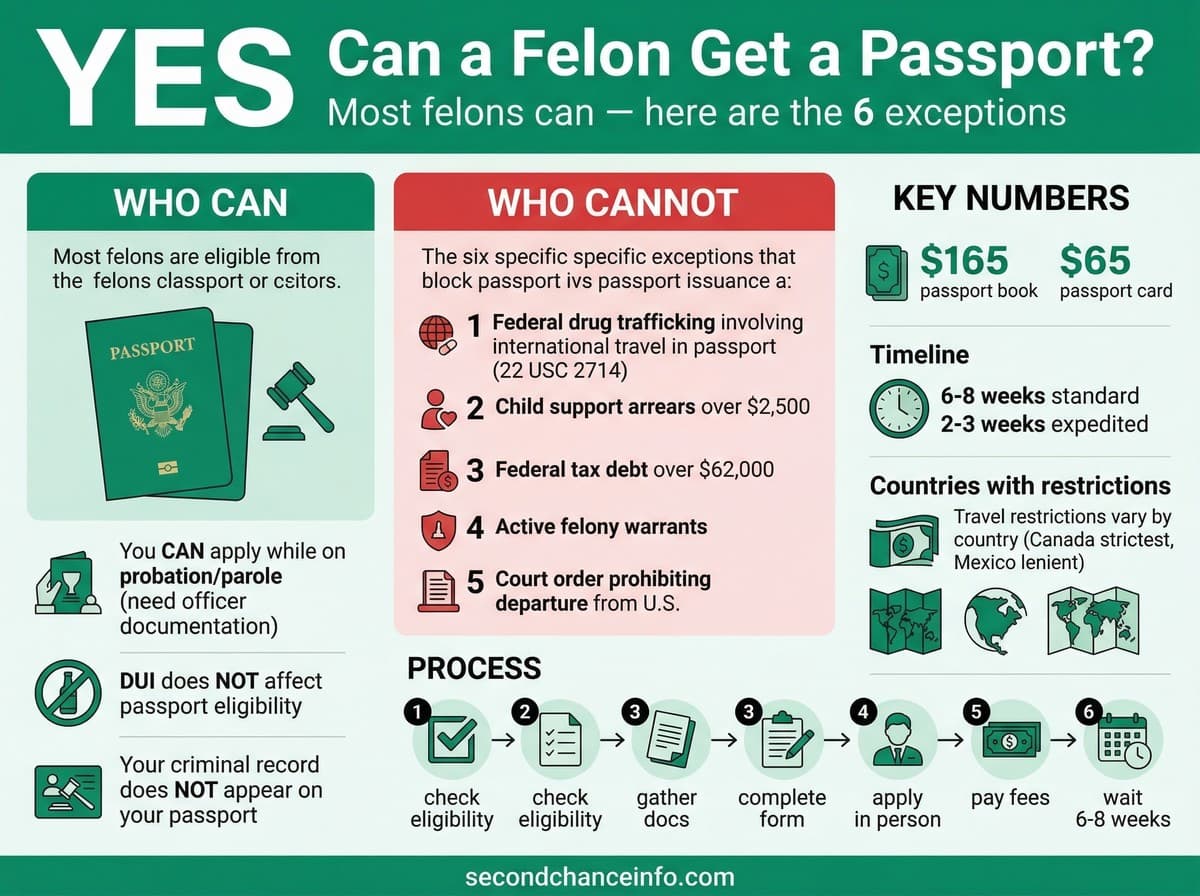
Yes, most people with a felony conviction can get a U.S. passport. A felony conviction alone does not disqualify you. There are only a few specific situations that prevent passport issuance: a state or federal felony drug conviction where you used a passport or crossed an international border during the offense, owing more than $2,500 in child support, owing more than $66,000 in federal tax debt (the 2026 threshold), active federal or state felony warrants, or a court order prohibiting you from leaving the country. If none of these apply to you, you can apply for a passport the same way anyone else does.
You CAN get a passport if you...
- ✓Completed a prison sentence for any state felony (murder, robbery, assault, theft, etc.)
- ✓Completed probation or parole (no special restrictions on passport application)
- ✓Currently on probation or parole — you CAN apply but need documentation from your probation officer
- ✓Convicted of a misdemeanor (including DUI — a DUI alone does not affect passport eligibility)
- ✓Have an expunged or sealed record
- ✓Convicted of a drug offense with no passport or border-crossing element (the 22 U.S.C. § 2714 bar requires that a passport was used or a border was crossed during the offense)
- ✓Previously denied a passport but the disqualifying condition has been resolved
You CANNOT get a passport if you...
- ✗Felony drug conviction involving a passport or border crossing
If you were convicted of a state or federal felony drug offense (manufacture, distribution, or possession) and used a passport or otherwise crossed an international border while committing the offense, you cannot be issued a passport while you are imprisoned, on parole, or on supervised release for that offense. A first misdemeanor possession conviction is exempt, and the Secretary of State may still issue a passport in emergency or humanitarian circumstances. This is the only category of criminal conviction that directly blocks passport issuance by law. (22 U.S.C. § 2714)
- ✗Child support arrears over $2,500
The Department of Health and Human Services reports non-custodial parents who owe more than $2,500 in child support to the State Department. Your passport application will be denied until the debt is resolved or a payment plan is in place. (42 U.S.C. § 652(k))
- ✗Seriously delinquent federal tax debt over $66,000
The IRS certifies taxpayers with seriously delinquent tax debt (more than $66,000 including penalties and interest for 2026 — the amount is adjusted for inflation each year) to the State Department. Your passport can be denied, revoked, or limited to return travel only. (26 U.S.C. § 7345 (FAST Act))
- ✗Active federal or state felony arrest warrant
If there is an outstanding federal felony warrant (22 C.F.R. § 51.60(b)(1)) or state/local felony warrant (§ 51.60(b)(9)), the State Department may refuse to issue you a passport. Clear the warrant first. (22 C.F.R. § 51.60(b)(1), (b)(9))
- ✗Court order prohibiting departure from the U.S.
If a criminal court order, condition of probation, or condition of parole forbids you from departing the United States, the State Department may refuse to issue a passport until the order is lifted. (22 C.F.R. § 51.60(b)(2))
- ✗Covered registered sex offenders (passport identifier)
If the Angel Watch Center determines you are a covered sex offender (currently required to register under any jurisdiction's sex offender registration program), the State Department cannot issue you a passport unless it carries a conspicuous unique identifier, and an unmarked passport may be revoked so it can be reissued with the identifier. The law does not deny passports outright — it requires the identifier. (22 U.S.C. § 212b (International Megan's Law))
Gray areas — it depends
Currently on probation or parole
You CAN apply for and receive a passport while on supervision. However, you must provide documentation: a discharge notice, letter of termination from your probation officer, or court order. Your probation officer may also need to send verification to the State Department. Having a passport does not mean you can travel — you still need your probation/parole officer's permission to leave the country.
Pending criminal charges (not yet convicted)
A pending charge does not automatically prevent passport issuance unless there is a court order or warrant. However, if you are on pre-trial release with travel restrictions, you may be blocked.
Previously surrendered or seized passport
If your passport was surrendered to a court or law enforcement, you can request its return. Submit a notarized letter with your full name, DOB, SSN, and photo ID, plus a letter from your probation officer confirming you can receive it. Send to PPTReturnRequests@state.gov or U.S. Department of State, CA/PPT/S/A/RA, Sterling, VA 20166-1243.
How to Apply — Step by Step
Check if you have any disqualifying conditions
Before applying, verify you have no outstanding felony warrants, no child support debt over $2,500, no federal tax debt over $66,000, no felony drug conviction involving a passport or border crossing while you are still imprisoned or on supervised release, and no court order preventing departure from the U.S.
Gather required documents
You need: proof of U.S. citizenship (birth certificate or naturalization certificate), a valid government-issued photo ID, a passport photo (2"x2"), and completed Form DS-11 (first-time) or DS-82 (renewal). If on probation/parole, also get a discharge notice or letter from your officer.
Complete the application form
Fill out Form DS-11 (new passport) or DS-82 (renewal). You must disclose your criminal history truthfully — lying on a passport application is a federal crime under 18 U.S.C. § 1542, punishable by fines and up to 10-15 years in prison (up to 20 years if done to facilitate drug trafficking, and up to 25 years if done to facilitate international terrorism).
Apply in person at a passport acceptance facility
First-time applicants must apply in person at a post office, library, county clerk, or passport agency. Bring all documents and payment. Existing passport holders may renew by mail using DS-82.
Pay the fees
Passport book: $130 (adult) + $35 execution fee = $165 total. Passport card: $30 + $35 = $65. Expedited processing: additional $60. These fees are the same for felons as for anyone else.
Wait for processing and receive your passport
Standard processing: 4-6 weeks (excluding mailing). Expedited: 2-3 weeks. The State Department screens applications against warrant and certified-debt records. If certified tax debt is found, your application is held for 90 days so you can pay, arrange payments, or correct an erroneous certification — otherwise it is denied.
What to Do If Your Passport Is Denied
There is no general formal appeal for a passport denial. For certified tax debt, the State Department holds your application open for 90 days while you pay, arrange payments, or correct an erroneous certification. For any other denial, you can ask the State Department in writing to reconsider, and ultimately file suit in federal court.
- Request a written explanation of the denial reason from the State Department
- Gather documentation that addresses the denial (e.g., proof of child support payment, warrant clearance, court order modification)
- Submit your appeal in writing to the Office of Adjudication, U.S. Department of State
- If the appeal is denied, you may file suit in federal court
Should I get a passport card or passport book?
A passport card ($65) works for land and sea travel to Canada, Mexico, the Caribbean, and Bermuda only. A passport book ($165) works for all international travel including air. Both have the same eligibility requirements — if you can get one, you can get the other. For felons, the passport book is usually more useful since many countries require it for entry.
Does a DUI affect my ability to get a passport?
No. A DUI conviction — even a felony DUI — does not affect your ability to get a U.S. passport. However, a DUI CAN affect your ability to enter certain countries, especially Canada, which treats DUI as a serious criminal offense and may deny entry.
If my record is expunged, does that help with getting a passport?
It depends. Federal checks can surface records even after state-level expungement. However, if your conviction was the type that blocks passport issuance (a felony drug conviction involving a passport or border crossing under 22 U.S.C. § 2714), expungement may help. For most felons, expungement is not necessary because most convictions don't block passport issuance in the first place.
Is renewing a passport different from getting a new one with a felony?
No meaningful difference. Both are screened against the same denial grounds. If you had a passport before your conviction, you can renew by mail (Form DS-82) as long as your previous passport is undamaged, was issued in the last 15 years, and you were 16 or older when it was issued. If your passport was surrendered to the court, you'll need to request its return or apply for a new one.
Visual Guide
International Travel Restrictions by Country
| Country | Restriction | Details |
|---|---|---|
| Canada | Strict — even misdemeanor DUI can block entry | Canada treats any criminal conviction as potential inadmissibility. DUI is classified as a serious offense. Options: Temporary Resident Permit (TRP, valid up to 3 years) or Criminal Rehabilitation application (commonly takes over a year to process, permanent once approved). 10 years after completing your sentence, you may be 'deemed rehabilitated' automatically. |
| United Kingdom | Denied if sentence exceeded 12 months | UK immigration rules deny entry to anyone sentenced to 12+ months imprisonment, regardless of how long ago. Shorter sentences may also be grounds for denial at the border officer's discretion. No formal waiver process — you must convince the immigration officer. |
| Australia | Character test — sentenced to 12+ months = fail | Australia's Migration Act requires all visitors to pass a 'character test.' A sentence of 12+ months (whether served or suspended) is an automatic fail. You can apply for a Character Waiver, but approval is not guaranteed. |
| European Union / Schengen Area | ETIAS screening when it launches (expected 2027) | When ETIAS launches (originally targeted for late 2026, now expected to slip to 2027 while the EU completes its Entry/Exit System rollout), non-EU travelers will need ETIAS authorization (€20, valid 3 years), which asks about criminal history. A conviction does not automatically deny ETIAS, but offenses may trigger additional review. Each Schengen country can refuse entry at the border independently. Check the official EU ETIAS site for the current start date. |
| Japan | Drug offenses = denied entry | Japan is extremely strict on drug-related convictions. Any drug offense, including marijuana possession, can result in permanent denial of entry. Non-drug felonies are reviewed on a case-by-case basis. |
| Mexico | Generally lenient for most felonies | Mexico does not typically screen for foreign criminal records at entry. However, Mexican immigration law allows denial of entry to anyone convicted of a 'serious crime.' In practice, most felons enter Mexico without issues. |
| New Zealand | Sentenced to 5+ years = denied; 12+ months = discretionary | Anyone sentenced to 5+ years of imprisonment at any point in their life is automatically denied entry. Sentences of 12 months to 5 years within the last 10 years are reviewed case-by-case. You can apply for a Special Direction waiver. |
| China | Visa required — criminal history may block | China requires a visa for U.S. citizens. The visa application asks about criminal history. Convictions may result in visa denial, particularly for drug and violent offenses. |
| Israel | Security screening at entry — case-by-case | Israel conducts thorough security screenings. Criminal records may trigger additional questioning but do not automatically deny entry. |
| South Korea | Drug offenses strictly enforced | South Korea, like Japan, is very strict on drug convictions. Other felonies are generally not grounds for denial unless there is an active Interpol notice. |
Take Action — Direct Links
- Check passport application status
Official State Department tool to track your passport application
- Find a passport acceptance facility near you
Post offices, libraries, and clerks that accept passport applications
- Download Form DS-11 (new passport application)
Official application form for first-time passport applicants
- Download Form DS-82 (passport renewal)
Renewal form for eligible existing passport holders
- Request return of a surrendered passport
Email the State Department to request return of a passport seized by court or law enforcement
- Canada — Temporary Resident Permit application
If you need to enter Canada with a criminal record
Frequently Asked Questions
- Can a felon get a passport?
- Yes. Most people with a felony conviction can get a U.S. passport. A felony conviction alone does not prevent you from getting one. Only specific conditions block passport issuance: a state or federal felony drug conviction involving a passport or border crossing (22 U.S.C. § 2714), child support arrears over $2,500, federal tax debt over $66,000, active felony warrants, or a court order prohibiting departure.
- Does your criminal record show up on a passport?
- No. A U.S. passport does not contain any information about your criminal record. It is strictly an identity and citizenship document. However, the exception is covered registered sex offenders (as determined by the Angel Watch Center) — their passports must contain a unique identifier under International Megan's Law (22 U.S.C. § 212b).
- Can I get a passport while on probation or parole?
- Yes, you can apply for and receive a passport while on probation or parole. You'll need to submit documentation from your probation officer (discharge notice, letter of termination, or court order). However, having a passport does not give you permission to travel — you still need your officer's approval to leave the country.
- Can I travel internationally with a felony conviction?
- Having a passport allows you to leave the U.S., but each destination country has its own entry rules. Canada is the strictest (even a DUI can block entry). The UK and Australia deny entry for sentences over 12 months. Most other countries are more lenient. Always check the specific country's requirements before booking travel.
- Does a DUI prevent me from getting a passport?
- No. A DUI — even a felony DUI — does not prevent you from getting a U.S. passport. However, a DUI can prevent you from entering Canada, which classifies DUI as a serious criminal offense.
- What happens if I lie on my passport application?
- Lying on a passport application is a federal crime under 18 U.S.C. § 1542, punishable by fines and 10-15 years in prison (up to 20 years if the lie facilitated drug trafficking, up to 25 years if it facilitated international terrorism). Always disclose your criminal history truthfully. In most cases, your conviction will not prevent you from getting a passport anyway.
- How long does it take to get a passport with a felony record?
- The same as anyone else: 4-6 weeks for standard processing (excluding mailing), 2-3 weeks for expedited ($60 extra). Applications are screened against warrant and certified-debt records, but this does not add extra processing time unless a disqualifying record is found.
- What if my passport was taken by the court?
- You can request its return by submitting a notarized letter (with full name, DOB, SSN, photo ID) and a letter from your probation officer to PPTReturnRequests@state.gov. If your passport was reported lost, stolen, revoked, or expired, it cannot be returned — you'll need to apply for a new one.
- Can I get a passport if I was convicted of murder?
- Yes, if you have completed your sentence and have no active warrants or court orders. Murder is a serious crime, but it is not one of the specific offenses that blocks passport issuance under federal law. The statutory bar is for felony drug convictions involving a passport or border crossing (while imprisoned or on supervised release); registered sex offenders face a passport identifier, not a denial; and certain certified debts (child support, tax) block issuance.
- Does expungement help with getting a passport?
- For most people, expungement is not necessary because most convictions don't block passport issuance. However, if your conviction was a felony drug offense involving a passport or border crossing (the main disqualifier), expungement or a pardon may help. Federal checks can still surface records after state-level expungement.
Related Resources on This Site
Helpful guides
- ExpungementClean Slate laws — automatic expungement
- Criminal LawFelony vs. misdemeanor — what's the difference?
- Free Legal AidFree legal aid by state
- ToolsReentry Checklist — Preparation Steps After Release
Video Guides
Sources
- U.S. Department of State — Passports and Criminal Records
- 22 U.S.C. § 2714 — Denial of Passports to Drug Traffickers
- 42 U.S.C. § 652(k) — Child Support Passport Denial
- 26 U.S.C. § 7345 — Seriously Delinquent Tax Debt
- 22 C.F.R. § 51.60 — Grounds for Denial or Restriction of Passport
- International Megan's Law (22 U.S.C. § 212b)