
What Shows Up on a Background Check?
Last updated:
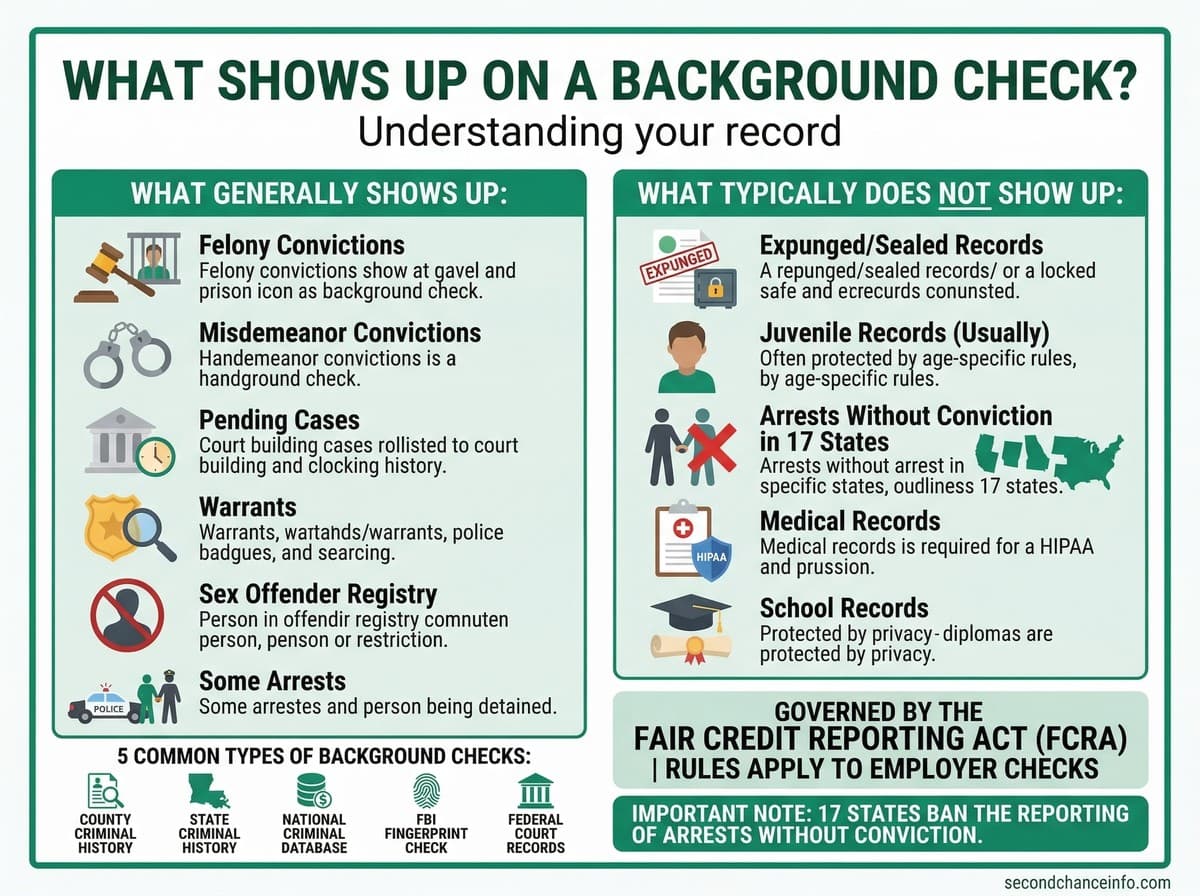
A standard criminal background check typically shows felony and misdemeanor convictions, pending charges, active warrants, and in many cases arrests that did not lead to conviction. What appears depends on who is running the check, what type of check it is, and which state you are in. Under the federal Fair Credit Reporting Act (FCRA), arrests without conviction generally cannot be reported after 7 years, but convictions can be reported indefinitely in most states. Sealed and expunged records should not appear on most standard checks, though FBI checks may still show them.
What DOES show up on a background check
| Record Type | How Long It Appears | Details |
|---|---|---|
| Felony convictions | Indefinite (federal) or 7 years (in some states) | All felony convictions (murder, robbery, drug trafficking, fraud, etc.) appear on criminal background checks. Under federal FCRA rules, convictions can be reported indefinitely. However, 12 states limit conviction reporting to 7 years for employment purposes. |
| Misdemeanor convictions | Indefinite (federal) or 7 years (in some states) | Misdemeanors (DUI, petty theft, simple assault, disorderly conduct, etc.) show up the same as felonies. They remain on your record and can be reported on background checks unless sealed or expunged. |
| Pending criminal charges | Until the case is resolved | Active cases that have not yet reached a verdict appear because they are current court records. Employers must follow EEOC guidelines and cannot automatically reject someone based on pending charges alone. |
| Active warrants | Until the warrant is cleared | Outstanding arrest warrants (bench warrants, failure to appear, etc.) show up on NCIC and state databases. These are flagged immediately and can lead to arrest during the background check process. |
| Arrests that did not lead to conviction | Up to 7 years (FCRA) or prohibited in some states | Arrests without conviction (dismissed, acquitted, nolle prosequi) can appear on background checks. Under FCRA, consumer reporting agencies cannot report non-conviction arrests older than 7 years. Some states prohibit reporting arrests without conviction entirely. |
| Sex offender registry status | Duration of registration requirement (often lifetime) | If you are on a state or national sex offender registry, this information is publicly available and will appear on virtually any background check. Registration is separate from your criminal record and is not affected by expungement of the underlying conviction in most states. |
| Incarceration records | Indefinite | State and federal prison records, including dates of incarceration and release, are typically available through departments of corrections and appear on comprehensive background checks. |
| Probation and parole status | Until supervision is completed | Current supervision status may appear on background checks, particularly those conducted through state criminal justice databases. This tells employers or landlords that you are currently under court supervision. |
What does NOT show up on a background check
- ✓Expunged records
Records that have been expunged (destroyed or sealed by court order) should not appear on standard background checks run through consumer reporting agencies. However, FBI checks and certain government checks may still show expunged records.
- ✓Sealed records
Sealed records are hidden from public view and should not show on most background checks. Like expunged records, they may still appear on FBI or government-level checks.
- ✓Juvenile records
In most states, juvenile adjudications (not technically 'convictions') are sealed or confidential by default and do not appear on standard adult background checks. Exceptions exist for serious offenses tried in adult court.
- ✓Records from pardoned offenses
A full pardon may remove a conviction from background checks, depending on the state. A presidential pardon does not automatically expunge the federal record but may limit reporting.
- ✓Infractions and traffic tickets
Minor infractions (speeding tickets, parking violations, non-criminal traffic offenses) do not appear on criminal background checks. They may appear on driving record (MVR) checks, which are a separate type of screening.
- ✓Civil lawsuits and civil judgments
Standard criminal background checks do not include civil matters (lawsuits, restraining orders, small claims). These require a separate civil records search. Under FCRA, civil judgments cannot be reported after 7 years.
- ✓Mental health records
Mental health treatment records are protected under HIPAA and state privacy laws. They do not appear on criminal background checks. However, involuntary commitment records may be in the NICS database for firearm purchases.
- ✓Drug test results
Past drug test results are not part of a criminal background check. Drug testing is a separate screening process. Previous failed drug tests at other employers are not reported.
Types of Criminal Background Checks
County criminal records search
Searches court records in a specific county. This is the most accurate type of criminal background check because it goes directly to the courthouse. It reveals felonies, misdemeanors, pending cases, and dispositions filed in that county.
State criminal records search
Searches the state's central criminal database (maintained by state police or department of justice). Coverage varies by state — some states have comprehensive databases, others are incomplete because not all counties report consistently.
National criminal database search
Searches a compiled database of records from multiple states and counties. These are fast and cheap but NOT comprehensive — they may miss records from counties that do not contribute to the database. Best used as a supplement to county-level searches.
FBI Identity History Summary (rap sheet)
The most comprehensive check available. Includes all arrests and convictions reported to the FBI by federal, state, and local agencies. Based on fingerprints, so it is not subject to name-matching errors. May include expunged records. Costs $18.
Federal criminal records search
Searches U.S. district court records through PACER or direct court access. Covers federal crimes only — drug trafficking, wire fraud, tax evasion, immigration offenses, federal weapons charges, etc.
Your Rights Under the FCRA
7-year rule for non-convictions
Consumer reporting agencies (CRAs) cannot report arrests that did not result in conviction if the arrest is more than 7 years old. The 7-year clock starts from the date of arrest or charge filing, not the date of dismissal.
No time limit on convictions (federal)
Under federal FCRA, convictions can be reported indefinitely regardless of age. There is no federal time limit on reporting criminal convictions. However, 12 states have enacted their own limits (typically 7 years).
$75,000 salary exception
The FCRA 7-year limit on adverse information does not apply to jobs with an expected annual salary of $75,000 or more. For these positions, CRAs can report arrests, convictions, and other adverse information without any time limit.
Written consent required
Before running a background check through a CRA, the employer or landlord must get your written authorization. You must also receive a standalone disclosure that a background check will be conducted.
Adverse action process
If an employer decides not to hire you based on your background check, they must follow a two-step adverse action process: (1) send a pre-adverse action notice with a copy of the report and a summary of your rights, (2) wait a reasonable time (usually 5 business days), then (3) send a final adverse action notice.
Right to dispute
You have the right to dispute any inaccurate or incomplete information on your background check. The CRA must investigate your dispute within 30 days and correct or remove inaccurate information.
States That Prohibit Reporting Arrests Without Conviction
These states prohibit consumer reporting agencies from including non-conviction arrest records on background checks, regardless of when the arrest occurred:
Take Action — Direct Links
- Request your FBI Identity History Summary ($18)
Official FBI portal to check your own federal criminal record via fingerprints
- Free annual credit report (includes some background data)
Get your free credit report from Equifax, Experian, and TransUnion
- EEOC guidance on criminal records in employment
Federal guidelines on how employers should evaluate criminal records
- File a complaint about a background check error
CFPB complaint portal if a background check contains errors
- Find your state expungement eligibility
Check if you can clear your record to remove it from background checks
Visual Guide
Frequently Asked Questions
- What shows up on a background check?
- A standard criminal background check typically shows felony and misdemeanor convictions, pending criminal charges, active warrants, and in many states, arrests that did not lead to conviction. Depending on the type of check, it may also show sex offender registry status, incarceration records, and probation/parole status. Sealed, expunged, and juvenile records generally do not appear on standard checks.
- Do dismissed charges show up on a background check?
- Yes, dismissed charges can appear on a background check, especially if they are less than 7 years old. Under the federal FCRA, arrests that did not result in conviction can be reported for up to 7 years. Some states prohibit reporting non-conviction records entirely. Employers cannot legally use dismissed charges as the sole reason to deny employment under EEOC guidelines.
- Do expunged records show on a background check?
- Expunged records should not appear on standard background checks conducted by consumer reporting agencies. However, they may still show up on FBI fingerprint-based checks and certain government or law enforcement databases. If an expunged record appears on a CRA report, you have the right to dispute it and have it removed.
- Does a misdemeanor show up on a background check?
- Yes. Misdemeanor convictions (including DUI, petty theft, simple assault, and drug possession) appear on criminal background checks the same way felonies do. They can be reported indefinitely under federal FCRA rules, though some states limit reporting to 7 years.
- Will a DUI show up on a background check?
- Yes. A DUI conviction (whether misdemeanor or felony) appears on a criminal background check. It will also appear on a driving record (MVR) check. A DUI arrest that was dismissed may still appear for up to 7 years under FCRA rules, or may be prohibited from reporting depending on your state.
- Do arrests without conviction show on a background check?
- Under federal FCRA rules, arrests without conviction can be reported for up to 7 years from the date of arrest. However, at least 17 states prohibit consumer reporting agencies from reporting arrests that did not result in conviction, regardless of when they occurred. Even in states that allow it, EEOC guidance says employers should not use arrest records alone to make hiring decisions.
- Can an employer see sealed records?
- No. Sealed records are removed from public access and should not appear on background checks run by consumer reporting agencies. If a sealed record appears on an employer's background check, it is likely an error and you can dispute it with the CRA. Certain government positions and law enforcement agencies may have access to sealed records through direct database access.
- How far back does a criminal background check go?
- Under federal FCRA rules, convictions can be reported indefinitely, while non-conviction arrests are limited to 7 years. However, 12 states limit conviction reporting to 7 years for employment screening. The actual lookback period depends on the state, the type of check, and the salary of the position. See our detailed guide on background check lookback periods.
- Does a background check show my entire criminal history?
- Not necessarily. A background check only shows what is in the database being searched. County checks only cover that county. State checks may miss records from non-reporting counties. National database checks have gaps. Only an FBI fingerprint-based check comes close to showing your complete criminal history across all jurisdictions.
- What does an employer see on a background check?
- An employer running a standard pre-employment background check typically sees: felony and misdemeanor convictions, pending charges, and sometimes arrests without conviction (depending on state law). They may also run additional checks such as employment verification, education verification, driving record, and credit history (with your permission). They cannot see sealed or expunged records, juvenile records, or medical/mental health information.
Related Resources on This Site
Helpful guides
- ExpungementClean Slate laws — automatic expungement
- HousingNo credit check apartments & rentals
- ToolsReentry organizations directory
- Free Legal AidFree legal aid by state