
Employment vs Apartment Background Checks
Last updated:
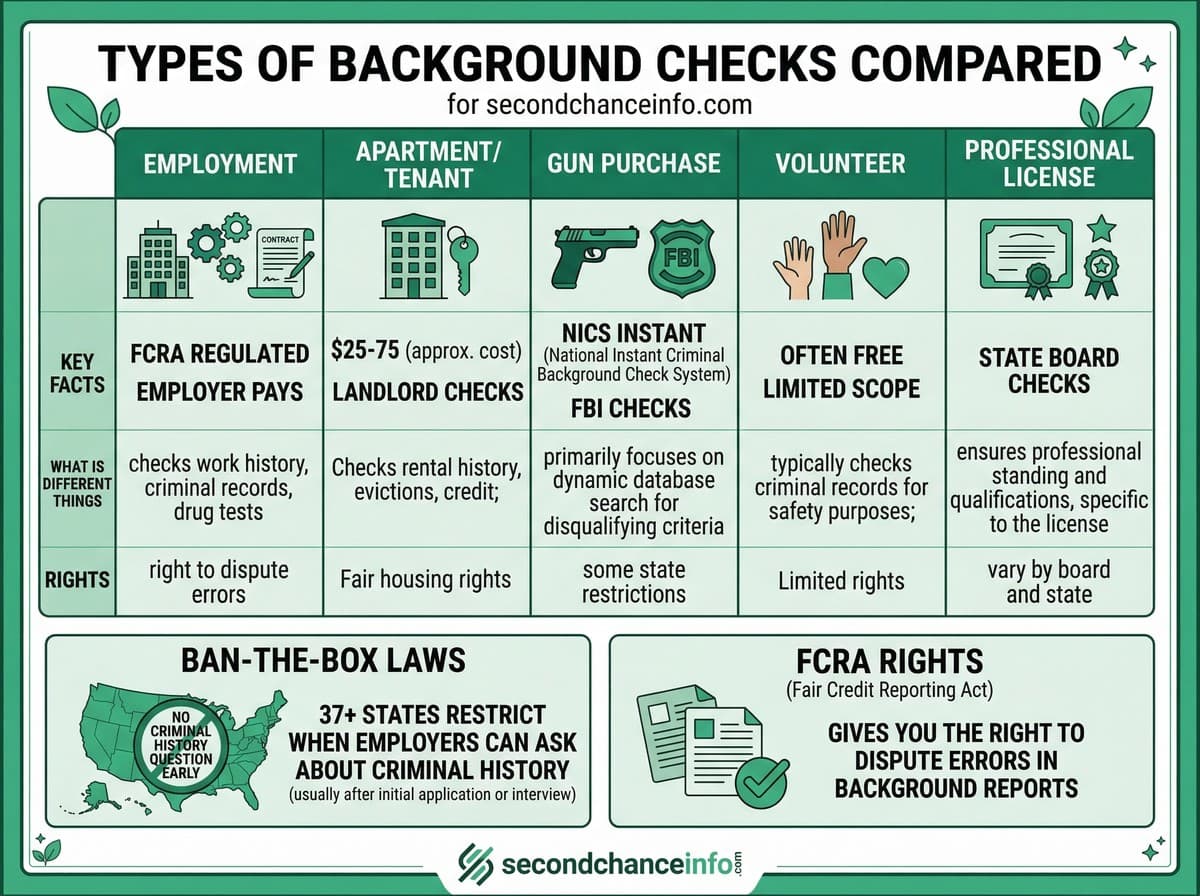
Not all background checks are the same. An employment background check focuses on criminal history, employment verification, and sometimes credit and driving records. An apartment (tenant) background check emphasizes credit history, eviction records, and rental payment history alongside criminal records. Other types include gun purchase checks (NICS), volunteer screening, and professional license checks. Each type looks at different records, follows different rules, and gives you different rights under the law.
Side-by-Side Comparison
| Feature | Employment | Apartment | Gun (NICS) | Volunteer | Prof. License |
|---|---|---|---|---|---|
| Criminal history | Yes | Yes | Yes | Yes | Yes |
| Credit score / credit history | Sometimes (with extra consent) | Yes (primary focus) | No | No | Rarely |
| Eviction records | No | Yes (primary focus) | No | No | No |
| Employment verification | Yes | Sometimes (income verification) | No | No | Sometimes |
| Education verification | Yes | No | No | No | Yes |
| Driving record (MVR) | For driving jobs | No | No | Sometimes | For CDL/transport |
| Sex offender registry | Yes | Yes | Yes (via NCIC) | Yes | Yes |
| Mental health records | No | No | Yes (involuntary commitment only) | No | No |
| Written consent required | Yes | Yes | No (ATF Form 4473 is the consent) | Yes | Varies |
| FCRA adverse action process | Yes | Yes | No (different appeal process) | Yes | Varies |
Employment (pre-employment) Background Check
Typically 7 years for non-convictions; convictions may go back indefinitely (varies by state)
Paid by the employer (typically $20-$100+ depending on scope)
1-5 business days for standard checks; instant for database-only checks
What It Checks
- •Criminal history (felonies and misdemeanors)
- •Employment verification (past employers, dates, titles)
- •Education verification (degrees, certifications)
- •Professional license verification
- •Credit history (for financial positions — requires separate consent)
- •Driving record / MVR (for driving positions)
- •Drug screening (separate process, not part of criminal check)
- •Sex offender registry
Your Rights
- ✓Employer must get your written consent before running the check
- ✓You must receive a standalone disclosure (not buried in the application)
- ✓If the employer decides not to hire you based on the check, they must follow the FCRA adverse action process: pre-adverse notice, copy of the report, wait period, then final adverse action notice
- ✓You have the right to dispute any inaccurate information
- ✓In ban-the-box states (37+ states as of 2026), employers cannot ask about criminal history on the initial application
Apartment / tenant screening Background Check
Credit and eviction: 7 years. Criminal: varies by state (7 years to indefinite)
Often passed to the applicant as an 'application fee' ($25-$75)
1-3 business days; some services provide instant results
What It Checks
- •Credit score and credit history
- •Eviction history (typically 7 years)
- •Criminal history (felonies and misdemeanors)
- •Rental payment history
- •Income verification
- •Previous addresses and landlord references
- •Sex offender registry
- •Identity verification (SSN trace)
Your Rights
- ✓Landlord must get your written consent before running the check
- ✓You are entitled to a copy of the report if you are denied housing
- ✓You can dispute inaccurate information with the screening company
- ✓HUD withdrew its 2016 criminal-record screening guidance effective September 25, 2025. That document is not a current requirement for every landlord to conduct an individualized assessment. Federal fair housing law and applicable state/local protections still matter; ask legal aid to review the property, screening policy and your facts. Request and dispute inaccurate screening reports rather than assuming an arrest or conviction creates one nationwide answer.
- ✓Some cities and states have 'fair chance housing' laws that limit when landlords can check criminal history
- ✓The landlord must tell you if they used the report to deny your application
Gun purchase (NICS) Background Check
No time limit — checks entire criminal history
Free to the buyer (part of the dealer's FFL obligations)
Usually instant (minutes); can take up to 3 business days if delayed
What It Checks
- •Felony convictions (any felony = prohibited person)
- •Misdemeanor domestic violence convictions
- •Active domestic violence restraining orders
- •Involuntary mental health commitments
- •Fugitive from justice / active warrants
- •Unlawful drug use (including marijuana in any state)
- •Dishonorable military discharge
- •Renounced U.S. citizenship
- •Indictment for felony (pending charges)
Your Rights
- ✓NICS check is run by the FBI or a state point of contact
- ✓Results are Proceed, Deny, or Delay (further review needed)
- ✓If delayed, the dealer can legally proceed with the sale after 3 business days if no final determination is made (the 'default proceed' or 'Charleston loophole')
- ✓If denied, you can appeal through the FBI NICS Section or your state's point of contact
- ✓NICS records are supposed to be destroyed within 24 hours for approved transactions
Volunteer screening Background Check
Varies — typically 7 years, but sex offender checks have no limit
Usually paid by the organization ($10-$40)
1-5 business days
What It Checks
- •Criminal history (felonies and misdemeanors)
- •Sex offender registry
- •Child abuse and neglect registries (for youth-serving organizations)
- •Sometimes driving record (if transporting people)
Your Rights
- ✓FCRA applies to volunteer background checks the same as employment checks
- ✓Written consent is required
- ✓Many volunteer screening services offer reduced rates or free checks for nonprofits
- ✓You have the same dispute rights as with employment checks
Professional license / regulatory Background Check
Often no time limit — entire criminal history reviewed
Varies widely ($20-$200+), typically paid by the applicant
1-8 weeks depending on the licensing board
What It Checks
- •Criminal history (felonies and misdemeanors — often no time limit)
- •Disciplinary actions from other states or licensing boards
- •Education and credential verification
- •Civil malpractice history (for healthcare, legal, financial professions)
- •Fingerprint-based FBI check (required for many licenses)
Your Rights
- ✓Licensing boards have their own rules — FCRA may or may not apply depending on whether a third-party CRA is used
- ✓Most boards allow you to explain your criminal history before making a decision
- ✓Many states have reformed licensing laws to prohibit blanket disqualifications based on criminal history
- ✓You typically have the right to a hearing if your license is denied
Ban-the-Box & Fair Chance Hiring
Ban-the-box laws prohibit employers from asking about criminal history on the initial job application. The question about criminal records is delayed until later in the hiring process — typically after an interview or conditional job offer. This gives candidates a chance to be evaluated on qualifications first.
As of 2026: 37+ states and D.C. have ban-the-box laws, plus 150+ cities and counties.
Recent Updates
- •Philadelphia expanded ban-the-box rules in January 2026
- •Washington State strengthened fair chance hiring requirements effective July 2026
- •Texas enacted its first statewide ban-the-box law in September 2025
Key States
| State | Scope |
|---|---|
| California | Public and private employers with 5+ employees |
| New York | Public and private employers statewide (Fair Chance Act) |
| Illinois | Public and private employers with 15+ employees |
| New Jersey | Public and private employers with 15+ employees |
| Massachusetts | Public and private employers statewide (CORI Reform) |
| Washington | Public and private employers statewide (Fair Chance Act) |
| Colorado | Public and private employers statewide (Chance to Compete Act) |
| Texas | Public employers statewide; private employers in select cities |
Fair Housing & Criminal Records
HUD withdrew its 2016 criminal-record screening guidance effective September 25, 2025. That document is not a current requirement for every landlord to conduct an individualized assessment. Federal fair housing law and applicable state/local protections still matter; ask legal aid to review the property, screening policy and your facts. Request and dispute inaccurate screening reports rather than assuming an arrest or conviction creates one nationwide answer.
- •Blanket bans on renting to people with any criminal record may violate the Fair Housing Act
- •Arrests without conviction cannot be the basis for denial — only convictions
- •Landlords should consider the nature of the crime, how long ago it occurred, and whether the applicant poses an actual risk
- •Some cities (Seattle, Oakland, Portland) have enacted specific fair chance housing ordinances
- •Federal screening restrictions depend on the housing program. For ordinary Housing Choice Vouchers, mandatory rules cover lifetime state sex-offender registration, methamphetamine production on federally assisted premises, specified current drug activity, some drug-related assisted-housing evictions and specified alcohol-related threats. Some rules have exceptions. Ask the PHA for the applicable rule and a review of the actual record; other screening criteria may be discretionary.
Take Action — Direct Links
- Check if your state has ban-the-box laws
State-by-state list of fair chance hiring laws
- HUD fair housing complaint
File a complaint if you were illegally denied housing based on your record
- CFPB — Review your tenant background check
Understand your rights and how to dispute errors in rental screening
- NICS denial appeal
Appeal a firearm purchase denial through the FBI
- Find your state expungement eligibility
Clear your record to improve results on all types of background checks
Visual Guide
Frequently Asked Questions
- What is the difference between an employment and apartment background check?
- Employment checks focus on criminal history, employment/education verification, and sometimes credit and driving records. Apartment checks focus on credit score, eviction history, rental payment history, and criminal records. Both require written consent and follow FCRA rules, but they look at different databases and prioritize different information.
- Do landlords see the same criminal record as employers?
- Generally yes — both use consumer reporting agencies that access similar criminal databases. However, the context differs. Landlords primarily care about crimes that indicate risk to property or other tenants (violent crimes, drug manufacturing, arson). Employers focus on crimes relevant to the job duties. The same FCRA time limits apply to both.
- Can a landlord deny me for a criminal record?
- HUD withdrew its 2016 criminal-record screening guidance effective September 25, 2025. That document is not a current requirement for every landlord to conduct an individualized assessment. Federal fair housing law and applicable state/local protections still matter; ask legal aid to review the property, screening policy and your facts. Request and dispute inaccurate screening reports rather than assuming an arrest or conviction creates one nationwide answer.
- What is ban-the-box?
- Ban-the-box laws prohibit employers from asking about criminal history on the initial job application. As of 2026, 37+ states, D.C., and 150+ cities have enacted some form of ban-the-box law. The goal is to give candidates a chance to be evaluated on qualifications before their criminal record is considered. The criminal history question is typically delayed until after an interview or conditional job offer.
- What does a gun background check (NICS) show?
- The National Instant Criminal Background Check System (NICS) checks three FBI databases: NCIC, III, and the NICS Index. It looks for felony convictions, domestic violence misdemeanors, restraining orders, involuntary mental health commitments, active warrants, drug use, dishonorable discharges, and other federal disqualifiers. It does not check credit, employment, or education.
- Can I fail a background check for a misdemeanor?
- For employment and housing, a misdemeanor alone typically will not result in automatic disqualification — employers and landlords should conduct individualized assessments. For gun purchases, a misdemeanor domestic violence conviction is a federal disqualifier. For professional licenses, certain misdemeanors may disqualify you depending on the profession and state.
- Do volunteer background checks show the same things as employment checks?
- Volunteer checks are similar to employment checks but often narrower in scope. They typically focus on criminal history and sex offender registry status, especially for organizations working with children or vulnerable adults. The same FCRA rules apply — written consent is required and you have the right to dispute errors.
- Can an employer check my credit history?
- Yes, but only with your separate written consent, and only for positions where credit history is relevant (financial roles, positions handling money, etc.). Eleven states restrict or prohibit employer use of credit checks: California, Colorado, Connecticut, Delaware, Hawaii, Illinois, Maryland, Nevada, Oregon, Vermont, and Washington. New York City also restricts credit checks.
- What happens if I am denied a job or apartment based on a background check?
- Under the FCRA, the employer or landlord must follow the adverse action process: (1) send you a pre-adverse action notice with a copy of the background check report and a summary of your rights, (2) give you time to review and dispute any errors (typically 5 business days), and (3) send a final adverse action notice. If this process is not followed, you may have grounds for an FCRA lawsuit.
- Are professional license background checks more thorough?
- Yes. Professional license checks often require fingerprint-based FBI checks and have no time limit — they review your entire criminal history. They may also check disciplinary records from other states, education credentials, and civil malpractice history. However, many states have reformed licensing laws to prevent blanket denials based on criminal records.
Related Resources on This Site
Helpful guides
- ExpungementClean Slate laws — automatic expungement
- HousingNo credit check apartments & rentals
- ToolsReentry organizations directory
- Free Legal AidFree legal aid by state
Sources
- Fair Credit Reporting Act (15 U.S.C. § 1681)
- FTC — Using Consumer Reports: What Landlords Need to Know
- HUD — Notice withdrawing the 2016 criminal-record guidance (effective September 25, 2025)
- FBI — NICS (National Instant Criminal Background Check System)
- EEOC — Enforcement Guidance on Arrest and Conviction Records
- iProspect Check — Ban the Box Laws by State 2026